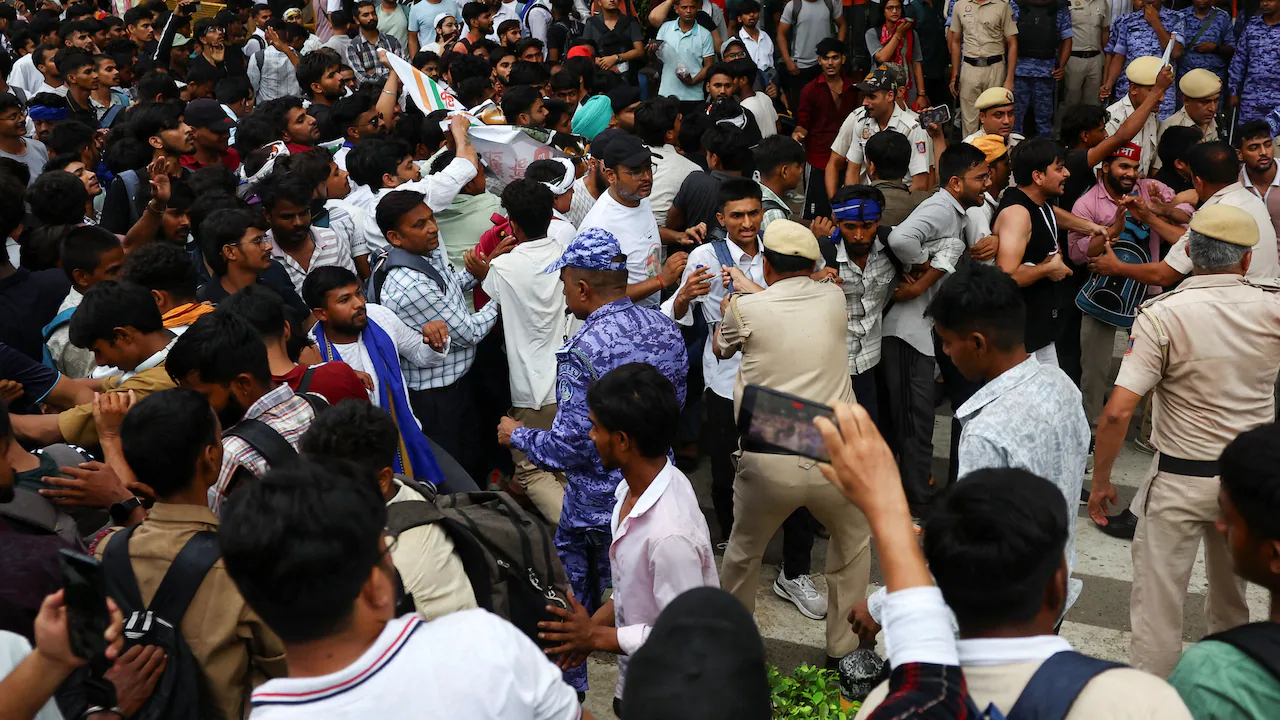
Tear Gas, Lathi-Charge and Metro Disruptions Mark CJP’s ‘Chalo Sansad’ Protest in Delhi
Thousands of supporters of the Cockroach Janta Party (CJP) gathered in Delhi on Monday for the ‘Chalo Sansad’ march towards Parliament, despite police refusing permission for the protest. Click Here To Follow Our WhatsApp Channel
Delhi Police used tear gas shells and carried out a lathi-charge to disperse the large crowd, which was made up mostly of young protesters. The demonstration was organised to protest alleged irregularities in the NEET medical entrance examination and to demand the resignation of Union Education Minister Dharmendra Pradhan.
According to officials, some protesters and police personnel suffered minor injuries after a section of the crowd allegedly tried to cross police barricades while moving towards Parliament.
As a security measure, mobile internet services were suspended in parts of Central Delhi.
The CJP appealed to its supporters to remain peaceful despite the police action. In a message shared on social media, the party urged protesters to stay calm, avoid violence and continue the movement peacefully.
Delhi Police had denied permission for the march on Sunday and imposed restrictions on large public gatherings. Authorities warned that anyone violating the prohibitory orders could face legal action.
In a post on X, Delhi Police said that protest marches, demonstrations and gatherings of five or more people were prohibited without prior permission, except at the designated protest site at Jantar Mantar. The police also appealed to citizens to cooperate in maintaining public peace and security.
Metro Services Disrupted
The protest also caused major disruption to Delhi Metro services. Five metro stations—Rajiv Chowk, Janpath, Patel Chowk, Central Secretariat and Seva Teerth—were temporarily closed due to security concerns.
The closures left hundreds of passengers stranded, while many others had to take longer routes to reach their destinations. Large crowds were seen outside Rajiv Chowk Metro Station, one of the busiest stations in the capital.
Background of the CJP Protest
The Cockroach Janta Party was launched in May by Abhijeet Dipke as a satirical digital movement following a controversy surrounding remarks made by Chief Justice of India Surya Kant.
The organisation quickly gained widespread attention on social media, attracting millions of followers as well as support from several opposition leaders, activists, artists and sportspersons.
Dipke, 30, who had been living in the United States for the past two years, returned to India in June to lead the campaign demanding reforms in the education system after allegations of paper leaks and irregularities in competitive examinations.
The movement later received support from activist Sonam Wangchuk, who began an indefinite hunger strike at Jantar Mantar on June 28. Wangchuk was admitted to hospital by police last Saturday after his health reportedly deteriorated.
In a handwritten note released from the hospital on Monday, Wangchuk said he would end his fast only if the government accepted responsibility for the alleged examination failures or if Members of Parliament and political leaders assured him that the issue would be raised in Parliament.