Furqan Dawodi Wins Gold Medal, Announces New Journey to Al-Azhar University

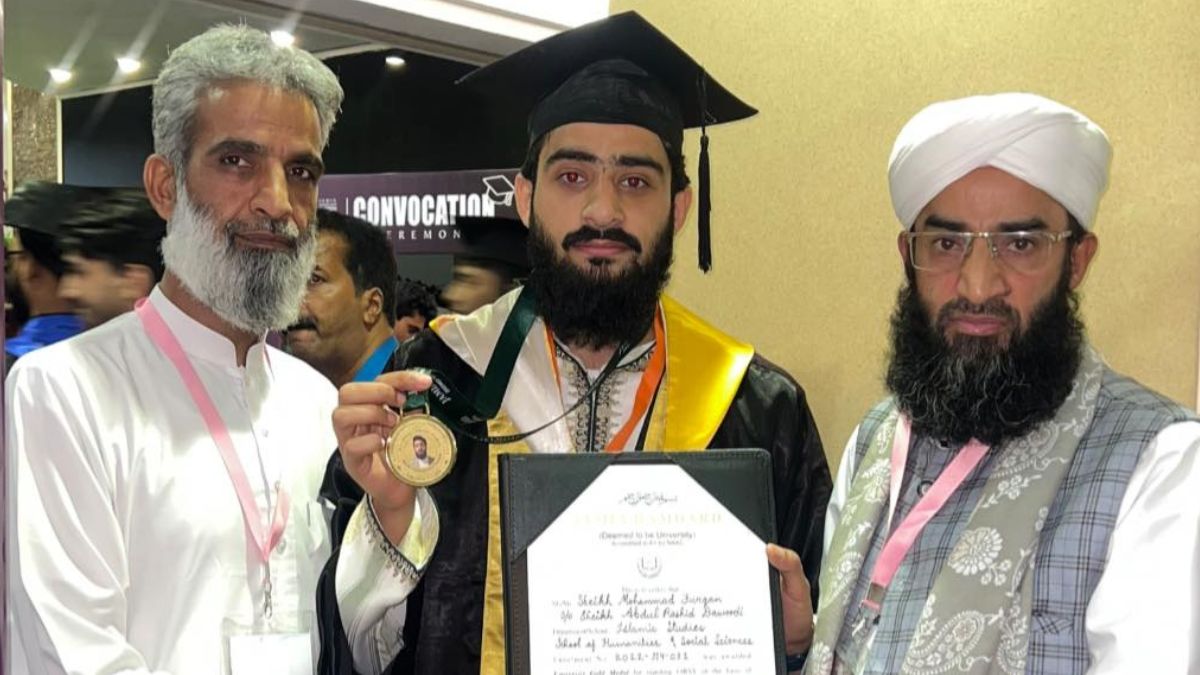
Furqan Dawodi from Kashmir has shared an emotional message after receiving a Gold Medal, thanking Allah, his parents, teachers, relatives, and friends for helping him reach this important milestone.

He said his heart is filled not with pride, but with gratitude, as this success belongs to everyone who supported him. Click Here To Follow Our WhatsApp Channel

Credits Parents for Success

Furqan Dawodi gave special credit to his father, Shaykh Abdul Rashid Dawoodi, who used to wake him after Fajr prayer and personally teach him with patience and sincerity.

He said the foundation of all his learning was built during those early morning lessons.

He also thanked his mother for her duas, encouragement, sacrifices, and silent strength during every difficult phase of life.

Special Thanks to Family Supporter

He expressed heartfelt gratitude to Shakir Ahmed Bhat, saying he was more than an uncle and acted like a mentor and true friend.

Remembers Teachers and Study Journey

Furqan also remembered all his teachers from childhood to higher studies.

He especially thanked:

  • Arif Sir
  • Muhibullah Usthad
  • Dr. Fazrul Rehman
  • Dr. Waris Mazhari

He said his years in Delhi were transformative, where he gained knowledge, skills, confidence, and lifelong friendships.

Life Lessons Beyond Books

He added that living away from home taught him important life skills, including independence and even cooking for himself.

According to him, a student must not only be strong in studies but also capable and prepared for life.

Friends Shared the Journey

He thanked close friends Adil, Raza, Huzaifa, and Marifath for supporting him through every high and low.

He said the medal belongs to them as well.

Message of Hard Work and Faith

Furqan said not everyone is born with ease, so people must build their own success through hard work, sincerity, and good intention.

He added that when intentions are for Allah, doors open in unexpected ways.

Next Destination: Al-Azhar University

The gold medalist said this achievement is only the beginning of a new chapter.He requested prayers as he prepares to continue his studies at Al-Azhar University.He prayed for strength, sincerity, and the ability to serve the people of Kashmir and the wider Ummah.

Turning Away from a Troubled World: Finding Peace Through Faith and Inner Reflection

Dr Akram Nadwi

Wherever you cast your gaze, you behold rampant evil and blazing corruption; wherever you alight or journey on, trials receive you in succession like the ceaseless waves of an unquiet sea, and wars follow one upon another as though they were a fate unwilling to loosen its grip upon this earth.
Turn away from this world with deliberate resolve, and say to it in the calm of one assured: Peace be upon you; I am not of you, nor are you of me. Recite within yourself the words of the Friend: “I love not those that set.” For what declines deserves not to be adored, and what perishes ought not to be made a homeland for the heart. Click Here To Follow Our WhatsApp Channel
Fashion for yourself another world, one unseen by eyes yet apprehended by insight; a world you build in your depths, brick by brick: a brick of patience, a brick of certainty, and a roof of hope raised high above them. Turn towards your own soul as a lover turns towards the beloved, and enter into an inward retreat wherein you cleanse the mind of its impurities, the heart of its dust, and restore the spirit to its first clarity, when it was nearer to heaven than to earth.
Let not the clamour of people trouble you thereafter, nor their disputes, nor the trifles over which they contend; they are but passing shadows and a mirage that the thirsty supposes to be water. Make your chief concern the worship of your Lord and the seeking of His pleasure, and say in the humility of the knower and the certainty of the convinced: “Indeed, I have turned my face towards Him who created the heavens and the earth, inclining wholly to truth, and I am not of those who associate others with Him.”
When you do this, what was turbulent within you shall grow still, what was agitated shall be calmed, and you will perceive that though the edges of the world tremble with unrest, within the heart there remains a spaciousness for a peace no war can disturb, and a light no trial can extinguish.
Then you will understand that salvation lies not in fleeing from people, but in rising above them, elevating your soul until you behold things as they truly are: small, though they seem great; fleeting, though they appear enduring. And there remains only the Face of your Lord, full of Majesty and Honour.

At 13, This Kashmiri Boy Built 31 Apps and AI Tools

Delhi Court Convicts Kashmiri Separatist Asiya Andrabi in UAPA Case

Two-Day International Seminar on Alama Anwar Shah Kashmiri’s Scholarly Legacy Begins in Deoband

Alama Anwar Shah Kashmiri

A two-day international seminar focusing on the life, thoughts, and scholarly contributions of Alama Anwar Shah Kashmiri (رحمہ اللہ) has formally begun in Deoband. The event has brought together leading Islamic scholars, researchers, university teachers, and madrasa representatives from across India and abroad.Click Here To Follow Our WhatsApp Channel

The opening session was held in a serious and dignified academic atmosphere. Ameer-e-Shariat and thinker of the Ummah, Hazrat Maulana Ahmad Wali Faisal Rahmani (دامت برکاتہم), the sajjada-nashin of Khanqah Rahmani, Munger, attended the inaugural programme along with many senior scholars and well-known academic personalities. Their presence added weight and importance to the seminar.

From the very beginning, the seminar reflected deep respect for knowledge and tradition. A large gathering of scholars and researchers participated, showing the lasting influence of Anwar Shah Kashmiri (رحمہ اللہ) in Islamic learning. The organisers highlighted that the purpose of the seminar is not only to remember his personality, but also to understand his thoughts and apply them in today’s academic and intellectual environment.

During different sessions over the two days, detailed papers are being presented on his major contributions to Hadith, Tafsir, Fiqh, and Arabic literature. Speakers are discussing his teaching style, depth of knowledge, strong memory, and his role in shaping Islamic scholarship in the Indian subcontinent. Special attention is being given to how his works continue to guide students and scholars even today.

Speakers also stressed that Anwar Shah Kashmiri (رحمہ اللہ) was not limited to one field of learning. His ability to connect different branches of knowledge made him a unique scholar of his time. Through discussions and presentations, participants are exploring how his approach can help strengthen current educational and research traditions.

The organisers said that this international seminar is a sincere effort to promote intellectual dialogue and encourage research-based learning. It aims to provide a strong academic foundation for future generations while keeping alive the rich legacy of past scholars.

Overall, the seminar stands as a meaningful tribute to Imam al-Asr Anwar Shah Kashmiri (رحمہ اللہ), reminding the academic world of his lasting impact and the continued relevance of his scholarly heritage.

Islamic University of Science and Technology’s English Department Hosts Two-Day Workshop for Darul Uloom Students

Darul Uloom Students

The Department of English Language and Literature, Islamic University of Science and Technology (IUST) conducted a two-day workshop titled “Bridging Barriers: Connecting Communities through Language and Literature” under its Community Outreach Program.Click Here To Follow Our WhatsApp Channel

According to a statement issued here, the workshop engaged students from Darul Uloom Jamiat-ur-Rashad, Awantipora, through a series of interactive and skill-oriented sessions designed to promote communication skills and strengthen community bonds, in line with the University’s Community Connect initiative.

Welcoming the participants, Head of the Department, Dr. Munejah Khan, introduced the visiting students to the Department’s academic offerings and the advanced facilities of the Language Lab. She underscored the importance of effective communication and the need to build meaningful connections across diverse communities. Day one focused on the foundational skills of language reading, writing, listening, and speaking through practical language activities, a hands-on session on application writing, and a guided tour of the University campus.

Day two explored the power of storytelling and poetry in fostering expression and understanding. Participants took part in literary exercises aimed at enhancing their appreciation of narrative techniques and poetic forms, gaining a deeper insight into the elements and structure of both genres. The workshop was coordinated by Dr. Muddasir Ramzan, Community Connect Coordinator for the Department included sessions by different faculty members of the department.

Prof. Mohammad Sanaullah al-Nadawi Represents India at London Conference on Early Islamic Translation Traditions

Prof. Mohammad Sanaullah al-Nadawi

Professor Mohammad Sanaullah al-Nadawi, a well-known Indian Arabic scholar and former Head of the Department of Arabic at Aligarh Muslim University (AMU), recently represented India at a major international conference held in London. The two-day event was organised by the prestigious Al-Furqan Islamic Heritage Foundation and focused on “Early Traditions of Translation in Islamic History.”

Keynote Lecture on India’s Influence on Medieval Baghdad

During the conference, Professor Sanaullah delivered an important keynote lecture titled “India’s Role in the Formation of Medieval Baghdad.”
In his talk, he explained how large numbers of Indian (especially Sanskrit) books on medicine, astronomy, philosophy, mathematics, and literature were translated into Arabic during the Abbasid period in Baghdad.

He highlighted that:

  • Sanskrit scientific works greatly influenced the development of Islamic knowledge.
  • Abbasid rulers and the famous Barmakid ministers strongly supported translation projects.
  • Indian ideas helped shape Baghdad’s intellectual and scientific culture in the medieval period.

His lecture received appreciation from scholars and participants for shedding light on India’s long-standing contribution to global learning.

Strong Role in Al-Tilmeez Research Journal

Professor Sanaullah is also the Vice Chief Patron of the International Research Journal Al-Tilmeez, one of the leading Arabic journals published from Jammu & Kashmir under the Chief Editorship of Dr Meraj Nadvi.
His guidance and international experience have helped the journal grow in academic quality and global recognition.

Visits to London’s Historic and Academic Centres

During his visit, Professor Sanaullah also toured several iconic places in London, including:

  • The Royal Palaces
  • University of London
  • The British Museum
  • The British Library
  • The Athenaeum Club
  • Caxton Hall
  • 21 Mecklenburg Square

The Athenaeum Club and 21 Mecklenburg Square hold great historical value, as they are linked to Sir Syed Ahmad Khan, the founder of Aligarh Muslim University, who stayed there during 1869–70.

Engagements at Oxford and Cambridge

After the London conference, Professor Sanaullah visited the Universities of Oxford and Cambridge, where he met prominent scholars such as:

  • Professor Julia Bray, Bodleian Chair of Medieval Arabic Literature at Oxford
  • Professor Tahera Qutbuddin, award-winning scholar of Arabic oratory
  • Scholars from the Oxford Centre for Islamic Studies, including Dr Mohammad Akram Nadwi, founder of the Al-Salam Institute in London

He also met Dr Wafaa Abdul Razzaq, a distinguished literary figure and nominee for the Nobel Prize in Literature.

A Proud Moment for Indian Scholarship

Professor Sanaullah’s participation in this international conference and his interactions with leading academics have been widely appreciated in India’s academic community. His visit highlighted the important historic links between India and the Islamic world and strengthened India’s presence in global scholarly discussions on Islamic heritage.


A Letter to Arabic Students: Guidance on Building Fluency and Confidence in Reading

Arabic Students

My dear students,
It has been brought to my attention, through my dear student, Mr Ali Rasul, that many of you at Al-Salam feel disheartened because, despite your sincere effort and hard work, you still struggle to progress quickly in understanding the Arabic language. Some of you mentioned that it can take nearly an hour to read a single page from my book Man ‘Allamani, even when you consult a good dictionary. I understand this feeling very well, and I wish to offer you some guidance that may help you move forward with renewed clarity and confidence.

Let me first reassure you that what you are experiencing is entirely normal. Arabic, being a rich and deeply expressive language, requires time and steady exposure before one begins to read it with ease and fluency. The book Man ‘Allamani was not designed for beginners; it assumes a certain mastery of grammar, morphology, and vocabulary, as well as familiarity with Arabic style and idiom. Starting directly with such a book can make you feel discouraged because it demands skills that naturally develop only after reading many simpler texts. Therefore, do not begin your Arabic reading journey with Man ‘Allamani. Instead, build your foundation through easier and more enjoyable readings that will strengthen your understanding step by step.

Language learning is most effective when it follows a graded progression, moving gradually from the simple to the complex, from short phrases to longer and more sophisticated expressions. Begin with texts that are easy, fluent, and engaging. A very useful starting point is the Silsilat al-‘Arabiyyah lil-Nāshi’īn (العربية للناشئين) series or similar graded readers. These books teach you grammar, vocabulary, and sentence structure in a balanced way, helping you gain confidence in both reading and comprehension. Once you have mastered such materials, you can move on to the next stage: developing a taste for Arabic literature.

After completing the elementary stage, I strongly recommend that you study Kalīlah wa Dimnah. This marvellous collection of fables, originally an Indian work translated into Persian and then rendered into Arabic by the great writer Ibn al-Muqaffa‘, is a masterpiece of Arabic prose. It combines simplicity with eloquence, wisdom with beauty, and offers a gateway into the world of Arabic literature. Our revered teacher, Shaykh Abul Hasan ‘Ali Nadwi (may Allah have mercy on him), once told us that he read Kalīlah wa Dimnah forty times, and he advised his students to do the same. I have followed his example and likewise recommend that you read it repeatedly, each reading will reveal new subtleties and deepen your appreciation of Arabic expression.

Once you have become comfortable with Kalīlah wa Dimnah, continue with Majmū‘ah min al-Nazm wa al-Nathr lil-Ḥifẓ wa al-Tasmī‘, reading it attentively and analysing the beauty of both its poetry and prose. Thereafter, explore Manthūrāt min Adab al-‘Arab by Shaykh Muḥammad al-Rābi‘ al-Ḥasanī al-Nadwī, and Mukhtārāt min Adab al-‘Arab by Shaykh Abul Hasan ‘Ali al-Ḥasanī al-Nadwī. For students who wish to experience the grandeur of classical Arabic, I also recommend studying Dīwān al-Ḥamāsah by Abū Tammām, especially the sections on manner, elegy, and valour, accompanied by the commentaries of al-Marzūqī and al-Tabrīzī. These works will train your literary sensitivity and help you appreciate the strength and elegance of Arabic expression.

In addition to classical works, it is equally important to read the writings of modern masters of Arabic style, who combined clarity, depth, and eloquence. Among them are Muṣṭafā Luṭfī al-Manfalūṭī, Ṭāhā Ḥusayn, Aḥmad Amīn, Muṣṭafā Ṣādiq al-Rāfi‘ī, Shaykh ‘Alī al-Ṭanṭāwī, and Abul Hasan ‘Ali al-Nadwī. Their books are treasures of modern Arabic literature, rich in thought and refined in language, and they can serve as excellent models for students who aspire to write and speak with fluency and taste.

For practical guidance, I suggest the following sequence. Begin with simple, well-written Arabic texts containing short, clear, and eloquent sentences. Progress to short storybooks that use familiar vocabulary and straightforward grammar. Then move on to longer narratives and essays with richer vocabulary and more complex ideas. For Arabic learners, the following books are highly beneficial and beautifully written: the children’s stories of Kāmil Kilānī; Qiṣaṣ al-Nabiyyīn by Abul Hasan ‘Ali Nadwī; Ṣuwar min Ḥayāt al-Ṣaḥābah and Ṣuwar min Ḥayāt al-Tābi‘īn by ‘Abd al-Raḥmān Rāfat Bashā; Al-Ayyām by Ṭāhā Ḥusayn; and Dhikrayāt by ‘Alī al-Ṭanṭāwī. Reading these works in order will gradually increase your fluency, vocabulary, and literary appreciation.

Finally, remember that progress in Arabic, or in any language, depends not on speed, but on consistency, patience, and genuine love for the language. Read daily, even if only for a few pages. Try to understand the context before looking up every new word; allow your mind to absorb meaning naturally. Read aloud when possible, and listen to good Arabic speech to attune your ear to the language’s rhythm and melody. With time, you will find that what once took you an hour to read will take only minutes. The Arabic language will open its beauty to you gradually, and your effort will surely bear fruit.

May Allah bless your studies and make your journey in the Arabic language one of joy, insight, and spiritual enrichment.

Islam’s Unique Civilisation: Unity of Faith, Culture and History

Islam’s Unique Civilisation

Islam is unique in that it is the only religion that established a civilisation according to its own principles and temperament. Islam is unique also in recognising that religions other than itself exist, that their adherents claim they are true, and that these religions somehow have to coexist. From a position of political and cultural strength the Muslims accordingly established a civilisation that made space for other religions, and the languages and cultures associated with them. The language of its founding Scripture and its founding figure retained its authority. In fact, the authority of that language naturally flowed out of its Arab heartland to wherever the Muslims went, and it became the common language of all cultured peoples, whatever their religion, throughout the vast area from the Atlantic to the South China Sea.Click Here To Follow Our WhatsApp Channel

Other religions have, either by choice or by force of circumstance or a mixture of the two, developed within civilisations founded on principles other than their own. Christianity is perhaps the most extreme case. Its beliefs and rituals, its conception of religious authority and the expression of that authority in formal structures and organisations, were heavily influenced by the Hellenic civilisation into which it had deliberately drifted, away from the beliefs and rituals of the Jewish community where it began. Its principal scriptural language was not the language of the man claimed as its founding figure, but the Greek and, later the Latin, of the Roman world.

History in Islam is dated to the Hijrah – one of a number of momentous decisions taken by the Companions without specific guidance from the Qur’an or God’s Messenger. Another was the decision to collect the Qur’an into a single Mushaf, or Book. The first hijrah, to Abyssinia, was a flight from danger into safety, from persecution to protection. The Hijrah proper, to Yathrib, had those aspects, but more than that, it was the foundation of Madina, the first Muslim city, the gathering in a territory and a jurisdiction of people associated not by tribe, nor by a military and political alliance, but by a common commitment to the faith and to what that commitment entailed. The Hijrah represented an effort to leave behind one way of life and establish a new way of life based on the faith. The conversion of Yathrib into Madina symbolises that momentous change. It entailed lasting effects on personal manners, ethical conduct, social, economic and political relationships, and, very importantly on the pursuit of knowledge, the relationship human beings build with the world around them. This world includes the past as well as the present; it includes natural as well as human phenomena. Muslims made huge leaps in understanding both.

History is important in Islam. It is the informal and unfolded expression of being Muslim. The five daily prayers, the Ramadan fasting, the hajj, and other distinctively Muslim acts of worship and lifestyle, are formal and closed expressions of being Muslim, not shared with peoples who are not Muslim. But history is what Muslims do in the world, the public space, the space that they share with non-Muslims as well as Muslims. In this respect also the exceptional unity of Islam is evident. Aristotle achieved astonishing feats as a thinker and philosopher – many of the divisions and disciplines of knowledge we know today are owed to him. Yet he was a cultural bigot; he despised peoples other than the Greeks and considered them barbarians who should be enslaved until they could become civilised, i.e. Greek. His pupil Alexander, and his imperial successors, put this concept into practice with astonishing courage, military and organisational skill, and unflinching cruelty. Within the mainstream of Islam, by contrast, the greatest men and women were not admired unless they combined great achievement in the world with depth of understanding of Islam and personal piety. It is not until the twentieth century that men like Kemal Ataturk came to be regarded as popular heroes because of their political service to the Muslims, even though, in their personal conduct and attitudes to Islam, they were on the side of the cultural enemies of the Muslims.

The history of Islam is a story of human effort to express and achieve unity between culture, civilisation and religion in every sphere of life. It is an uneven effort, with uneven success. IN our diminished present time, it is found very active in personal lives, especially among the poor; there is not much evidence of it in legal and political structures. But even now, there is very little of elaborated liturgy, or song and dance, in Islamic worship. Worship is still every-day and is allowed to flow into the rest of life. The aesthetic elements of religious activity, among the mainstream Sunnis, are not elaborated and emphasised as they are in other religions, and so expressions in art-forms do not become a substitute for the expression of faith and identity in history.

GDC Women Baramulla Hosts Lecture on Mir Syed Ali Hamadani’s (RA) Enduring Legacy

naseem

Government Degree College (GDC) for Women, Baramulla, organised an insightful extension lecture on the life, works, and contributions of the revered Sufi scholar and reformer, Mir Syed Ali Hamadani (RA). The event was held under the guidance of the college Principal, Prof. (Dr.) Neelofar Bhat, and aimed to shed light on the multidimensional impact of Hamadani’s teachings on Kashmir’s spiritual, cultural, and intellectual evolution.

In his address, Prof. Rafiabadi offered a comprehensive overview of Mir Syed Ali Hamadani’s (RA) spiritual mission and intellectual legacy. He described the 14th-century Sufi saint as a bridge between Central Asian scholarship and Kashmiri civilisation, noting that Hamadani’s arrival in Kashmir introduced a transformative era in art, spirituality, and social ethics.

Highlighting his contributions to Persian literature, calligraphy, crafts, and architecture, Prof. Rafiabadi explained how Hamadani (RA) helped shape the very identity of Kashmir as a centre of culture and spirituality. He particularly emphasised his influence on the introduction of handicrafts and shawl weaving in the Valley, which later became the hallmark of Kashmiri economy and aesthetics.

The speaker further reflected on Hamadani’s efforts to reform society through education, ethical trade, and moral discipline, underscoring that his teachings were deeply rooted in the Quran and Sunnah. “Mir Syed Ali Hamadani (RA) was not only a spiritual leader but also a visionary social reformer who understood the importance of knowledge, unity, and economic independence,” Prof. Rafiabadi remarked.

Principal Prof. (Dr.) Neelofar Bhat, in her concluding remarks, appreciated the enlightening lecture and said that understanding figures like Hamadani (RA) is crucial for young generations to reconnect with their spiritual and cultural roots. She also stressed the need to integrate such legacy-based discourses into academic learning for a holistic educational experience.

Faculty members, students, and scholars from different departments attended the event, engaging actively in the interactive session that followed. The lecture concluded with a note of gratitude to Prof. Rafiabadi for his scholarly insights and to the organising committee for successfully hosting a session that celebrated one of Kashmir’s most influential spiritual personalities.

Dr. Yusuf al-Qaradawi: A Life of Faith and Influence

Dr. Yusuf al-Qaradawi

When I think about Dr. Yusuf al-Qaradawi, I picture a man whose life touched millions, sparking both admiration and debate. He was a scholar, a preacher, and a voice for Muslims worldwide, blending old Islamic teachings with the challenges of modern life. Born in a small Egyptian village on September 9, 1926, he grew up to become one of the most famous Sunni Muslim scholars of our time. He passed away on September 26, 2022, in Doha, Qatar, at 96, leaving behind a legacy that still stirs hearts and minds. Let me take you through his story in a way that feels like we’re sitting down for a chat, exploring who he was, what he stood for, and why he remains such a big deal.

Growing Up in Egypt

Yusuf al-Qaradawi’s early life wasn’t easy. Born in Safat Turab, a village in Egypt’s Nile Delta, he lost his father at two years old. His uncle raised him, and even as a kid, Yusuf showed a knack for faith. By 12, he’d memorized the entire Quran—a huge feat that marked him as special. He loved learning and went to Al-Azhar University in Cairo, one of the oldest and most respected Islamic schools in the world. In 1953, he graduated with a degree in Islamic theology, and years later, in 1973, he earned a PhD there. His thesis was about zakat (Islamic charity) and how it could help solve social problems. That work became a book that’s still studied today.

As a teenager, Yusuf joined the Muslim Brotherhood, a group founded by Hassan al-Banna to revive Islamic values and resist Western influence. This choice shaped his life. The Brotherhood’s ideas about faith and justice spoke to him, but it also got him in trouble. Egypt’s rulers—first King Farouk, then Gamal Abdel Nasser—saw the group as a threat. Yusuf was arrested three times (in 1949, 1954, and 1962) for his activism. By 1961, things got so tough that Egypt took away his citizenship, forcing him to leave. He moved to Qatar, where he’d spend most of his life.

A New Home in Qatar

In Qatar, Yusuf found a fresh start. He taught at universities and started building a name for himself. Qatar gave him a safe place to write, speak, and share his ideas. In 1977, he helped start the Faculty of Sharia and Islamic Studies at Qatar University, where he served as dean. Later, he founded the Centre for Sunnah and Seerah, a place to study the Prophet Muhammad’s life. These roles let him teach young Muslims and shape how Islam was understood in a fast-changing world.

But what really made him famous was his TV show, Al-Sharia wa al-Hayat (Sharia and Life), which aired on Al Jazeera from 1996 to 2013. Every week, millions tuned in to hear him talk about everything—family life, money, politics, even how Muslims should live in non-Muslim countries. His warm, clear style made complex religious ideas feel approachable. I imagine people sitting in their living rooms, nodding along as he explained how to be a good Muslim in today’s world.

A Voice for the “Middle Way”

Yusuf al-Qaradawi believed in something called wasatiyya, or the “middle path.” For him, Islam didn’t have to be stuck in the past or blindly follow modern trends. He wanted a balance—sticking to core Islamic values while adapting to new times. This idea made him popular, especially with younger Muslims who felt torn between tradition and modernity.

He wrote over 120 books, covering topics like charity, women’s rights, and jihad (struggle or holy war). His book on zakat is still a go-to for scholars. He also started groups like the International Union of Muslim Scholars in 2004, which he led until 2018, and the European Council for Fatwa and Research, helping Muslims in the West live by Islamic rules. His fatwas (religious rulings) were practical—like saying it’s okay for Muslims to wish Christians a happy holiday or that women could study and work.

But not everyone agreed with him. His views on some issues stirred up big arguments, and that’s where things get complicated.

What He Believed

Let’s talk about what made Yusuf al-Qaradawi such a big figure—and why some people loved him while others didn’t.

  • Palestinian Rights and Jihad: He strongly supported Palestinians, calling their fight against Israeli occupation a legitimate form of jihad. He believed Muslims had a duty to resist oppression. This made him a hero to many who saw him standing up for justice. But he also supported suicide bombings in Palestine and attacks on U.S. troops in Iraq, which shocked others. To critics, this was promoting violence, and it led to bans from countries like the U.S., UK, and France.
  • Women’s Roles: He encouraged women to get educated and work, which was progressive for some Muslim scholars. But he also said husbands could lightly “discipline” their wives in rare cases, based on his reading of the Quran. Many called this outdated and harmful, accusing him of supporting abuse.
  • The Arab Spring: When uprisings swept the Arab world in 2011, he cheered them on, seeing them as a chance for Muslims to demand fair governments. He wanted societies based on Islamic principles but not strict theocracies. Some saw this as a push for democracy; others thought he was tied too closely to the Muslim Brotherhood’s political goals.
  • Interfaith and Social Issues: He was open to dialogue with other faiths, saying Muslims could greet Christians or Jews on their holidays. He also called stoning for adultery “un-Islamic,” linking it to Jewish law, not the Quran. But he held harsh views on homosexuality, saying it deserved punishment, and made comments about Jews and the Holocaust that critics called anti-Semitic.

These mixed messages made him a lightning rod. Supporters saw him as a bold voice for justice and moderation. Critics said he fueled division, with some calling him the Muslim Brotherhood’s spiritual leader.

Why He Mattered

Yusuf al-Qaradawi wasn’t just a scholar; he was a bridge between old and new. His TV show, books, and fatwas reached people from Morocco to Malaysia. He gave Muslims a way to think about faith in a world of smartphones, global politics, and cultural clashes. For many, he was a guide who made Islam feel alive and relevant.

When he died in 2022, people mourned him as a giant. Posts on X called him a “light for the Muslim ummah” (community), quoting his prayers for places like Al-Aqsa Mosque. Others criticized him, pointing to his controversial fatwas as a source of division. His family carries on his legacy—his three daughters are PhD holders, one a nuclear scientist, and his son, Abdulrahman, is a poet and activist. Sadly, Abdulrahman has been detained in Egypt since 2023, and groups like Amnesty International are fighting for his release.

The Big Picture

Looking back, I see Yusuf al-Qaradawi as a man of his time. He lived through wars, revolutions, and huge changes in the Muslim world. He tried to answer tough questions: How do you stay true to faith in a globalized world? How do you fight injustice without losing compassion? Not everyone liked his answers, but he got people talking. His life reminds me that faith isn’t just about rules—it’s about wrestling with big ideas and trying to make a difference.

If you want to dig deeper, his autobiography, Ibn al-Qarya wa al-Muhtadi (Son of the Village and the Guide), tells his story in his own words. For now, his name lives on—in classrooms, mosques, and debates about what it means to be Muslim today.

Cristiano Ronaldo Greets Fans on Saudi National Day, Celebrates Pride and Unity 

Abhishek Sharma, Shubman Gill Script Record 105-Run Partnership as India Defeat Pakistan

School of Engineering and Technology Wins Vice Chancellor’s Employee Cricket Tournament 2025 Final with Enthusiasm

Teachers’ Day: The Importance and Role of a Teacher in Shaping Society

Teachers’ Day

A teacher is often described as a guide, mentor, and a second parent. Teachers’ Day is celebrated every year to honour their dedication and contribution in shaping the future of students and society. While doctors save lives and engineers build cities, it is teachers who build minds, values, and the foundation upon which every profession rests.

The Importance of a Teacher

A teacher is not just a transmitter of knowledge but a builder of character. Their importance can be seen in different aspects:

  1. Knowledge Provider – Teachers help students learn new concepts, ideas, and skills. They open the doors of wisdom and curiosity.
  2. Character Builder – A good teacher instills discipline, respect, honesty, and empathy in students. These qualities last a lifetime.
  3. Role Model – Students often look up to teachers as examples to follow. A teacher’s words and actions deeply influence young minds.
  4. Nation Builder – By educating individuals, teachers indirectly shape the destiny of a nation. As the saying goes, “No country can rise above the level of its teachers.”

The Role of a Teacher in Society

  • Mentorship: Teachers guide students not only in academics but also in personal growth.
  • Motivation: They encourage learners to dream big and work hard towards achieving their goals.
  • Counselling: In times of confusion or weakness, teachers act as counsellors, offering wisdom and support.
  • Innovation: A good teacher adapts to modern methods of teaching and nurtures creativity.
  • Bridging Generations: Teachers pass knowledge, culture, and values from one generation to another.

The Eternal Respect for Teachers

In every culture and religion, the position of a teacher is considered sacred. In Islam, a teacher is seen as a guide to truth. In Hindu philosophy, the teacher is revered as Guru – the remover of darkness. Across the world, teachers are recognised as architects of humanity.

Conclusion

Teachers are more than professionals; they are torchbearers of wisdom, moral strength, and social progress. Celebrating Teachers’ Day reminds us that their hard work deserves gratitude and recognition every single day. A society that honours its teachers secures a bright future for generations to come.


🌹 A Poem for Teachers

The Light of a Teacher

A teacher is a gentle flame,
That lights the path, yet seeks no fame.
Through words of hope, through patient care,
They build a world beyond compare.

They shape the mind, they touch the soul,
They guide the heart, they make it whole.
With wisdom deep and spirit true,
They paint the sky in brighter hue.

No crown they wear, no throne they own,
Yet seeds of greatness they have sown.
For every dream, for every start,
A teacher lives in every heart.


Faith, Family & the Future: Navigating Chaos with Purpose

Kashmir Fruit Growers Face Heavy Losses as Highway Closure Disrupts Transport

From Boom to Bust: How the April 22 Terror Attack Shattered Pahalgam’s Tourism Dream

Milad un Nabi 2025: History, Significance, Celebrations, and Debates Around Prophet Muhammad

Azmat-e-Quran Conference 2025 Inspires Thousands in Srinagar

Azmat-e-Quran Conference

Srinagar witnessed a profound spiritual gathering on Sunday as the Azmat-e-Quran Conference 2025, organised by Jamiat Ahli Hadees Jammu & Kashmir, drew thousands of participants at Markaz Masood Ground, Moominabad Bypass and Markaz Ibn Masood Ground, Batmaloo.

The day-long event, inaugurated by Dr. Zahoor Ahmad Malik al-Madani (Hafizahullah), featured lectures from prominent Islamic scholars who underlined the need to uphold the Quran and Sunnah as guiding principles in daily life.

A highlight of the conference was the Huffaz-ul-Quran Dastarbandi ceremony, where young memorizers of the Quran were honoured for their achievement. Scholars stressed the importance of nurturing Quranic education for future generations, calling it a collective responsibility of the community.

The atmosphere was described as both spiritual and unifying, with reminders of peace, steadfastness, and devotion. Residents praised the organisers for creating an inclusive space that attracted scholars, students, and worshippers from across the Valley.

A parallel gathering at Al-Kulliyah Salafia, Bemina also reflected the widespread enthusiasm for the conference. Organisers said the aim was to strengthen faith, promote unity, and encourage Muslims to reconnect with the Quran and Sunnah.

The Azmat-e-Quran Conference 2025 continues Srinagar’s tradition of hosting major religious events, leaving attendees inspired and committed to living by the Quranic message.


Kashmir Politics From Mahraja Hari Singh To Syed Ali Geelani

From Boom to Bust: How the April 22 Terror Attack Shattered Pahalgam’s Tourism Dream

Former Jamat-e-Islami Spokesperson Advocate Zahid Ali Surrenders to Jammu and Kashmir Police

Sajad Lone Slams J&K Government for Taking Over 215 Jamaat e Islami Schools, Calls Move Political Overreach

J&K Government Takes Over 215 Jamaat-e-Islami Schools Amid Intelligence Concerns, Sparks Political Backlash

Jamaat e Islami Schools

The Jammu and Kashmir (J&K) government has ordered the takeover of the management of 215 schools affiliated with the banned Jamaat-e-Islami (JeI) and its educational wing, Falah-e-Aam Trust (FAT), starting August 23, 2025. This decision follows adverse reports from intelligence agencies indicating direct or indirect links between these schools and the proscribed organization, with the managing committees of these schools either expired or flagged negatively. The move is authorized under the J&K School Education Rules of 2010, aiming to safeguard the academic future of approximately 55,000 students enrolled in these institutions.

The schools, spread across districts including Anantnag (37), Baramulla (53), Budgam (20), Bandipora (6), Ganderbal (6), Kulgam (16), Kupwara (36), Pulwama (21), Shopian (15), and Srinagar (4), were previously managed by FAT, which offered both Islamic and modern syllabi. The government has directed District Magistrates/Deputy Commissioners to assume control and propose new managing committees after verification, ensuring uninterrupted education aligned with the National Education Policy (NEP) 2020 norms.

However, J&K Education Minister Sakina Itoo clarified that she had not ordered Deputy Commissioners to take over but instead intended for principals of nearby government schools to manage these institutions temporarily for three months due to registration issues and expired committees. She noted errors in the official order issued by the School Education Department’s secretary, which she claims misrepresented her instructions. The minister emphasized protecting students’ futures, as the J&K Board of School Education had refused examination forms from these schools post the 2019 JeI ban.

The decision has sparked controversy, with political figures like Peoples Conference chairman Sajad Lone calling it “shameful” and PDP legislator Waheed Parra labeling it “unfortunate, undemocratic, and derogatory,” accusing the government of servility. The JeI, banned in 2019 and again in 2024 under the Unlawful Activities (Prevention) Act for alleged terror links, has a history of controversy, including ties to militancy and separatist movements, notably through its role in the 1987 Muslim United Front.

The takeover aims to ensure quality education and secure students’ academic careers, but the conflicting statements from the minister and the official order highlight administrative discrepancies, drawing significant local criticism.

Kashmir Politics From Mahraja Hari Singh To Syed Ali Geelani

From Boom to Bust: How the April 22 Terror Attack Shattered Pahalgam’s Tourism Dream

Former Jamat-e-Islami Spokesperson Advocate Zahid Ali Surrenders to Jammu and Kashmir Police

Sajad Lone Slams J&K Government for Taking Over 215 Jamaat e Islami Schools, Calls Move Political Overreach

Mufti Nazir Ahmad Qasmi Suffers Heart Attack, Stable After Treatment; Community Rallies in Prayer

Renowned Islamic scholar and Shaykh-ul-Hadith at Darul Uloom Raheemyah, Mufti Nazir Ahmad Qasmi, suffered a major heart attack on Friday, sending shockwaves throughout Kashmir’s religious and academic communities. The 65-year-old scholar was rushed to a local medical facility where he received emergency treatment. By late evening, sources close to the seminary confirmed that Mufti Qasmi’s condition had stabilized, thanks to timely medical intervention and widespread public concern.

Incident Details and Current Health Status

The heart attack reportedly occurred in the early hours of May 23. As soon as the news surfaced, especially on social media platform X (formerly Twitter), an outpouring of support began. Dozens of users posted urgent calls for prayers (duas), expressing their deep concern for the health of a man widely regarded as one of Kashmir’s foremost Islamic jurists and community leaders.

Though official medical bulletins are yet to be released, reliable sources from Darul Uloom Raheemyah indicated that Mufti Qasmi is now out of immediate danger. “He is under observation, and we are hopeful of a full recovery,” said a close associate of the seminary. Family members have requested privacy but acknowledged the immense love and prayers pouring in from across the region.

Mufti Qasmi’s Eminence in Islamic Scholarship

Mufti Nazir Ahmad Qasmi is no ordinary figure in Kashmir’s religious landscape. As Shaykh-ul-Hadith and head jurist (faqih) at Darul Uloom Raheemyah in Bandipora, he has long been a pillar of scholarly guidance, deeply rooted in the Deobandi school of thought. His teachings in Hadith and Fiqh have shaped generations of students and imams across Jammu and Kashmir.

Known for blending traditional Islamic principles with contemporary issues, Mufti Qasmi has addressed subjects ranging from medical ethics to socio-economic justice. He was one of the most prominent voices during the COVID-19 pandemic, urging the public to take vaccinations and support preventive measures in mosques.

In February 2025, he gained further attention for officiating the marriage of Maulana Shah Mohammad Asghar Kirmani, where he stressed the importance of simplifying Islamic weddings and removing social and financial barriers.

Community Reactions and Social Media Mobilization

As news of the heart attack spread, religious leaders, scholars, and laypersons alike took to social media to express their distress and extend prayers. One user wrote, “In contemporary times, Mufti Nazir Qasmi is not just a scholar, he is a spiritual light for our youth.” Another referred to him as “the topmost faqhi in Kashmir,” a sentiment echoed in tributes that poured in throughout the day.

Community leaders offered collective prayers (duas) in several mosques across the Valley, while some institutions postponed academic sessions in solidarity. The spiritual stature of Mufti Qasmi was evident in the unity his health crisis inspired—across sects, regions, and age groups.

Broader Reflections on the Health of Religious Leaders

Mufti Qasmi’s health scare follows a pattern that has become familiar in recent years—where prominent religious leaders face health challenges due to demanding schedules and the emotional weight of communal responsibilities. In 2023, similar concern followed the injury of Mufti Muzaffar Hussain Qasmi during Umrah in Mecca, who later recovered. Such incidents bring attention to the need for health awareness and support systems for aging scholars whose services are critical to community guidance.

A Scholar Beyond Borders

Though based in Bandipora, Mufti Nazir Ahmad Qasmi’s influence extends far beyond Kashmir. His lectures, writings, and public interventions have earned him respect across the Muslim world. He is often described as “a torchbearer of divine light,” whose balanced approach has helped youth bridge faith with modernity.

His advocacy for ecological awareness, reform in religious practices, and unity among Muslims has made him a figure of national and even global relevance. For many, Mufti Qasmi represents not just scholarly depth, but moral clarity in times of social confusion.

Looking Ahead

While the immediate danger appears to have passed, the coming days will be critical in determining Mufti Qasmi’s recovery path. His students, followers, and fellow scholars remain hopeful and continue to organize prayer sessions for his health. In the absence of his regular lectures and public appearances, many reflect on his lasting impact and the need to support those who dedicate their lives to spiritual and social leadership.

As the sun sets over the Valley today, countless prayers are being whispered in homes and mosques alike—for a scholar whose voice has brought guidance, compassion, and clarity to an entire generation.

Maulana Ghulam Mohammad Vastanvi Passes Away at 75: A Visionary in Islamic and Modern Education

Maulana Ghulam Mohammad Vastanvi

The Islamic world and educational community mourn the loss of Maulana Ghulam Mohammad Vastanvi, a towering figure in Islamic scholarship and modern education, who passed away on May 4, 2025, at the age of 75. The revered scholar and educationist breathed his last in a Mumbai hospital, leaving behind a legacy that transformed the landscape of Islamic education in India and beyond. His funeral, held in Akkalkuwa, Maharashtra, on May 5, 2025, was attended by thousands, reflecting the profound impact of his life and work.

A Visionary Educationist

Maulana Vastanvi was the founder and rector of Jamia Islamia Ishaatul Uloom, an institution established in 1979 in Akkalkuwa, a remote town in Maharashtra’s Nandurbar district. Under his leadership, the institution grew from humble beginnings into a beacon of learning, blending traditional Islamic studies with modern disciplines. Today, Jamia Islamia is a sprawling educational hub, offering courses in theology, medicine, engineering, pharmacy, and more. Its medical college, recognized by the Medical Council of India, holds the distinction of being the first minority-run medical institution in the country.

Vastanvi’s vision was rooted in the belief that education could bridge divides and empower marginalized communities. He championed the integration of Islamic teachings with contemporary sciences, ensuring that students were equipped to navigate both spiritual and professional realms. His efforts provided opportunities to thousands of students, particularly from underprivileged backgrounds, who went on to serve as scholars, doctors, engineers, and educators across the globe.

A Brief but Controversial Tenure at Darul Uloom Deoband

In January 2011, Maulana Vastanvi was appointed Vice Chancellor of Darul Uloom Deoband, one of the most prestigious Islamic seminaries in the world. His appointment was initially celebrated, given his reputation as a progressive educationist. However, his tenure was short-lived and marred by controversy. Vastanvi’s remarks praising the economic development of Gujarat under then-Chief Minister Narendra Modi sparked outrage among some sections of the Deoband community, who viewed the comments as politically charged and insensitive to the state’s history of communal tensions. The backlash led to his removal from the post within months, a decision that remains a subject of debate among scholars and followers.

Despite the controversy, Vastanvi’s contributions to education and his commitment to fostering harmony through knowledge remained undeterred. He returned to Akkalkuwa, focusing on expanding Jamia Islamia and mentoring the next generation of scholars and professionals.

A Legacy of Compassion and Innovation

Born in 1950 in Vastan, a village in Gujarat, Maulana Vastanvi rose from modest beginnings to become a globally respected figure. His life was a testament to the power of education and perseverance. He was known for his humility, accessibility, and unwavering dedication to his students and community. Colleagues and students recall his ability to inspire, often spending hours discussing ideas to improve educational access and quality.

Under his guidance, Jamia Islamia introduced innovative programs, including vocational training and women’s education, at a time when such initiatives were rare in minority institutions. Vastanvi also emphasized interfaith dialogue, fostering understanding between communities through educational outreach programs. His work earned him recognition as a bridge-builder in a diverse and often divided society.

Tributes Pour In

The news of Maulana Vastanvi’s passing prompted an outpouring of grief and tributes from political leaders, scholars, and students. Congress leader and former Telangana Minister Mohammed Ali Shabbir described him as “a guiding light for the Muslim community,” emphasizing his role in revolutionizing education. Former MP and AIMIM leader Imtiaz Jaleel called his death “an irreparable loss,” noting that Vastanvi’s institutions had empowered countless individuals to achieve their dreams.

Social media platforms, particularly X, buzzed with messages of condolence, with many sharing personal anecdotes of Vastanvi’s kindness and wisdom. “Maulana Vastanvi was not just a scholar but a visionary who showed us that faith and progress can go hand in hand,” wrote one user. Another recalled, “His doors were always open to students, no matter the time of day.”

A Lasting Impact

Maulana Vastanvi’s passing marks the end of an era, but his legacy endures through the institutions he built and the lives he touched. Jamia Islamia Ishaatul Uloom stands as a living testament to his vision, producing graduates who carry forward his ideals of knowledge, compassion, and service. His emphasis on education as a tool for empowerment continues to inspire educators and community leaders worldwide.

As the world bids farewell to this remarkable scholar, his words resonate: “Education is the key to dignity and progress. Without it, we are lost.” Maulana Ghulam Mohammad Vastanvi’s life was a beacon of that belief, illuminating the path for generations to come.

Massive Fire Erupts in Bemina, Srinagar; Six Firefighters Injured, Fire Engulfs Madrassa Sabeel-ul-Huda and Homes

Madrassa Sabeel-ul-Huda

A major fire broke out on Friday evening in Gousia Colony, Bemina, Srinagar, prompting a swift response from the Fire and Emergency Services Department.

According to officials, the fire alert was received at 7:19 PM, and the first fire units reached the spot within a minute. Nine fire tenders were deployed from various stations, including Fire Headquarters Bemina, Veer Chatabal, Safa Kadal, Syed Hameed Pora, and Rawalpora.

Firefighters faced intense and risky conditions while battling the blaze. Six personnel, including a senior officer, were injured during the operation. The injured have been identified as Divisional Fire Officer Zorawar Singh, and firemen Ishfaq Ahmad, Waseem Ahmad Ganaie, Bashir Ahmad Ahangar, Javaid Baba, and Sahil.

All injured firefighters received immediate medical attention. The fire has been brought under control, and cooling operations are currently underway to prevent any flare-ups.

Authorities have launched an investigation to find the cause of the fire and assess the property damage.

219 Madrasas in Azamgarh UP Getting Govt Aid Found Non-Existent, FIRs Lodged

219 Madrasas in Azamgarh

In a major crackdown on financial fraud, the police in Azamgarh have registered cases against 219 madrasas that were found to be non-existent despite receiving government aid. The action follows an investigation by the Economic Offences Wing (EOW), which uncovered irregularities in government funding.

Investigation Uncovers Fraud

The probe began after discrepancies were noticed during online data entry on the madrasa portal. Initially, 313 madrasas were flagged for irregularities. However, a Special Investigation Team (SIT) inquiry, initiated after a 2017 complaint to the government, confirmed that 219 of these institutions did not exist at all.

Superintendent of Police Hemraj Meena stated, “Investigation was done in this case through EOW, in which there was an allegation of government money being siphoned off in the name of madrasas. Government money was received on the basis of forged documents.”

FIRs Registered Across the District

Following the EOW’s findings, FIRs were lodged at 22 police stations across the district. The first case was registered on February 6 at Kandharapur police station, based on a complaint by EOW Inspector Kunwar Brahma Prakash Singh. Subsequently, additional cases were registered at Kotwali, Sidhari, Rani ki Sarai, Mubarakpur, Nizamabad, and other police stations.

Legal Action and Further Investigation

The authorities have assured strict action against those involved in the scam. “The matter is being investigated, and action will be taken based on whatever facts come to light during the investigation,” SP Meena added. The police are also looking into whether officials or other entities were complicit in approving funds for these non-existent madrasas.

The revelation has raised serious concerns about transparency in the allocation of government funds meant for educational institutions. The authorities are now focusing on identifying the individuals responsible for submitting forged documents and ensuring that such fraudulent practices are curbed in the future.

This case highlights the importance of stringent monitoring mechanisms to prevent financial fraud and ensure that public funds are utilized for genuine educational purposes.

Uttarakhand Government Seals Over 50 Madrasas, Sparking Controversy and Protests

Uttarakhand Government Seals Over 50 Madrasas

The Uttarakhand government has recently sealed more than 50 ‘illegal’ madrasas in various parts of the state, triggering strong reactions from political leaders, religious organizations, and human rights activists. The move, ordered by Chief Minister Pushkar Singh Dhami, is part of an intensified crackdown on unregistered religious educational institutions. While the state government claims that the action is necessary to curb illegal activities, critics have termed it discriminatory and unconstitutional.

Crackdown on Madrasas

Over the past two weeks, authorities have sealed 52 madrasas in different districts, particularly in Dehradun and Udham Singh Nagar. According to officials, these institutions were operating without proper registration, violating land use policies, and failing to meet the state’s education standards.

Chief Minister Dhami defended the move, stating, “In ‘Devbhoomi’ Uttarakhand, we will not allow any illegal madrasa or unlawful construction. Action has been taken against those that were found to be violating the law, and this drive will continue.”

The decision comes months after Dhami highlighted issues such as religious conversions, illegal encroachments, and demographic changes in the state. He emphasized that the government would not tolerate any activity perceived as a threat to the state’s religious and cultural identity.

Opposition and Backlash

The sealing of madrasas has drawn sharp criticism from opposition parties, Muslim organizations, and human rights groups, who argue that the action unfairly targets a specific community. The Uttarakhand Congress has accused the government of using communal politics to divert attention from pressing issues like unemployment, women’s safety, and drug abuse.

Congress spokesperson Garima Dasauni questioned the selective crackdown, stating, “Are only madrasas illegal in the state? What about the numerous unauthorized hotels, restaurants, and other educational institutions? The government should take action across the board rather than targeting one community.”

The Muslim Seva Sangathan, a rights group advocating for the Muslim community, has called the move “unconstitutional” and has staged protests demanding justice for affected students and institutions. Naeem Qureshi, the president of the organization, condemned the action, saying, “The Constitution grants minorities the right to establish and manage their own educational institutions. The authorities have sealed madrasas without any prior notice or due process.”

Impact on Students

One of the biggest concerns arising from this crackdown is the impact on students. According to estimates, around 2,000 students have been affected, many of whom now face uncertainty regarding their education. Critics argue that the government has failed to provide alternative arrangements for these students.

Shadab Shams, the chairman of the Uttarakhand Waqf Board, acknowledged the problem but defended the government’s action, stating, “There are 419 recognized madrasas in Uttarakhand, but around 400 others are running illegally. The government is taking action only against unregistered institutions. We are working to establish ‘modern madrasas’ to provide quality education.”

Political and Religious Implications

Several political analysts believe that the crackdown is part of the ruling BJP’s broader Hindutva agenda. Jai Singh Rawat, a political expert from Uttarakhand, remarked, “Under CM Dhami, the state government has shifted its focus from development issues to communal politics. By emphasizing topics like ‘land jihad’ and ‘love jihad,’ the government aims to consolidate its support among Hindu voters.”

Reports suggest that some BJP leaders have been vocal about demographic shifts in the state, particularly migration from neighboring Uttar Pradesh. These leaders argue that unchecked expansion of religious institutions could alter the region’s religious composition.

Government’s Justification

State officials have defended the crackdown, citing legal violations as the primary reason. “We have received multiple complaints about illegal madrasas operating in unauthorized areas. Many of them do not follow basic safety regulations and lack proper educational standards,” said a senior government official.

Another official explained that the action was taken primarily against institutions that had encroached on government land or failed to meet state educational requirements. However, opposition leaders argue that such legal actions should apply equally to all illegal establishments, not just madrasas.

Conclusion

The sealing of over 50 madrasas in Uttarakhand has ignited a heated debate over religious freedom, communal politics, and governance. While the state government maintains that the action is purely legal, critics see it as an attempt to target a specific community under the guise of regulation. With protests mounting and legal challenges likely, this issue is expected to remain a significant flashpoint in the coming months.

As the controversy unfolds, questions remain about the fate of the displaced students and whether the state will offer them alternative education pathways. Meanwhile, opposition leaders continue to demand a fair and transparent approach to dealing with illegal institutions across the board, rather than singling out religious schools.

Grand Islamic institution Darul Uloom Raheemia Kashmir First-Ever Islamic University on Deoband Pattern

DARUL ULOOM RAHEEMIAH

Bandipora, a picturesque township nestled in the foothills of the snow-clad Harmukh peaks and overlooking the serene Wular Lake, is embarking on a transformative journey. Long known for its historical significance, literary richness, and intellectual contributions, the town is now taking a monumental step in the realm of education and faith. The establishment of an Islamic University on the revered Deoband pattern marks a turning point not only for Bandipora but also for the entire region of Jammu and Kashmir.

The Legacy of Bandipora: A Hub of Learning and Culture

Historically, Bandipora was a thriving centre for trade and literature, boasting an illustrious past that extended well beyond the borders of Kashmir. The town produced scholars and intellectuals of great repute, including the renowned historian Hassan Khoehami. Before 1947, Bandipora’s prominence as a cultural and educational hub was unmatched. However, post-partition upheavals led to its gradual neglect, relegating it to a “far-flung, backward area.” Despite these challenges, the township maintained its literary essence, achieving one of the highest literacy rates in Jammu and Kashmir.

The establishment of an Islamic University in Bandipora draws inspiration from its historical legacy. It aims to revive the intellectual and spiritual traditions that once defined the region, addressing the long-standing need for higher Islamic education in the predominantly Muslim state.

Darul Uloom Raheemia: A Journey of Faith and Knowledge

At the heart of this historic leap lies Darul Uloom Raheemia, an institution that has been a beacon of Islamic education in Bandipora since its inception in September 1979. Initially launched as “Madrasah Islamia Arabia” after the renaming of Islamic Public School, the institution began with modest resources. With only 11 students, three teachers, and an annual budget of Rs 11,000, its mission was clear: to impart Islamic teachings and revive the spiritual consciousness of the community.

Under the visionary leadership of Maulana Muhammad Rahmatullah Qasmi, an alumnus of the prestigious Darul Uloom Deoband, the institution has grown exponentially. By 1994, the student strength had increased to 225, supported by 37 staff members. The annual budget had surged to Rs 13 lakh, reflecting the community’s trust and commitment to the cause. Over the years, Darul Uloom Raheemia has produced 73 Hafiz-e-Quran, 22 advanced Arabic scholars, and countless students proficient in Quranic recitation and Islamic jurisprudence.

The Vision: A Full-Fledged Islamic University

The transformation of Darul Uloom Raheemia into a full-fledged Islamic University is a dream nurtured by Maulana Rahmatullah and the institution’s dedicated management. Modelled on the iconic Darul Uloom Deoband, this university aims to become a centre of excellence in Islamic education, with a modern approach to teaching and learning.

Three Main Wings of the University:

  1. Hadees College: Focused on the sayings and traditions of Prophet Muhammad (PBUH).
  2. Tafseer College: Dedicated to the interpretation and understanding of the Quran.
  3. Fiqah College: Specialising in Islamic jurisprudence and law.

These wings will offer a comprehensive curriculum that balances traditional Islamic studies with contemporary educational methodologies, ensuring that graduates are well-equipped to address the challenges of modern society.

Facilities and Infrastructure

The proposed Islamic University promises state-of-the-art facilities to create a conducive environment for learning and spiritual growth. Some of the key features include:

  • Hostel Accommodation: Housing for 1,000 students, fostering a sense of community and discipline.
  • Grand Mosque: A mosque with a capacity for 1,000 worshippers, expandable to accommodate 5,000 during congregations.
  • Family Quarters: One hundred family quarters and single-room sets to support the needs of staff and students’ families.
  • Library and Reading Room: A fully equipped library with an attached reading room to encourage scholarly pursuits.
  • Guest House: A welcoming space for visitors and dignitaries.

The institution also plans to integrate modern amenities such as a water tank and other essential infrastructure to ensure the seamless operation of the university.

A Remarkable Act of Generosity

One of the most inspiring aspects of this initiative is the story behind the acquisition of land for the university. The management of Darul Uloom Raheemia faced a significant challenge in finding suitable land for the expansion. The existing premises were surrounded by a graveyard, a government hospital, a stream, and army barracks, leaving no room for growth. An appeal for land donation was published in the institution’s magazine, Al-Noor, in July 1993.

In a heartwarming turn of events, Aziz-u-Nisa, a pious widow in her eighties, came forward to donate her 48 canals (6 acres) of land for the cause. Her selfless act ensured that the dream of an Islamic University could move closer to reality. Tragically, she passed away shortly after formalising the donation, but her legacy lives on. She was laid to rest in a corner of the donated orchard, as per her wishes. Aziz-u-Nisa’s contribution is a testament to the enduring spirit of community and faith.

A Centre of Independent Learning

One of the defining principles of Darul Uloom Raheemia and the proposed university is its independence. Maulana Rahmatullah has emphasized that the institution has no affiliations with any political or non-political organisation. This independence ensures that the focus remains solely on imparting quality education and fostering a deeper understanding of Islam.

The curriculum at the university will continue to prioritise core Islamic subjects such as:

  • Tafseer: Interpretation of the Quran.
  • Hadees: Teachings and traditions of Prophet Muhammad (PBUH).
  • Fiqah: Islamic jurisprudence.
  • Tajweed-u-Kirat: Proper recitation of the Quran.

These disciplines, complemented by modern teaching methods, will prepare students to become well-rounded individuals capable of contributing meaningfully to society.

Community Support and Financial Sustainability

The success of this ambitious project hinges on the unwavering support of the Muslim community in Jammu and Kashmir. The institution relies solely on donations to meet its financial needs. The overwhelming response to the appeal for land is indicative of the community’s commitment to this noble cause. With continued support, the Islamic University is poised to become a beacon of knowledge and spirituality.

Reviving Bandipora’s Glory

The establishment of this Islamic University is not just an educational milestone but also a cultural renaissance for Bandipora. It signifies the revival of the town’s historical role as a centre of learning and intellectual discourse. The university will attract students, scholars, and visitors from across the region, fostering an exchange of ideas and enriching the local community.

Moreover, the project underscores the resilience and determination of the people of Bandipora. Despite decades of neglect and challenges, the town has retained its literary and spiritual essence. The Islamic University is a symbol of hope and progress, reflecting the aspirations of a community that values education and faith.

Challenges and the Road Ahead

While the journey to establish the Islamic University is filled with promise, it is not without challenges. Securing sufficient funds for construction and operational costs remains a significant hurdle. Additionally, the management must ensure that the institution upholds its commitment to independence and quality education.

Collaboration with established institutions such as Darul Uloom Deoband will be crucial in shaping the university’s academic and administrative framework. By learning from the experiences of similar institutions, Darul Uloom Raheemia can position itself as a model for Islamic education in the region.

Conclusion: A Transformative Vision

The establishment of the first-ever Islamic University in Bandipora on the Deoband pattern is a historic leap for the township and Jammu and Kashmir as a whole. It is a testament to the power of vision, faith, and community support. This initiative not only addresses the pressing need for higher Islamic education but also revives the rich intellectual and cultural heritage of Bandipora.

As the university takes shape, it will inspire generations to come, nurturing scholars, leaders, and individuals who embody the principles of knowledge, compassion, and spirituality. Bandipora’s leap into the future is firmly rooted in its past, creating a legacy that will shine for years to come.

Dr. Muzaffar Hussain Nadvi An Esteemed Arabic and Islamic Scholar from Kashmir

DR Muzaffar Nadwi

Dr. Muzaffar Hussain Nadvi, a renowned scholar from Bandipora, Kashmir, has left an indelible mark on Arabic and Islamic literature. His magnum opus, Khulasat-ul-Tafseer, a simplified Arabic exegesis of the Quran, epitomises his dedication to making Islamic knowledge accessible to a broader audience. Over decades of scholarly pursuits, Dr. Nadvi has contributed significantly to the fields of Arabic language, Islamic theology, and Kashmiri cultural heritage. This article delves into his monumental contributions under several thematic headings.


1. Early Life and Educational Journey

Dr. Muzaffar Hussain Nadvi was born in the serene district of Bandipora, Kashmir. His early passion for knowledge led him to pursue advanced studies in Islamic theology and Arabic literature, culminating in a PhD from the University of Kashmir.

2. Inspiration Behind Scholarly Pursuits

While studying at Nadwatul Ulama, Lucknow, Dr. Nadvi was deeply influenced by a remark from a teacher, suggesting a decline in Kashmir’s scholarly contributions. This spurred his resolve to research and revive Kashmir’s intellectual legacy.

3. Doctoral Dissertation: A Foundation for Future Work

His doctoral research focused on the contributions of Kashmiris to Arabic language and literature between 900 and 1300 AH. This comprehensive study became the cornerstone for his future works.

4. Introduction to Khulasat-ul-Tafseer

Khulasat-ul-Tafseer is Dr. Nadvi’s masterpiece, a simplified Arabic exegesis of the Quran. This work, a product of 14 years of dedication, aims to make Quranic interpretation accessible to non-Arabic speakers.

5. Simplifying Tafseer for Broader Understanding

Unlike classical tafseers, which often use complex linguistic styles, Khulasat-ul-Tafseer employs easy Arabic, enabling even novice readers to understand Quranic verses and their meanings.

6. Influence of Kashmiri Scholars on Khulasat-ul-Tafseer

Dr. Nadvi drew inspiration from the works of Kashmiri scholars like Molana Mohideen Naqsbandi, whose Zurda-dut-Tafseer laid the groundwork for his simplified approach.

7. A Blend of Classical and Contemporary Interpretations

In Khulasat-ul-Tafseer, Dr. Nadvi amalgamates insights from 30 classical tafseer books, offering a holistic view of Quranic interpretation.

8. Promoting Accessibility Through Language

By translating Quranic interpretations into easy Arabic, Dr. Nadvi made Islamic knowledge more approachable for learners and scholars alike.

9. 14 Years of Scholarly Dedication

The journey of creating Khulasat-ul-Tafseer was arduous, involving meticulous research, editing, and verification over 14 years.

10. Support from UGC for Scholarly Endeavors

Dr. Nadvi’s work was bolstered by two UGC-funded projects, which facilitated the research and compilation of Khulasat-ul-Tafseer.

11. Reviving Kashmiri Intellectual Legacy

Through his writings, Dr. Nadvi has spotlighted Kashmir’s rich tradition of scholarship in Arabic and Islamic studies, bridging the past with the present.

12. Compilation of Manuscripts and Rare Works

Dr. Nadvi’s meticulous efforts in gathering and preserving Arabic manuscripts have provided invaluable resources for future scholars.

13. Collaboration with Libraries and Institutions

His research often involved collaboration with prestigious institutions like Khuda Bhaksh Library, enriching his understanding of classical tafseers.

14. Highlighting Contributions of Kashmiri Scholars

In his works, Dr. Nadvi has chronicled the lives and contributions of Kashmiri luminaries, such as Shaykh Yaqub Sarfi and Sayyid Ali Hamadani.

15. Arabic Poetry and Literature

Apart from tafseer, Dr. Nadvi has explored Arabic poetry, showcasing the linguistic prowess of Kashmiri scholars in this genre.

16. Academic Relations Between Kashmir and Delhi

Dr. Nadvi has highlighted the historical academic exchanges between Kashmiri and Delhi-based scholars, emphasizing mutual enrichment.

17. Role of Sufi Saints in Islamic Scholarship

He extensively documented the contributions of Sufi saints like Sayyid Ali Hamadani, who played a pivotal role in spreading Islam in Kashmir.

18. Importance of Sustainable Islamic Education

Dr. Nadvi advocates for sustainable educational models that combine traditional Islamic teachings with contemporary needs.

19. Editing and Annotating Classical Texts

His editorial work on classical Arabic texts ensures their relevance and accuracy for modern readers.

20. Modern Relevance of Khulasat-ul-Tafseer

In today’s context, Khulasat-ul-Tafseer serves as a vital tool for understanding the Quran in an increasingly globalized world.

21. Inspiring Future Generations

Dr. Nadvi’s dedication inspires young scholars to explore Arabic and Islamic studies, fostering a new wave of intellectual growth.

22. Challenges Faced During Research

His journey was fraught with challenges, from limited access to manuscripts to the reluctance of private collectors to share resources.

23. Recognition and Appreciation

Dr. Nadvi’s works have been widely acclaimed, earning praise from scholars and institutions globally.

24. Impact on Arabic Language Studies in Kashmir

His contributions have sparked renewed interest in Arabic studies among students and academics in Kashmir.

25. Preserving Kashmir’s Cultural and Scholarly Heritage

Through his writings, Dr. Nadvi has played a crucial role in preserving and celebrating Kashmir’s rich cultural and intellectual heritage.

26. Promoting Interdisciplinary Approaches

Dr. Nadvi’s works bridge theology, literature, and history, promoting an interdisciplinary approach to Islamic studies.

27. Encouraging Lifelong Learning

Dr. Nadvi’s belief in lifelong learning underscores the importance of passion and dedication in scholarly pursuits.

28. Expanding the Horizons of Islamic Scholarship

With his innovative approach, Dr. Nadvi has expanded the boundaries of traditional Islamic scholarship.

29. Vision for the Future

Dr. Nadvi envisions a world where Islamic knowledge is accessible to all, fostering understanding and harmony.

Conclusion

Dr. Muzaffar Hussain Nadvi’s contributions to Arabic and Islamic literature are unparalleled. His magnum opus, Khulasat-ul-Tafseer, exemplifies his dedication to making Islamic teachings accessible to all. By bridging the gaps between tradition and modernity, he has revitalized the rich legacy of Kashmiri scholarship. Dr. Nadvi’s life and works will continue to inspire generations, illuminating the path of knowledge and understanding.

10th Meeting of the Internal Quality Assurance Cell The Islamic University of Science and Technology

10th Meeting of the Internal Quality

The Islamic University of Science and Technology (IUST) today convened its 10th meeting of the Internal Quality Assurance Cell (IQAC). The meeting was chaired by Prof. Shakil A. Romshoo, Vice Chancellor IUST, and coordinated by Dr. Peer Bilal Ahmed, Director DIQA.

The meeting addressed several significant issues aimed at enhancing the academic and administrative environment at the university. Key discussions focused on the digitalization of services, the implementation of advanced student and scholar support systems, the development of a comprehensive feedback mechanism, and the establishment of a tribal museum to promote cultural heritage and inclusivity.

The meeting was attended by university officials, including the Dean Academic Affairs, Registrar, Dean Research, Controller of Examinations, Dean Students, Dean Outreach, Finance Officer, and External members, including representatives from industry and academia, also participated.

Prof. Romshoo emphasized the importance of adopting innovative practices to ensure quality education and efficient services. He appreciated the efforts of the IQAC team in fostering a culture of continuous improvement and highlighted the university’s commitment to creating a student-centric and technologically advanced campus. The meeting concluded with actionable strategies to streamline services and improve the overall academic and administrative framework.

During the meeting, the actions taken on previous decisions were also reviewed, highlighting the progress made. Emphasis was also placed on conducting academic and administrative audits on campus, which have already shown good progress. Furthering linkages and collaborations with society and industry was also a key point of discussion.

Verified by MonsterInsights