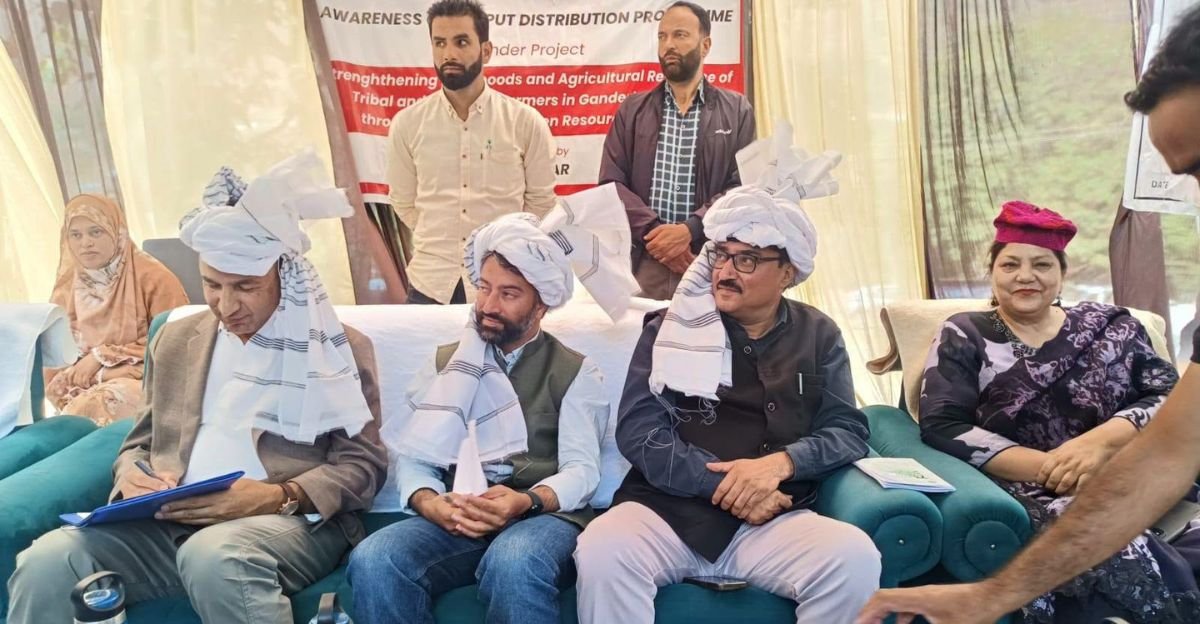
Ganderbal: The KVK Ganderbal and Directorate of Extension, Sher-e-Kashmir University of Agricultural Sciences and Technology of Kashmir (SKUAST-K), organised an Awareness-cum-Input Distribution Programme at Bagpati, Gund Kangan, under an ICAR Tribal Sub-Plan (TSP) project aimed at strengthening the livelihoods and agricultural resilience of tribal and marginal farmers in Ganderbal district. Click Here To Follow Our WhatsApp Channel
The programme focused on creating awareness among farming communities and promoting improved agricultural technologies, quality inputs and technology-driven resource packages to strengthen farm productivity, livelihoods and resilience.
Kangan MLA Mian Meher Ali, who delivered the presidential address, stressed the importance of strengthening the agricultural sector and providing farming communities with appropriate technologies, quality inputs and institutional support. He also appreciated efforts aimed at improving the livelihoods and resilience of tribal and marginal farmers in the area.
SKUAST-K Vice Chancellor Prof Nazir Ganai highlighted the university’s commitment to farmer-oriented extension programmes and the effective transfer of modern agricultural technologies to farming communities at the grassroots level.
He emphasised the need for greater collaboration between the Indian Council of Agricultural Research (ICAR), SKUAST-K and other stakeholders to improve agricultural productivity, strengthen resilience and support rural livelihoods.
Prof Rajbir Singh, Deputy Director General (Agricultural Extension), ICAR, shared his views on strengthening agricultural extension services and appreciated the work being carried out by SKUAST-K and KVK Ganderbal for tribal and marginal farming communities.
He also acknowledged the university’s efforts to strengthen extension outreach and highlighted the contribution of Krishi Vigyan Kendras in providing need-based support to farmers.
Prof Singh also appreciated SKUAST-K for securing the third position in the national ranking, recognising the university’s contribution to agricultural education, research and extension.
Director Extension, SKUAST-K, Prof Raihana Habib Kanth, underlined the importance of effective extension services, technology transfer and need-based assistance for farmers, particularly those belonging to tribal and marginal communities.
She highlighted the role of KVKs in taking agricultural innovations from research institutions to farmers’ fields and strengthening farmer-centric extension services.
Dr Ajaz Ahmed Malik, Senior Scientist and Head of KVK Ganderbal, delivered the welcome address and outlined the objectives of the programme. He also highlighted the importance of technology-driven interventions in improving agricultural productivity and strengthening the livelihoods of the targeted communities.
Technology Packages Distributed Among Farmers
A key feature of the programme was the distribution of Technology-Driven Resource Packages among beneficiaries.
The packages are intended to support the adoption of improved agricultural practices and technologies while strengthening the productive capacity and resilience of tribal and marginal farmers.
The programme brought together scientists, extension personnel, government officials, farmers and beneficiaries from the targeted communities.
The event underlined SKUAST-K’s focus on inclusive and farmer-centred agricultural development, particularly through technology transfer, stronger extension services and support for vulnerable farming communities in Jammu and Kashmir.
You Might Also Like:
Education In Kashmir with Complete Statistics
TCS Nashik ‘Conversion’ Scandal: Accused Nida Khan Suspended as Sexual Harassment and Coercion Probe Intensifies