Kashmir Bombshell: US Envoy’s “Important Part of India” Remark Leaves Pakistan Furious
By: Sheikh Mohammad Isa
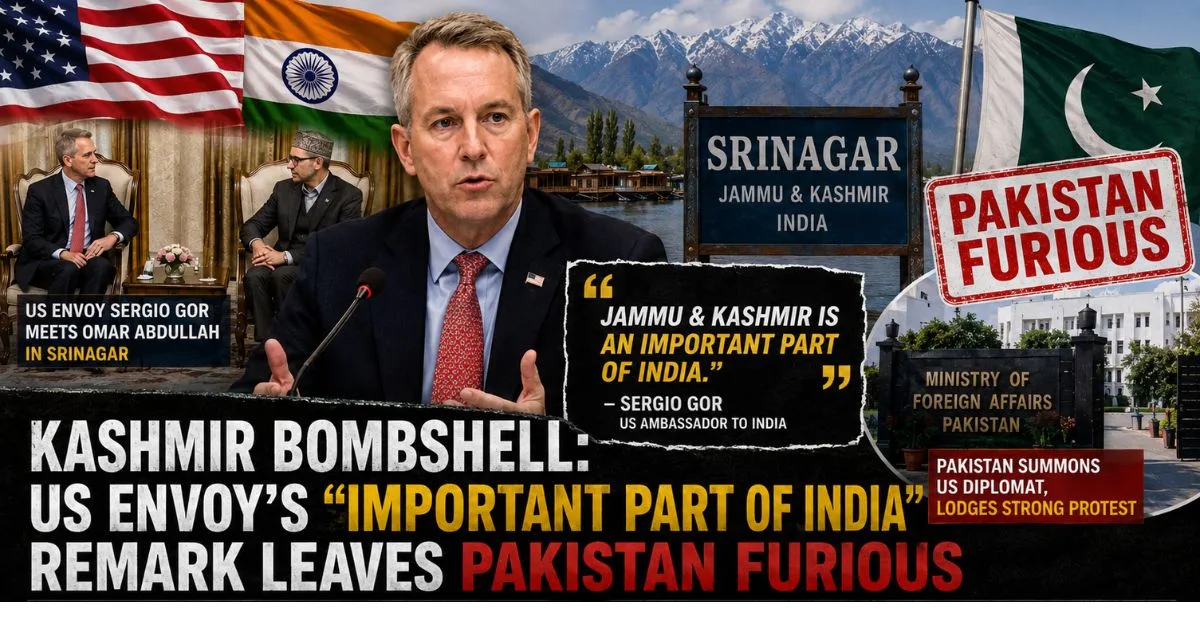
US Ambassador to India Sergio Gor’s description of Jammu and Kashmir as an “important part of India” has triggered a sharp diplomatic reaction from Pakistan, with Islamabad summoning the US Chargé d’Affaires and lodging a strong protest. Click Here To Follow Our WhatsApp Channel
Gor made the remarks during his first visit to Jammu and Kashmir on Wednesday, August 19, after meeting Jammu and Kashmir Chief Minister Omar Abdullah in Srinagar. The statement has attracted particular attention because of the long-running dispute between India and Pakistan over the region and Washington’s historically cautious public position on the issue.
What Did Sergio Gor Say in Srinagar?
Gor, who is also the US Special Envoy to South and Central Asia, arrived in Srinagar for high-level engagements and met Chief Minister Omar Abdullah.
Speaking to reporters after the meeting, the US ambassador described Jammu and Kashmir as an “important part of India” and praised the region as an “incredibly beautiful place”.
He also said that this was his first visit to the region in his capacity as US Ambassador to India.
The remarks were made during a visit that included diplomatic and regional engagements and were followed by Gor’s trip to Leh, marking his maiden visit to Ladakh.
Why the Remark Is Significant
The wording immediately drew attention because Kashmir remains one of the most sensitive issues in India-Pakistan relations.
India maintains that Jammu and Kashmir is an integral part of the country, while Pakistan continues to describe the region as an internationally recognised disputed territory and argues that its final status should be settled in accordance with relevant United Nations Security Council resolutions and the aspirations of the Kashmiri people.
Therefore, a public statement by a senior US diplomat referring to Jammu and Kashmir as an “important part of India” carries considerable diplomatic weight, even though one ambassador’s public remarks should not automatically be treated as a formal announcement of a comprehensive change in US policy.
Pakistan Reacts Within Hours
Islamabad responded strongly to Gor’s comments.
Pakistan’s Foreign Office summoned US Chargé d’Affaires Natalie Baker and lodged what it described as a “strong demarche” over the ambassador’s remarks.
The Pakistani Foreign Office said it strongly condemned and rejected the characterisation of Jammu and Kashmir as a part of India. Islamabad described Gor’s remarks as “factually incorrect” and “irresponsible”.
Pakistan also argued that the statement contradicted what it considers the longstanding US position on the Kashmir dispute.
According to Islamabad, Jammu and Kashmir remains an internationally recognised disputed territory whose final disposition should be determined through the relevant UN Security Council resolutions and the aspirations of the Kashmiri people.
Islamabad Points to Earlier US Position
Pakistan’s Foreign Office also argued that Gor’s remarks were inconsistent with Washington’s previous statements on Kashmir.
Islamabad urged the United States to maintain consistency in its public statements and referred to what it described as Washington’s earlier position concerning the Kashmir dispute.
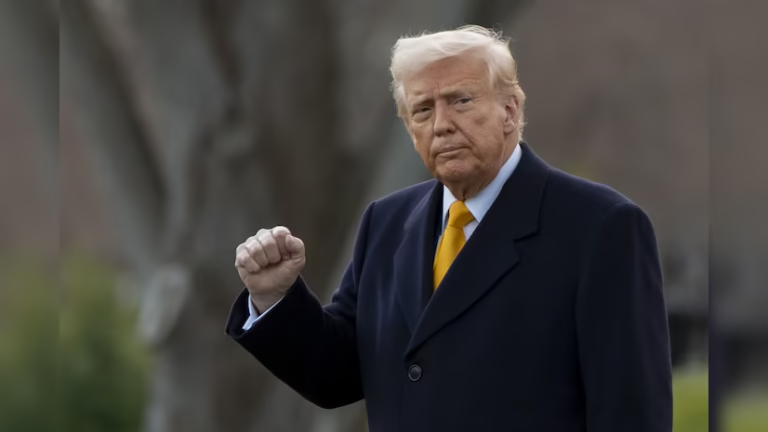
The Pakistani Foreign Office also cited US President Donald Trump’s previous offer to mediate between India and Pakistan on the Kashmir issue, arguing that the latest remarks appeared inconsistent with such an approach.
This has added another layer to the diplomatic dispute, with Pakistan seeking to highlight what it sees as a contradiction between previous US statements and Gor’s latest comments.
US May Reconsider Kashmir Travel Advisory
Gor’s comments on Kashmir were not limited to the region’s political significance.
During his Srinagar visit, he indicated that the United States would reassess its travel advisory for Jammu and Kashmir, pointing to improvements in the security situation.
The possibility of revising the advisory could be significant for Jammu and Kashmir’s tourism sector, which depends heavily on visitors from different parts of India and abroad.
However, reports indicate that the ambassador did not announce a specific new advisory level during the visit. The comments instead pointed towards a possible future reassessment based on security conditions.
Omar Abdullah Holds Talks With US Envoy
Gor’s visit also brought renewed attention to direct diplomatic engagement between US officials and Jammu and Kashmir’s elected administration.
The US ambassador met Omar Abdullah in Srinagar, with the discussions taking place against the backdrop of India-US relations and developments in Jammu and Kashmir.
Ahead of the visit, Omar Abdullah had stressed that issues concerning Jammu and Kashmir should be addressed through India’s domestic political process rather than by taking complaints to foreign governments.
The meeting therefore carried significance beyond the ambassador’s subsequent public comments, particularly because of the level of the visiting US diplomat and the sensitivity surrounding Jammu and Kashmir.
A Symbolically Important US Visit
Gor’s trip has also attracted attention because of its timing.
It represents a high-level US diplomatic visit to Jammu and Kashmir after the constitutional changes of August 2019. Reports have described it as the first standalone visit by a sitting US ambassador to the region since those changes.
The visit was followed by Gor’s first trip to Ladakh, further expanding the geographical scope of his engagement with the region.
For India, the visit provides an opportunity to showcase Jammu and Kashmir and Ladakh to a senior US diplomatic representative.
For Pakistan, however, the ambassador’s public characterisation of Jammu and Kashmir has created an immediate diplomatic challenge.
Is This a Formal US Policy Shift?
Despite the political significance of Gor’s remarks, it is important not to overstate what they mean.
The statement is certainly notable, particularly because it was made publicly during the ambassador’s visit to Srinagar. However, a single diplomatic statement does not by itself constitute a formal treaty, legal declaration or comprehensive revision of US foreign policy.
The significance lies primarily in the message and diplomatic optics.
Gor publicly referred to Jammu and Kashmir as an important part of India while physically visiting Srinagar and meeting the region’s elected Chief Minister. Pakistan interpreted that language as a departure from the position it says Washington has maintained on the Kashmir dispute.
Why Pakistan Is Concerned
For Islamabad, the Kashmir dispute remains a central foreign-policy issue.
Pakistan has consistently sought international attention to the dispute and has called for a settlement based on UN resolutions and what it describes as the aspirations of the Kashmiri people.
A public statement from a senior US diplomat that appears to endorse India’s description of Jammu and Kashmir therefore carries significance beyond the immediate wording.
It could make Pakistan’s diplomatic effort to secure stronger international engagement on Kashmir more difficult, particularly if similar statements are repeated by other major powers.
At the same time, it would be premature to conclude that the United States has completely abandoned every aspect of its previous diplomatic language on Kashmir solely because of Gor’s statement.
What Comes Next?
The immediate diplomatic confrontation is likely to remain centred on the wording used by the US ambassador and Pakistan’s demand for clarification.
For India, Gor’s visit and remarks provide an important diplomatic moment, particularly alongside his comments about potentially reassessing the US travel advisory for Jammu and Kashmir.
For Pakistan, the challenge is to prevent the statement from becoming an accepted indication of a wider international shift in the way major powers describe the region.
For Washington, the episode highlights the delicate balance between its strategic relationship with India, its broader interests in South Asia and its longstanding engagement with both India and Pakistan.
One thing is already clear: Sergio Gor’s brief description of Jammu and Kashmir as an “important part of India” has produced a much larger diplomatic reaction than the few words themselves might suggest.