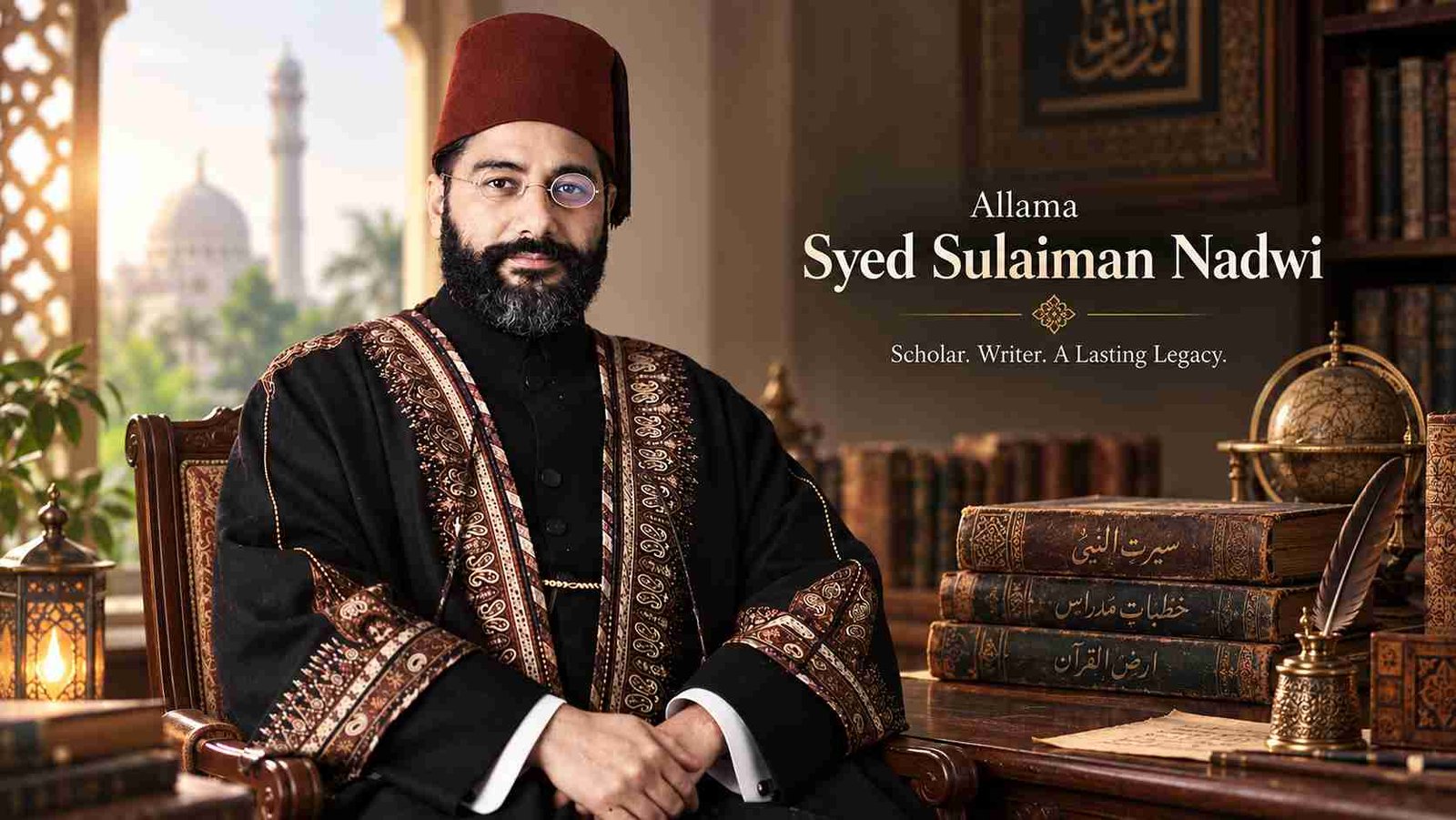
Allama Syed Sulaiman Nadwi: Life, Works, Scholarship and Lasting Legacy
Allama Syed Sulaiman Nadwi (22 November 1884 – 22 November 1953) was one of the most respected Islamic scholars, historians, biographers and Urdu writers of the Indian subcontinent.
A distinguished student and close associate of Allama Shibli Nomani, Nadwi carried forward his teacher’s work in Islamic history, Seerah and literature. His writing combined traditional Islamic scholarship with historical research and clear literary expression.
His most important contributions include Sirat-un-Nabi, Khutbat-e-Madras, Ard-ul-Quran, Seerat-e-Aisha and several other works on Islamic history, culture and literature. Click Here To Follow Our WhatsApp Channel
He also played an important role in the development of Darul Musannefin, popularly known as the Shibli Academy, in Azamgarh. Later in life, he moved to Pakistan, where he took part in important discussions about Islam, education and the country’s constitutional development.
Early Life of Allama Syed Sulaiman Nadwi
Syed Sulaiman Nadwi was born on 22 November 1884 in Desna, a historic village in present-day Nalanda district of Bihar.
His father, Hakim Syed Abul Hasan, was a respected physician and was also associated with religious learning and Sufism.
Nadwi received his early education from his family and local teachers. He later travelled to important centres of Islamic learning to continue his studies.
He studied at Phulwari Sharif and later at Madrasa-e-Imdadia in Darbhanga. These early years gave him a strong foundation in Islamic studies and Arabic.
Education at Nadwatul Ulama
In 1901, Sulaiman Nadwi joined Darul Uloom Nadwatul Ulama in Lucknow.
Nadwa was one of the important centres of Islamic education in India, and his years there proved decisive for his future career.
It was at Nadwa that he came under the influence of Allama Shibli Nomani, one of the leading Muslim scholars and historians of his time.
Shibli recognised Nadwi’s ability as a researcher and writer. Under his guidance, Nadwi developed a strong interest in Islamic history, biography, Arabic literature and Seerah.
He completed his studies at Nadwa in 1906.
His intellectual abilities became clear at an early age. He began writing articles and gradually developed a reputation as a talented Urdu and Arabic writer.
Relationship with Allama Shibli Nomani
The relationship between Shibli Nomani and Sulaiman Nadwi became one of the most important scholarly partnerships in modern Islamic literature in South Asia.
Shibli encouraged Nadwi to study history through original sources and to present Islamic subjects in a systematic and well-researched manner.
Nadwi later became one of Shibli’s closest students and intellectual associates.
When Shibli began his major work on the life of Prophet Muhammad ﷺ, Nadwi became closely involved with the project.
After Shibli’s death in 1914, Nadwi continued his teacher’s work and eventually completed the monumental Sirat-un-Nabi.
This made Nadwi one of the most important heirs of Shibli’s scholarly tradition.
Sirat-un-Nabi: His Most Famous Work
One of Sulaiman Nadwi’s greatest achievements was his contribution to Sirat-un-Nabi, the major Urdu biography of Prophet Muhammad ﷺ.
Shibli Nomani had begun the project and completed its first two volumes. However, he died in 1914 before the work could be completed.
Nadwi then took responsibility for continuing the project.
He edited and published the material prepared by Shibli and wrote the later volumes himself. The completed work became one of the most important and widely respected Urdu works on the life of Prophet Muhammad ﷺ.
Sirat-un-Nabi brought together traditional Islamic sources and historical research. It remains an important reference for readers and researchers studying the Seerah in Urdu.
Khutbat-e-Madras
Another major work by Nadwi is Khutbat-e-Madras.
In 1925, Nadwi delivered a series of lectures in Madras, now Chennai, on the life and character of Prophet Muhammad ﷺ.
The lectures were later published as a book.
The work became popular because it presented the Seerah in an informative and literary style while discussing important historical aspects of the Prophet’s life.
Khutbat-e-Madras remains one of Nadwi’s best-known works on Seerah.
Role in Darul Musannefin and Shibli Academy
Sulaiman Nadwi was also closely associated with the development of Darul Musannefin, also known as the Shibli Academy, in Azamgarh.
The institution developed from an initiative launched by the students and admirers of Shibli Nomani after his death in 1914.
According to the Shibli Academy’s own historical account, Maulana Hamiduddin Farahi became its first President, while Sulaiman Nadwi served as its first Secretary.
Darul Musannefin was established as a centre for research, writing and publication.
The institution became particularly important for Islamic history, Urdu literature and historical research. It helped continue the intellectual tradition established by Shibli Nomani.
Nadwi’s association with the institution became one of the most important parts of his scholarly career.
Major Works of Sulaiman Nadwi
Nadwi wrote extensively on Islamic history, Seerah, biography, geography, Arabic literature and South Asian history.
Some of his important works include:
- Sirat-un-Nabi – a major biography of Prophet Muhammad ﷺ.
- Khutbat-e-Madras – lectures on the life and character of Prophet Muhammad ﷺ.
- Ard-ul-Quran – a study of geographical and historical places mentioned in the Quran.
- Seerat-e-Aisha – a biography of Sayyidah Aisha (R.A).
- Rahmat-e-Aalam – a work about the life of Prophet Muhammad ﷺ.
- Arab-o-Hind Ke Ta’alluqaat – a study of historical relations between Arabia and India.
- Khayyam – a work connected with the Persian poet and scholar Omar Khayyam.
His writings covered a wide range of subjects and demonstrated his deep knowledge of Islamic sources and South Asian history.
Sulaiman Nadwi and Urdu Literature
Nadwi was not only an Islamic scholar but also an accomplished Urdu writer.
His prose was known for its clarity, depth and literary quality. He helped develop a style of Islamic historical writing that could reach both traditional scholars and educated general readers.
His works also helped strengthen the use of Urdu as a language for serious historical and religious research.
Through his books, lectures and editorial work, he became an important figure in the development of modern Urdu scholarship.
His Public and Political Role
Nadwi’s activities were not limited to academic and literary work.
During the final decades of British rule in India, he became involved in wider educational and public affairs.
He was associated with the Khilafat Movement and took part in discussions concerning the political and social position of Muslims in India.
He was also associated with the early development of Jamia Millia Islamia.
Nadwi’s public thought included an interest in Hindu-Muslim relations and the cultural future of India. He supported efforts towards greater understanding between different communities.
His involvement in public affairs reflected the wider political and intellectual changes taking place in India during the early 20th century.
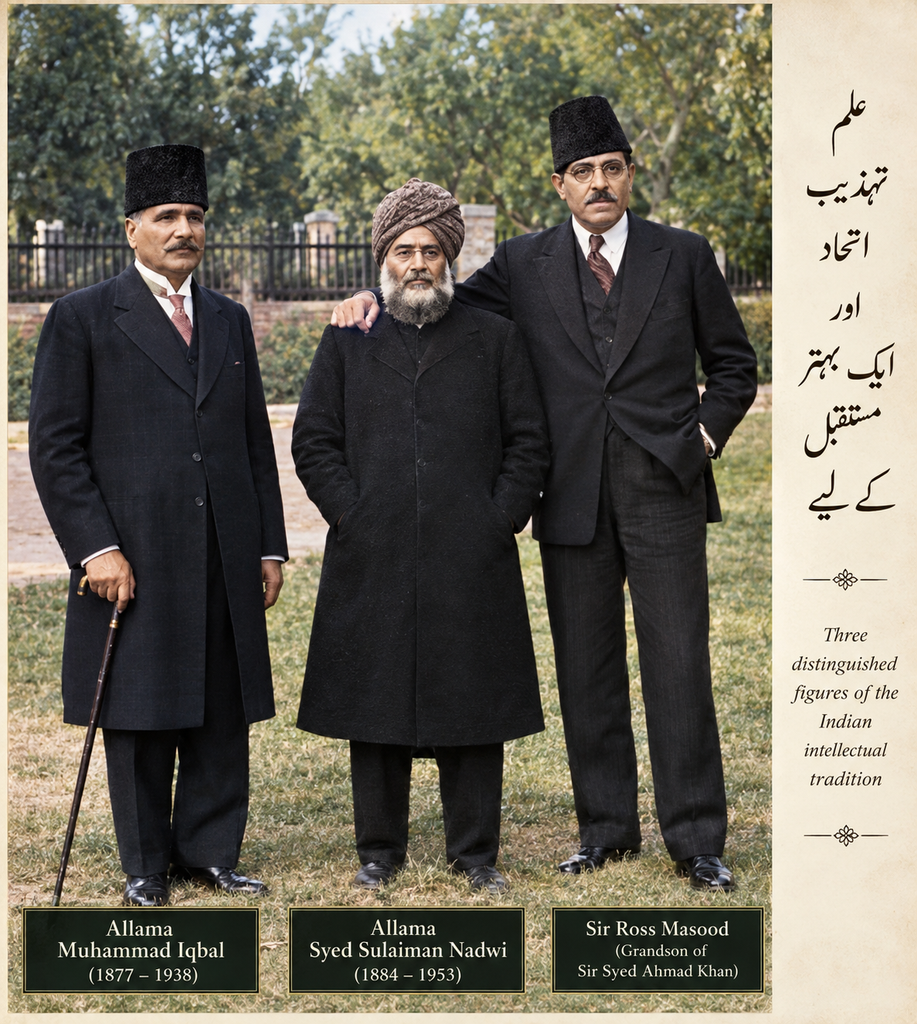
Relationship with Allama Iqbal
Nadwi was respected by many leading scholars and intellectuals of his generation.
Allama Muhammad Iqbal held him in high regard. Nadwi’s scholarship and literary abilities earned him recognition among some of the leading Muslim thinkers of the period.
He was also known by the honorific “Ustad-ul-Kul”, meaning “Teacher of All”, reflecting the respect he received in scholarly circles.
Move to Pakistan
After the Partition of India, Sulaiman Nadwi moved to Pakistan in June 1950.
He settled in Karachi and became associated with the country’s early efforts to develop an Islamic constitutional framework.
He was appointed Chairman of the Taleemat-e-Islami Board, which was involved in discussions about Islamic principles and their place in Pakistan’s constitutional development.
His experience in Islamic scholarship and history made him an important participant in these discussions during Pakistan’s early years.
Death of Allama Syed Sulaiman Nadwi
Allama Syed Sulaiman Nadwi died in Karachi on 22 November 1953, exactly 69 years after his birth.
His death marked the end of a remarkable scholarly career that had crossed two major periods of South Asian history: the final decades of British rule and the early years of independent Pakistan.
However, his intellectual influence continued through his books, students and the institutions connected with his work.
Legacy of Allama Syed Sulaiman Nadwi
The legacy of Sulaiman Nadwi extends across Islamic scholarship, history, Seerah and Urdu literature.
His completion of Sirat-un-Nabi preserved and extended the major scholarly project started by Shibli Nomani. His Khutbat-e-Madras became another important contribution to Seerah literature.
His work with Darul Musannefin helped establish a lasting tradition of research and publication in Islamic history and Urdu literature.
He also demonstrated how traditional Islamic scholarship could engage with historical research and modern literary methods without losing its connection with classical sources.
In 1992, Pakistan Post honoured him with a commemorative stamp as part of its Pioneers of Freedom series.
More than seven decades after his death, his writings continue to be studied by readers, students and researchers interested in Islamic history, the Seerah of Prophet Muhammad ﷺ, Urdu literature and the intellectual history of South Asia.
Conclusion
Allama Syed Sulaiman Nadwi remains an important figure in the intellectual history of the Indian subcontinent.
From his early education at Nadwatul Ulama and his close association with Allama Shibli Nomani to his work on Sirat-un-Nabi, Khutbat-e-Madras and Darul Musannefin, his life was devoted to scholarship, writing and research.
His contribution went beyond individual books. He helped create a tradition of Islamic historical writing that influenced generations of scholars and readers.
For this reason, Sulaiman Nadwi’s name continues to hold an important place in the history of Islamic scholarship, Seerah literature, Urdu writing and South Asian intellectual thought.
You Might Also Like:
Education In Kashmir with Complete Statistics
TCS Nashik ‘Conversion’ Scandal: Accused Nida Khan Suspended as Sexual Harassment and Coercion Probe Intensifies