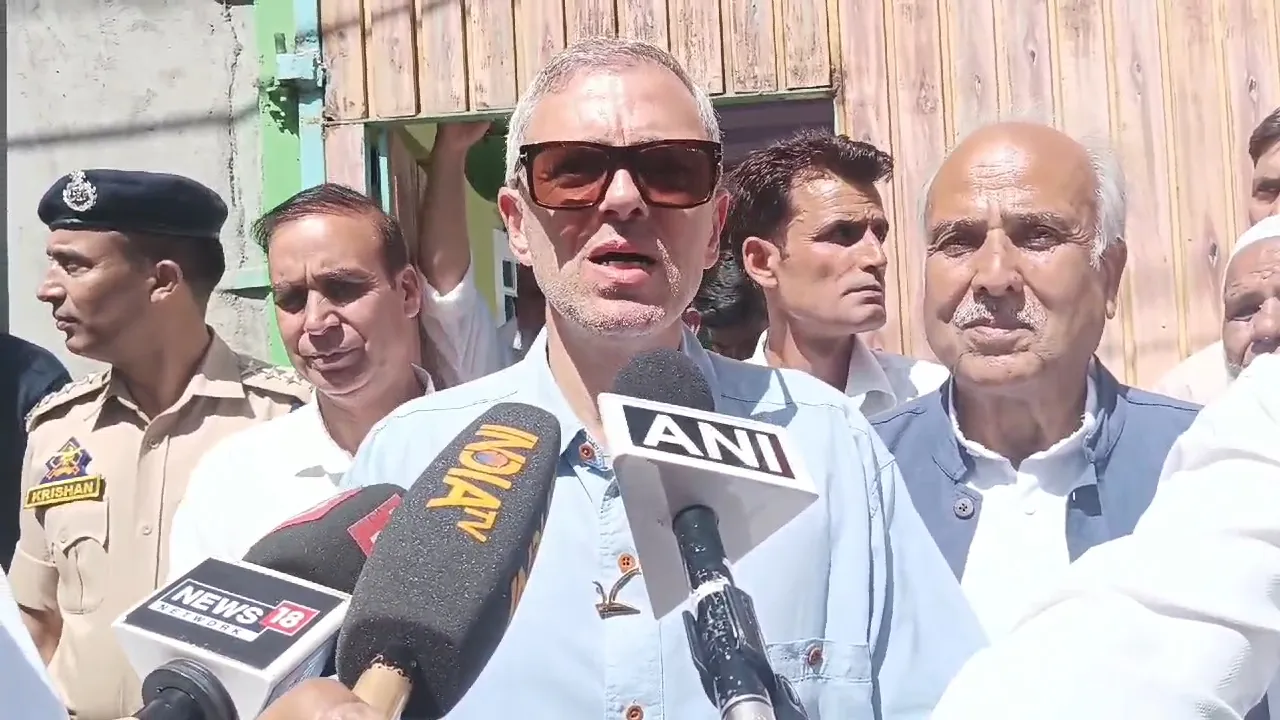
Omar Abdullah Says Statehood Delay Has Cost Him ‘Huge Political Capital’ in Jammu and Kashmir
SRINAGAR: Jammu and Kashmir Chief Minister Omar Abdullah has expressed deep frustration over the continued delay in restoring full statehood to the Union Territory, acknowledging that the issue has damaged not only public confidence in the Centre but also his own political standing.
In a recent interview with journalist Karan Thapar for The Wire, Abdullah said the anger and disappointment over the delay was no longer directed exclusively at the Narendra Modi government.
He said he had also suffered a significant political cost because he chose to build a constructive relationship with the Union government in the hope that statehood would be restored quickly.
“I put a huge amount of my own political credibility at stake for this. I know for a fact that I’ve eroded a large part of it,” Abdullah said in the interview.
He added that he was prepared to “pay the price for sins that are not mine”, saying the political consequences were something he had to bear. Click Here To Follow Our WhatsApp Channel
The comments come amid a renewed National Conference campaign demanding the immediate restoration of Jammu and Kashmir’s statehood.
Why Omar Abdullah says he has lost political capital
Restoration of statehood was one of the central political issues in the National Conference’s campaign for the 2024 Jammu and Kashmir Assembly elections.
After forming the government, Abdullah initially adopted a relatively constructive approach towards the Union government.
The strategy was based partly on the expectation that repeated assurances from the Centre would eventually lead to the restoration of statehood.
However, the absence of a clear timeline has increasingly become a political problem for the Jammu and Kashmir government.
Abdullah now acknowledges that his decision to place political credibility behind those assurances has come at a cost.
His concern is that people in Jammu and Kashmir increasingly judge the elected government against an outcome that is largely outside its constitutional control.
This has created a difficult political situation: the elected administration is expected by the public to deliver statehood, while the final decision rests with the Union government and Parliament.
The problem with ‘appropriate time’
One of Abdullah’s strongest criticisms is directed at the Centre’s repeated use of phrases such as “at an appropriate time” when discussing restoration of statehood.
According to the chief minister, such language gives the Union government considerable flexibility while leaving the Jammu and Kashmir government without a clear objective or deadline.
He compared the situation to a marathon in which the finishing line keeps moving.
His argument is straightforward: if the Centre wants the elected government in Jammu and Kashmir to work towards a particular outcome, it should provide a clear timeline or set of conditions.
Without that clarity, Abdullah believes public frustration will continue to grow.
The ‘moving finish line’ argument
Abdullah’s marathon analogy captures the central political problem.
The Union government has repeatedly indicated that statehood will eventually be restored, but it has not publicly provided a firm date for doing so.
The Supreme Court, in its December 2023 judgment concerning the constitutional changes in Jammu and Kashmir, recorded the Centre’s submission that statehood would be restored and said the restoration should take place at the earliest.
The National Conference has repeatedly argued that phrases such as “at the earliest” or “as soon as possible” cannot remain open-ended indefinitely.
Abdullah made a similar argument in a 2025 letter to political parties, saying the people of Jammu and Kashmir had already waited long enough and that the restoration of statehood should not be treated as a discretionary favour.
What is ‘Modi Ka Wada’?
The chief minister has repeatedly referred to Prime Minister Narendra Modi’s public assurances on statehood as “Modi Ka Wada”, or Modi’s promise.
Abdullah has argued that the phrase matters because the Prime Minister personally attached his credibility to the commitment.
In his 2025 appeal to political parties, Abdullah referred to assurances made by Modi in Parliament and in public appearances, as well as the Centre’s position before the Supreme Court.
He argued that the Union government’s commitment to restore statehood should therefore be treated as a formal political undertaking rather than a general statement of intent.
The National Conference has since used the phrase “Modi ka wada, kyun raha aadha?” — why has Modi’s promise remained incomplete? — during its protests over statehood.
The issue of terrorism
One of the most important arguments raised by Abdullah concerns the suggestion that statehood may depend on the complete elimination of terrorism or militancy.
The chief minister rejected that reasoning.
He argued that Jammu and Kashmir’s elected government does not control the security apparatus responsible for counter-terrorism operations.
According to Abdullah, decisions relating to the military, intelligence and wider counter-terrorism structure remain outside the direct authority of the elected administration.
He therefore questioned why an elected government should face political consequences for a security issue over which it has limited or no operational control.
His argument is that linking statehood to the complete elimination of militancy effectively makes restoration dependent on factors controlled elsewhere.
‘You are transferring the decision to Islamabad’
Abdullah took the argument further by saying that if restoration of statehood depends on the complete end of Pakistan-sponsored terrorism, the effective decision-maker would no longer be New Delhi.
In his view, such a condition would mean that the timing of statehood ultimately depends on developments across the border.
He argued that the Union government should instead define clear conditions that can be assessed objectively and that are within the control of the elected administration.
This is one of the strongest political arguments he has made against an indefinite security-based condition for statehood.
Why Abdullah criticises the Union Territory model
The chief minister is also sharply critical of the present governance structure.
Jammu and Kashmir is currently a Union Territory with a Legislative Assembly.
Abdullah described this model as an extremely difficult arrangement for democratic governance.
He argued that an elected Assembly and Council of Ministers exist, but their authority remains limited compared with that of a full state government.
His criticism is not simply about political symbolism.
It concerns the practical distribution of administrative powers between the elected government and the Lieutenant Governor.
The Lieutenant Governor’s role
Under the current Union Territory framework, the Lieutenant Governor retains significant powers.
This creates a system in which an elected government operates alongside an appointed constitutional authority with substantial administrative responsibilities.
Abdullah argues that this can create uncertainty over who ultimately controls important decisions.
He has previously highlighted the limitations faced by the elected administration and has argued that statehood is necessary to create a clearer division of powers.
The chief minister’s latest comments therefore reflect a broader criticism of the post-2019 administrative structure.
Key institutions and administrative control
Abdullah also pointed to important institutions that, according to his argument, remain outside the full control of his elected government.
He cited institutions including the Jammu and Kashmir Power Development Corporation and Sher-i-Kashmir Institute of Medical Sciences (SKIMS).
His broader complaint is that an elected government should have greater authority over the administration if it is expected to deliver on public promises.
He also argued that his Cabinet does not have the same control over senior administrative appointments that a state government would normally exercise.
Why statehood matters for governance
The statehood debate is therefore not simply about a change in constitutional status.
It has direct implications for:
- Administrative authority
- Legislative powers
- Control over public institutions
- Appointment of senior officials
- Relationship with the Lieutenant Governor
- Accountability of elected representatives
- Political responsibility for government decisions
For the National Conference, restoring statehood is therefore both a political and administrative demand.
What about Article 370?
Abdullah was also asked about criticism that the National Conference government has become less vocal about restoring Article 370.
His response was that the constitutional structure of Article 370 and statehood cannot simply be treated as separate questions.
He argued that Article 370 historically dealt with the division of powers between the Union and the state.
His position is that the question of restoring the constitutional division of powers cannot be properly addressed while Jammu and Kashmir remains a Union Territory.
In simple terms, his argument is that statehood must come before any meaningful restoration of the state-level distribution of powers.
This represents a political shift in emphasis rather than an abandonment of the National Conference’s historical position.
The National Conference’s changing strategy
The National Conference has historically maintained restoration of Article 370 and statehood as major political objectives.
However, since returning to government, the party has increasingly focused its immediate political campaign on statehood.
That is partly because statehood is viewed as a more immediately achievable demand than restoration of Article 370.
The Supreme Court’s 2023 judgment upheld the Union government’s constitutional changes relating to Article 370, while also recording the Centre’s commitment regarding restoration of statehood.
As a result, the National Conference has concentrated considerable political energy on statehood.
From cooperation to confrontation
The latest comments also illustrate a change in Abdullah’s political strategy.
After becoming chief minister, he sought to maintain working relations with the Union government.
The underlying calculation was that confrontation might make it harder to secure statehood.
However, as the delay continued, the political benefit of that approach became increasingly difficult to defend among his supporters.
The National Conference has now moved towards a more confrontational campaign.
In July 2026, the party organised a major protest in Delhi demanding restoration of statehood and accusing the Union government of failing to honour its commitment.
Delhi protest marks a new phase
The July 2026 protest represented an important escalation.
National Conference leaders and workers gathered in New Delhi during the opening of Parliament’s Monsoon Session.
They carried placards demanding:
“Restore full statehood”
and
“Apna wada pura karo” — fulfil your promise.
Protesters also raised the slogan:
“Modi ka wada, kyun raha aadha?”
The protest was intended to put pressure on the Union government directly in the national capital rather than limiting the campaign to Jammu and Kashmir.
The protest and police restrictions
The Delhi demonstration also generated a separate confrontation.
The National Conference delegation was reportedly prevented from proceeding towards its planned protest location.
Omar Abdullah was eventually seen travelling by autorickshaw after police restrictions disrupted the planned movement.
The incident received considerable media attention and became another part of the wider statehood campaign.
The political message from the National Conference was that the demand for statehood would no longer remain confined to speeches inside Jammu and Kashmir.
What does the public mood mean for Omar Abdullah?
Abdullah’s admission that he has lost political capital is significant because it acknowledges a problem within his own political base.
The National Conference returned to power after the 2024 Assembly elections with statehood among its major political demands.
If statehood remains unresolved, voters may increasingly ask what the elected government has actually been able to achieve on one of its most important promises.
At the same time, the chief minister’s argument is that the final decision is not within his government’s authority.
This creates a political dilemma.
The public can hold the elected government accountable for governance, but statehood itself depends on a decision by the Union government and Parliament.
The political risk for the Centre
The delay also carries political consequences for the Union government.
The BJP has repeatedly maintained that Jammu and Kashmir’s statehood will eventually be restored.
However, without a clear timeline, the opposition can continue to portray the promise as indefinite.
The National Conference has already begun turning the phrase “Modi Ka Wada” into a political slogan.
The July 2026 protests demonstrate that the issue is becoming an increasingly visible part of the political contest between the Centre and the elected government in Jammu and Kashmir.
What happens next?
Abdullah has indicated that his government will continue pressing for statehood through several channels.
These include:
- Political dialogue with the Union government
- Parliamentary engagement
- Public protests
- Demonstrations in Delhi
- Political mobilisation within Jammu and Kashmir
The National Conference has already demonstrated its willingness to take the campaign outside the Union Territory.
The question now is whether the Centre responds with a concrete timeline or continues to use broader assurances about restoration “at an appropriate time”.
The central question
The dispute ultimately comes down to one question:
What does “at the earliest” actually mean?
For the Jammu and Kashmir government and the National Conference, the answer is that the waiting period has already become too long.
For the Union government, the timing of restoration remains linked to its assessment of the political and security situation.
Until that difference is resolved, the statehood issue is likely to remain one of the most important political disputes between Srinagar and New Delhi.
Conclusion
Omar Abdullah’s latest remarks reveal the growing political cost of Jammu and Kashmir’s prolonged Union Territory status.
The chief minister says he deliberately invested political credibility in maintaining a constructive relationship with the Union government because he believed statehood would be restored.
Instead, the absence of a clear timeline has left him facing growing disappointment among constituents while the final decision remains outside his government’s direct control.
His criticism of the Centre is now more direct: he wants a clear set of conditions, a defined objective and a credible path towards statehood.
The National Conference has also moved from private political engagement towards public mobilisation, culminating in its July 2026 statehood protest in Delhi.
The dispute is therefore no longer simply about a constitutional promise made in the aftermath of the 2019 reorganisation.
It has become a test of political credibility — for the Union government that promised eventual restoration, and for the elected government in Jammu and Kashmir that built part of its political strategy around that assurance.
For Omar Abdullah, the frustration is now personal as well as political: he says he has already paid a substantial political price for a decision that ultimately does not rest with him.