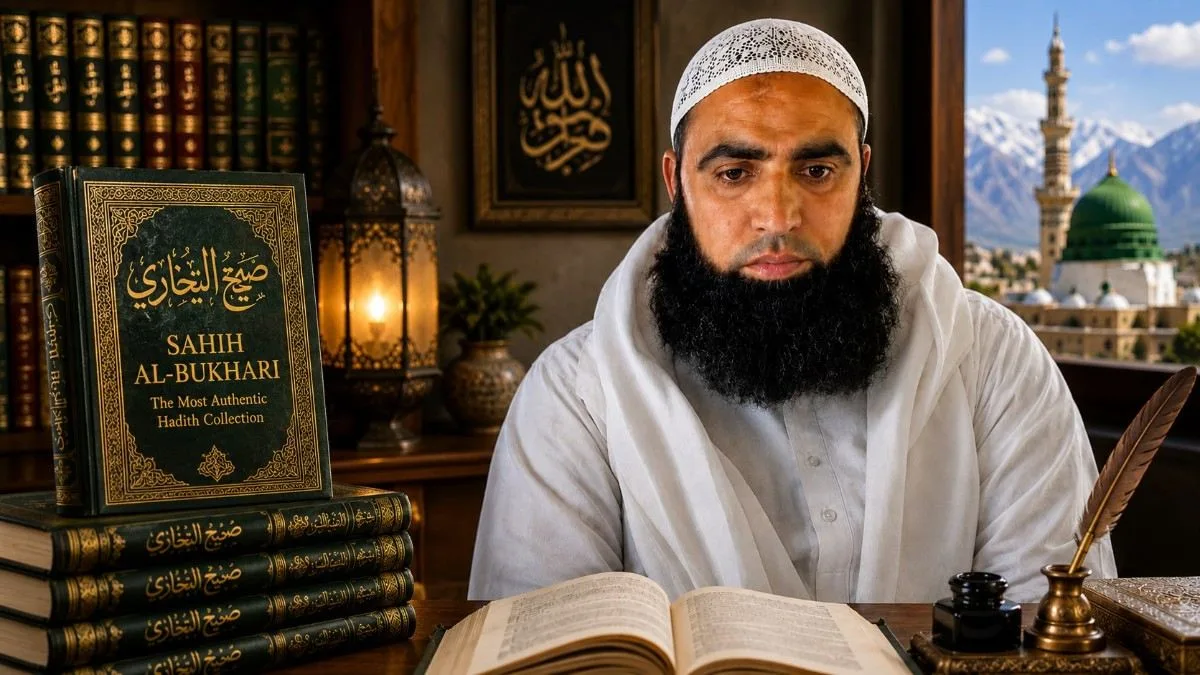
South Kashmir Scholar Mufti Showkat Ahmad Qasmi Memorises Entire Sahih al-Bukhari
SHOPIAN: In a remarkable achievement in Islamic scholarship, Mufti Showkat Ahmad Qasmi, an Islamic theologian from Kanjiullar village in South Kashmir’s Shopian district, is reported to have memorised the entire Sahih al-Bukhari. Click Here To Follow Our WhatsApp Channel
The accomplishment is being described as an extraordinary feat of memory, dedication and religious learning. It has also drawn attention to Kashmir’s long tradition of Quranic and Hadith education.
While Kashmir has produced thousands of Huffaz, or people who memorise the Holy Quran, memorising an entire major Hadith collection presents a very different and highly demanding challenge.
What makes memorising Sahih al-Bukhari so difficult?
Sahih al-Bukhari, compiled by the renowned Islamic scholar Imam Muhammad ibn Ismail al-Bukhari, is regarded by Sunni Muslims as the most authoritative Hadith collection after the Holy Quran.
Standard editions contain 7,563 numbered narrations, including repetitions, organised into 97 books.
The work covers a wide range of subjects, including faith, knowledge, prayer, charity, fasting, pilgrimage, marriage, business, manners, history and other aspects of Islamic life.
Memorising such a large work requires much more than remembering isolated sayings. A student must maintain a strong grasp of the exact wording, the order of the material and the context in which individual narrations appear.
The importance of the chains of narration
One of the distinctive features of Hadith scholarship is the Isnad, or chain of transmission.
A Hadith is traditionally studied together with the names of the people through whom it was transmitted. In Sahih al-Bukhari, these chains form an important part of the scholarly structure of the collection.
For a person attempting to memorise the complete work, retaining the Arabic text along with its chains of transmission requires exceptional concentration and years of disciplined study.
The final Hadith in the standard numbering, for example, is Hadith 7563, and its chain lists several transmitters before reaching the companion Abu Hurairah (RA).
More than simply memorising words
The study of Sahih al-Bukhari also involves understanding why Imam al-Bukhari placed particular narrations under specific chapter headings.
His chapter headings are an important part of the scholarly character of the collection because they can indicate legal and theological points drawn from the Hadith.
As a result, advanced study of the collection requires students to pay attention not only to the text of the narrations but also to their placement, chains of transmission and scholarly context.
This makes the complete memorisation of the collection a particularly demanding undertaking.
A rare Hadith memorisation tradition
In the early centuries of Islamic scholarship, scholars placed great importance on the preservation of Hadith through both written records and memory.
The term Hafiz al-Hadith was historically associated with scholars who possessed extensive knowledge of Hadith, including narrators, chains of transmission, textual variations and other technical aspects of the discipline.
Over time, the availability of printed books and, more recently, digital Hadith databases has changed how students access and study these works.
Even so, traditional Islamic seminaries continue to teach Sahih al-Bukhari as part of advanced Hadith studies. Complete memorisation of a major multi-volume Hadith collection remains a highly demanding accomplishment.
Recognition for Kashmir’s Islamic scholarship
Mufti Showkat Ahmad Qasmi’s reported achievement has brought renewed attention to the traditional Islamic education system in South Kashmir.
The Kashmir Valley has a long history of religious learning, with Islamic seminaries and scholars playing an important role in preserving Quranic studies, Hadith, jurisprudence and other Islamic disciplines.
Coming from Kanjiullar in Shopian, the achievement highlights the continuing interest among young and traditional scholars in the rigorous study of classical Islamic texts.
For students pursuing religious education, such accomplishments can also serve as an encouragement to develop strong habits of reading, memorisation, research and disciplined study.
An inspiration for students
Memorising the entire Sahih al-Bukhari requires sustained effort and dedication over a long period. It demands regular revision because retaining thousands of narrations, chains and related details is a continuous challenge.
For students of Islamic studies, the reported accomplishment therefore represents not only a feat of memory but also a reflection of perseverance and commitment to religious scholarship.
It also highlights the importance of preserving traditional methods of learning at a time when digital technology has made religious texts more easily accessible than ever before.
Kashmir’s continuing scholarly tradition
Kashmir has historically been known for its spiritual and scholarly traditions, and religious education remains an important part of the cultural life of many communities across the Valley.
The reported achievement of Mufti Showkat Ahmad Qasmi adds another notable chapter to that tradition and has the potential to inspire greater interest in the study of Hadith among students in Jammu and Kashmir.
For the younger generation, the accomplishment carries a broader message: serious scholarship requires patience, consistency, discipline and a willingness to devote years to learning.
The memorisation of Sahih al-Bukhari, if independently documented as described, would stand as a significant achievement in the field of traditional Islamic learning and a source of pride for the scholarly community in South Kashmir.
You Might Also Like:
Professor Mufti Abdul Ghani Azhari: Scholar, Sufi, Historian, and Social Reformer of Kashmir
Ruhullah Says He Will Respond Soon to Farooq Abdullah’s Resignation Challenge