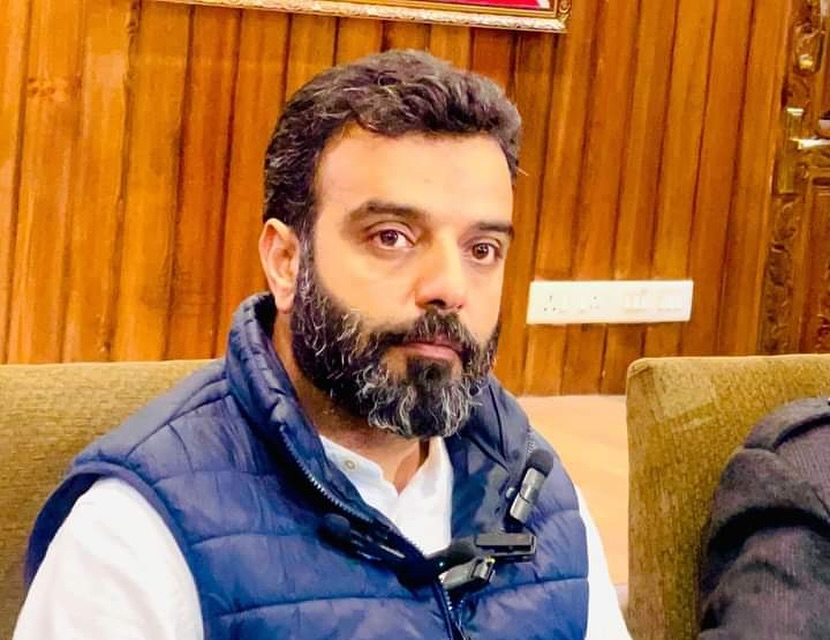
National Conference Lok Sabha member Aga Syed Ruhullah Mehdi has reaffirmed his decision to leave the party and resign from the Srinagar parliamentary seat, setting November 3, 2026, as the date for formally submitting his resignation.
Mehdi’s announcement marks a major escalation in his differences with the National Conference leadership, particularly over the party’s position on the restoration of Jammu and Kashmir’s special constitutional status, statehood and other political issues. Click Here To Follow Our WhatsApp Channel
The Srinagar MP had first announced his intention to resign after National Conference president Farooq Abdullah publicly challenged him to leave the party and seek a fresh mandate if he disagreed with its political position.
Mehdi subsequently confirmed that he would resign from both the National Conference and the Lok Sabha. He said he plans to submit his resignation on November 3, which will mark the 26th death anniversary of his father, Aga Syed Mehdi.
Why November 3 Matters
The date has a strong personal significance for Mehdi.
His father, Aga Syed Mehdi, a prominent Shia leader from Jammu and Kashmir, was killed in an IED blast in 2000. Mehdi has chosen the anniversary of his father’s death to formally announce his political separation from the National Conference.
He has indicated that after leaving the party and Parliament, he intends to consult people across Jammu and Kashmir before deciding his future political course.
The Srinagar MP has also spoken about building a grassroots network of people who share his political concerns. He has not formally announced whether he will establish a new political organisation or join another alliance.
Article 370 at the Centre of Rift
One of the main sources of disagreement between Mehdi and the National Conference leadership has been the party’s position on Article 370.
Mehdi has repeatedly criticised what he describes as a change in the party’s approach towards the restoration of Jammu and Kashmir’s special constitutional provisions.
In a letter addressed to Farooq Abdullah, Mehdi questioned the party’s position on Article 370 and statehood and argued that restoring statehood should not be treated as a substitute for the political commitments made by the party.
He has also criticised the leadership over what he considers a weakening of the demand for restoration of the constitutional position that existed before August 2019.
The National Conference leadership has taken a different political position, with the disagreement becoming increasingly public in recent months.
Farooq Abdullah’s Challenge
The latest confrontation followed remarks by Farooq Abdullah challenging Mehdi to resign from Parliament and contest a fresh election if he believed he could win without the National Conference.
Mehdi accepted the challenge and announced that he would leave both the party and his Lok Sabha seat.
His decision could eventually lead to a by-election in the Srinagar parliamentary constituency, although the timing and process would depend on the formal acceptance of his resignation and subsequent decisions by the Election Commission.
Mehdi won the Srinagar Lok Sabha constituency in the 2024 general election on an NC ticket. He secured 356,866 votes, according to election results.
Reservation Policy Becomes Another Flashpoint
Mehdi has also been vocal about Jammu and Kashmir’s reservation policy.
The current framework increased reservation for reserved categories to 67 per cent, leaving 33 per cent for the open category. The policy has faced criticism from sections of students, job aspirants and political groups, who have demanded its rationalisation.
The issue became a major challenge for the Omar Abdullah government after student groups protested against the reservation structure.
The government subsequently established a Cabinet Sub-Committee to examine the issue. The committee submitted its report to the Council of Ministers, after which the report was forwarded for further legal examination.
Mehdi has supported demands for changes to the reservation system and has participated in protests connected with the issue.
He has also argued that an elected government should respond to concerns raised by students and job aspirants.
Criticism of Lieutenant Governor’s Office
Mehdi has taken a separate position on the role of the Lieutenant Governor’s office in Jammu and Kashmir.
When questioned about directing his criticism towards the Lieutenant Governor’s administration over the reservation issue, Mehdi said he did not recognise the institution in the political sense and compared it to a colonial-era arrangement.
He has instead said that he prefers to raise such matters through Parliament, where he has submitted questions relating to Jammu and Kashmir.
His position reflects his broader argument that decisions affecting the region should be addressed through elected institutions.
Political Future Remains Unclear
Although Mehdi has announced his intention to leave the National Conference and Parliament, his next political move remains undecided.
In recent remarks, he said he would consult people in Jammu and Kashmir before making a decision about his political future.
Possible options could include contesting a future election independently, establishing a new political platform or working with another political formation. However, Mehdi has not formally committed himself to any of these options.
For now, his immediate plan is to formally resign on November 3.
A Significant Moment for the National Conference
Mehdi’s planned departure comes after a prolonged period of disagreement with the National Conference leadership.
The dispute has involved Article 370, statehood, reservation policy and the direction of the party after the 2024 elections.
The National Conference remains the governing party in Jammu and Kashmir, with Omar Abdullah serving as Chief Minister, while Farooq Abdullah remains the party’s president.
Mehdi’s decision therefore creates a significant political development for the party, particularly in the Srinagar constituency and among voters who supported him in the 2024 parliamentary election.
At the same time, his resignation has not yet taken effect. Until November 3 and the formal submission and acceptance of his resignation, Mehdi remains the elected Lok Sabha member from Srinagar.
His eventual decision on whether to contest a fresh election or create a new political platform could determine the next stage of the political dispute.
For now, the November 3 deadline has transformed months of public disagreement between Mehdi and the National Conference leadership into a formal separation that is set to take place later this year.
You Might Also Like:
Education In Kashmir with Complete Statistics
TCS Nashik ‘Conversion’ Scandal: Accused Nida Khan Suspended as Sexual Harassment and Coercion Probe Intensifies