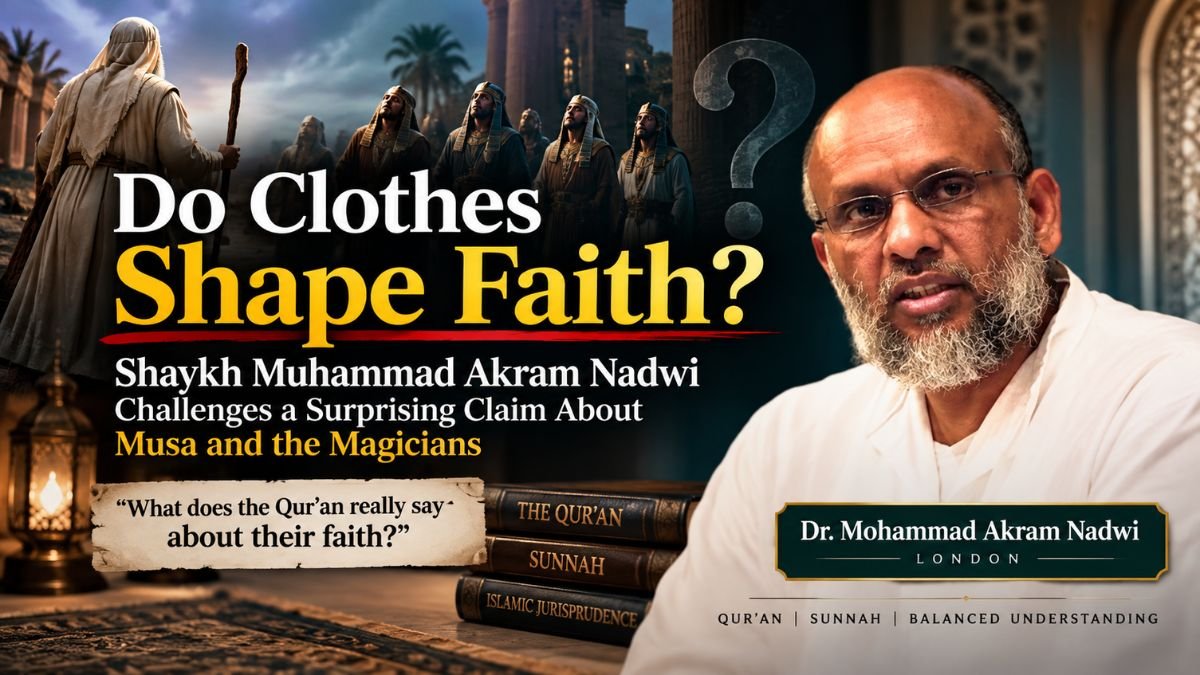
Respected and honoured teacher, Shaykh Muhammad Akram Nadwi, may Allah preserve you.
Assalamu ‘alaykum wa rahmatullahi wa barakatuh.
Today we listened to a video by a respected religious scholar in which he stated that a person’s clothing has a considerable effect on his character and morals.
He said that when Musa (Moses), peace be upon him, confronted the magicians, all of the magicians embraced faith because they were wearing clothing similar to that of Musa, peace be upon him.
He further stated that the clothing presently worn by Arabs is also not particularly close to the Sunnah; rather, it is women’s clothing. Men’s clothing, he said, should reach only to the calves: both the kurta and pyjama should extend only to the calves. Men should come for prayer dressed in this manner and should avoid trousers and shirts. Click Here To Follow Our WhatsApp Channel
We would be grateful for your guidance on this matter.
Umar Mahboob Nadwi
Nala Sopara, Palghar District, Maharashtra
Answer
Wa ‘alaykum al-salam wa rahmatullahi wa barakatuh.
In my view, two separate issues have been conflated in this discussion:
- The psychological, moral and social effects of clothing;
- The legal status of clothing in the Shari‘ah and the question of designating something as “Islamic dress.”
With regard to the first claim, there may be some limited truth in saying that clothing can affect a person’s psychology, social identity and behaviour. However, to move from this general psychological effect to the conclusion that wearing a particular type of clothing causes a person to move towards faith, piety or recognition of the truth is an entirely different and much greater claim—one that would require independent evidence from the Shari‘ah.
In particular, using the story of Musa, peace be upon him, and the magicians as evidence for this claim does not accord with the Qur’an’s explicit account or with the overall Qur’anic context of the incident.
Firstly: There Is No Qur’anic Evidence Attributing the Magicians’ Faith to Their Clothing
The Qur’an relates the confrontation between Musa, peace be upon him, and the magicians in several places. Various details of the incident occur in Surahs al-A‘raf, Yunus, Ta Ha and al-Shu‘ara’.
Yet nowhere in any of these passages does the Qur’an state that the magicians were dressed similarly to Musa, peace be upon him, or that their clothing inclined them towards faith.
On the contrary, the Qur’an explains very clearly that the magicians’ faith resulted from witnessing the miracle of Musa, peace be upon him, and recognising its true nature.
In Surah al-A‘raf, Allah says:
«﴿وَأَوْحَيْنَا إِلَىٰ مُوسَىٰ أَنْ أَلْقِ عَصَاكَ ۖ فَإِذَا هِيَ تَلْقَفُ مَا يَأْفِكُونَ فَوَقَعَ الْحَقُّ وَبَطَلَ مَا كَانُوا يَعْمَلُونَ فَغُلِبُوا هُنَالِكَ وَانقَلَبُوا صَاغِرِينَ وَأُلْقِيَ السَّحَرَةُ سَاجِدِينَ﴾»
That is, when Musa, peace be upon him, cast down his staff and it began swallowing up their false magic, the truth was established and what they had been doing was rendered false. Thereupon, the magicians fell down in prostration.
Surah Ta Ha provides further clarification:
«﴿فَأُلْقِيَ السَّحَرَةُ سُجَّدًا قَالُوا آمَنَّا بِرَبِّ هَارُونَ وَمُوسَىٰ﴾»
“The magicians were cast down in prostration. They said: ‘We believe in the Lord of Harun and Musa.’”
And in Surah al-Shu‘ara’:
«﴿فَأُلْقِيَ السَّحَرَةُ سَاجِدِينَ قَالُوا آمَنَّا بِرَبِّ الْعَالَمِينَ رَبِّ مُوسَىٰ وَهَارُونَ﴾»
“The magicians were cast down in prostration. They said: ‘We believe in the Lord of all worlds—the Lord of Musa and Harun.’”
The Qur’anic sequence is therefore perfectly clear:
Miracle → Manifestation of the truth → Exposure of falsehood → Prostration → Faith.
Clothing does not feature anywhere in this sequence.
Secondly: The Qur’anic Cause of the Magicians’ Faith Was Their Witnessing the Miracle
An important exegetical principle should be kept in mind here. When the Qur’an relates an incident repeatedly in different places and consistently highlights the same central cause or meaning, it is methodologically questionable to disregard that cause and instead present something not mentioned in the text as the principal explanation.
The magicians themselves were experts in the art of magic. For precisely this reason, they were able to recognise the true nature of what happened with the staff of Musa, peace be upon him, more quickly than ordinary people could. They realised that what they had witnessed did not belong to the art in which they themselves were experts.
Their response, therefore, was not simply one of astonishment or psychological influence. They immediately fell into prostration and proclaimed their faith.
The Qur’anic words:
«فَوَقَعَ الْحَقُّ وَبَطَلَ مَا كَانُوا يَعْمَلُونَ»
“The truth was established, and what they had been doing was rendered false,”
make the intellectual basis of the event entirely clear: the manifestation of truth and the exposure of falsehood for what it was.
This is why the exegetes have generally understood this incident in terms of the truth becoming manifest to the magicians through the miracle of Musa, peace be upon him—not as an example of the psychological influence of clothing.
Thirdly: If Clothing Was the Cause of Their Faith, What Need Was There for the Miracle?
This claim also raises a fundamental logical question.
If the magicians had already been influenced towards accepting the truthfulness and prophethood of Musa, peace be upon him, because they were wearing clothing similar to his, then why was there any need for Musa, peace be upon him, to perform the miracle?
The sequence of events is clear: Pharaoh gathered the magicians for the contest; they cast down their ropes and staffs; Musa, peace be upon him, cast down his staff by Allah’s command; the staff destroyed their artificial magic; the magicians recognised the truth; and then they fell into prostration and proclaimed their faith.
If their clothing had already led them to the truth, the entire miraculous event would become superfluous.
Indeed, the beauty of the Qur’anic narrative lies precisely in the fact that those who were themselves experts in magic were the first to submit to the truth because, in their own field of expertise, they recognised the distinction between a divine miracle and magic.
Fourthly: The Clothing of the Prophets and the Clothing of Nations
Another question of principle arises here. If the particular clothing of a prophet exerted such an influence upon faith and guidance that those wearing it would accept that prophet’s religion, why does the history of prophetic preaching not support such a theory?
The prophets, peace be upon them, came to their respective peoples and preached within environments connected to the language, society and customs of those peoples.
The Qur’an itself states this principle regarding the sending of messengers:
«وَمَا أَرْسَلْنَا مِن رَّسُولٍ إِلَّا بِلِسَانِ قَوْمِهِ»
“We never sent a messenger except in the language of his people.”
Likewise, in matters of social dress, the Shari‘ah did not make the cultural clothing of any one nation obligatory upon the whole of humanity.
After the spread of Islam, Arabs, Persians, Turks, Afghans, Indians, Africans, Central Asians and Southeast Asian Muslims continued to dress in accordance with their respective cultural traditions.
Had one particular form of dress been inherently “Islamic dress,” such extensive cultural diversity would not have continued to exist within the Muslim world.
Fifthly: Exaggeration Regarding the Relationship Between Clothing and Faith Must Be Avoided
It is certainly possible for clothing to influence a person’s behaviour. A particular form of dress may give someone a sense of belonging to a profession, institution, social class or religious community. The psychological and social significance of uniforms, military dress, judicial robes and religious clothing cannot be denied.
But there is a fundamental distinction between influence and the cause of faith.
Clothing may influence a person’s feelings or social identity, but to describe faith itself as the result of the influence of clothing is neither a general psychological principle nor a religious principle established by the Qur’an and Sunnah.
If traditional religious clothing possessed an intrinsic power to produce faith, an interesting empirical question would arise: when scholars and religious shaykhs dressed in such clothing meet non-Muslims, do those non-Muslims accept Islam merely upon seeing their clothes?
Clearly, they do not.
Inviting a non-Muslim to Islam still requires presenting tawhid, prophethood, the Qur’an, the Hereafter, morality, reasoned argument and the call to truth.
This makes clear that regarding clothing as a possible social or psychological factor is one thing; regarding it as a fundamental means of producing faith and guidance is something entirely different.
Sixthly: If Clothing Becomes a Fundamental Means of Guidance, What Place Remains for Revelation and Da‘wah?
If this theory is taken to its logical conclusion, a highly unusual result emerges.
If merely wearing the clothing of a prophet can bring about such a transformation within a person that he accepts that prophet’s religion, then the need for revelation, the Qur’an, miracles, teaching, da‘wah and reasoned argument would be greatly diminished.
Yet the entire methodology of the Qur’an demonstrates precisely the opposite.
The Qur’an guides human beings towards the truth through reflection, contemplation, evidence, revelation and the signs of Allah.
The same methodology is evident in the story of Musa, peace be upon him: evidence was presented before Pharaoh, the miracle appeared, the magicians recognised its reality, and only then did they proclaim their faith.
Therefore, to make an unsubstantiated form of clothing an effective cause of faith is, in reality, to alter the causal structure presented by the Qur’an. Rather than sound exegesis, it becomes an unsupported conjecture.
The Shari‘ah Conception of Clothing: Distinguishing Religion from Culture
We now come to the second aspect of the issue.
In our societies, particularly in the Indian subcontinent, a noteworthy degree of excess and imbalance has developed in this matter. A particular outward style of dress is labelled “Islamic dress” or “Shari‘ah-compliant dress” and then treated as a measure of a person’s religiosity.
The first necessity here is to distinguish between religion and culture.
Religion concerns worship and obedience to Allah, faith, Islam, halal and haram, morality and religious obligations.
Culture, by contrast, consists of the collective ideas, customs, habits, social practices and historical traditions of a people or society.
Islam did not abolish culture wholesale. Rather, it corrected those elements involving shirk, disbelief, oppression and other prohibited matters, while allowing many other social customs to continue.
This is why styles of dress vary considerably across different Muslim societies.
The Basis of Shari‘ah-Compliant Clothing: Its Qualities, Not Its Particular Form
The fundamental question regarding clothing should not be:
“Is it Arab or non-Arab?”
Nor should it be:
“Is it Indian or Western?”
Rather, the fundamental questions should be:
- Does the clothing properly cover the parts of the body that the Shari‘ah requires to be covered?
- Is the clothing itself free from anything inherently prohibited?
- Does wearing it involve any other violation of the Shari‘ah?
- Is it a means of arrogance, ostentation, extravagance or some other prohibited purpose?
For example, the prohibition of pure silk for men is independently established. Similarly, clothing involving some other religious prohibition, or worn as a means of arrogance and ostentation, will have its own ruling.
But such prohibitions cannot be used to establish the principle that every form of clothing apart from one particular cultural style is un-Islamic.
Is the Kurta-Pyjama Alone “Islamic Dress”?
The kurta-pyjama is a familiar and dignified form of clothing and, provided it conforms to the limits of the Shari‘ah, is perfectly permissible.
Likewise, the Arab thobe, shalwar kameez, jubba, turban and other recognised forms of clothing may all be permissible subject to their relevant conditions.
But to designate one particular form of clothing as “Islamic” and consequently describe other permissible forms of clothing as un-Islamic requires independent evidence from the Shari‘ah.
According to the same principle, if trousers and a shirt adequately cover the ‘awrah, are neither transparent nor excessively tight, are not inherently prohibited, and are not a means of arrogance or some other violation of the Shari‘ah, then their mere association with Western culture does not make them religiously prohibited or un-Islamic.
A garment being Western and a garment being contrary to the Shari‘ah are two entirely different things.
Likewise, a garment being Arab or South Asian and a garment being Shari‘ah-compliant are not synonymous.
Distinguishing Sunnah from Custom
The concept of Sunnah also requires a degree of precision in this context.
A number of different forms of clothing are reported from the blessed life of the Prophet ﷺ, but it would not be correct to regard every detail of them necessarily as an independent legislative command.
The Messenger of Allah ﷺ wore the clothing commonly known in the society in which he lived.
If clothing worn by the Prophet ﷺ is described as Sunnah by virtue of his having worn it, the use of the term should preserve an important distinction: was that particular form of clothing adopted as an act of worship, or was it adopted as part of prevailing custom and habit?
This distinction is significant in the jurists’ discussions concerning Sunnah ‘adiyyah (customary Sunnah) and Sunnah tashri‘iyyah (legislative Sunnah).
Love for the clothing of the Messenger of Allah ﷺ and following him in this respect is undoubtedly a blessed practice in its own right. But transforming it into a particular cultural uniform binding upon the entire Ummah is not consistent with the broader spirit of the Shari‘ah.
“Islamic Make-Up” and Outward Appearance as a Measure of Religiosity
Another problem that has developed in our societies is that certain outward signs have come to be treated almost as a complete measure of religiosity.
Upon seeing a particular form of clothing, cap, turban, beard or outward appearance, people begin making judgements about a person’s faith, piety and scholarly standing for which they possess no certain knowledge.
This way of thinking can lead a person towards an excessive preoccupation with outward appearances.
Clothing is important, but clothing is not the entirety of religion.
The Qur’an expresses this reality in remarkably comprehensive words:
«﴿وَلِبَاسُ التَّقْوَىٰ ذَٰلِكَ خَيْرٌ﴾»
“But the garment of piety—that is best.”
Likewise, Allah describes the servants of the Most Merciful:
«﴿وَعِبَادُ الرَّحْمَٰنِ الَّذِينَ يَمْشُونَ عَلَى الْأَرْضِ هَوْنًا﴾»
“The servants of the Most Merciful are those who walk upon the earth with humility.”
These verses remind us that the true objectives of religion are piety, humility, good character, worship and obedience.
May Allah Almighty grant us a balanced and sound understanding of the Qur’an and Sunnah; enable us to reform both our outward and inward selves; protect us from excess and deficiency; and grant us such religious insight that we are able correctly to understand the relationship between the revealed texts, the principles of Islamic jurisprudence and human society.

You Might Also Like:
Education In Kashmir with Complete Statistics
TCS Nashik ‘Conversion’ Scandal: Accused Nida Khan Suspended as Sexual Harassment and Coercion Probe Intensifies