Is Imran Khan Going Blind in Adiala Jail? Inside the High-Stakes Battle for His Life!
Pakistan’s former Prime Minister Imran Khan’s health and medical treatment in Adiala Jail have become a major source of political and legal tension between his Pakistan Tehreek-e-Insaf (PTI) party and the government. Click Here To Follow Our WhatsApp Channel
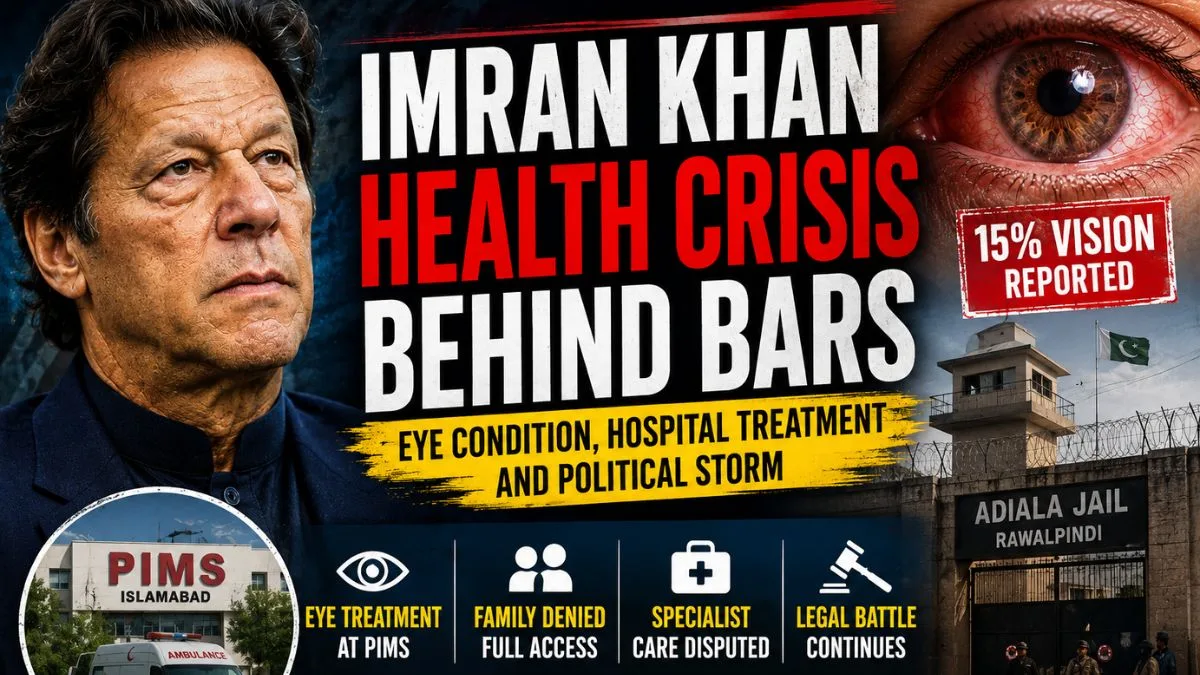
Khan has remained in custody since August 2023 and is being held at Adiala Jail in Rawalpindi. His imprisonment, multiple legal cases and continuing restrictions on access to family members, lawyers and personal doctors have kept his detention at the centre of Pakistan’s political debate.
The latest dispute centres on a serious condition affecting his right eye and disagreements over the transparency of his medical treatment.
Imran Khan’s Right Eye Condition
Concerns about Khan’s health intensified in early 2026 after doctors diagnosed him with Right Central Retinal Vein Occlusion (CRVO).
CRVO occurs when the main vein draining blood from the retina becomes blocked. The condition can cause swelling and bleeding in the retina and may lead to serious vision problems.
A report submitted to Pakistan’s Supreme Court stated that Khan had reported severe loss of vision in his right eye, with his vision said to be around 15 per cent at one stage.
The issue quickly became a legal matter after Khan’s lawyers raised concerns about his access to specialist treatment and personal doctors.
Khan Taken to Hospital for Eye Treatment
Khan was taken from Adiala Jail to the Pakistan Institute of Medical Sciences (PIMS) in Islamabad for treatment and follow-up care.
He received intravitreal anti-VEGF injections, a treatment used for certain retinal conditions to reduce abnormal blood-vessel leakage and swelling.
The treatment was carried out by specialist ophthalmologists, including doctors associated with PIMS and Al-Shifa Trust Eye Hospital.
A later medical assessment by PIMS reported that Khan’s eyesight had “improved remarkably” following his second anti-VEGF injection. Doctors also carried out detailed examinations, including optical coherence tomography, to assess the condition of his retina.
However, the improvement reported by government-linked medical authorities did not end the dispute.
PTI Questions Transparency of Medical Reports
PTI leaders and members of Khan’s family have repeatedly questioned whether his medical treatment is being handled transparently.
The party has raised concerns about restrictions on access to Khan’s personal physicians and family members. His personal doctor has also said that he could not independently verify reports about improvements in Khan’s eyesight because he had not been allowed to examine him personally.
PTI has therefore continued to demand greater access for Khan’s family and doctors, as well as independent medical assessments.
The party argues that an independent medical team would provide greater confidence about Khan’s actual condition and ensure that any further treatment is based on a complete assessment.
Government Says Khan Is Receiving Medical Care
The Pakistani authorities have rejected claims that Khan is being denied necessary medical treatment.
Jail officials have maintained that his health is being monitored and that medical facilities are available to him inside the prison.
Authorities have also reported regular checks of his vital signs and specialist examinations when required.
The government’s position is that Khan’s detention is connected to judicial proceedings and that his medical needs are being addressed according to established procedures.
This has created a sharp disagreement between the government and PTI over whether Khan’s treatment should be managed primarily through prison medical facilities or through independent doctors and hospitals chosen by his family and legal team.
Pakistan Supreme Court Steps In
Khan’s medical condition has also reached Pakistan’s Supreme Court.
In February, the court ordered authorities to arrange a medical examination after concerns were raised about the deterioration of his eyesight. The court also directed that Khan be allowed to speak with his sons.
The court’s intervention highlighted the seriousness of the dispute surrounding Khan’s prison conditions and access to medical care.
The legal battle has continued beyond the initial eye examination. Khan’s legal team has sought greater access to personal physicians, family members and specialist medical facilities.
In August 2026, the Supreme Court accepted a chamber appeal concerning Khan’s request to be shifted to Shifa International Hospital in Islamabad, along with requests for access to his personal physicians and family.
PTI Demands Hospital Transfer and Greater Access
The dispute has not been limited to Khan’s eyesight.
PTI has also raised broader concerns about his living conditions inside Adiala Jail.
In June, the party demanded that Khan be moved to a hospital, allowed regular meetings with family members and given greater access to lawyers and political associates. PTI also called for regular telephone contact with his sons.
The party has described restrictions on Khan’s access as part of a wider pattern of isolation.
Government authorities, however, have rejected the suggestion that Khan is being deliberately isolated for political reasons.
Health Becomes Part of Pakistan’s Political Struggle
Khan’s medical condition has become closely linked to the wider political conflict between PTI and Pakistan’s ruling authorities.
Since his imprisonment, PTI has repeatedly used questions surrounding his detention, legal cases and prison conditions to mobilise supporters.
The health dispute has added another major issue to that political confrontation.
For Khan’s supporters, access to proper medical treatment is a basic right and should not depend on political circumstances.
For the government, however, Khan remains a prisoner facing multiple legal proceedings, and his treatment must operate within the rules governing his detention.
This difference in position has made his medical care a politically sensitive issue.
Why the Eye Condition Is Significant
CRVO can seriously affect eyesight and requires specialist monitoring.
Khan’s reported loss of vision therefore created genuine concern, particularly because he is in his seventies and remains in prison.
At the same time, the later PIMS assessment that his eyesight had improved following treatment provides a different picture from the earlier reports of severe vision loss.
The conflicting claims have made independent verification particularly important.
PTI has questioned examinations conducted without the presence of Khan’s personal doctors, while authorities have relied on assessments carried out by specialist medical boards.
Legal and Political Pressure Continues
The Supreme Court and other Pakistani courts continue to deal with petitions concerning Khan’s medical treatment, prison access and meetings with lawyers and family members.
In June, the Supreme Court issued notices to senior Punjab officials and the Adiala Jail superintendent in a case concerning meetings between Khan and his lawyers.
These proceedings demonstrate that the dispute over Khan’s detention extends beyond his health.
Questions about legal access, family meetings, medical treatment and prison conditions have become part of a much larger political and constitutional debate.
What Happens Next?
The immediate focus is likely to remain on Khan’s medical condition and whether he will receive access to independent specialists and his personal physicians.
His lawyers are also seeking greater access to family members and medical information.
For the government, the challenge will be to demonstrate that Khan is receiving appropriate care while complying with court orders concerning his legal and medical rights.
For PTI, the issue provides another basis for demanding greater transparency and challenging the conditions surrounding Khan’s imprisonment.
Conclusion
Imran Khan’s health has become one of the most sensitive issues surrounding his continued detention at Adiala Jail.
His diagnosis of Central Retinal Vein Occlusion, reports of severe vision loss and subsequent claims of significant improvement after treatment have produced conflicting narratives from authorities, PTI and Khan’s personal medical team.
While doctors at PIMS have reported encouraging progress, PTI continues to demand independent medical oversight and greater access for Khan’s family and personal physicians.
The Supreme Court’s involvement means the dispute is no longer simply a political argument. It has become an important legal issue involving medical access, prison conditions and the rights of a former prime minister.
As Khan remains behind bars, his health is likely to remain a major point of political tension in Pakistan, with further court decisions potentially shaping what medical treatment and access he receives in the months ahead.