Maqam-e-Wudu: How Ablution Can Become a Symbol of Spiritual Greatness
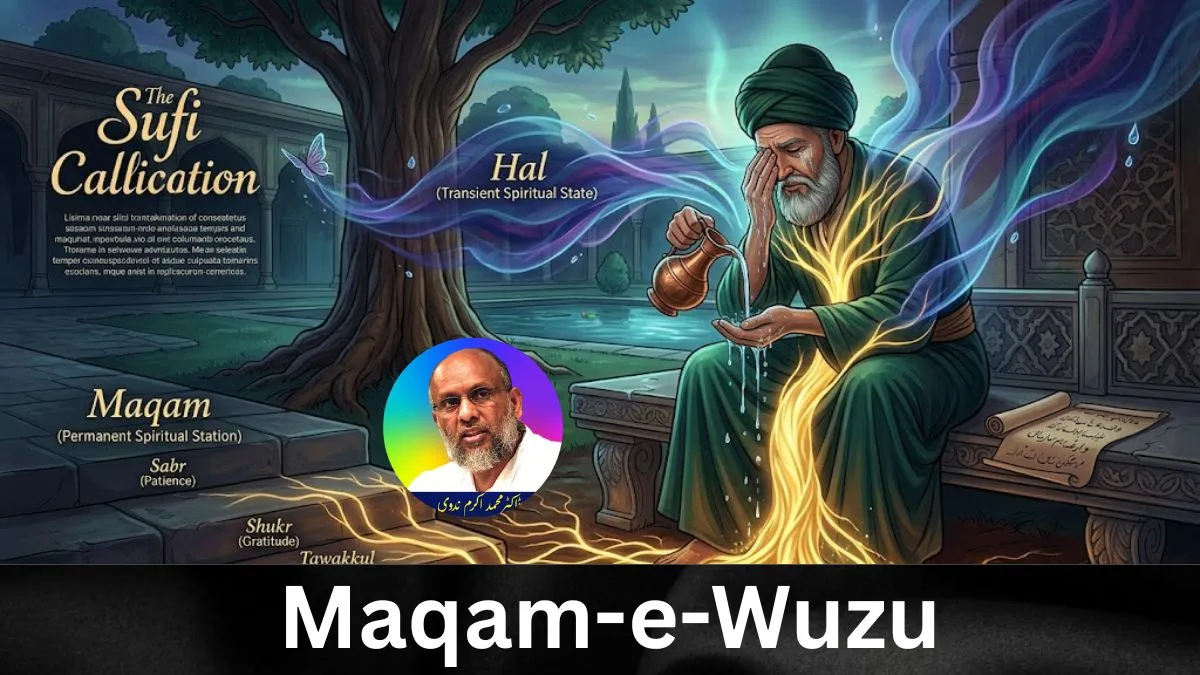
In the world of Sufism, “Hal” (transient spiritual state) and “Maqam” (permanent spiritual station) are two fundamental terms, and the entire edifice of mystical conduct and spiritual training is, to some degree, tied to these two concepts. For the Sufis, neither can the concept of spiritual conduct be complete without Hal, nor can the spiritual journey find its meaning without Maqamat (stations). A Sufi is not one upon whom no spiritual state ever descends, nor is he a seeker who halts at one station and does not travel to the next. One who is unfamiliar with these basic discussions of Sufism often fails to distinguish between Hal and Maqam, even though there is a profound and significant difference between the two. Click Here To Follow Our WhatsApp Channel

Hal is a condition that descends upon the seeker’s heart involuntarily and as a divine gift, whereas Maqam is a spiritual milestone that the seeker attains through struggle (mujahada), austerity (riyadat), meditation (muraqaba), purification (tazkiya), and continuous training. Hal can be temporary; it comes and it passes away. But Maqam creates a relatively enduring quality within a person’s character. For this reason, according to the people of spiritual wayfaring, the ultimate goal is not merely states (ahwal), but stations (maqamat). One may derive pleasure from the condition of Hal; tenderness may descend upon the heart, tears may flow from the eyes, and a state of ecstasy (wajd) may overwhelm the soul. But if these states do not produce any lasting change in a person’s morals, actions, and inner self, then their significance is nothing more than a passing event.
It is for this reason that in Sufi gatherings, sama (spiritual audition) was sometimes arranged, or means were adopted—such as the contemplation of beauty and loveliness—to induce a state that would descend upon the heart. The uninitiated often mistake this state for the ultimate destination and consider it the final sign of spiritual progress. But the people of the heart know that if such states become the primary objective, they can become a snare for the novice seeker. Trapped in this snare, the seeker starts chasing after the state, while the spiritual masters direct him towards struggle, purification, and the acquisition of stations. True perfection is not that an extraordinary state overcomes a person, but rather that patience (sabr) is born within him, gratitude (shukr) becomes firmly rooted, the fear of God takes abode in his heart, piety (taqwa) becomes the motto of his life, scrupulousness (wara’) becomes part of his nature, trust in God (tawakkul) grows strong, conviction (yaqin) deepens, and the quality of submission and contentment (taslim wa ridha) permeates his being.
These are the true stations that the early spiritual masters deemed the real milestones of spiritual wayfaring. Stations like patience, gratitude, fear, piety, scrupulousness, trust, conviction, and submission and contentment transform a person’s inner self, refine his character, and bring him closer to the knowledge of Allah and true servitude. In contrast, in later times, discourse on the true meaning of stations diminished, while talk increased of terms that dazzle the masses—such as unveiling (kashf), miracles (karamat), sainthood as the cosmic pole (qutbiyyat), succor (ghawthiyyat), eternal sustenance (qayyumiyyat), and absolute independence (samadiyyat). These terms gained such importance in certain circles that the original spirit of the stations of wayfaring receded into the background. Strangely enough, the great spiritual masters who played a historic role in the spiritual training of this Ummah never claimed for themselves to be the Qutb (Pole), Qayyum, or Samad. Whether it is Junayd al-Baghdadi, Shibli, Dhul-Nun al-Misri, Imam Ghazali, Shaykh Abdul Qadir al-Jilani, Khwaja Moinuddin Chishti, Khwaja Bahauddin Naqshband, or Shaykh Shihabuddin Suhrawardi—the greatness of these luminaries was not in such claims, but rather in their piety, sincerity, servitude, knowledge, struggle, and reformation of souls.

This discussion is actually a prelude to a vast topic concerning stations and states, but at this moment, my focus is on the “Station of Ablution” (Maqam-e-Wudu).
It is a strange and extremely subtle experience for me that whenever I envision any great, righteous, or spiritually advanced elder of this Ummah, I see them appearing on the canvas of my mind in the act of performing Wudu. It feels as though there is a fixed image of greatness in my vision, and the features of that image are formed by the water of ablution. I see Najmuddin Kubra performing Wudu; I see Khwaja Bahauddin Naqshband performing Wudu; the personality of Shah Wasiullah Fatehpuri is also associated in my mind with this same state of Wudu. Maulana Syed Abul Hasan Ali Nadwi, Maulana Muhammad Ahmad Partabgarhi, and Maulana Syed Muhammad Rabey Hasani Nadwi—whenever they appear through the windows of my memory, I am shown alongside them a radiant, pure, and silent image of Wudu.
I have pondered over this matter greatly. This is not something that emerged today; this feeling has existed within me for years. But until now, I have not been able to fully unlock the secret of why this is so. Why is greatness and Wudu becoming synonymous in my sight? Why, when a concrete image of righteousness and piety appears before me, is it always engaged in Wudu? Is Wudu merely the name for washing certain body parts before prayer, or is there hidden within it a purification of the soul that the people of the heart manifest through their character?
Perhaps my mind has not seen Wudu in the lives of the greats as merely a habit, but has perceived it as a symbol of their inner selves. Wudu was certainly a preparation for prayer for them, but maybe, even more than that, it was a metaphor for their entire lives. Washing the face, washing the hands, wiping the head, and washing the feet are apparently a few brief actions, but within them lies an entire philosophy of the purification of a person’s outer and inner selves. The face, which is a person’s identity before the world; the hands, which represent action and earning; the head, which is the center of thought and will; and the feet, which are symbols of a person’s journey and direction—Wudu, in essence, reminds a person that my outer life should be pure, and so should my inner direction.
I feel that for the saints, Wudu was far more than just a prelude to prayer; it was a part of the order of their lives. When they performed Wudu, it was as if they were preparing themselves to stand once again in the presence of Allah. The water touched their limbs, but its effect fell upon their hearts. For them, Wudu was perhaps a renewal of the realization that the servant is every moment before his Lord, and that he must keep not only his outer self, but also his inner self, pure.
That is why when I envision Najmuddin Kubra, I see his greatness not veiled in some unveiling or miracle, but reflected in the water of his Wudu. When I think of Khwaja Bahauddin Naqshband, his greatness does not appear to me in the form of a claim to cosmic poleship or eternal sustenance, but in the form of a servant of God who is silently performing Wudu. I feel the same quality when I think of those great figures of my era whom I have seen or had the opportunity to be close to. Maulana Syed Abul Hasan Ali Nadwi, Maulana Muhammad Ahmad Partabgarhi, and Maulana Syed Muhammad Rabey Hasani Nadwi also appear in my mind adorned with this same symbol of Wudu.
Perhaps the reason is that true greatness does not contain noise. In it, claims are few and servitude is abundant; display is less and sincerity is more; steadfastness exceeds miracles, and piety surpasses mystical unveilings. Wudu is the most beautiful symbol of this silent greatness. In it, a person says nothing, yet conveys so much. He takes the water, washes his limbs, silently turns his attention to his Lord, and in a few moments, emerges from the clamor of the world and enters the atmosphere of servitude.
Perhaps that is why the concept of “Maqam-e-Wudu” was born in my mind. By Maqam-e-Wudu, I do not mean that Wudu itself is a distinct Sufi station, but rather that in my mind, Wudu has taken on a symbolic form of the Station of Servitude, the Station of Purity, the Station of Piety, and the Station of Sincerity. For me, Wudu is a silent language in which greatness speaks; it is a mirror in which piety sees its own face; and it is a door through which the servant passes to prepare himself to enter the court of his Lord.
I sometimes think that perhaps I love Wudu because it contains within it a brief map of a person’s entire spiritual life. Water flows, impurity is removed, limbs become clean, and the person enters a new state. But the true perfection is when this external Wudu transforms into an internal Wudu: the eyes perform Wudu from the forbidden, the tongue performs Wudu from backbiting and falsehood, the hands perform Wudu from oppression and betrayal, the heart performs Wudu from malice and envy, and the feet perform Wudu from the paths of falsehood. When this quality is attained, Wudu is no longer merely a jurisprudential act, but becomes a station of life.
Then it is understood that greatness is perhaps not the name of acquiring extraordinary things, but rather the name of performing ordinary actions with extraordinary sincerity. Perhaps the Wudu of a saint touches the heart because behind it lie years of struggle, worship, fear of God, piety, trust, and contentment. The water is the same, the limbs are the same, but the heart of the one performing Wudu has changed; therefore, Wudu itself takes on a different meaning.
Perhaps this is the station where “Maqam” ascends above “Hal.” If tears come to the eyes during Wudu, tenderness descends upon the heart, or some special state arises, this is Hal. But when purity becomes a person’s nature, piety his habit, sincerity his soul, and the presence of Allah becomes a constant consciousness in his life, then this is Maqam.
That is why, now, when I remember a saint, I do not feel the need to recall their miracles. I only remember this much: that they are performing Wudu. Perhaps because in Wudu, I see the summary of their entire lives: purity, humility, servitude, preparation, and the consciousness of standing before Allah.
And perhaps the answer to my own question—why I love performing Wudu so much—is also hidden within this. I myself do not fully know. But I certainly feel that when drops of water fall on the face, something also descends upon the heart; when the hands are washed, a person begins to think about his actions; when the head is wiped, the scattered thoughts are somewhat gathered; and when the feet are washed, a person reflects upon his journey and his direction.
Perhaps that is why, for me, Wudu is not just Wudu. It is a silent image of greatness, a voiceless exegesis of piety, and a station of servitude where a person washes his limbs with water and returns to his Lord with his heart.
If, in Sufi terminology, “Maqam” is the destination attained through struggle, then in my personal lexicon, “Maqam-e-Wudu” is perhaps the name of that state where the servant makes both his outer and inner selves capable of standing before his Lord. And perhaps this is why the brightest image of the saints in my mind is not one in which they are performing some extraordinary miracle, but one in which they are silently performing Wudu—water is flowing, the world is silent, and a servant is purifying himself to journey towards his Lord.