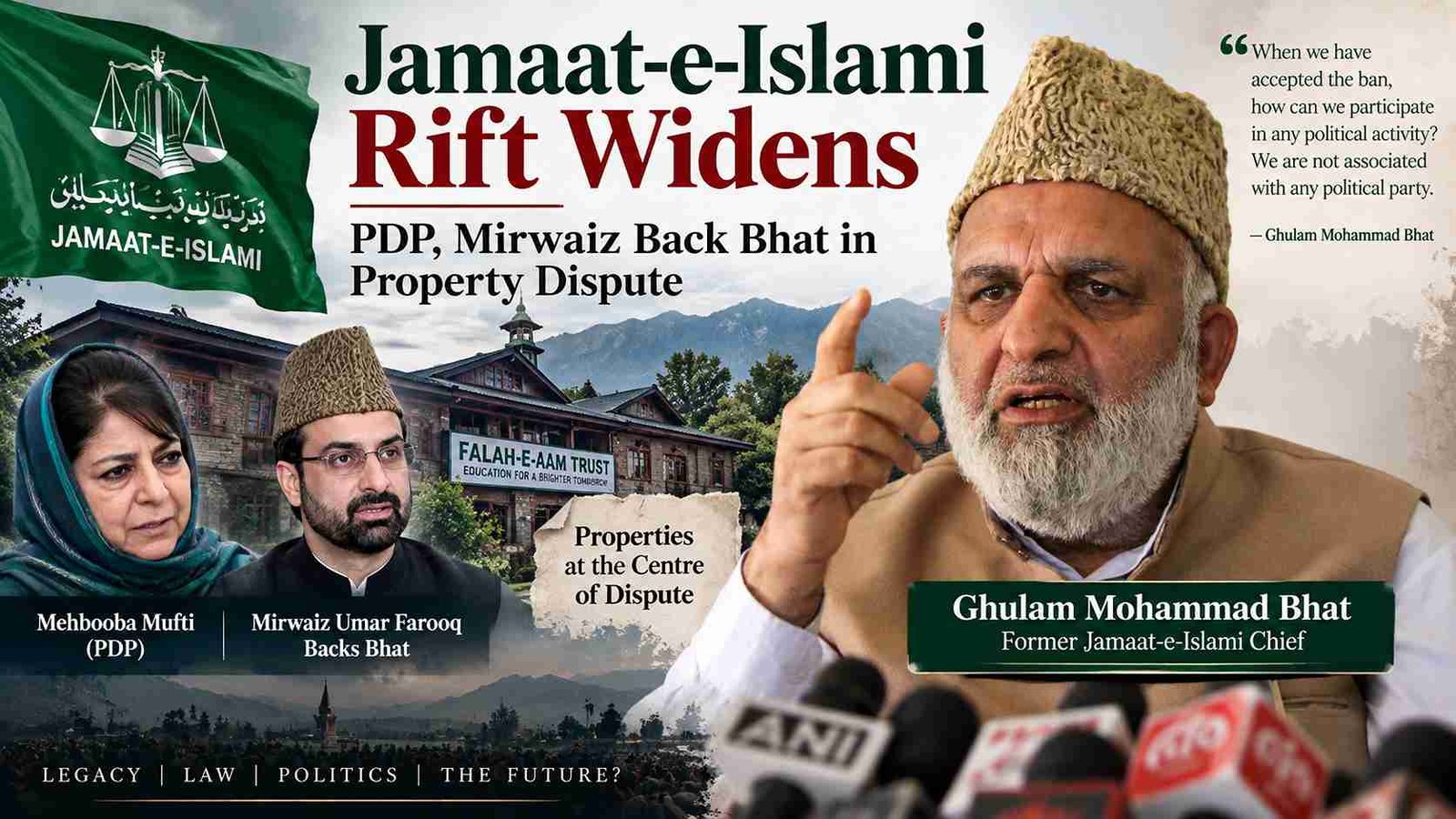
A growing dispute within the banned Jamaat-e-Islami has now spilled into the public domain, with the Peoples Democratic Party (PDP) and Kashmir’s chief cleric, Mirwaiz Umar Farooq, backing former Jamaat chief Ghulam Mohammad Bhat in his differences with the Justice and Development Front (JDF).
The dispute centres on who has the right to represent the Jamaat and carry forward its legacy, as well as control over properties and institutions linked to the organisation. Click Here To Follow Our WhatsApp Channel
What was previously largely an internal disagreement has increasingly moved into the public arena, with statements and accusations being exchanged on social media and drawing political and religious figures into the controversy.
Ghulam Mohammad Bhat distances Jamaat from JDF
Bhat, who served three terms as Jamaat chief, has again distanced the banned organisation from the JDF and accused the group of occupying Jamaat properties.
Many of these properties have been attached by the government under the Unlawful Activities (Prevention) Act (UAPA).
In a video statement, Bhat said the Jamaat had accepted the government’s ban while retaining its right to challenge the decision in court.
“When we have accepted the ban, how can we participate in any political activity?” Bhat asked.
“We are not associated with any political party,” he said.
Bhat, who was also the founding chairman of the Falah-e-Aam Trust, a Jamaat-linked educational organisation, also accused the JDF of taking control of its office in Srinagar.
He said the Trust had always been kept separate from the Jamaat’s political and social activities during his tenure.
“When I was the chairman of the Trust or as Jamaat chief, I always de-linked Falah-e-Aam Trust from any political or social activity of Jamaat. It was purely for education,” Bhat said.
He questioned why the JDF had allegedly turned the institution into a political centre, adding that he believed the Trust had a right to defend its position.
Mehbooba Mufti calls for due process
Former Jammu and Kashmir Chief Minister and PDP president Mehbooba Mufti backed Bhat’s position, saying the government was bound to follow the law.
She said that since the Jamaat leadership had publicly stated that it would respect the judicial process and challenge the ban through legal channels, the government should also act in accordance with the law.
Mufti said no coercive or irreversible action should be taken against attached properties while the matter remained before the courts.
“The rule of law requires equal treatment, procedural fairness, and respect for judicial authority. It cannot be applied selectively or at the discretion of those in power,” she said.
Her intervention drew a strong response from the JDF.
JDF rejects PDP’s intervention
JDF president Shameem Ahmad Thoker accused the PDP of having a vested interest in the dispute and rejected what he described as political interference in Jamaat affairs.
“The Jamaat leadership is neither PDP’s making nor its choosing,” Thoker said.
He said Jamaat’s current head Ghulam Qadir Wani, along with the government-recognised panel, had rejected the PDP’s intervention.
Thoker also said that nobody would be allowed to decide who represents the “real Jamaat”.
According to him, the Shura-backed Jamaat panel and the JDF-backed political voice would continue to advocate democratic participation and elections.
“The political landscape is changing. This time, the victim will decide its own fate, not the victor,” he said, referring to Jamaat sympathisers who had supported the PDP in previous Assembly elections, particularly in south Kashmir.
Mirwaiz backs Bhat’s position
Kashmir’s chief cleric, Mirwaiz Umar Farooq, also expressed support for Bhat’s position and described the statement by the Jamaat chief as concerning.
Mirwaiz said the government in New Delhi should listen to people’s concerns and reconsider its policy of banning social and political organisations in Jammu and Kashmir.
He also called for an end to what he described as harassment and intimidation linked to such restrictions.
Where bans and restrictions are challenged in court, Mirwaiz said, the legal process should be allowed to continue.
He further called for attached properties and institutions to be dealt with carefully and in accordance with the law and judicial procedures.
The property dispute had already reached the authorities, with the Jamaat writing to the Deputy Commissioner of Shopian over the issue. The organisation questioned how the rival group had been allowed to put up its signboard on properties seized by the government.
JDF challenges Bhat’s claims
The JDF has rejected Bhat’s allegations.
At a press conference, former Jamaat deputy chief Ahmadullah Parray said Bhat had also spoken last year about challenging the ban through legal means but had not taken the matter forward.
Parray questioned Bhat’s authority to repeatedly comment on the JDF’s activities.
“To raise this issue again on social media, to raise fingers at the Constitutional proceedings and create doubts is a moment of reflection for us and all the government institutions,” Parray said.
He also questioned the capacity in which Bhat was speaking against the JDF’s activities and said his statements were creating confusion among Jamaat sympathisers.
Parray claimed that the panel which eventually developed into the JDF had been formed with the approval of former members of the Jamaat’s executive council.
He also denied that the JDF had taken over the Falah-e-Aam Trust office in Srinagar.
According to Parray, the JDF had only rented a few rooms next to the main building under an agreement.
JDF yet to win broad Jamaat support
Despite presenting itself as the political voice of Jamaat-e-Islami, the JDF has not received widespread backing from the organisation’s senior leadership.
Several prominent Jamaat leaders have either remained silent over the dispute or publicly distanced themselves from the JDF.
They include former Jamaat chiefs Ghulam Mohammad Bhat and Mohammad Abdullah Wani, while another former chief, Sheikh Ghulam Hassan, recently passed away.
Only a limited number of senior Jamaat figures, including current head Ghulam Qadir Wani, Ghulam Qadir Lone and Ahmadullah Parray, are seen as supporting the JDF.
The dispute has therefore raised a broader question over who can legitimately speak for Jamaat-e-Islami and represent its political and organisational legacy.
For now, the disagreement appears far from settled, with questions over leadership, political participation and control of Jamaat-linked properties continuing to deepen the divide.
You Might Also Like:
Education In Kashmir with Complete Statistics
TCS Nashik ‘Conversion’ Scandal: Accused Nida Khan Suspended as Sexual Harassment and Coercion Probe Intensifies