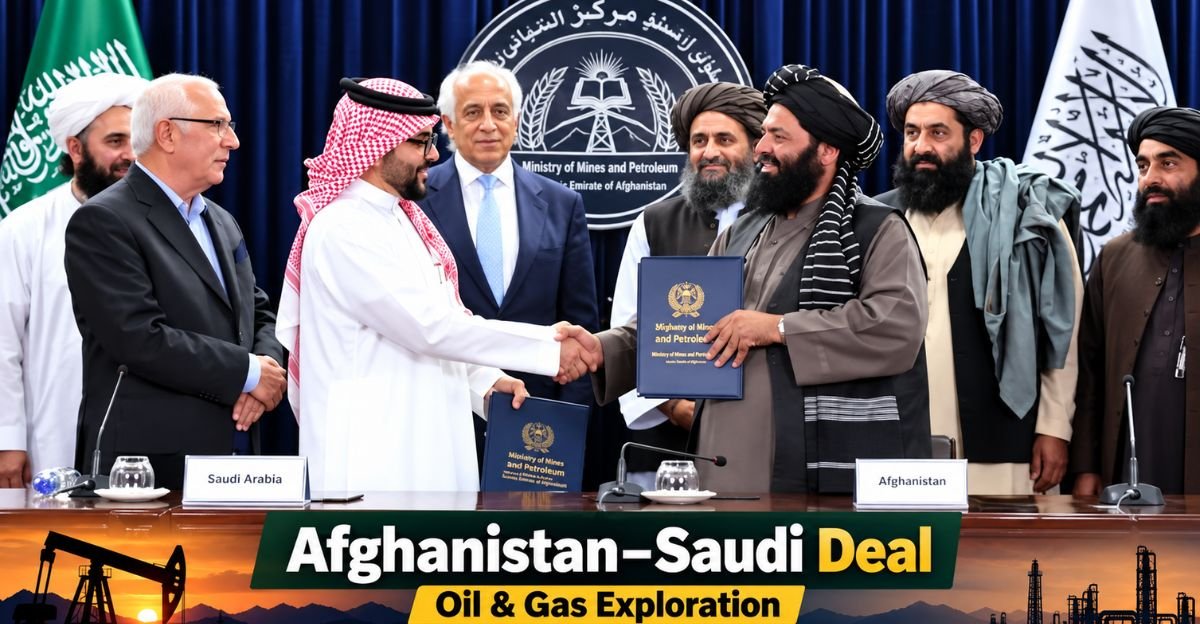
The Taliban government in Afghanistan has signed an agreement with Saudi company Delta International for the exploration and extraction of oil and gas in the country.
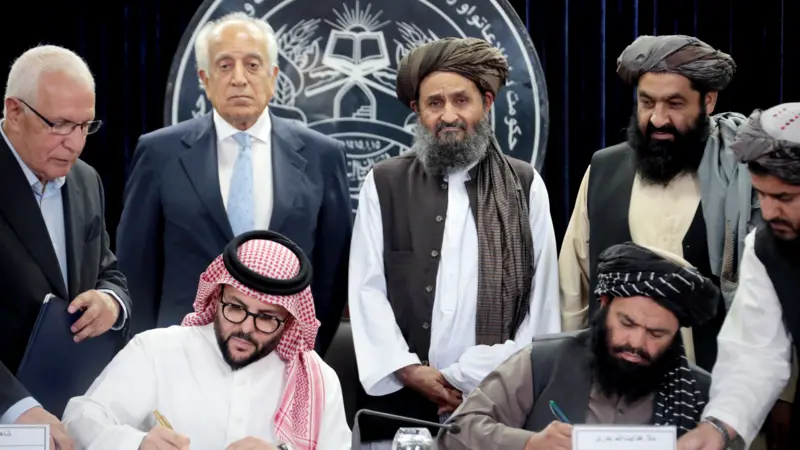
The agreement was signed in Kabul on Monday by Taliban Minister of Mines and Petroleum Hidayatullah Badri and Delta International Chief Executive Shaher Al-Taqi. Click Here To Follow Our WhatsApp Channel
Taliban Deputy Prime Minister Mullah Abdul Ghani Baradar and former US Special Representative for Afghanistan Zalmay Khalilzad were among those present at the signing ceremony.
Under the agreement, Delta International will explore and extract oil and gas in the Kushk-Tirpul region, which covers around 22,000 square kilometres across Herat and Badghis provinces.
According to Afghanistan’s Ministry of Mines and Petroleum, a significant part of the reserves in the region consists of natural gas.
The Saudi company plans to invest $200 million in the first phase of the project, which will involve the exploration and extraction of seven gas blocks. The exploration period has been set at eight years, while the overall contract will run for 25 years.
Afghan authorities hope the project will help meet the country’s demand for petroleum products while creating jobs for a large number of unemployed Afghans.
A statement shared on X by Afghanistan’s Deputy Prime Minister for Economic Affairs said Da Afghanistan Bank Governor Noor Ahmad Agha and Taliban government spokesman Mullah Zabiullah Mujahid also attended the ceremony.
Khalilzad described the agreement as a sign of Afghanistan’s readiness to attract investment. He said the country had managed to attract significant investment in the development of its natural resources, particularly gas, as well as their transmission and export.
His presence at the signing has also drawn attention because of his previous involvement with the company. In November last year, Delta International CEO Shaher Al-Taqi, accompanied by Khalilzad, met Mullah Abdul Ghani Baradar in Kabul to discuss oil and gas exploration, extraction and the development of transmission pipelines.
Khalilzad, an Afghan-born American diplomat and foreign policy expert, previously served as the US Special Representative for Afghanistan Reconciliation. He has also travelled to Afghanistan as part of US efforts involving American citizens held by the Taliban.
However, his exact role in the negotiations between Delta International and the Taliban government has not been officially explained.
The agreement has attracted considerable discussion on social media, with some observers describing it as an important development for Afghanistan’s economy and regional connectivity.
Afghan journalist Sami Yousafzai said the agreement was “much bigger than it appears”. He pointed to Saudi Arabia’s growing engagement with both Pakistan and Afghanistan, although through different channels.
Yousafzai noted that Saudi Arabia had generally kept its distance from the Taliban after 2001 while maintaining close strategic relations with Pakistan. He suggested that Riyadh’s renewed economic engagement with Kabul could become particularly significant amid current tensions between Afghanistan and Pakistan.
He also raised the possibility that greater Saudi economic and political engagement with the Taliban may not be welcomed in Pakistan.
Pakistan’s former ambassador to Afghanistan, Mansoor Ahmad Khan, described the agreement as an important development. He said stronger economic ties could contribute to long-term peace and stability in Afghanistan and the wider region.
Analyst Abdullah Khan, meanwhile, suggested that Khalilzad’s presence at the signing could indicate some level of American support for the agreement. However, this remains an assessment and has not been officially confirmed.
Analyst Zaigham Khan compared the $200 million investment with Afghanistan’s existing mineral exports, particularly coal.
He noted that Afghanistan exported around $476 million worth of coal in 2022, with almost all of it going to Pakistan. He argued that the initial Saudi investment, although significant, is relatively modest compared with the value of Afghanistan’s coal exports.
Zaigham Khan also pointed out that while Afghanistan is believed to possess large reserves of copper, lithium and iron, coal and talc are among the minerals that can currently be extracted more easily.
He added that Pakistan remains the main market for Afghan coal and that a decline in Pakistani demand has previously led to a sharp fall in Afghanistan’s coal exports.
Khalilzad’s Presence at Taliban-Saudi Oil Deal Raises Questions Over Possible US Backing
The signing of a major oil and gas agreement between Afghanistan’s Taliban government and a Saudi company has raised questions over whether the deal may have received indirect support from the United States, after former US special envoy Zalmay Khalilzad attended the ceremony in Kabul.
The agreement between the Taliban Ministry of Mines and Petroleum and Saudi Arabia’s Delta International was signed on Monday, September 7, for the exploration and extraction of oil and gas in the Kushk-Tirpul basin in western Afghanistan.
Taliban Minister of Mines and Petroleum Hedayatullah Badri and Delta International Chief Executive Shaher Al-Taqi signed the agreement in the presence of Taliban Deputy Prime Minister for Economic Affairs Mullah Abdul Ghani Baradar and other senior officials. Khalilzad was also present at the ceremony.
Under the initial agreement, Delta International is expected to invest $200 million in the exploration and extraction of seven gas blocks. The Kushk-Tirpul basin covers around 22,000 square kilometres across Herat and Badghis provinces. The exploration period has been set at eight years, while the contract is for 25 years.
Why Khalilzad’s presence matters
Khalilzad’s appearance at the signing ceremony is particularly significant because of his long involvement in US-Afghanistan diplomacy and his previous contacts with the Taliban.
He served as the US Special Representative for Afghanistan Reconciliation and played a central role in negotiations that led to the 2020 Doha agreement between Washington and the Taliban.
His involvement with the Delta International project also appears to predate Monday’s signing.
In October 2025, Khalilzad was present when Delta International CEO Shaher Al-Taqi met Mullah Abdul Ghani Baradar in Kabul. That meeting also focused on investment in Afghanistan’s oil and gas sector, including exploration, extraction and gas pipeline development.
The repeated presence of Khalilzad alongside Delta International representatives and Taliban officials has therefore fuelled speculation that he may have played a role in facilitating contacts between the Saudi company and the Taliban.
However, there is no public evidence confirming that the US government officially backed or approved the agreement.
Washington distances itself from Khalilzad
In fact, the US State Department has made clear that Khalilzad does not currently represent the American government.
Following his recent meetings with Taliban officials, a State Department spokesman said Khalilzad is not a US government employee and does not represent Washington. His activities, according to the department, are being carried out in a personal capacity.
This makes his presence at the signing ceremony more intriguing rather than providing direct proof of official US involvement.
Khalilzad himself, however, spoke positively about the agreement. Afghanistan’s Ministry of Mines and Petroleum quoted him as describing the deal as an indication that Afghanistan is ready to attract foreign investment. He also praised the Taliban negotiating team’s technical and legal work.
Saudi investment and a changing regional picture
The deal also comes at a time when Afghanistan is seeking greater foreign investment in its natural resources.
The Taliban authorities say the project could help Afghanistan develop its domestic energy sector, create employment and attract further international investment.
The agreement is also notable because Saudi Arabia has maintained relations with Afghanistan but has not formally recognised the Taliban government. The involvement of a Saudi company in such a major natural-resource project could therefore mark a further expansion of economic engagement.
Some reports have also highlighted a potentially much larger investment package connected to the project, including possible gas infrastructure and pipeline development. However, those larger figures remain dependent on successful exploration and technical studies, while the officially announced initial investment is $200 million.
A possible bridge between Kabul and international investors?
For the Taliban, the agreement represents more than an energy project. It is also an opportunity to demonstrate that foreign companies are willing to do business in Afghanistan despite the country’s political isolation.
For Khalilzad, his continued presence in meetings involving the Taliban and international business interests suggests that he may still be playing an informal role in encouraging engagement with Kabul.
But whether that role amounts to American support for the Saudi-Taliban agreement remains unclear.
What is clear is that Khalilzad’s presence at both the earlier talks and the final signing has added a US connection to a deal that otherwise involves the Taliban government and a Saudi company. His involvement is likely to fuel further debate over whether Washington is quietly encouraging economic engagement with Kabul, even while officially maintaining that Khalilzad does not speak for the US government.
You Might Also Like:
Education In Kashmir with Complete Statistics
TCS Nashik ‘Conversion’ Scandal: Accused Nida Khan Suspended as Sexual Harassment and Coercion Probe Intensifies