Sheikh Noor-ud-din Noorani: The Spiritual Soul of Kashmir and Founder of the Rishi Tradition
By: Alia Kashmiri
Sheikh Noor-ud-din Noorani, widely revered as Nund Rishi, Sheikh-ul-Alam and Alamdar-e-Kashmir, remains one of the most influential spiritual figures in the history of Kashmir.
Born around 1377 and passing away in 1438, he was a mystic, poet and Islamic preacher whose teachings left a lasting mark on the spiritual, cultural and literary life of the Kashmir Valley. Click Here To Follow Our WhatsApp Channel
Nund Rishi founded the indigenous Rishi tradition, blending Islamic spirituality with the region’s long-standing traditions of asceticism and contemplation. His message of compassion, simplicity, equality and peaceful coexistence continues to resonate with people across Kashmir.
Early Life and Spiritual Journey
Sheikh Noor-ud-din Noorani was born around 1377 in Khee Jogipora, in present-day Kulgam district. He was the son of Salar Sanz and Sadra, who had embraced Islam.
Much of his early life is surrounded by local traditions and stories. One of the best-known accounts connects him with Lalleshwari, or Lal Ded, the celebrated Kashmiri Shaivite mystic and poet. According to local tradition, the newborn Noor-ud-din refused to nurse until Lal Ded arrived and fed him. The story is often viewed as a powerful symbol of the shared spiritual heritage of Kashmir.
As a young man, Noor-ud-din worked with traders and married Zai Ded. He had children, but personal tragedies deeply affected him. Following the death of his young children, he gradually turned away from worldly life and devoted himself to spiritual practice.
At around the age of 30, he withdrew to a cave in Qaimoh, where he spent years in meditation and ascetic discipline. Local accounts describe him living a remarkably simple life, surviving on wild plants and eventually water.
After years of spiritual retreat, he returned to society with a clear mission: to share his understanding of faith, humanity and ethical living with ordinary people.
The Rise of the Rishi Tradition
Nund Rishi went on to establish the Rishi tradition, an indigenous spiritual movement that became deeply rooted in Kashmiri society.
His teachings placed great emphasis on humility, self-discipline, compassion and equality. He spoke strongly against greed, hypocrisy, social injustice and empty ritualism.
Although he was a devout Muslim and played an important role in the spread of Islamic spiritual thought in Kashmir, his approach was not based on confrontation. His simple lifestyle and inclusive message attracted people from different communities.
Over time, Nund Rishi became a symbol of Kashmir’s tradition of coexistence, with his teachings being respected by both Kashmiri Muslims and Hindus.
Nund Rishi and the Kashmiri Language
One of Sheikh Noor-ud-din’s greatest contributions was his use of Koshur, or the Kashmiri language, in his poetry and spiritual teachings.
At a time when Persian was becoming the dominant language of administration and the Muslim elite, while Sanskrit remained an important language among Hindu scholars, Nund Rishi chose the language spoken by ordinary people.
His famous Shrukhs were composed in simple Kashmiri and dealt with subjects that people could easily relate to, including farming, nature, family life, morality and spirituality.
This made his teachings accessible to farmers, artisans, labourers and others who did not have access to elite literary traditions.
Along with Lal Ded’s Vakhs, Nund Rishi’s Shrukhs are regarded as an important foundation of classical Kashmiri literature.
Poetry That Reached Ordinary People
Nund Rishi’s poetry was direct, powerful and rooted in everyday life. Rather than using complicated philosophical language, he used familiar images and experiences to communicate deeper spiritual ideas.
His verses were short, memorable and easy to pass from one generation to another through oral tradition. As a result, many of his expressions became part of Kashmiri speech, idioms and popular wisdom.
His decision to write in Kashmiri also gave the language a stronger literary and spiritual identity at a time when languages associated with administration, scholarship and political power dominated public life.
His Message on Protecting Nature
Long before environmental protection became a modern global concern, Nund Rishi spoke about the importance of forests and nature.
One of his most famous lines says:
“Ann poshi teli yeli wan poshi.”
It is commonly translated as:
“Food will last as long as the forests last.”
The verse connects human survival with the health of the natural environment. For Nund Rishi, protecting forests was not simply an economic or practical concern; it was also part of responsible and ethical living.
His teachings and traditions surrounding tree planting and respect for nature have therefore contributed to his reputation as an early voice for environmental responsibility.
Three Teachings That Still Resonate
1. The importance of forests
“Ann poshi teli yeli wan poshi.”
The verse expresses a simple but powerful idea: human food and survival depend on healthy forests and a balanced natural environment.
Centuries later, the message remains remarkably relevant as communities around the world face deforestation, environmental degradation and climate challenges.
2. Universal brotherhood
Another widely cited teaching associated with Nund Rishi expresses the idea that Hindus and Muslims share the same human origin and should not allow religious differences to divide them.
The message reflects the broader ideal of Kashmiriyat — a cultural tradition associated with coexistence, mutual respect and shared belonging.
Rather than focusing on outward differences, Nund Rishi urged people to recognise their common humanity and devotion to God.
3. Do not delay spiritual responsibility
Another memorable verse uses the familiar image of preparing food:
“I performed no devotion to Him in my younger days;
Now, at the moment of boiling, I have remembered to obtain salt.”
The metaphor carries a simple warning. Just as remembering salt only after a pot has begun boiling is too late, postponing spiritual and moral responsibility can leave a person with little time to make amends.
The verse encourages people to reflect on their lives before old age or difficult circumstances force them to do so.
A Lasting Contribution to Kashmiri Identity
Nund Rishi’s influence extended far beyond religion. His poetry helped establish Kashmiri as a language capable of expressing profound spiritual, philosophical and ethical ideas.
By addressing ordinary people in their mother tongue, he brought religious and philosophical thought outside the circles of scholars and rulers.
His verses reflected the daily life of Kashmir — its fields, forests, villages, seasons and people. Because they were easy to remember and pass on orally, they survived for centuries despite periods when Kashmiri had little official support in education or administration.
His work therefore became an important part of the preservation of Kashmiri linguistic and cultural identity.
Charar-e-Sharief and His Enduring Legacy
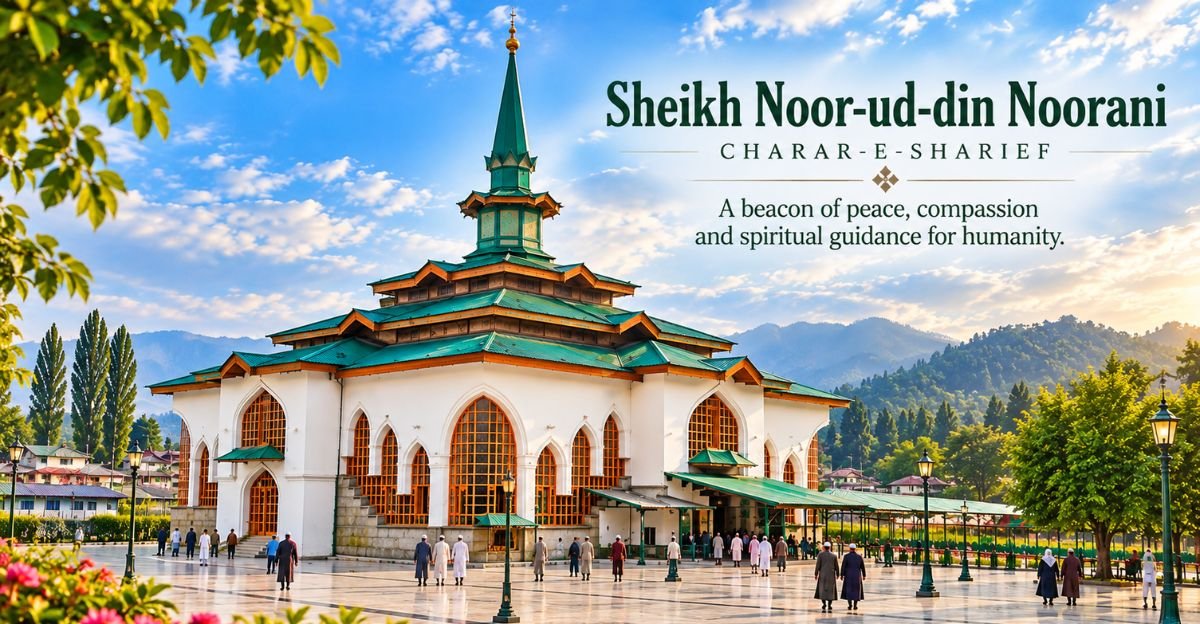
Sheikh Noor-ud-din Noorani died in 1438. He was laid to rest at Charar-e-Sharief in Budgam district, where his shrine remains one of Kashmir’s most important spiritual sites.
Thousands of devotees have visited the shrine over the generations, seeking blessings and reflecting on his teachings.
Nund Rishi’s legacy rests not only on his role as a spiritual leader but also on his contribution to Kashmiri literature, language, culture and social thought.
His emphasis on simplicity, compassion, equality, respect for nature and peaceful coexistence has allowed his message to remain relevant centuries after his death.
For many Kashmiris, Sheikh Noor-ud-din Noorani is more than a historical figure — he represents an enduring spiritual and cultural soul of Kashmir.
This version is deliberately human-sounding rather than overly polished or AI-like, while retaining the key historical details, searchable names and important Kashmiri terms.
You Might Also Like:
Al-Tilmeez: A Pioneering Arabic Literary Journal from Jammu and Kashmir
Dr. Muzaffar Hussain Nadvi An Esteemed Arabic and Islamic Scholar from Kashmir