Nepal Flood Death Toll Rises to 734, Nearly 2,500 Missing as Bhote Koshi Flow Triggers Fresh Alert
By: Sheikh Mohammad Isa
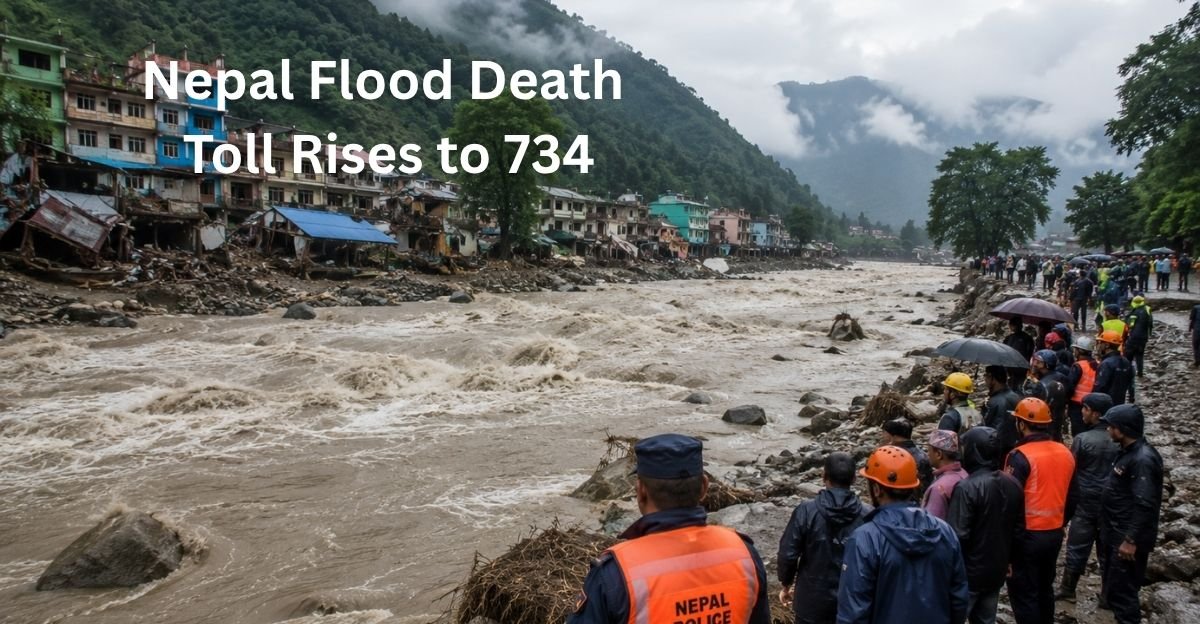
The death toll from the devastating Bhote Koshi River flood disaster in Nepal has risen to 734, while thousands of people remain missing as rescue and relief operations continue across the worst-hit areas.Click Here To Follow Our WhatsApp Channel
The catastrophe struck on August 26, when a massive flood surged through the Bhote Koshi River in Rasuwa district, devastating settlements and infrastructure along the river corridor. The disaster also affected Nuwakot, Dhading, Gorkha, Chitwan and other areas as floodwaters and debris travelled downstream. Nepal’s Ministry of Home Affairs said the disaster caused heavy loss of life and property and triggered immediate search, rescue and emergency relief operations.
According to the latest figures from the National Disaster Risk Reduction and Management Authority (NDRRMA), 734 people have died in Nepal. A 9 am update cited by local reports had put the number of people missing or out of contact at 2,419, although subsequent updates reported the figure at 2,498.
The scale of the disaster has made the rescue operation one of the most challenging in Nepal in recent years, with rescuers searching collapsed buildings, riverbanks, mud-covered settlements and tunnels at damaged hydropower projects.
Chitwan records highest number of recovered bodies
The NDRRMA’s district-wise figures show that Chitwan recorded the highest number of recovered bodies, with 259 bodies and human remains recovered.
It was followed by:
- Nawalparasi East: 184
- Nawalparasi West: 82
- Gorkha: 58
- Nuwakot: 52
- Dhading: 50
- Tanahun: 36
- Rasuwa: 13
The figures include human body parts recovered during the extensive search operations.
Many of the bodies remain unidentified. Authorities have kept unidentified remains at hospitals in 21 hospitals across different districts, while forensic teams are being brought in to help identify victims through DNA analysis.
Hundreds of foreign nationals remain missing
The disaster has also had a major impact on foreign nationals travelling or working in the affected region.
Of those reported missing or out of contact in the NDRRMA update, 589 were foreign nationals, while another 127 were Nepalis accompanying foreign tourists.
A particularly large number of people reported missing are connected to hydropower projects.
The NDRRMA said 933 people associated with hydropower projects were among those unaccounted for, including 562 in Rasuwa and 115 in Nuwakot.
The situation has made damaged hydropower tunnels one of the most urgent areas for rescue teams.
Nearly 20,000 security personnel deployed
Nepal has deployed a huge security force for the rescue, search and relief operation.
A total of 19,895 security personnel have been mobilised, including:
- 8,399 Nepal Army personnel
- 7,293 Nepal Police personnel
- 4,203 Armed Police Force personnel
The teams are working across multiple districts, searching for survivors and missing people while also delivering relief supplies and helping evacuate those stranded by the floods.
So far, 8,186 people have been rescued, according to the NDRRMA figures provided in the latest update.
The Nepal Army has rescued 2,974 people, Nepal Police 2,699 and the Armed Police Force 2,513.
279 people rescued from hydropower tunnel
One of the most difficult rescue operations has involved people trapped inside hydropower tunnels.
Authorities said 279 people, including 227 foreign nationals, were rescued by helicopter from a hydropower tunnel.
The operation highlights the scale of the destruction suffered by Nepal’s hydropower infrastructure.
Rescuers continue to face difficult terrain, unstable ground, thick mud and damaged access routes while attempting to reach other people believed to be trapped underground. Specialist tunnel rescue teams have been deployed as the search continues.
242 injured as medical teams deployed
The disaster has also left at least 242 people injured, including people who remain under treatment as well as those who have already been discharged from hospitals.
Surgical medical teams have been deployed to affected areas to provide emergency treatment to survivors.
The medical response has become increasingly important as rescue teams recover people from areas that were buried under mud and debris.
Fresh warning as Bhote Koshi river rises
Even as rescue operations continue, authorities have issued a fresh warning after a further increase in the Bhote Koshi River’s flow.
NDRRMA urged personnel involved in search, rescue and relief operations in Rasuwa, Nuwakot, Dhading, Chitwan and surrounding areas to exercise extreme caution.
The warning also applies to people living in riverside and other vulnerable areas.
The renewed alert has complicated an already difficult rescue operation, with teams being forced to balance the search for survivors against the risk of another sudden rise in water levels.
Nepal government releases emergency funds
The Nepal government has released emergency financial assistance for several affected areas.
According to the NDRRMA update, NPR 10 million each has been provided to Rasuwa and Nuwakot, while NPR 5 million has been allocated to Dhading.
A further NPR 67.5 million has been provided to 15 local municipalities to support immediate relief operations.
The government is simultaneously assessing the wider destruction and preparing for rehabilitation and reconstruction.
Nepal’s government has warned that the disaster will require a major reconstruction effort after homes, roads, bridges, hydropower facilities and other infrastructure were damaged or destroyed.
Food and relief supplies reach affected areas
Relief operations are continuing despite damaged roads and difficult terrain.
The government said 37 trucks carrying food and non-food relief materials had been dispatched to affected areas, while seven helicopter flights had been conducted to transport supplies.
Two tonnes of food and rescue materials were also airlifted to Uttargaya and Dhunche.
Communication equipment, including radios and communication sets, has been sent to affected locations to help restore links between rescue teams and communities.
Fuel stocks being monitored
Authorities are also closely monitoring fuel supplies because damaged roads and disrupted transport routes have made fuel distribution more difficult.
The NDRRMA said the Bhairabi, Suryamati and Panchakanya oil stores in Nuwakot had 36,000 litres of diesel and 24,000 litres of petrol in stock.
Aviation fuel stocks stood at 14,000 litres against consumption of around 25,000 litres.
Maintaining adequate fuel supplies is particularly important because helicopters are playing a major role in rescue operations and delivery of essential materials to isolated communities.
Nepal Home Minister visits Nuwakot
Nepal Home Minister Sudan Gurung visited flood-hit areas of Nuwakot on Sunday and gave instructions to rescue teams involved in the ongoing operation.
The visit came as authorities faced the twin challenge of continuing the search for missing people while responding to the fresh rise in the Bhote Koshi’s water flow.
Officials have warned that the situation remains dangerous and that rescue personnel must remain vigilant.
India sends fourth relief flight
India has stepped up its assistance to Nepal, sending its fourth relief flight to Kathmandu on Sunday.
The aircraft carried 11 tonnes of relief material, including blankets, sleeping bags, tarpaulins, plastic sheets and hygiene kits. It also brought specialised technical capabilities to support the rescue operation.
Indian External Affairs Minister S Jaishankar said the aircraft carried essential supplies and technical capabilities to support Nepal’s ongoing rescue and relief efforts.
The latest Indian assistance included a specialised tunnel rescue team equipped to assist in searches inside damaged hydropower tunnels.
India has also sent a team of forensic experts equipped for DNA analysis, which will help Nepal identify victims whose bodies cannot be identified through conventional means.
India has now sent 68.5 tonnes of relief material to Nepal through its relief flights, according to reports.
India also supports bridge reconstruction
India’s assistance extends beyond immediate relief.
Equipment for a 230-foot modular steel bridge has been sent to Nepal, while equipment for additional Bailey bridges is also being prepared to help restore transport links damaged by the floods.
The restoration of roads and bridges is crucial because several affected communities have been cut off after floodwaters destroyed or damaged transport infrastructure.
China also involved in rescue operations
The disaster has affected both sides of the Nepal-China border.
In Tibet’s Gyirong area, Chinese authorities have reported deaths and missing people following the same catastrophic event, while Chinese rescue teams have been deployed to affected areas. Reuters reported that China had confirmed 16 deaths and 546 missing people in Gyirong County.
Across Nepal and Tibet, the combined death toll has therefore risen above 750, with more than 3,000 people still missing according to the latest international reporting.
Disaster linked to glacier collapse and massive mudflow
The August 26 disaster began after a massive collapse in the Himalayan region triggered an enormous surge of water, rock, mud and debris into the Bhote Koshi River system.
The resulting flood swept through valleys at tremendous speed, destroying settlements and infrastructure along the river corridor.
Experts and international reporting have linked the disaster to a glacier or ice-related collapse and the region’s increasing vulnerability to extreme Himalayan hazards.
The disaster has also renewed concerns about the impact of climate change on Himalayan glaciers, unstable slopes and glacial hazards.
Search for missing people continues
For families waiting for news of relatives, the rescue operation remains a race against time.
Hundreds of people are believed to have been trapped in or around damaged hydropower facilities, while others may have been swept downstream or buried beneath enormous quantities of mud and debris.
Specialist teams are using heavy machinery, helicopters, drilling equipment and other technology to reach areas that remain inaccessible by conventional means.
The presence of foreign tourists and workers among those missing has also added an international dimension to the rescue effort.
Nepal remains on high alert
The Nepal government has pledged to maintain rescue and relief operations at full capacity until affected citizens are brought to safety and rehabilitation begins.
But the fresh rise in the Bhote Koshi’s flow demonstrates that the immediate danger has not completely passed.
With unstable terrain, damaged infrastructure, difficult weather and the possibility of further flooding, rescue teams continue to operate under extremely hazardous conditions.
For now, the priorities remain clear: find survivors, recover the missing, identify the dead, provide emergency assistance and restore access to communities cut off by the disaster.
As Nepal confronts the aftermath of one of its most devastating recent flood disasters, assistance from India, China and other international partners is becoming increasingly important for both the immediate rescue operation and the enormous reconstruction effort that lies ahead.
You Might Also Like:
Amarnath Yatra 2026 Concludes on Raksha Bandhan
J&K Weather: Hot and Humid Conditions Likely, Heavy Rain Forecast on August 31 and September 1
Aga Ruhullah Mehdi Says He Will Resign as Srinagar MP and Quit National Conference on November 3