Bukhari Urges Mirwaiz to Guide People as Kashmir Seeks United Political Response
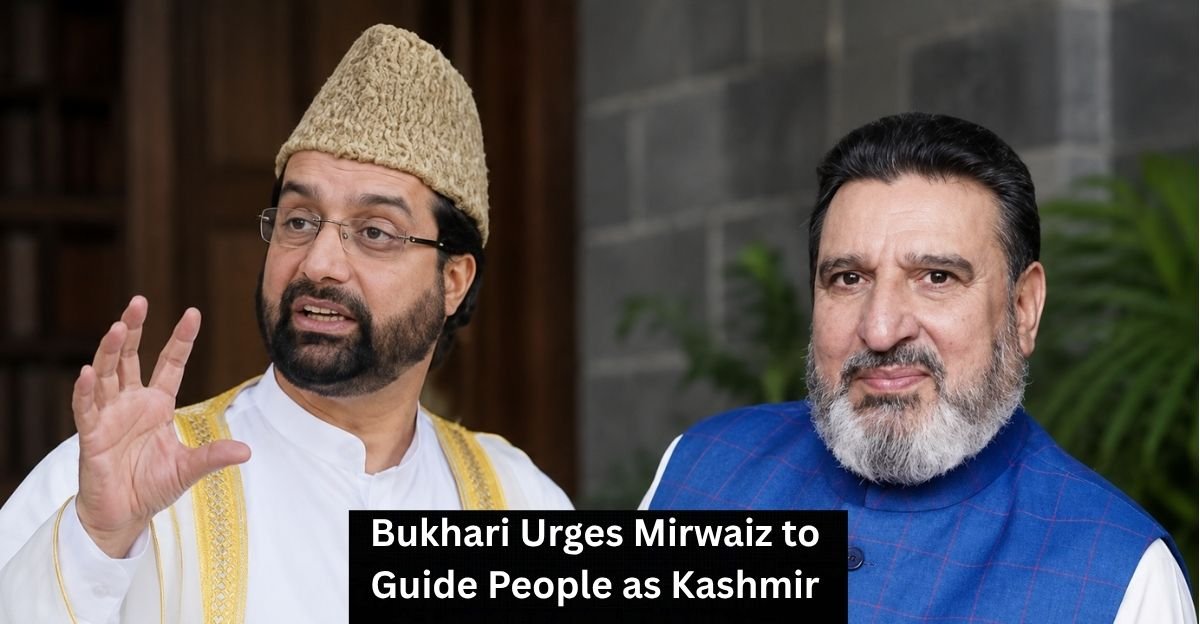
Jammu and Kashmir Apni Party president Syed Mohammad Altaf Bukhari has made a significant political outreach to Kashmir’s chief cleric Mirwaiz Umar Farooq, urging him to step forward and guide the people on “what needs to be done”. Click Here To Follow Our WhatsApp Channel
Bukhari’s remarks come amid renewed political discussion over the restoration of Jammu and Kashmir’s statehood and the future direction of politics in the region.
His appeal is notable as it seeks a greater role for Kashmir’s socio-religious leadership in shaping public opinion at a time when mainstream political parties are debating how to respond to the region’s changing political circumstances.

Bukhari seeks Mirwaiz’s guidance
Bukhari’s appeal to the Mirwaiz reflects the influence the cleric continues to exercise among sections of Kashmiri society.
By asking Mirwaiz Umar Farooq to guide the public, the Apni Party chief appears to be seeking a broader political and social consensus on issues that continue to carry considerable emotional and political importance in Jammu and Kashmir.
The outreach also comes against the backdrop of Bukhari’s recent comments on the emotional impact of the August 2019 abrogation of Article 370.
Bukhari has described the decision as having caused a “deep wound” to the emotions of the people, while maintaining that political efforts should focus on addressing the concerns and aspirations of the people of Jammu and Kashmir.
Mirwaiz calls for political unity
Bukhari’s remarks come shortly after Mirwaiz Umar Farooq called for political unity during his Friday sermon at the historic Jamia Masjid in Srinagar.
The Mirwaiz urged political parties in Jammu and Kashmir to come together and work towards the restoration of statehood, while stressing that the government should fulfil the commitments made to the people.
His appeal has brought the question of statehood back into the centre of political discussion in the region.
For Bukhari, seeking the Mirwaiz’s guidance could represent an attempt to bring different sections of Kashmiri society together around issues that extend beyond electoral politics.
BJP rejects Article 370 restoration
The Mirwaiz’s comments have already triggered a strong reaction from the Jammu and Kashmir unit of the Bharatiya Janata Party (BJP).
BJP spokesperson Altaf Thakur said Parliament’s decision of August 5, 2019, was a constitutional decision and pointed to the Supreme Court’s subsequent judgment upholding the abrogation of Article 370.
Thakur said there was no possibility of restoring Article 370, while maintaining that the restoration of statehood was a separate issue.
“There is a clear distinction between statehood and Article 370,” Thakur said, reiterating the BJP’s position that statehood would be restored at an appropriate time but Article 370 would not return.
Statehood remains a key political issue
The debate highlights the different positions being taken by political parties and leaders in Jammu and Kashmir.
While the BJP has maintained that Article 370 will not be restored, several political leaders and parties continue to raise the issue of statehood and the political aspirations of the people.
The restoration of statehood has emerged as one of the major demands of mainstream political parties following the reorganisation of the former state into the Union Territories of Jammu and Kashmir and Ladakh in 2019.
The Supreme Court, while upholding the constitutional changes related to Article 370, directed that elections to the Jammu and Kashmir Legislative Assembly be held by September 2024 and that statehood be restored at the earliest.
A changing political landscape
Bukhari’s appeal to the Mirwaiz is significant because it comes at a time when Kashmir’s political landscape is undergoing another phase of adjustment.
Mainstream political parties are attempting to balance electoral politics, demands for greater political rights and the broader social and emotional concerns surrounding the changes made since 2019.
The Mirwaiz, meanwhile, remains an important socio-religious figure whose Friday sermons at Jamia Masjid often attract considerable public and political attention.
Bukhari’s request for the cleric to guide the people therefore carries significance beyond a routine political statement.
It suggests that mainstream political leadership may increasingly seek dialogue with influential social and religious figures as it attempts to build wider consensus on the region’s future.
What comes next
Whether Bukhari’s appeal results in a broader political initiative remains to be seen.
For now, his statement has added another dimension to the discussion over statehood, political unity and public sentiment in Jammu and Kashmir.
With the BJP ruling out any return of Article 370 while maintaining that statehood will eventually be restored, and other political voices calling for greater unity and engagement, the debate is likely to remain an important part of Kashmir’s political discourse in the months ahead.
You Might Also Like:
Amarnath Yatra 2026 Concludes on Raksha Bandhan
J&K Weather: Hot and Humid Conditions Likely, Heavy Rain Forecast on August 31 and September 1
Aga Ruhullah Mehdi Says He Will Resign as Srinagar MP and Quit National Conference on November 3