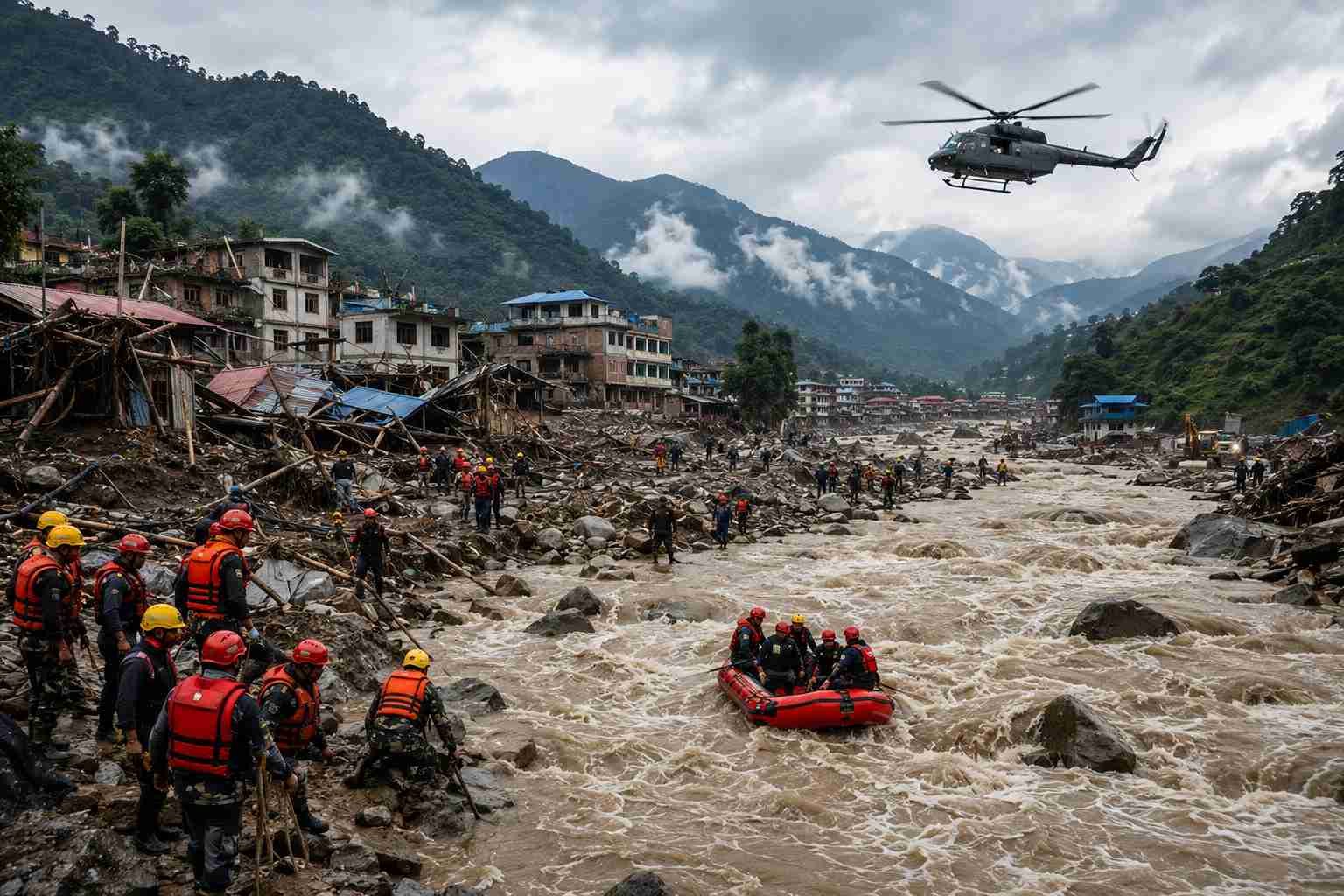
Nepal Flood Death Toll Reaches 538 as 977 Remain Missing Amid Fresh Barrier Lake Threat
Nepal’s death toll from devastating flash floods and landslides has risen to 538, while 977 people remain missing as rescue teams continue search and recovery operations for a third day. Click Here To Follow Our WhatsApp Channel
The disaster has also created a fresh threat. Authorities are closely monitoring a rapidly filling barrier lake near the Tibet-Nepal border, which could breach and send another powerful surge of water towards already devastated communities.
Glacier Collapse Triggered the Disaster
The disaster began at an altitude of around 5,200 metres, where bedrock beneath a Himalayan glacier collapsed.
The huge mass of ice, rock and sediment fell into the Lhende Khola, a tributary of the Bhote Koshi River. The debris temporarily blocked the river, creating a natural dam.
When the temporary dam broke, a powerful torrent of water, mud, rocks and debris rushed downstream.
At Galchhi, a settlement further downstream on the Trishuli River, water levels rose by as much as nine metres within just 30 minutes. The sudden rise left residents and travellers with very little time to escape.
Death Toll and Missing People
According to Nepal’s National Disaster Risk Reduction and Management Authority (NDRRMA), most of the recovered bodies have been found in downstream districts.
Chitwan has recorded the highest number of deaths at 221, followed by Nawalparasi East with 134 and Dhading with 33.
The disaster has also affected people from several countries.
Of the 977 people still missing, 517 are foreign nationals. Many of them were believed to be in the region for trekking trips or pilgrimages towards Mount Kailash in Tibet.
Among the missing foreign nationals are 288 Indians, 65 US citizens, 53 Ukrainians, 51 Malaysians, 35 Australians and 33 British nationals.
New Barrier Lake Raises Fresh Fears
While rescue teams continue digging through thick mud and debris, authorities are facing another serious danger upstream.
A new barrier lake has formed near the meeting point of the Chhochen Khola and Purepu Tsangpo rivers in Tibet, shortly before the water flows into Nepal as the Bhote Koshi River.
The lake has already collected around 2 million cubic metres of water.
Chinese water authorities estimate that another 3 million cubic metres could enter the lake over the next three days because of forecasts for moderate to heavy rainfall.
A sudden breach could send a large volume of water downstream, increasing the danger for communities that have already suffered heavy destruction.
The NDRRMA has warned people living downstream to stay away from riverbanks and other dangerous areas.
Nepal is also preparing to carry out aerial inspections of the Bhote Koshi and Rasuwa areas, with helicopters based in Dhunche being used to assess the situation and the risk of a possible breach.
Rescue Teams Continue Search Operations
More than 14,800 security personnel remain deployed across the worst-hit areas.
One of the most urgent rescue operations is taking place at the Upper Trishuli-1 Hydropower Project in Rasuwa, where Nepali Army personnel are working to rescue workers trapped inside a tunnel filled with mud and debris.
On the northern side of the border, Chinese engineering teams are using drones, 3D laser scanners and portable satellite equipment to map blocked areas and study possible flood movements.
However, rescue and recovery efforts remain extremely difficult.
Heavy rainfall, steep mountain terrain, blocked roads and the continuing risk of landslides are slowing operations on both sides of the border.
With hundreds of people still missing and another potential flood threat developing upstream, rescue teams are racing against time to find survivors and protect vulnerable communities.
You Might Also Like:
IGP Kashmir Sujit Kumar Says Anti-Terror Operations Remain Top Priority
Two Hand Grenades Recovered During Naka Checking in Baramulla’s Kunzer
Aga Ruhullah Mehdi Says He Will Resign as Srinagar MP and Quit National Conference on November 3