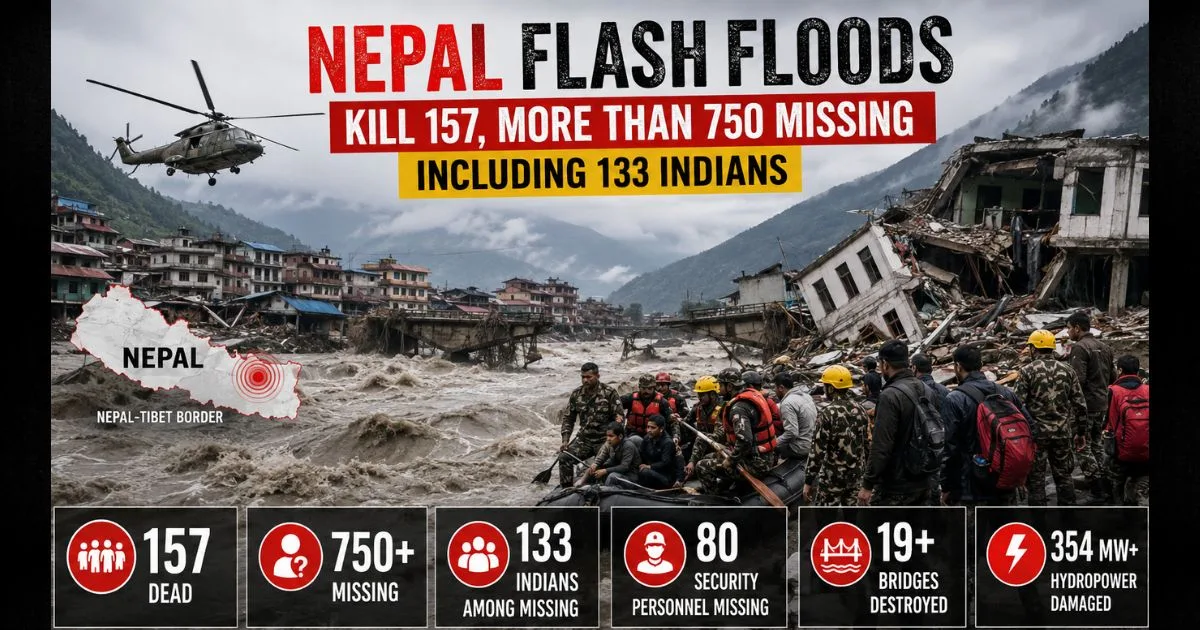
Nepal Flash Floods Kill 157, More Than 750 Missing, Including 133 Indians
By: A. Husain
A devastating flash flood carrying huge amounts of mud, rocks, ice and water swept through northern and central Nepal on Wednesday, killing at least 157 people and leaving more than 750 missing.Click Here To Follow Our WhatsApp Channel
The disaster struck along the Bhote Koshi and Trishuli river systems near the Nepal-Tibet border. Powerful floodwaters destroyed bridges, buildings, roads and other important infrastructure, while several hydropower projects were also badly damaged.
Hundreds of Tourists and Pilgrims Missing
Rescue teams from the Nepal Army, Armed Police Force and Nepal Police are searching for survivors and missing people in the worst-hit areas, including Rasuwa, Nuwakot and Dhading.
More than 400 foreign nationals are among those reported missing. At least 133 Indian nationals are also unaccounted for, including people travelling along the Kailash Mansarovar route.
The missing foreign nationals include citizens from the United States, Australia, the United Kingdom, Canada, Malaysia and other countries.
The Isha Foundation said 77 of its members were at an immigration centre in Nepal when the flood struck and remain unaccounted for. The organisation said 495 other members had returned safely.
At least 80 security personnel, including 44 Nepal Army soldiers, are also reported missing.
The disaster also affected China’s Tibet region. Chinese authorities reported three deaths and 265 people missing near the Gyirong border area.
Glacial Collapse Believed to Have Triggered the Flood
The cause of the disaster was initially linked to an earthquake detected in Tibet.
Nepal’s Foreign Minister Shisir Khanal told Parliament that seismic activity was recorded at around 8:37 am, shortly before the flood hit the area.
However, later investigations provided a different explanation.
The US Geological Survey said the seismic signal was not a normal tectonic earthquake. Instead, it was linked to a massive collapse involving ice and rock at high altitude. The collapse sent a huge amount of debris into the Lhende Khola river, creating a powerful surge that entered the Bhote Koshi river system.
The sudden release of water, mud, rocks and ice then travelled downstream at great speed, causing widespread destruction.
Roads, Bridges and Hydropower Projects Destroyed
The floods have caused major damage to Nepal’s infrastructure.
At least 19 motorable bridges have been washed away, while a 42-kilometre road connecting Betrawati in Nuwakot with the Rasuwagadhi border crossing was also badly damaged.
The country’s hydropower sector has also suffered heavy losses.
Eight operating hydropower projects with a combined capacity of around 354 MW were damaged. Five other projects that were still under construction were also affected. Major projects hit by the disaster include the 111 MW Rasuwagadhi project, the 78 MW Sanjen Khola project and the 60 MW Upper Trishuli 3A project.
Riverside settlements, vehicles, buildings and other facilities were swept away by the fast-moving floodwaters.
Rescue Operations Continue
Nepal has launched a large-scale rescue and relief operation involving the Army, Armed Police Force and Nepal Police.
The Nepal Army has deployed helicopters to rescue people trapped in difficult-to-reach areas. However, bad weather, damaged roads and the difficult Himalayan terrain are making rescue operations extremely challenging.
Hospitals in Kathmandu are treating people who have been rescued from the affected areas.
Prime Minister Balendra Shah has chaired an emergency meeting and ordered authorities to step up rescue and relief operations.
India has also offered assistance to Nepal. Prime Minister Narendra Modi spoke to Nepal’s Prime Minister and assured him of India’s support. India has sent an initial supply of relief materials to help with the emergency response.
Authorities have warned people living near the Bhote Koshi and Trishuli rivers to remain alert. A temporary blockage in the river system has raised fears of further flooding if water is suddenly released.
With hundreds of people still missing and rescue teams continuing their search, Nepal is facing a major humanitarian emergency following one of the region’s most devastating recent flash floods.
You Might Also Like:
Inspiring Journeys of Syed Sehrish Asgar and Syed Abid Rasheed Shah
Nepal Flash Floods Kill 157, More Than 750 Missing, Including 133 Indians
Professor Mufti Abdul Ghani Azhari: Scholar, Sufi, Historian, and Social Reformer of Kashmir