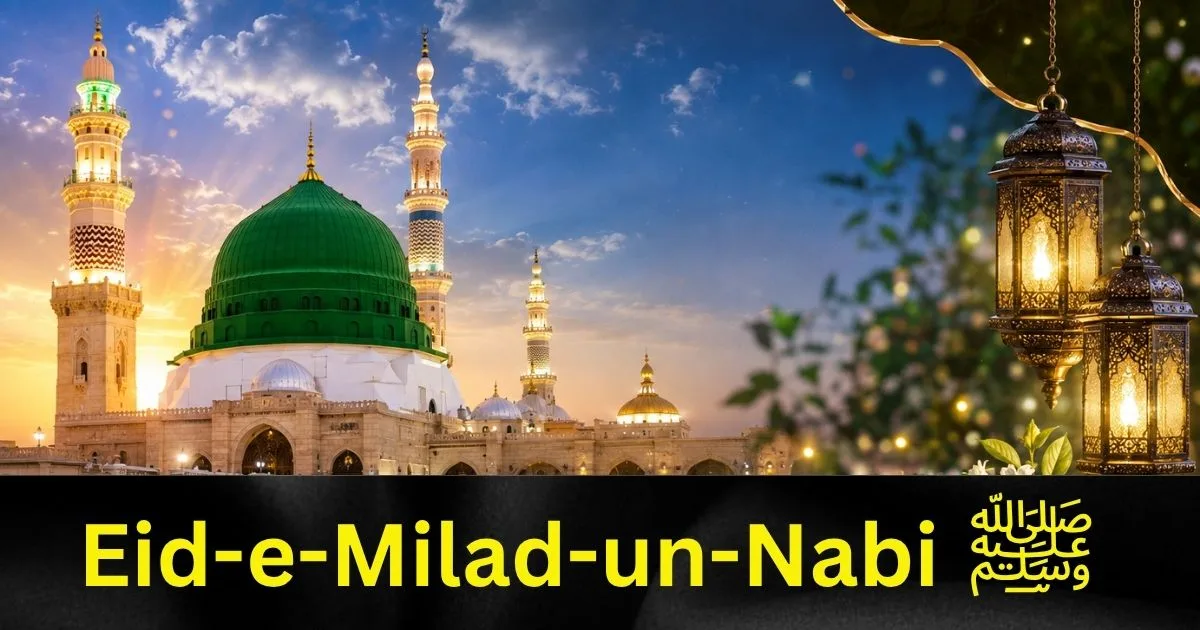
Eid-e-Milad-un-Nabi: Significance, Traditions and Islamic Perspectives
Eid-e-Milad-un-Nabi, also known as Mawlid al-Nabi, is observed by many Muslims to commemorate the birth of the Prophet Muhammad ﷺ. The occasion falls in Rabi’ al-Awwal, the third month of the Islamic lunar calendar. Click Here To Follow Our WhatsApp Channel
The exact date of the Prophet’s ﷺ birth has been discussed differently by Islamic scholars and historians. The 12th of Rabi’ al-Awwal is widely observed by many Sunni Muslims, while 17th of Rabi’ al-Awwal is traditionally associated with Shia Muslims. However, the historical date itself is subject to scholarly discussion.
For millions of Muslims, the occasion provides an opportunity to remember the Prophet’s ﷺ life, his character, his compassion towards others and the principles he taught throughout his mission.
The significance of the Prophet Muhammad ﷺ
The Prophet Muhammad ﷺ holds a central position in Islam as the final messenger of Allah. Muslims look to his life, known as the Seerah, as an example of faith, patience, honesty, justice and compassion.
The Quran describes the Prophet ﷺ as a mercy to the worlds, highlighting the universal nature of his message. His teachings transformed the social and moral landscape of seventh-century Arabia and established principles centred on worshipping one God, justice, responsibility and the dignity of human beings.
His life is remembered not only for his religious teachings but also for his treatment of family members, neighbours, the poor, orphans and members of other communities.
Compassion, forgiveness and mercy
One of the most important themes associated with the Prophet’s ﷺ life is compassion.
He encouraged Muslims to treat others with kindness and patience and demonstrated forgiveness even towards people who had caused him personal hardship. His conduct towards opponents, neighbours and vulnerable members of society remains an important part of the Seerah.
For those who observe Eid-e-Milad-un-Nabi, the occasion therefore serves as a reminder that love for the Prophet ﷺ should be reflected in everyday behaviour through mercy, honesty, patience and good character.
Justice and equality
The Prophet Muhammad ﷺ also emphasised justice and the rights of vulnerable people.
His teachings addressed the treatment of women, children, orphans, the poor and those without social or political power. He repeatedly warned against injustice and encouraged believers to fulfil their responsibilities towards other people.
His message also challenged the importance placed on tribal and social status. Human dignity, righteousness and moral conduct were given greater importance than wealth, lineage or worldly position.
These principles continue to form an important part of discussions about the Prophet’s ﷺ legacy.
How Eid-e-Milad-un-Nabi is observed
Practices associated with Mawlid vary considerably between countries, communities and Islamic traditions.
In many parts of South Asia, including Jammu and Kashmir, Muslims may mark the occasion through religious gatherings, sermons, Quran recitation, Naat poetry, Seerah programmes and discussions about the Prophet’s ﷺ life.
Mosques, Islamic institutions and community organisations may arrange programmes in which scholars and religious speakers discuss his teachings and character.
In some communities, streets, mosques and public spaces are decorated with lights, banners and other forms of illumination. Peaceful processions and gatherings are also held in several countries.
Charity and helping others
Charity is another important feature of many Mawlid observances.
Families, mosques and community organisations may distribute food and arrange communal meals for people from different backgrounds. Some people also use the occasion to provide financial assistance, clothes or food to those in need.
Such acts of charity are often presented as an opportunity to put the Prophet’s ﷺ teachings about generosity and concern for others into practice.
Rather than focusing solely on celebration, many Muslims regard helping vulnerable people as a meaningful way of remembering the Prophet’s ﷺ example.
Naat and remembrance
Religious gatherings during Mawlid frequently include the recitation of Naat, devotional poetry expressing love and respect for the Prophet Muhammad ﷺ.
In some communities, scholars also narrate important events from the Prophet’s ﷺ life, including his childhood, the beginning of revelation, his migration to Madinah, his relationships with his companions and his conduct during times of hardship and conflict.
The purpose of such gatherings is often to strengthen knowledge of the Seerah and encourage Muslims to follow the Prophet’s ﷺ example in their daily lives.
Fasting and personal devotion
Some Muslims also mark the occasion through additional acts of worship, including voluntary fasting, prayer, Quran recitation and supplication.
The Prophet Muhammad ﷺ was known to fast on Mondays. When asked about this practice, he referred to Monday as the day on which he was born and the day on which revelation came to him.
However, Muslims differ over whether particular acts should be specifically associated with an annual Mawlid celebration. Therefore, practices vary according to different schools of Islamic thought.
Different scholarly views on Mawlid
Eid-e-Milad-un-Nabi is also an occasion on which different Islamic scholarly opinions become particularly visible.
Many Sunni Muslims, particularly within Sufi-oriented traditions, regard gatherings remembering the Prophet’s ﷺ birth and life as permissible or praiseworthy when they remain within Islamic principles. Such communities often view Mawlid gatherings as a means of expressing love for the Prophet ﷺ, learning about his Seerah and encouraging charitable and religious activities.
Other Muslim scholars and traditions, including Salafi-oriented scholars, do not consider an annual celebration of the Prophet’s ﷺ birth to be an established religious practice. They argue that Muslims should demonstrate their love for the Prophet ﷺ by following his Sunnah throughout the year rather than establishing a specific annual religious celebration.
Shia Muslim communities also observe the Prophet’s ﷺ birth, traditionally marking it on 17th Rabi’ al-Awwal, and the date is also associated with the birth anniversary of Imam Ja’far al-Sadiq.
These differences demonstrate that Muslims have varying scholarly approaches to the observance. For many communities, however, the central focus remains remembrance of the Prophet Muhammad ﷺ and his teachings.
A reminder of the Prophet’s ﷺ character
Beyond differences over how Mawlid should be observed, the Prophet Muhammad’s ﷺ character and teachings remain central to Muslims worldwide.
His life offers examples of patience during hardship, forgiveness after conflict, generosity towards the poor, honesty in business, kindness towards neighbours and responsibility towards family and society.
The occasion can therefore serve as an opportunity for Muslims to study the Seerah and consider how the Prophet’s ﷺ values can be applied to contemporary life.
Eid-e-Milad-un-Nabi in Kashmir
In Jammu and Kashmir, Eid-e-Milad-un-Nabi is marked by religious gatherings and programmes in many areas. Mosques and religious institutions may organise Seerah sessions, Naat gatherings and lectures, while communities may also arrange charitable activities and distribute food.
For many people in the region, the occasion is an important part of the Islamic religious calendar and provides an opportunity for families and communities to come together in remembrance of the Prophet Muhammad ﷺ.
Ultimately, the significance of Eid-e-Milad-un-Nabi extends beyond decorations, gatherings or public programmes. For those who observe it, the occasion provides a chance to remember the Prophet’s ﷺ life, learn from his character and renew their commitment to values such as mercy, justice, honesty, humility and compassion.
Eid-e-Milad-un-Nabi Mubarak to all those observing the occasion.
You Might Also Like:
Opposition Parties Protest 6.83% Power Tariff Hike Across Srinagar
Farooq Abdullah Challenges Ruhullah Mehdi to Resign and Seek Fresh Mandate
Ruhullah Says He Will Respond Soon to Farooq Abdullah’s Resignation Challenge
Farooq Abdullah Urges Economic Self-Reliance Amid J&K Electricity Tariff Rise