Why J&K Congress Is Not Ready to Join Omar Abdullah’s Cabinet ?
By : A. Husain Kashmiri
The National Conference-led government in Jammu and Kashmir is once again facing an important political question: Will the Congress join Chief Minister Omar Abdullah’s Cabinet? Click Here To Follow Our WhatsApp Channel
The question has resurfaced after the ruling National Conference (NC) approached the Congress with a fresh offer to join the Council of Ministers ahead of a proposed Cabinet expansion and reshuffle.
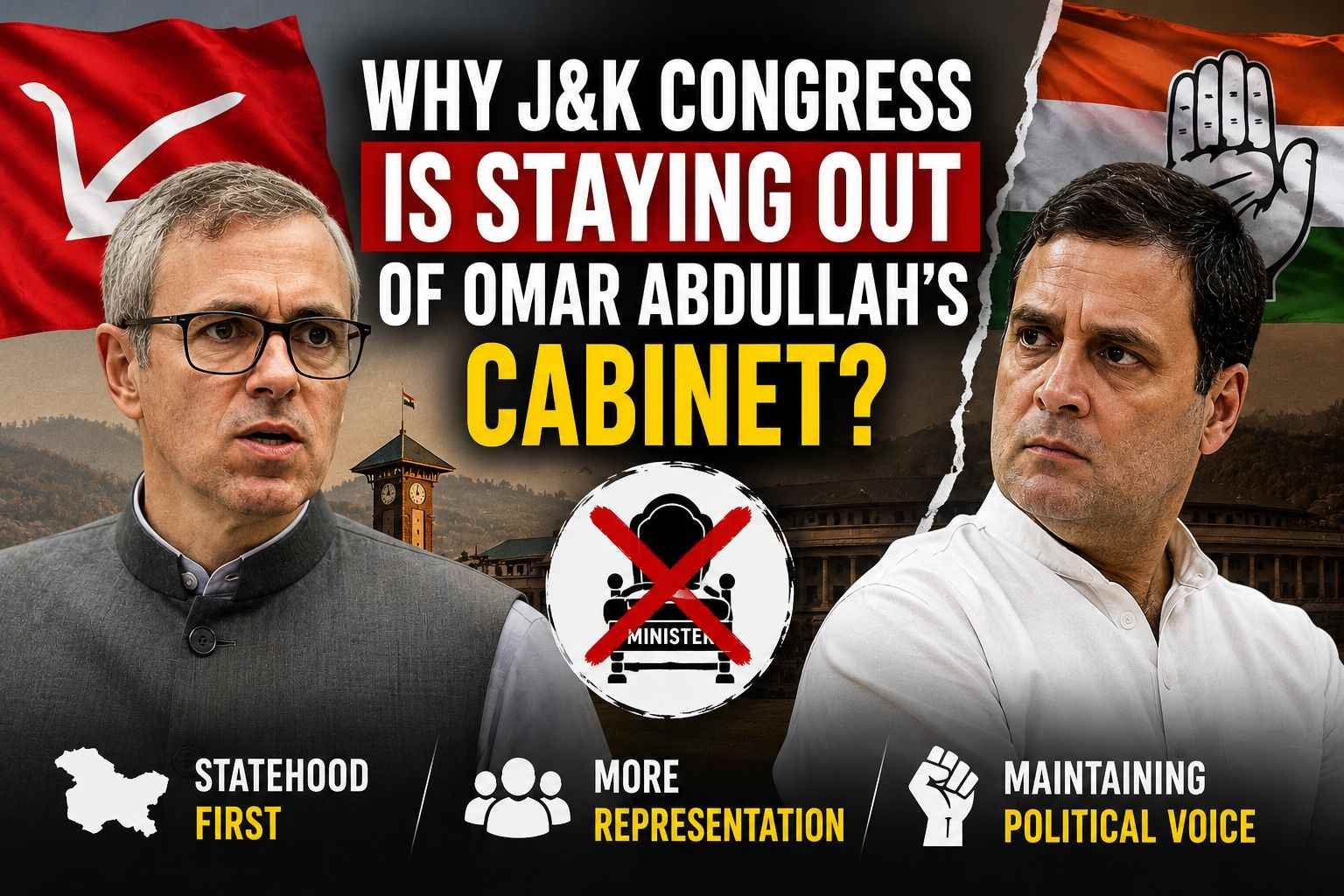
However, the Jammu and Kashmir Pradesh Congress Committee (JKPCC) has now made its position clear. Congress president Tariq Hameed Karra said on Thursday that the party will not join the Cabinet until Jammu and Kashmir’s statehood is restored.
At the same time, an important distinction has emerged within the latest reports. AICC General Secretary in charge of J&K, Syed Naseer Hussain, said earlier on Thursday that the Congress had not yet taken a final decision on joining the Council of Ministers, while reports suggested that the J&K unit was seeking greater representation and a formal role in alliance decision-making.
So why is the Congress reluctant to accept Omar Abdullah’s offer?
Statehood Remains Congress’s Main Condition
The most important reason is restoration of Jammu and Kashmir’s statehood.
Congress has repeatedly maintained that it does not want to become part of the Cabinet while J&K continues to remain a Union Territory.
JKPCC president Tariq Hameed Karra reiterated this position on August 27, saying the party’s stand had remained unchanged and that supporting the National Conference government from outside should not be confused with joining the Cabinet.
According to Karra, restoration of statehood and protection of people’s rights over land, jobs and natural resources remain among Congress’s foremost concerns.
This means the party is attempting to draw a clear political line:
Congress can support the Omar Abdullah government without becoming responsible for running it.
Karra has also said that Congress will continue to support the government when necessary, particularly if there is an attempt to destabilise it or undermine it politically. At the same time, the party wants to retain the freedom to criticise government decisions when it believes public interests are being affected.
This Is Not a New Position
Congress’s decision to stay outside the Cabinet is not something that has emerged only during the latest Cabinet expansion discussion.
When Omar Abdullah formed his government in October 2024, the National Conference and Congress had already fought the Assembly elections as allies. The alliance crossed the majority mark, with the NC emerging as the dominant partner and Congress winning six seats.
Yet Congress did not enter the Cabinet.
At that time, J&K Congress chief Tariq Hameed Karra said the party was unhappy that statehood had not been restored and therefore decided not to join the ministry. Congress instead chose to provide outside support to the Omar Abdullah government.
Therefore, the present disagreement is essentially a continuation of a political position Congress has maintained since the formation of the government.
But There Is Also a Question of Cabinet Berths
While statehood is the official and publicly emphasised reason, reports indicate that there is also a question of representation.
The National Conference reportedly renewed its offer of one ministerial berth to Congress.
Sources cited by multiple reports, however, said that the J&K Congress unit was seeking two berths, while remaining open to negotiations over the second position. The party has also reportedly sought suitable adjustment for one of its legislators if two Cabinet positions cannot be accommodated.
Congress has also been reported to favour the creation of a coordination committee of alliance partners so that the party has a more formal role in decision-making.
This makes the situation more complicated than a simple rejection of Omar Abdullah’s offer.
There are effectively two issues on the table:
- Congress’s stated political condition — restoration of statehood before joining the Cabinet.
- The practical question of representation and decision-making within the NC-Congress alliance.
Why Does the Number of Ministers Matter?
The size of the Jammu and Kashmir Council of Ministers is constitutionally restricted.
Under the Jammu and Kashmir Reorganisation Act, the Council of Ministers in the Union Territory cannot exceed 10 per cent of the total strength of the Legislative Assembly.
With a 90-member Assembly, the maximum strength of the Council of Ministers is therefore nine members, including the Chief Minister.
The Omar Abdullah government initially had six members, leaving limited space for further appointments.
That creates a difficult balancing act for the National Conference.
Omar Abdullah has to consider not only Congress’s demand but also the expectations of his own legislators and other political supporters. Giving Congress two positions would consume a significant portion of the remaining ministerial space.
This helps explain why the question of Cabinet representation has remained politically sensitive.
Why Would Congress Prefer to Stay Outside?
There is also a political advantage for Congress in remaining outside the Cabinet.
By supporting the government without joining it, Congress can maintain a degree of political independence.
If Congress becomes a Cabinet partner, it would share responsibility for government decisions, including decisions that may become unpopular with the public.
Outside the Cabinet, however, Congress can support the government on issues it considers important while simultaneously criticising policies with which it disagrees.
Karra demonstrated this approach while criticising the recent power tariff hike, saying Congress supported the government but that such support did not mean remaining silent on issues affecting ordinary people.
In political terms, this gives Congress considerable flexibility.
It can say:
“We support the government when J&K’s interests are at stake, but we are not responsible for every decision taken by the government.”
Congress Wants to Keep Statehood at the Centre of Its Politics
Another important consideration is the political importance of the statehood issue.
Congress has been campaigning for the restoration of Jammu and Kashmir’s statehood and has repeatedly argued that the people of J&K should regain the constitutional and administrative position they held before the 2019 reorganisation.
Karra said in July that Congress had begun its statehood campaign before other political parties joined the movement and welcomed the fact that the National Conference had subsequently intensified its own demand for restoration of statehood.
For Congress, joining the Cabinet before statehood is restored could therefore create a political contradiction.
The party could face questions such as:
If statehood is important enough to campaign for, why join a Union Territory government without it being restored?
Remaining outside the Cabinet allows Congress to maintain a consistent political message.
Why Does Omar Abdullah Want Congress in the Cabinet?
From the National Conference’s perspective, bringing Congress into the Cabinet would have several advantages.
The NC and Congress remain alliance partners, and Congress has continued to support the Omar Abdullah government from outside.
Formal Cabinet participation would bring the alliance closer together institutionally and give Congress a direct role in governance.
It could also reduce the possibility of disagreements between the two parties over government policy and provide a broader political base for the administration.
For Omar Abdullah, therefore, Congress’s participation could strengthen the appearance of an integrated alliance government.
But for Congress, joining the Cabinet would come with a price: it would have to share responsibility for the government’s performance.
The Congress Position Has Become More Complicated
There is an interesting development in the latest statements.
On Thursday, AICC General Secretary Syed Naseer Hussain said that no final decision had been taken on joining the Council of Ministers. Reports also suggested that the J&K Congress unit was not completely opposed to joining and was discussing issues including the number of berths and a coordination mechanism.
But later on Thursday, JKPCC president Tariq Hameed Karra gave a much clearer public position, saying Congress would not join the Cabinet until statehood is restored.
This suggests that discussions may have taken place within the party, but the latest public position of the J&K Congress leadership remains firmly against Cabinet participation under the present circumstances.
A Delicate Balancing Act for the NC-Congress Alliance
The disagreement does not necessarily mean that the NC-Congress alliance is breaking apart.
In fact, Karra has repeatedly indicated that Congress will continue to support the Omar Abdullah government when it believes the government is being threatened or when larger interests of Jammu and Kashmir are involved.
At the same time, Congress wants the freedom to question the government’s decisions.
This creates an unusual political arrangement:
The Congress is an alliance partner, supports the government, but remains outside the Cabinet.
The arrangement allows the two parties to cooperate politically while maintaining separate positions on governance.
What Happens Next?
For now, the immediate issue is whether the National Conference can persuade Congress to reconsider its position or offer a formula that satisfies the party without requiring it to abandon its statehood stand.
But based on Tariq Hameed Karra’s latest statement, ministerial positions alone are unlikely to be enough to bring Congress into the Cabinet.
Unless there is a significant change in the statehood issue or Congress revises its position, the party appears set to continue supporting Omar Abdullah’s government from outside.
The latest developments therefore show that the dispute is not simply about how many ministries Congress should receive.
At its core, it is about statehood, political identity, representation and the balance between being an ally of the government and being part of the government.
For Omar Abdullah, bringing Congress into the Cabinet would strengthen the formal structure of the alliance. For Congress, staying outside allows it to retain its political independence and continue making restoration of J&K’s statehood and protection of people’s rights a central political demand.
For now, Congress appears unwilling to trade that position for a ministerial berth.
You Might Also Like:
Inspiring Journeys of Syed Sehrish Asgar and Syed Abid Rasheed Shah
Nepal Flash Floods Kill 157, More Than 750 Missing, Including 133 Indians
Professor Mufti Abdul Ghani Azhari: Scholar, Sufi, Historian, and Social Reformer of Kashmir