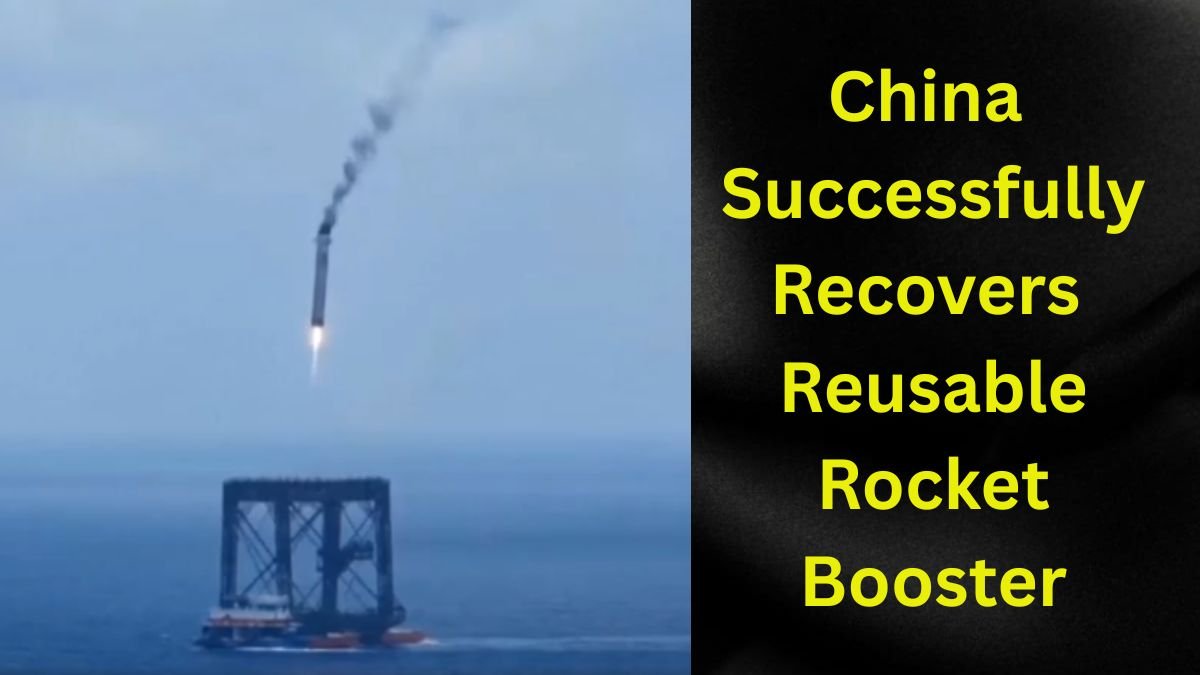
China has achieved a major milestone in its space programme by successfully recovering the first stage of its reusable Long March-10B rocket after its maiden orbital launch, becoming only the second country after the United States to demonstrate recovery of an orbital-class reusable rocket booster.Click Here To Follow Our WhatsApp Channel
The historic mission took place on Friday from the Hainan International Commercial Aerospace Launch Centre, where the Long March-10B lifted off and successfully placed its payload into the planned orbit. Around six minutes after launch, the rocket’s first-stage booster returned to Earth and was safely captured by a specially designed sea-based recovery platform using a net-and-cable system.
Unlike SpaceX’s Falcon 9, which lands vertically on deployable landing legs, China’s new recovery method uses four landing hooks attached to the booster to catch a large suspended net on an offshore platform. Engineers say this approach reduces the rocket’s overall weight, increases payload capacity, and could lower the cost of future space missions.
The successful recovery marks China’s first retrieval of an orbital-class reusable rocket booster and the world’s first successful sea-based net recovery of a launch vehicle. The breakthrough is expected to play an important role in China’s plans to build reusable launch systems for commercial satellite missions and future crewed Moon missions before 2030.
The Long March-10B is designed to carry up to 16 tonnes into low-Earth orbit in its reusable configuration. Chinese officials said the recovered booster will undergo inspection and is expected to fly again before the end of the year, demonstrating the country’s growing confidence in reusable launch technology.
While the achievement represents a significant advance for China’s space industry, the United States remains the global leader in reusable rocket operations. SpaceX has completed hundreds of successful booster recoveries and routinely reuses its Falcon 9 rockets for commercial, scientific, and crewed missions. Nevertheless, China’s latest success narrows the technological gap and signals increasing competition in the global space sector.
Experts believe reusable rockets will play a crucial role in reducing launch costs, increasing launch frequency, and supporting ambitious projects such as satellite mega-constellations, deep-space exploration, and future human missions to the Moon and beyond. China’s latest breakthrough is therefore being seen as a major step towards a more competitive and sustainable space programme.