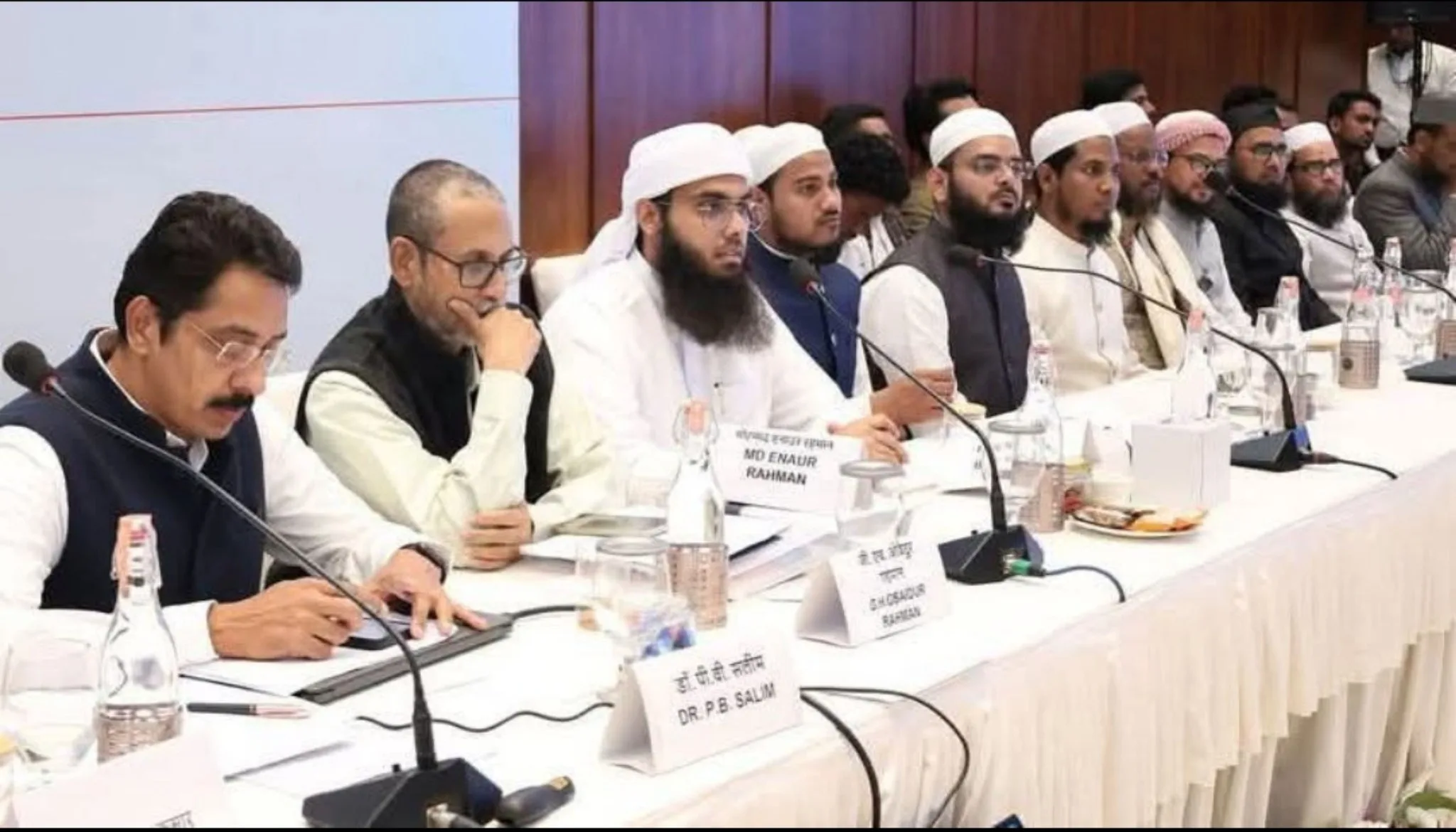
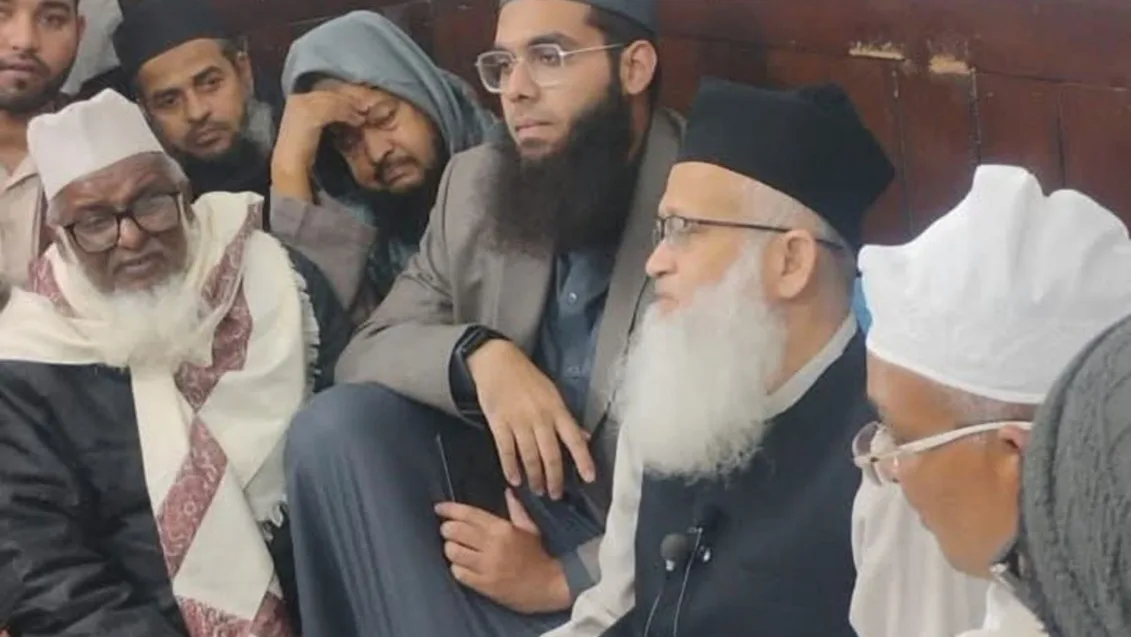
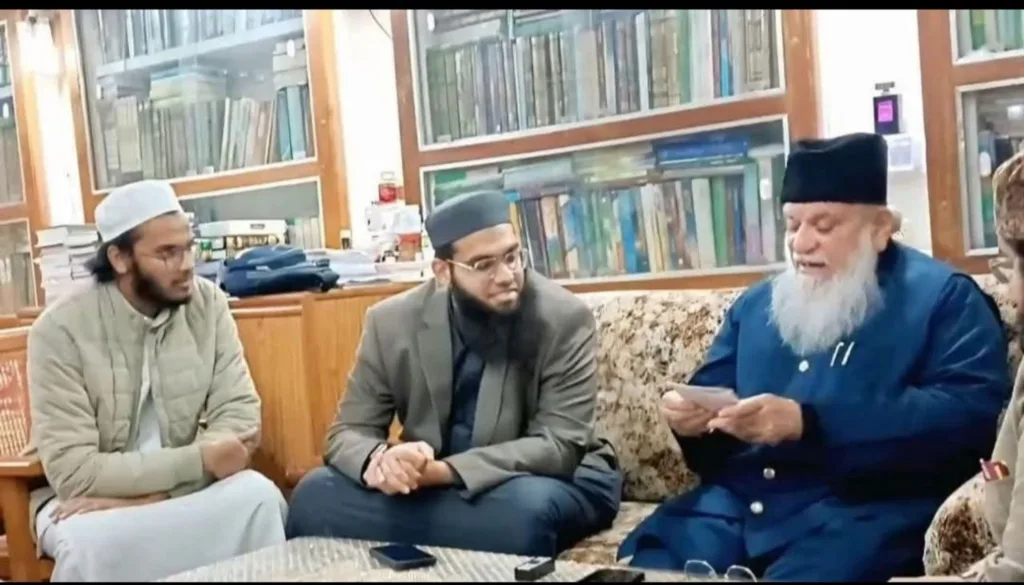
Mufti Shamail Nadwi is a young and well-known Islamic scholar from India. He is respected for his calm way of speaking, clear thinking, and ability to explain Islam in simple words. Many young Muslims in India, Pakistan, and other countries follow his lectures online because he answers modern questions about faith, life, and belief in an easy and logical manner.Click Here To Follow Our WhatsApp Channel
Early Life and Family
Mufti Shamail Ahmad Abdullah Nadwi was born in Kolkata, West Bengal, in the mid-1990s. He grew up in a religious family. His father, Maulana Shamsuzzaman Nadwi, is an imam and Islamic teacher.
From a young age, Mufti Shamail showed interest in Islamic learning. He memorised the Qur’an and studied basic Islamic subjects during his childhood. His home environment helped him develop discipline, respect for knowledge, and love for learning.
Education and Islamic Studies
For higher Islamic education, Mufti Shamail studied at Darul Uloom Nadwatul Ulama in Lucknow. This is one of the most respected Islamic institutions in India. It is known for teaching both traditional Islamic subjects and awareness of modern issues.
During his studies, he learned:
Arabic language
Qur’an explanation (Tafseer)
Hadith and their meanings
Islamic law (Fiqh) of the Hanafi school
Logic and belief studies
After completing his education, he earned the title of Mufti, which means he is qualified to guide people on Islamic legal matters. Like many students of Nadwa, he added “Nadwi” to his name.
Later, he went to Malaysia and is currently doing a PhD at International Islamic University Malaysia. This has helped him gain wider academic experience.
Teaching Work and Institutions
In 2021, Mufti Shamail started Markaz Al-Wahyain, an online Islamic learning centre. The aim is to provide proper Islamic education to people who cannot attend madrasas physically.
The platform offers:
Online classes on Qur’an and Hadith
Courses on Islamic belief and law
Special lessons for youth and beginners
He is also linked with the Wahyain Foundation, which works for education, community guidance, and youth awareness.
Style of Teaching and Online Presence
Mufti Shamail Nadwi is very active online. His teaching style is:
Calm and respectful
Clear and well-explained
Based on Qur’an, Hadith, and logic
He is popular on:
YouTube – long lectures and question-answer sessions
Instagram & Facebook – short clips and reminders
X (Twitter) – views on faith and society
Young people like his content because he explains difficult ideas in simple language and does not use harsh words.
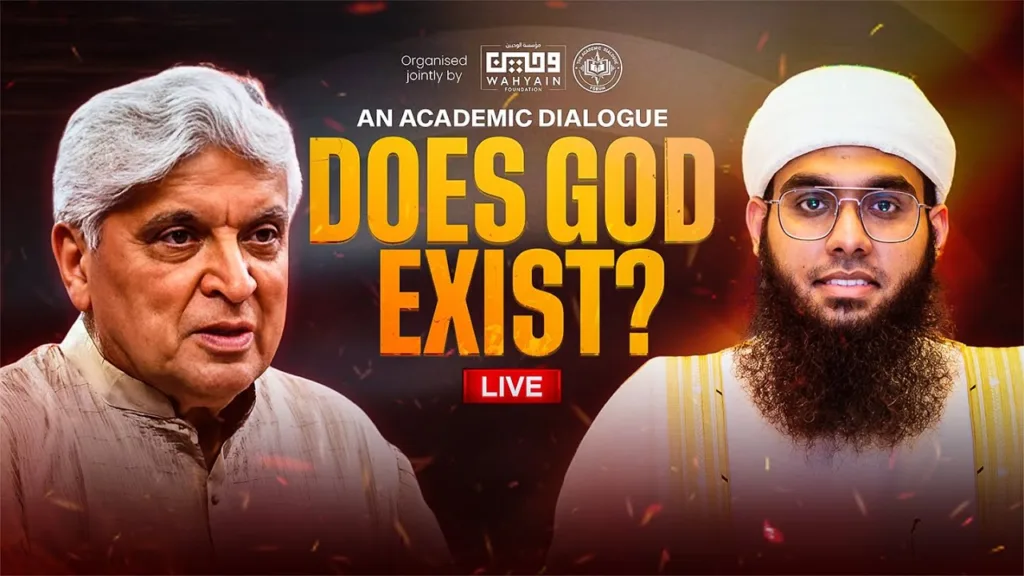
Famous Debate on God’s Existence
In December 2025, Mufti Shamail became widely known after a public debate with Javed Akhtar. The debate was held at the Constitution Club of India and moderated by journalist Saurabh Dwivedi.
The topic was “Does God Exist?”
Mufti Shamail explained that:
Science explains how things work, not why they exist
Moral values and human awareness point to a higher reality
Human free will explains suffering, not injustice by God
Not everything can be tested by physical tools
The debate remained polite and respectful. Many viewers praised Mufti Shamail for his patience, clarity, and strong reasoning.
Influence and Importance Today
Mufti Shamail Nadwi represents a new generation of Islamic scholars who:
Respect classical Islamic learning
Understand modern doubts and questions
Prefer dialogue instead of arguments
He has influenced thousands of young Muslims who were confused about faith and belief. His work has helped make Islamic learning more accessible and relatable in today’s fast-changing world.
Conclusion
Mufti Shamail Nadwi is a young but influential Islamic scholar who connects tradition with modern thinking. Through teaching, online platforms, and respectful discussions, he has become an important voice for many Muslims today.
As his education and work continue, his role in guiding young minds is expected to grow even further.
Question: My student, Abu Hanifah Dilawar, forwarded to me the following question: Assalāmu ʿalaykum wa raḥmatullāhi wa barakātuhu, Shaykh. This is a question from a Bangladeshi reader of the Bangla Facebook page who regularly reads your articles. They wrote: “I could not help but comment. I read the articles on this page almost regularly. Alḥamdulillāh, such beautiful writing—every single word reflects the depth of knowledge. SubḥānAllāh, these are not words that merely pass the lips; they penetrate deep into the heart, enriching my understanding and helping me recognise myself and the world anew. Alḥamdulillāh. May Allah ﷻ grant you the best reward. Āmīn. I do not know whether my question will reach you, but I will ask it nonetheless: When a person truly returns to the Dīn, what should they actually do in order to know themselves completely?”
Answer: Wa ʿalaykum as-salām wa raḥmatullāhi wa barakātuhu.
The question raised by the respected reader is sincere and deeply meaningful, because in Islam the matter of “knowing oneself” is directly connected to knowing one’s Lord and understanding the purpose for which one was created.Click Here To Follow Our WhatsApp Channel
It must first be made clear that a person who is born to Muslim parents is a Muslim by default. Such a person remains within Islam unless they knowingly and openly declare disbelief or commit an act that takes them out of the fold of Islam. Islam is not lost due to weakness, sin, confusion, or periods of neglect. Therefore, many people who speak of “returning to Islam” are in reality returning to practising Islam more consciously and sincerely, not re-entering it from outside.
If, however, a person had clearly left Islam and then wishes to return, then the door of Allah’s mercy is always open. Their return begins with sincerely declaring the Shahādah: that there is no god worthy of worship except Allah, and that Muḥammad ﷺ is the Messenger of Allah. With this declaration, all that came before is wiped away by Allah’s mercy.
Whether one is born Muslim, returning to Islam, or newly embracing Islam, the obligation thereafter is the same. Every Muslim is required to worship Allah alone according to the way taught by the Prophet Muḥammad ﷺ. There is no separate path for converts and no special category for those who “returned”; there is only submission to Allah upon guidance.
To truly return to the Dīn and to begin knowing oneself, a person must first recognise their reality: that they are a servant of Allah, created, weak, dependent, and in constant need of their Lord. True self-knowledge does not lead to pride or self-admiration, but to humility, repentance, and awareness of one’s limitations. The one who knows himself realises how much he needs Allah at every moment.
The foundation of this return is the establishment of worship, beginning with the obligatory acts. The five daily prayers, fasting in Ramaḍān, zakāh when applicable, and ḥajj for those who are able are not optional spiritual exercises; they are the pillars upon which the heart and soul are built. Without these, claims of inner transformation remain fragile and incomplete.
Alongside this, the Muslim must learn the Qur’an, recite it, understand its meanings, reflect upon its verses, and strive to act upon it. The Qur’an is not merely a book of blessing or recitation; it is the primary means through which a believer comes to understand himself, his flaws, his responsibilities, and his destination. Through the Qur’an, Allah speaks directly to the heart of the servant, guiding, correcting, and nurturing it.
Equally essential is learning the Sunnah of the Prophet ﷺ and striving to follow him in belief, worship, character, and conduct. The Prophet ﷺ is the living example of what submission to Allah looks like in practice. Without his guidance, a person may worship with sincerity yet fall into error. Following the Sunnah brings balance, depth, and clarity to one’s religion, and draws the believer closer to Allah in a sound and protected manner.
As a person progresses upon this path, they must guard themselves against seeking validation from others regarding the quality of their īmān or the depth of their spirituality. No scholar, teacher, or community can truly assess the state of a person’s heart. The reality of one’s faith is known only to Allah ﷻ. Even the most righteous of the early Muslims feared hypocrisy for themselves, despite their great deeds.
Therefore, the believer continues upon the path of worship with both fear and hope: fear of Allah’s justice and accountability, and hope in His vast mercy and forgiveness. A Muslim does not claim certainty of acceptance in this life, nor do they despair of Allah’s mercy because of their shortcomings. They continue worshipping Allah, repenting sincerely, and striving to improve until death comes to them.
In this way, returning to the Dīn is not a single event but a lifelong journey of returning to Allah again and again. Whoever persists upon worship, learning, reflection, and humility has already begun to know himself in the truest and most beneficial sense.
May Allah ﷻ keep our hearts firm upon His religion, increase us in knowledge and sincerity, and grant us a good ending. Āmīn.
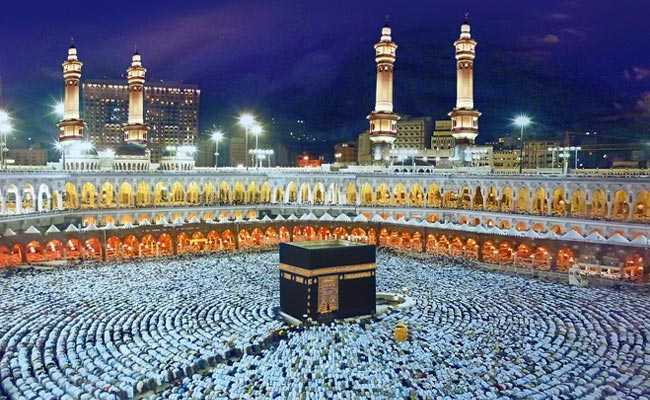
Question: I had a question that I wondered if you could help me with- a friend of mine is going for umrah and is likely to be on her period of the entire duration of it. Every source we’ve read online says that other than the Tawaf, she can do everything else. But that once she’s finished her period, will then need to complete tawaf. However, this won’t be possible as she’s likely to be on her period the whole time. What does that mean for her? That she won’t be able to complete umrah?Click Here To Follow Our WhatsApp Channel
Answer: The jurists agree that ṭawāf around the Kaʿbah cannot be performed while a woman is in a state of menstruation. The Prophet ﷺ made this explicit when he told ʿĀ’ishah (ra): “Do all that the pilgrims do except the ṭawāf around the House, until you become pure.” This establishes an unambiguous rule: tawāf requires ritual purity, and without it, the tawāf is invalid. Since tawāf is a fundamental pillar of ʿumrah, the entire ʿumrah depends upon its successful completion. One may perform duʿā’, dhikr, talbiyah, and even saʿī after tawāf, but none of these substitute for the tawāf itself.
If a woman expects her menstrual cycle to finish at some point during her stay in Makkah, she may make the intention of ʿumrah and enter iḥrām with full confidence that she will be able to perform her tawāf once she becomes pure. However, if she is almost certain that she will be menstruating for the entire duration of her trip and will not have even a single day of purity in which she can complete the essential tawāf, then she should not plan to perform ʿumrah at all. Entering iḥrām with the intention of ʿumrah would place her in a binding ritual state that she cannot exit until she completes the tawāf, and she would have no lawful way of completing it. The Sharīʿah does not ask a person to enter into an act of worship that she knows she cannot complete, nor to place herself in hardship or a legally restricted state without benefit.
For this reason, the sound and precautionary scholarly position is that she should avoid travelling for ʿumrah under these circumstances. Since the defining act of ʿumrah will not be possible for her, there is no benefit in formally undertaking the ritual.
There are situations, however, where a woman may be required to travel with family, a group, or for logistical reasons that do not allow her to adjust her timing. If she must travel to Makkah, yet knows she will be menstruating throughout her stay, then she must not make the intention of ʿumrah and must not enter iḥrām at the miqāt. Instead, she should travel simply as a visitor, not as a pilgrim, and enter Makkah without the obligations associated with ritual consecration. She may attend the masjid, make duʿā’ and dhikr, accompany her group, and benefit spiritually from being in a sacred place, but she does not begin the rites of ʿumrah and does not take on the restrictions of iḥrām. This avoids the difficulty and legal complications of being in iḥrām without any opportunity to complete the worship for which iḥrām was assumed.
Professor Mohammad Sanaullah al-Nadawi, a well-known Indian Arabic scholar and former Head of the Department of Arabic at Aligarh Muslim University (AMU), recently represented India at a major international conference held in London. The two-day event was organised by the prestigious Al-Furqan Islamic Heritage Foundation and focused on “Early Traditions of Translation in Islamic History.”
Keynote Lecture on India’s Influence on Medieval Baghdad
During the conference, Professor Sanaullah delivered an important keynote lecture titled “India’s Role in the Formation of Medieval Baghdad.” In his talk, he explained how large numbers of Indian (especially Sanskrit) books on medicine, astronomy, philosophy, mathematics, and literature were translated into Arabic during the Abbasid period in Baghdad.
Sanskrit scientific works greatly influenced the development of Islamic knowledge.
Abbasid rulers and the famous Barmakid ministers strongly supported translation projects.
Indian ideas helped shape Baghdad’s intellectual and scientific culture in the medieval period.
His lecture received appreciation from scholars and participants for shedding light on India’s long-standing contribution to global learning.
Strong Role in Al-Tilmeez Research Journal
Professor Sanaullah is also the Vice Chief Patron of the International Research Journal Al-Tilmeez, one of the leading Arabic journals published from Jammu & Kashmir under the Chief Editorship of Dr Meraj Nadvi. His guidance and international experience have helped the journal grow in academic quality and global recognition.
Visits to London’s Historic and Academic Centres
During his visit, Professor Sanaullah also toured several iconic places in London, including:
The Royal Palaces
University of London
The British Museum
The British Library
The Athenaeum Club
Caxton Hall
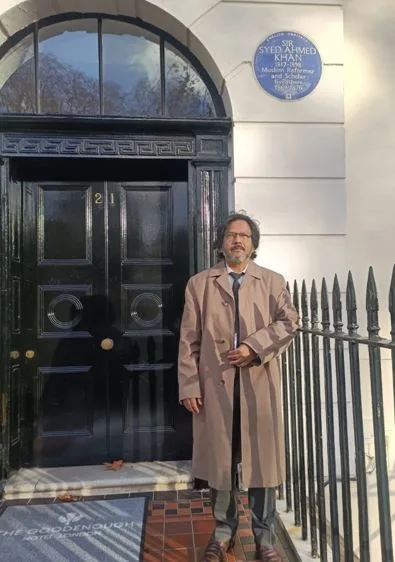
21 Mecklenburg Square
The Athenaeum Club and 21 Mecklenburg Square hold great historical value, as they are linked to Sir Syed Ahmad Khan, the founder of Aligarh Muslim University, who stayed there during 1869–70.
Engagements at Oxford and Cambridge
After the London conference, Professor Sanaullah visited the Universities of Oxford and Cambridge, where he met prominent scholars such as:
Professor Julia Bray, Bodleian Chair of Medieval Arabic Literature at Oxford
Professor Tahera Qutbuddin, award-winning scholar of Arabic oratory
Scholars from the Oxford Centre for Islamic Studies, including Dr Mohammad Akram Nadwi, founder of the Al-Salam Institute in London
He also met Dr Wafaa Abdul Razzaq, a distinguished literary figure and nominee for the Nobel Prize in Literature.
A Proud Moment for Indian Scholarship
Professor Sanaullah’s participation in this international conference and his interactions with leading academics have been widely appreciated in India’s academic community. His visit highlighted the important historic links between India and the Islamic world and strengthened India’s presence in global scholarly discussions on Islamic heritage.
The absolute and unique authority of the Qur’ān and the Sunnah of the Prophet (peace be upon him) constitutes a foundational principle of Islamic thought and practice. No individual, however learned, righteous, or influential, can reproduce, appropriate, or claim the authority inherent in divine revelation. This principle, while universally acknowledged in theory, has often been compromised in practice. Over the course of Islamic history, the interpretations and judgements of scholars have, at times, been presented to the Muslim community (ummah) as though they possessed the same epistemic and normative status as the very sources they sought to explicate. The consequences of such elevation have been profound: differences of interpretation, which are natural and inevitable, have too frequently ossified into sectarian identities and institutionalised divisions. The roots of this problem, its historical manifestations, and the means by which the special status of the Qur’ān and Sunnah may be preserved, together illuminate how diversity of thought can be prevented from devolving into fragmentation.
The Qur’ān and the Sunnah, by their nature, are divine and therefore infallible. The understanding of human beings, however sincere or intellectually gifted, remains limited, partial, and contingent. The Qur’ān repeatedly reminds its audience of human fallibility and warns against the dangers of arrogance, factionalism, and the elevation of human judgements to the level of revealed truth. This is not merely a theological humility but also a sociological safeguard: by acknowledging the limits of human interpretation, the community protects itself from the absolutising of local, personal, or historical perspectives. In theory, Muslim scholars throughout the centuries have recognised the distinction between revelation and interpretation. Classical jurisprudence developed sophisticated methodological frameworks, uṣūl al-fiqh, qawāʿid fiqhiyyah, and criteria for ijtihad, precisely to ensure that human reason remained a disciplined instrument, not an autonomous authority. The very notion of ikhtilāf (legitimate difference) and the well-known maxim, “My opinion is correct but may be mistaken; yours is mistaken but may be correct,” signal that intellectual humility and acknowledgment of fallibility are integral components of Islamic scholarly tradition.Click Here To Follow Our WhatsApp Channel
Despite this theoretical framework, Islamic intellectual history has witnessed repeated attempts by individuals, groups, or institutions to present their interpretations of the Qur’ān and Sunnah as definitive, normative, and binding. This process, sometimes subtle, sometimes overt, has contributed significantly to sectarian delineations and the hardening of intra-Muslim boundaries. Several factors explain this phenomenon. Pride in one’s intellectual school, personal position, or interpretive tradition can distort the intention of seeking truth, replacing it with the desire to defend one’s own conclusions. Over time, this personal inclination can evolve into a collective loyalty, where the prestige of one’s scholars or lineage is perceived to require defence at all costs. This dynamic, once entrenched, becomes institutionalised in the structures of religious authority, educational establishments, and even political systems. The preservation of status, influence, or livelihood may then become entangled with the preservation of doctrinal rigidity. Admitting error, or acknowledging the validity of alternative views, may be seen not merely as an intellectual concession but as a threat to one’s social and professional standing.
The Qur’ān warns the believers that division arises “after knowledge has come to them,” pointing not to ignorance but to the misuse of knowledge as the primary catalyst of discord. When knowledge becomes a means for asserting superiority rather than facilitating mutual understanding and communal guidance, it transforms into a source of fractiousness. In this light, sectarianism is not an inevitable result of differing interpretations; rather, it is a product of the human ego and the institutional structures built to protect it. A crucial distinction must therefore be drawn between difference and division. Difference is intrinsic to human cognition and is acknowledged, even celebrated, within Islamic jurisprudence. Division, on the other hand, is condemned. The difference lies not in the existence of multiple viewpoints, but in the manner in which they are engaged, communicated, and socially organised. Diversity of opinion, when approached with humility, generosity, and trust in divine guidance, becomes a source of richness and adaptability. When approached with pride, exclusivity, or institutional self-interest, it becomes a source of alienation.
One of the central failures that leads to division is the conflation of interpretation with revelation. When human conclusions are granted the aura of divine authority, disagreement becomes impossible without appearing to challenge revelation itself. This false equivalence closes the space for legitimate scholarly debate and fosters a culture in which dissent is seen as deviance. The Qur’ān and Sunnah become overshadowed by secondary discourses, and the ummah becomes fragmented not along substantive theological lines but along markers of school, sect, or scholarly pedigree. If the distinctive status of the Qur’ān and Sunnah is to be preserved, it must be reaffirmed not only in belief but also in scholarly behaviour and communal discourse. Scholars and students alike must internalise the principle that their interpretations, however carefully derived, remain human judgements, open to revision and respectful critique. This intellectual modesty does not diminish the value of scholarly endeavour; rather, it enhances it by safeguarding its integrity and ensuring that it serves the community rather than divides it.
Such a posture requires an ethical commitment to honest inquiry, a willingness to listen, and an appreciation for the plurality inherent in human engagement with revelation. Discussions and debates among the learned should model mutual respect, fairness, and the recognition that no individual or institution has a monopoly on understanding. When disagreements are navigated in this manner, they cease to be threats to unity and instead become opportunities for collective learning. The special authority of the Qur’ān and Sunnah cannot be replicated by any human agent, and any attempt to do so constitutes a distortion of the Islamic intellectual tradition. When interpretations are elevated to the level of revelation, they become instruments of division rather than means of guidance.
The historical tendency to conflate human judgement with divine authority has fuelled sectarianism, hardened intellectual boundaries, and at times undermined the unity of the ummah. By consciously preserving the unique status of revelation and embodying humility in scholarly engagement, Muslims can ensure that natural differences of thought do not become sources of disunity. A community nourished by this ethos will accommodate plural viewpoints without sacrificing reverence for its foundational sources. In such an environment, disagreement becomes a catalyst for growth, not a justification for division; and respect for the Qur’ān and Sunnah is manifested not only in belief but in the character of intellectual discourse itself.
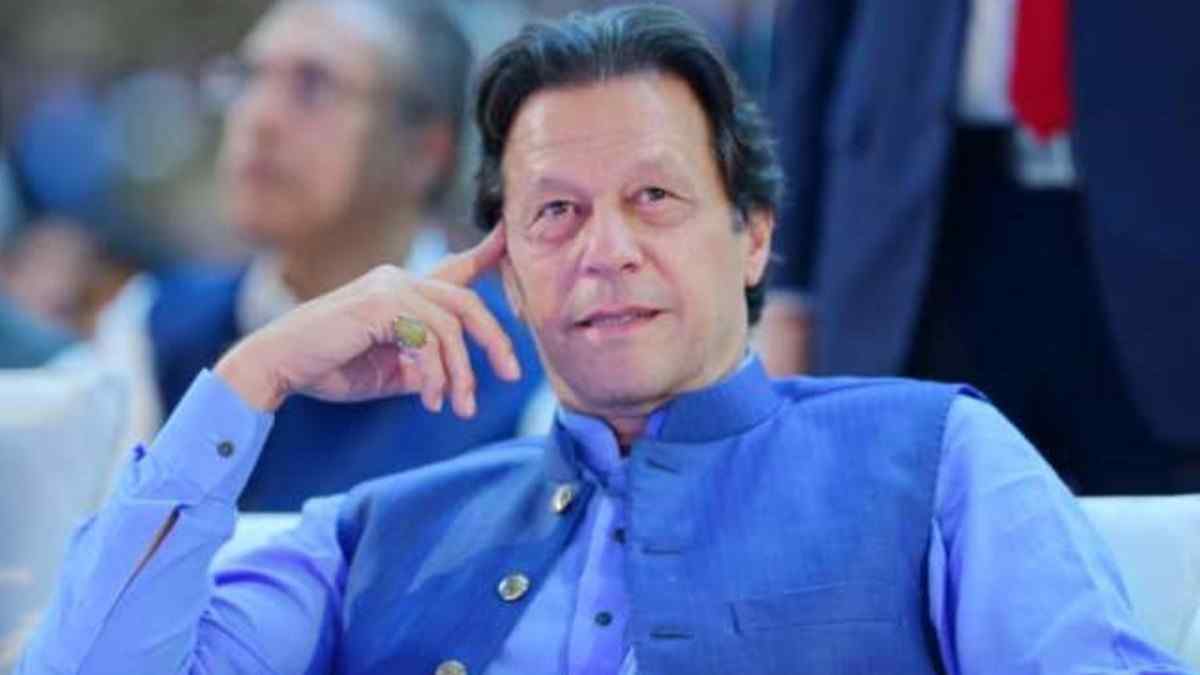
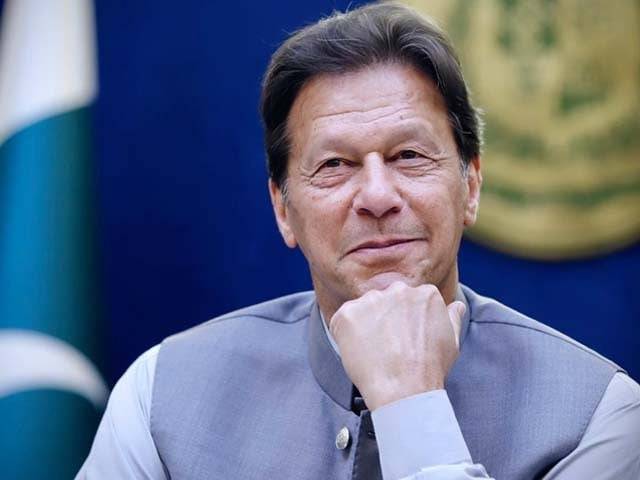
In recent days, Pakistan’s military has made strong statements against former Prime Minister Imran Khan. On December 5, 2025, the army’s spokesperson, Lt. Gen. Ahmed Sharif Chaudhry, called Khan’s ideas a “threat to national security.” He also said Khan is “mentally ill” and a “narcissist.” This has led to fears among Khan’s supporters that the army might harm him or even kill him. But is this true? This article looks at the facts, both sides of the story, and what it means for Pakistan. We will use simple words to explain everything.
Imran Khan was Pakistan’s Prime Minister from 2018 to 2022. He is a famous cricket player who started the Pakistan Tehreek-e-Insaf (PTI) party. Many people, especially young ones, like him because he talks about fighting corruption and making Pakistan stronger. In 2022, he lost power in a no-confidence vote. Khan says the army and the US helped remove him. Since then, he has been in jail on charges like corruption and leaking secrets. He calls these cases fake and made up by his enemies.
The Pakistan Army has a big role in the country’s politics. It has ruled directly many times through coups. Now, it often works behind the scenes. Khan was once close to the army, but now they are enemies. His party won many seats in the 2024 elections, but he says the vote was stolen. This has caused big protests and fights.
The Army’s Recent Statements
On December 5, 2025, Lt. Gen. Chaudhry held a long press conference in Rawalpindi. He said Khan’s words are hurting Pakistan’s security. Here are the main points:
Anti-Army Talk: Khan blames the army for his problems. The spokesperson said this creates hate between the people and the soldiers. It could make the army weaker against enemies like terrorists or India.
Mental Health Claims: He called Khan “mentally ill” and said he puts his ego first, not the country. Khan thinks, “If not me, then nothing for Pakistan.”
Links to Enemies: The army says Khan works with outside groups, like Indian media or Afghan networks, to spread bad stories about Pakistan. They also say he opposes army actions against terrorists, like the Tehreek-e-Taliban Pakistan (TTP).
Calls for Trouble: Khan is accused of telling people to protest, stop sending money home (remittances), and attack army leaders. This could hurt the economy and cause chaos.
Security Threat Label: The spokesperson said Khan’s ideas are a “creeping national security threat.” He compared Khan to past leaders who caused splits, like Sheikh Mujibur Rahman in Bangladesh. He warned that free speech has limits if it harms the state.
The army says it will fight back hard if needed. They also said Khan’s party runs fake social media campaigns to attack them.
Imran Khan and PTI’s Side
Khan and his party say these words are just to scare people and hide the army’s mistakes. From jail, Khan uses social media (through helpers) to fight back. PTI leaders like Gohar Ali Khan say the army is attacking democracy.
Popular Support: PTI says Khan has the people’s vote. In polls, over 60% want him free. Calling him a threat means calling millions of Pakistanis threats too.
Army as the Real Threat: Many supporters say the army is the problem. It controls too much, like businesses and politics. They break the law by interfering in elections and jailing opponents.
No Proof of Wrongdoing: PTI says there is no evidence Khan helps terrorists or enemies. He wants peace and strong borders, but without army control over everything.
Fears for Khan’s Life: Some posts on X say the “security threat” label could lead to a military trial, death sentence, or even killing him in jail. They point to past cases, like Zulfikar Ali Bhutto, who was hanged after army rule. Supporters worry the army is planning something bad.
PTI also attacked the spokesperson’s family, saying his father was once linked to terrorism by the UN. But the army calls this fake news.
Public Reactions
On social media like X, opinions are split:
Pro-Khan Views: Many call the army “fascist” and say it is the real security threat. They use hashtags like #ReleaseImranKhan and #PakistanLovesImranKhan. Some say the army wants to kill Khan to end his popularity.
Pro-Army Views: Others agree with the military. They say Khan is causing division and helping enemies. Government leaders like Azam Nazeer Tarar also call Khan a threat.
International media, like from India and the Arab world, report on this as a sign of deep problems in Pakistan.
Analysis: Is the Army Planning to Kill Khan?
The claim that the army “wants to kill” Khan is strong but not proven. Here is a fair look:
Historical Patterns: Pakistan has a dark history. Leaders like Bhutto were called threats and then executed. Nawaz Sharif and others were jailed or exiled. The army has used “security” reasons to remove rivals. This makes people worry.
Current Risks: Calling Khan a “threat” could mean military courts, where trials are secret and punishments harsh. Pakistan has the death penalty for treason. Supporters fear poison or an “accident” in jail, like past cases of journalists or activists.
No Direct Proof: The press conference did not say anything about killing. It focused on words and ideas. The army says it wants to protect the country, not harm people. But the strong language, like “bare-knuckle response,” scares many.
Why Now?: Pakistan faces big problems: high prices, terrorism, and bad economy. The army might want to blame Khan to distract people. Khan’s popularity is still high, even in jail. Banning PTI or hurting him could make things worse, causing more protests.
In simple terms, the label might be a way to justify tough actions, but killing would cause huge anger inside and outside Pakistan. It could split the country more.
Implications for Pakistan
This fight hurts everyone:
Security: If people hate the army, it could help terrorists. Attacks in areas like Khyber Pakhtunkhwa are rising.
Economy: Protests and boycotts make things unstable. Pakistan needs help from the IMF and friends like China.
Democracy: If the army wins, elections might not be fair. This could make young people lose hope.
Global View: The world watches. Groups like the UN or US might speak up if Khan is harmed. But Pakistan’s army is strong, and change is hard.
To fix this, both sides need talks. Maybe free Khan and hold fair elections.
Conclusion
The Pakistan Army’s words against Imran Khan are serious. They call him a security threat, but supporters see it as a plan to silence or harm him. There is no clear proof of a kill plot, but history and fears make it possible. Pakistan needs peace between leaders and the army. Without it, the country suffers. The people want leaders who work for them, not fight each other.
The Noble Qur’ān’s verse: “And indeed We have granted you seven of the oft-repeated (verses) and the Magnificent Qur’ān” (al-Ḥijr: 87), and likewise the related declaration: “A Book consistent in its parts, paired in its themes”, are clear proofs that the Qur’ān’s structure is profoundly intricate, wise, and exalted. Since ancient times the Muslim community has been accustomed to dividing the Qur’ān into seven manāzil; yet, from the perspective of meanings and themes as well, the Qur’ān possesses a subtle, eloquent, and aesthetically captivating division, which may be understood in the form of seven thematic groups.
These groups begin with the Makkan sūrahs and conclude with Madinan ones, and at certain points Madinan verses or sūrahs appear within the Makkan context, so that the entire discourse may manifest as a continuous and coherent sequence. Within each group, the Makkan sūrahs present the first aspect of the subject, while the Madinan sūrahs complete the second aspect of the same structural axis. Thus, in the miraculous coherence of the Qur’ān, a new avenue for reflection and deliberation is opened.
Here, an attempt is made to present the seven groups of the Mighty Qur’ān, along with the thematic axis of each group in a structured manner, so that the delicate interconnection of its subjects becomes clear. The earliest conception of this theory of Qur’ānic division, and its foundational basis, undoubtedly belongs to Mawlānā Ḥamīd al-Dīn Farāhī, who cast illuminating light upon the coherence (naẓm) of the Qur’ān and the harmony of its meanings. His student, Mawlānā Amīn Aḥsan Iṣlāḥī, refined this theory further and presented it in a comprehensive scholarly and analytical form, through which this conception not only gained clarity and firmness, but also highlighted the Qur’ān’s capacity to invite profound reflection.
The present division is derived from Mawlānā Iṣlāḥī’s Tadabbur-i-Qur’ān, in which the internal arrangement of themes, the interplay of Makkan and Madinan sūrahs within each group, and the historical and moral lessons are expounded with remarkable precision. It should, however, be noted that in explaining the axial theme of each group, we do not intend to adhere strictly to the precise wording or technical expressions of Farāhī or Iṣlāḥī where elaboration is possible. The objective is solely to acquaint readers with the Qur’ān’s internal coherence, the order of its sūrahs, and the interconnectedness of its themes, so that the possibilities of contemplation may expand and the secrets of its wisdom and eloquence may be illuminated.
First Group — al-Fātiḥah to al-Mā’idah This group opens with Sūrah al-Fātiḥah, which serves as a comprehensive preface and a prayer embodied in perfection. All subsequent sūrahs in this group are Madinan. The fundamental axis of this group is the exposition of religion, comprising two principal elements: Īmān and Islām. Sūrah al-Baqarah is the sūrah of faith, especially the call to faith in the Messenger; Sūrah Āl ‘Imrān is the sūrah of Islām; Sūrah al-Nisā’ is an appendix to Islām, emphasising obedience to God with specific concern for the vulnerable; Sūrah al-Mā’idah represents the completion of the entire religion. Within this collection, the subjects of law, worship, social dealings, societal structure, and the instructive accounts of earlier communities are presented in such a manner that it appears as though a complete constitution of life is being formulated for the Muslim community.
Second Group — al-An‘ām to al-Barā’ah (al-Tawbah) The opening two sūrahs of this group are Makkan, while the final two are Madinan. Its central axis is the clear proclamation of monotheism, Lordship and Divinity, and the manifestation of God’s decisive judgement following the completion of proof (itmām al-ḥujjah). In al-An‘ām and al-A‘rāf, the arguments for monotheism are expounded, natural proofs in al-An‘ām, and historical proofs in al-A‘rāf. In al-Anfāl and al-Barā’ah, the divine verdicts that follow the completion of proof are manifested, including the battles, treaties, the conquest of Makkah, and the decisive proclamation within Arabia. This group presents the historical emergence of the Prophethood of Muḥammad ﷺ and its outcomes with majesty and grandeur.
Third Group — Yūnus to al-Nūr This group is predominantly Makkan, except for its concluding sūrah, al-Nūr. Its central theme is the final stage of the prophetic call and the preparation for migration. Yūnus, Hūd, and Yūsuf highlight patience, steadfastness, and the moral qualities of the Prophets. Several sūrahs illuminate divine guidance, the decree of God, and the etiquettes of proclaiming the truth. Sūrah al-Ḥajj is considered Madinan by some exegetes; however, according to Iṣlāḥī, it is primarily Makkan, with certain verses belonging to a Madinan context, much like Sūrah al-Muzzammil, whose conclusion contains a Madinan verse. The group concludes with Sūrah al-Nūr, which, after the Hijrah, represents the proclamation of the dominance of truth. It presents the principles of social purity, chastity, legal punishments, testimony, and the moral order of home and family in a profoundly wise manner.
Fourth Group — al-Furqān to al-Aḥzāb All sūrahs in this group are Makkan except for the final sūrah, al-Aḥzāb. Its thematic axis is the struggle against falsehood, the proof of the truth of revelation, and the support and affirmation of the Messenger ﷺ. In al-Furqān and al-Shu‘arā’, the veracity of the Qur’ān, the refutation of poetical accusations, and the shared principles of prophetic missions are elaborated. Through the narratives of prophets, the outcomes of the struggle between truth and falsehood are brought to light. Sūrah al-Aḥzāb represents the historical climax of this struggle, depicting the Battle of the Trench, the trial of the believing community, and the firm manifestation of the Prophet’s leadership and legislative authority.
Fifth Group — Saba’ to al-Ḥujurāt This group is mostly Makkan, except for the final three Madinan sūrahs. Its axis is the call to faith in monotheism and accountability, along with the exposition of the principles governing the rise and decline of nations. The account of the people of Saba’, the eras of various prophets, and the certainties of reward and punishment are presented such that the moral foundations of human history become fully apparent. At its conclusion, the Madinan sūrahs, especially al-Ḥujurāt, give concrete social expression to this moral axis, setting forth the principles of communal order, brotherhood, inner reform, and the etiquettes of Islamic social life.
Sixth Group — Qāf to al-Taḥrīm This group contains seven Makkan and ten Madinan sūrahs. Its essential subject is resurrection, rising after death, and, as a consequence of faith, the renewal of monotheism, complete obedience to the Prophet, and the organisation of family and communal life. The initial Makkan sūrahs contain powerful admonitions, vivid portrayals of the Day of Judgement, and affirmations of the truth of prophethood. The Madinan sūrahs present the refinement of ethics, obedience, family relations, social order, and the etiquettes of the believing community, reaching their culmination in al-Taḥrīm, where the fine points of domestic life are addressed for reform.
Seventh Group — al-Mulk to al-Nās This group comprises mostly Makkan sūrahs, though the final five, from al-Naṣr to al-Nās, are Madinan. Sūrah Lahab’s classification is disputed; Iṣlāḥī regards it as Madinan. The central axis of this group is warning, the awakening of mind and heart, the reminder of ultimate destiny, and the safeguarding of the human interior. The sharp warnings and eschatological scenes that begin with al-Mulk culminate, at the end, in the supplicatory protection of the inner self found in the Mu‘awwidhatayn. Just as the Qur’ān begins with Sūrah al-Fātiḥah, it concludes with Sūrah al-Ikhlāṣ and the Mu‘awwidhatayn, which gather the Qur’ān’s message within an inner spiritual fortress, thus creating a subtle harmony between origin and end.
In this manner, the seven groups of the Mighty Qur’ān embody a remarkable coherence, delicate proportionality, and miraculous structure. Each group imparts a new significance to the relationship between Makkan and Madinan sūrahs, and each thematic axis establishes a refined balance between the two poles of faith’s call and the organisation of the Muslim community.
This miraculous composition has always invited people of insight and understanding to engage deeply with the Qur’ān’s pedagogical system, its historical continuity, and its treasury of divine wisdom.
Question: Assalamu Alaykum wa Rahmatullahi wa Barakatuh Shaykh. I pray you are well in sha Allah. I have a question. Can we apply for crowdfunding, or can we raise fund through such platforms once end up in financial hardship? Is it allowed in Islam to request help from a human being rather than Allah? Is it not contrary to the wisdom of Surah Fatiha: Iyyaka Nabudu va iyyaka nastain? Also, is it allowed to get a mortgage with interest and a standard loan with interest? Are these all riba? Jazakallahu Khair
Answer: Wa ʿAlaykum as-Salām wa Raḥmatullāhi wa Barakātuh. May Allah grant you ease, clarity, and barakah. Click Here To Follow Our WhatsApp Channel In Islam, seeking assistance from other human beings in times of hardship is permissible, and this does not contradict the spirit of reliance upon Allah expressed in the verse iyyāka naʿbudu wa iyyāka nastaʿīn. The essence of tawakkul is that a person’s heart depends upon Allah alone, while they still make use of the lawful worldly means that Allah has placed at their disposal. The Prophet ﷺ taught complete trust in Allah, yet instructed us to “tie the camel,” indicating that taking practical measures never negates spiritual reliance. Thus, if someone is facing genuine financial difficulty, it is entirely permissible for them to seek help from others, whether in the traditional forms of charity, zakāh, and ṣadaqah, or in modern forms such as crowdfunding. Crowdfunding is simply an organised mechanism through which donors can offer assistance; it does not constitute prohibited begging when the individual’s need is real, their appeal honest, and the funds used for their stated purpose.
The Qur’ān and Sunnah repeatedly emphasise the importance of alleviating hardship and supporting those in distress. The Prophet ﷺ said that whoever relieves a believer of a burden in this world, Allah will relieve one of their burdens on the Day of Judgement. Seeking help, therefore, is not only permitted but provides an opportunity for others to earn immense reward. The Companions themselves would ask one another for assistance when necessary, and the Prophet ﷺ did not censure them for doing so. What Islam discourages is habitual or unnecessary asking, especially from those who are capable of earning and resolving their situation independently. However, when a person faces a genuine difficulty, turning to their community is part of the normal means that Allah has made available. Asking Allah remains the foremost act, for He alone is the ultimate provider, but He often provides through secondary causes. When one asks others, they are not substituting people for Allah; they are employing the means Allah Himself has created while maintaining reliance upon Him.
As for interest-based loans and mortgages, classical Islamic law is unequivocal that ribā in loan contracts is prohibited. This ruling is rooted directly in revelation and is affirmed unanimously by the four Sunni schools of law. A conventional mortgage, in which one borrows money and repays it with interest, falls under this category of ribā. Personal loans with interest fall under the same prohibition. This is the foundational principle, and it remains the default ruling.
However, contemporary circumstances have compelled jurists to revisit how this principle applies to Muslims living in non-Muslim societies where the financial system is entirely interest-based, where Islamic alternatives may not exist, and where long-term renting may not provide security or stability for a family. Several respected modern scholars have examined the realities in such contexts. They note that Muslims living as minorities have no influence over the structure of the economy and cannot alter the system, yet are required to function within it. They further observe that owning a stable home may be closely connected to family wellbeing, dignity, and long-term security, all of which are recognised objectives of the Sharīʿah.
In light of this, some contemporary scholars have argued that securing a primary residence for one’s family in such conditions may reach the level of a pressing need (ḥājah) which, when widespread and continuous, can be treated with some of the considerations applied to necessity (ḍarūrah). Based on this reasoning, they permit taking an interest-bearing mortgage strictly for purchasing a personal residence when no genuinely Sharīʿah-compliant alternative is realistically available. This allowance is not a relaxation of the prohibition of ribā in principle; ribā remains impermissible. Rather, it is an exceptional ruling tied to unavoidable circumstances. Even those who permit it apply strict limits: it is only for one’s own home; it cannot be for business, investment, profit, buying to rent, or buying for resale; it does not extend to second properties; and it is justified solely by the need to secure shelter and stability for one’s family.
May Allah grant you clarity, strengthen your reliance upon Him, provide for you through lawful means, and place barakah in your sustenance.
There are leaders who rule through power, and there are leaders who rule through the hearts of people. In today’s Pakistan, the difference is clear. Imran Khan is not just another political figure — he has become a symbol of hope, dignity and resistance for millions of Pakistanis.
For many citizens, this clash was never simply about elections or political parties. It has become a fight between a system that has survived for decades and a man who dared to challenge it.Click Here To Follow Our WhatsApp Channel
Why Imran Khan Became the Voice of the People
Long before the current political crisis, Imran Khan inspired a new generation. His supporters believe that he represents honesty in a landscape filled with corruption and greed. They see him as a leader who:
speaks without fear,
questions authority,
and puts Pakistan first.
He did not come from a traditional political family. He did not inherit power. He earned it through public trust. That is why attempts to weaken him only bring more sympathy and support.
A Leader Who Refuses to Bow Down
In the eyes of his supporters, Imran Khan stands alone against a political machine stronger than any party. They believe:
he is being targeted because he refuses to compromise,
he exposed the weaknesses of traditional power structures,
and he awakened the confidence of ordinary people.
Whether on the streets, social media, or public discussions, one sentiment keeps returning again and again:
“He fights for us.”
This connection is emotional and personal — the kind of connection that cannot be taken away by force or intimidation.
A New Political Awakening
For decades, ordinary citizens felt powerless. The same families and the same elite circles controlled the country. Many Pakistanis felt they had no voice. But Imran Khan changed that. His supporters see him as the only leader who talks openly about:
national self-respect,
independence in foreign policy,
ending corruption,
dignity for every citizen.
It is not just admiration. It is belief. It is hope. It is love for a man who dared to say what millions had been feeling.
A Public That Refuses to Give Up
Even when Imran Khan faced political and legal pressure, his support did not collapse. If anything, it grew. His rallies became bigger. His message became louder. His image became stronger.
His followers say that this is because Pakistanis have changed. The public today is more aware, more emotional, more resistant. They are no longer silent. They no longer accept whatever the system decides.
And in this new Pakistan, Imran Khan has become a symbol of courage.
The Battle Is Not Over
This is not the end of the story. The struggle continues. The establishment has its power, but Imran Khan has something far more dangerous and powerful:
the people.
For millions who support him, he represents:
justice,
pride,
independence,
and a better future for Pakistan.
His movement is not just political. It is personal. It is emotional. It is a fight for dignity.
A Leader Who Became a Movement
Perhaps that is why no matter what challenges he faces, Imran Khan remains the heart of the nation. His supporters believe that he is the only leader who stands between them and a system they feel has failed them.
“Imran Khan is our voice. Imran Khan is Pakistan’s future.”
This slogan is more than just a line shouted at rallies. It has become the emotional heartbeat of an entire movement. To millions of Pakistanis, Imran Khan represents something they were waiting for all their lives: someone who speaks when they cannot, someone who dares when others stay silent.
He became the voice of frustration
For decades, ordinary people felt ignored. Inflation rose, corruption spread, and trust in the system faded. Many believed that no matter which party ruled, nothing changed for them. They were unheard.
Then came Imran Khan — talking about dignity, justice and fairness. Whether one agrees with his politics or not, there is no doubt that he gave people the confidence to speak. He changed the political conversation. He made the public believe that their voice matters.
He became the voice of hope
Supporters say he made them dream again. He made them believe that Pakistan deserves more than struggle, more than division, more than broken promises. Young people who once never cared about politics suddenly saw a future worth fighting for.
The older generation saw a leader who reminded them of Pakistan’s original promise: a country built on self-respect, independence and equality.
He became the voice of resistance
Whenever his supporters felt their country was controlled by the same handful of powerful figures, Imran Khan became the person who said:
“You deserve better.”
They saw him challenge the system openly, publicly, fearlessly. His supporters believe he is not just a politician — he is a movement.
Why they call him Pakistan’s future
Because his followers do not see him only in the present. They see him as the leader who can:
break old political traditions,
speak for the poor and ordinary people,
bring pride to the nation,
and build a future that belongs to everyone.
To them, the slogan is a promise:
Pakistan will not return to the past.
And whether he is in office or in opposition, inside parliament or outside, his supporters still say the same words with pride and emotion:
“Imran Khan is our voice. Imran Khan is Pakistan’s future.”
It is not just a sentence. It is a belief. It is a declaration of identity. It is a message from the people to the system.
The fiqh related to relief work generally begins and ends with an account of the obligations of zakah and its voluntary counterpart, sadaqa. Much of the discussion on zakah is focused on the legitimate expenditures from zakah funds and the right procedures for their collection and distribution. In the present age very few, if any, of the Muslim-majority states exercise real sovereignty over their economic and political affairs, and they have even less control of the educational and cultural influences on their people. The large-scale relief efforts undertaken by Muslim states and by non-governmental organisations (NGOs) run by Muslim volunteers respond to the emergencies that arise from natural disasters and wars. The funds they are able to raise and the relief work they are able to sustain are highly dependent on how intensively and for how long the emergencies are presented in the news cycle. Again, the reality Muslims must acknowledge is that the news cycle is not under their control, though this situation has improved a little in recent decades. The Muslim-run relief programmes and their sustainment after the immediate emergency are typically modelled on the legal and administrative forms of Western NGOs, and they run similar projects, such as health clinics, provision of access to clean water, primary education, and the like. Of course such programmes are necessary, deeply appreciated by the recipients of relief, and must continue. But, just as with the relief work of Western NGOs, the work of Muslim NGOs is always ongoing: the good that they do does not appear to result in freeing the recipients of relief from their need for relief. Instead, the relief efforts appear to highlight, and perhaps even aggravate, the dependency of the recipients of relief on the different agencies, Muslim or non-Muslim, which are providing the relief.
It hardly needs saying that the purpose of Islamic relief agencies cannot be to perpetuate Islamic relief agencies. Rather, their goal must be to establish the conditions in which the need for relief agencies is steadily reduced and the dependency of the recipients of relief comes to an end, ideally with a large contribution from their own local efforts. Everybody knows the Prophetic hadith in which a beggar is given the money to buy a rope and advised to collect firewood which he can then sell, instead of having to return to begging. This and other similar hadiths demonstrate the underlying principle: to the extent possible help persons in need to help themselves. That is the greater good, beyond short-term relief of poverty and hardship, which Islamic relief should be concerned about. However, the Western conception of relief efforts, and Western legal frameworks for that work, explicitly and formally discourage any challenge to the injustices in social and economic relations which keep the poor and needy always poor and needy. Allah has clearly said in His Book that wealth and opportunities to prosper should be freely and fairly circulated, not concentrated in the hands of the same social or ethnic group. The Islamic legal distinction, among means and ends, between halal and haram, and the commandments related to division of property under inheritance laws, are very much part of fiqh, no less important than the fiqh of zakah and sadaqa. Muslims should not be constrained by Western conceptions and practice of relief work. The intentions and actions of most volunteers in Western relief agencies may well be motivated by sincere concern and compassion for the people in need of relief, but ultimately their efforts are expressions of pity rather than compassion.
The world is on the edge of profound changes in the balance of political and economic power: the international order that has prevailed since mid-18th century, when European colonial expansion across the world became increasingly cruel and increasingly irresistible, appears to be coming to an end. Despite brutal resistance in some places, a new order is emerging, in which various Muslim polities will have a big part to play. Especially in sub-Saharan Africa, we see strong efforts to establish economic and political sovereignty, to reject the ongoing plunder of their natural and human resources by former European colonial powers, and to resist the takeover of those powers by the United States after the Second World War. This is an opportunity for Islamic relief agencies to re-think their motives and re-orient their programmes so that they distinguish clearly between short-term, emergency responses to the need for relief, and long-term responses which aim to end, and not perpetuate, the need for relief.
One way to understand the difference between short-term and long-term responses to need for relief is to understand the difference between pity and compassion. These two concepts or sentiments are very complexly interlinked and therefore hard to distinguish. It will be useful to look first at another pair of interlinked concepts, whose interlinkage is not so complex, namely remorse and repentance. Remorse is feeling bad about having done something we know is wrong or harmful to oneself or others, or that we know is disapproved by God. This feeling opens the door and should lead on to repentance, the determination never to do that bad thing again, and then never doing it again. However, as we all know, it is possible to feel remorse while still desiring and intending, perhaps even planning, to do the bad thing again. In other words, though remorse opens the door to repentance, it does not naturally flow into it. Rather, there is a need for a conscious decision and focused effort to pass through that door and realise repentance. Those who get stuck in remorse can become addicted to it: they look forward to the remorse as well as looking forward to doing the bad thing. Over time remorse may, perversely, flavour and enrich the enjoyment of what is then experienced as a ‘guilty pleasure’ or ‘pleasurable guilt’. This does not make remorse itself a bad thing. Remorse is a good thing always because it is the doorway to repentance. Even for those who habitually refuse to step through that doorway, it remains open until the close approach of the individual’s death, whereupon it is too late.
The relation between pity and compassion is similar but more complicated. Pity is what we naturally feel when we see someone else in trouble. This feeling quickly and naturally becomes an impulse to help lessen or end the trouble. The mechanism generating this feeling is the capacity to mirror in one’s own self the experience and situation that is presented to us in another person. This capacity, where in the brains it happens, and how exactly the so-called ‘mirror neurones’ do what they do, is not yet well understood. It is most likely that capacity underlies our ability to understand what someone else means, whether they speak effectively or not, and sometimes even when they do not speak; somehow, we already know more or less what they are feeling or thinking. Being able to feel what a person in trouble is feeling sparks the impulse to help them. Suffering what someone else is suffering is the root meaning of the English word ‘compassion’, namely ‘suffering with’. But there is a complication.
While the brain mirrors what another is suffering it does not stop being aware that the other is the one suffering, not oneself. Since in principle suffering is undesirable, there is an impulse to turn away from it. Then, instead of the feeling of pity flowing naturally into the feeling of compassion, the witness to suffering may become aware of their own exemption from that suffering, and experience instead a sense of superiority inasmuch as they are able to help the other, but the other is not in any position to help them. God has made us in such a way that pity opens the door to compassion and naturally flows into compassion –– unlike the relation between remorse and repentance, compassion flows naturally, it does not require a particular resolve and decision for pity to switch on compassion. However, God has also permitted Shaytan, until the end of time, to lay ambushes for humankind, and Shaytan has developed many stratagems to block that natural flow. For example, Shaytan will focus our attention on out being in a socially superior position, the position of help-giver and not help-recipient. Then, questions flood into the heart and perplex the impulse to compassion: does the recipient really deserve to be helped, and how much help would be appropriate, and so on. In the best case of such shaytani influence, what the Western media call ‘compassion fatigue’ sets in: surely, we tell ourselves, we have already done enough, we have done our part; we cannot do more, the need is just too great; etc. In the worst case of shaytani influence, ‘compassion refusal’ or ‘reversal’ sets in: this is the position of those reported in the Quran as saying: if God wanted these people to be fed, He would have fed them directly, or created for them circumstances in which they could feed themselves; these needy people are not our problem. Because pity has not been permitted to flow into compassion, pity itself erodes and disappears, and then, instead of pity, people feel something like contempt for the needy even though they may be too well-mannered to give expression to this contempt. Either way, their behaviour shows that they do not care, not really.
This self-exclusion from pity and compassion sooner or later turns into an incurable self-centredness, that is, a determined, enduring self-exclusion from any dependency on compassion, on the grace of God; people rely instead on their own strength, individual or collective, on their rationality, their efficiency and industriousness in exploiting the natural and human resources around them. Although it is obvious that the ground of there being any existence at all, let alone, sentient life, and especially the intelligibility to sentient human life of what happens in the world, is the rahma of Allah –– even the most determined atheists know that they did not create themselves, that they are indebted creatures, indebted to parents and family, to society, to the whole, vast span of heavens and earth –– although all this is obvious and obviously real, unbelievers will deny this rahma. In so doing, they affirm their kufr, they cover up the truth with theories like all existence is the product of chance collisions of particles moving at random. Even if that were true at the level of subatomic particles –– and it can be true only in light of our restricted observations and mathematical accounts of those collisions –– it cannot be true of the reality we experience as human beings, as individuated assemblages, at some certain time and place, of subatomic articles. Each of those assemblages is fully self-conscious, and fully capable of interacting with the self-consciousness of other assemblages of the same, human kind.
I have explained elsewhere that the fundamental assumption of modern Western economics, namely the scarcity of resources and the necessity of a pitiless competition to seize (and exhaust) those resources is false. The assumption is often expressed as ‘life is a jungle’; ‘it is dog-eat-dog world’, etc. In reality, the rich diversity of a jungle happens through the emergence over time of complex interactionof co-operativeness among different elements of inanimate and animate existence. Competition occurs within the co-operativeness: it broadens, magnifies, and intensifies the quality of the different life-forms, so that they diversify and entangle, re-diversify, re-entangle, and spread out little by little: the jungle is not an absence of moral order, but the presence of a moral order more richly and profoundly integrated than suits the narrow aspirations of human economic effort. Only human beings over-eat, over-produce, over-consume, to the point, way beyond satisfaction, of toxicity, of poisoning themselves and poisoning the jungle itself. As for the dog-eat-dog metaphor. Yes, dogs will fight over the same bone, and the dog who loses the fight will go hungry, and be emotionally and physically weakened before the next fight. But more often than not, fighting gestures and noises substitute for actual fighting, so that the ‘competition for resources’ is at worst only lethal, not fatal. So the dog who loses lives to fight another day, another, better fight. Again, only humans take this competition beyond the symbolic or mildly lethal level; they seem to need to kill off the competition, to take everything into self-centred ownership, convert everything into commodity and property, and actively prevent others from sharing in it. This mind-set is the absolute opposite to the grace of God, which gives to these as well as those, and which looks (to the religiously infirm) like randomness, an arbitrary distribution. If and when infected by Shaytan, the same mind-set becomes a prison of personal or national/cultural or racial pride: I/we are inherently better than them: we are entitled to rob them of their past and future; we are entitled to reduce them to a near-permanent servitude to our interests, our tastes, and our whims.
The grand gestures of philanthropists so characteristic of wealthy elites –– the support for food and water distribution, for sciences and arts, and for sports and other distractions –– have been, among the elites of Western civilisations, especially cynical. Under both Greek and Roman imperialisms, conquering generals, political administrators, owners of large land-holdings, and controllers of trade routes and of tribute- or tax-incomes, were expected to fund costly religious ceremonies for the general public, and these could include lavish food distribution, gifts of money, and distractions like sports festivals. The purpose of this philanthropy is to please the mass of people, to project a positive brand image for the donor, and to prevent the recipients of the largesse from resisting their deprivation by the individual donor or by the class of donors. Examples of such behaviour could easily be presented from Islamic history, and yet it has never been a settled characteristic of Islamic civilisation in general.
Christianity developed the earlier pre-Christian notion that the gods (spitefully) deprived human beings of immortality and other superpowers but allowed them to become ‘as gods’, to live (after death) like stars in the heavens, if they excelled in life, as warrior-heroes or sports-heroes or champions of some other sort –– these who did not excel (all humans except a handful), and defy the limitations the gods had imposed on them, lived on as shadows or shades of themselves in a space, distinct from the earth and distinct from the habitations of the gods. somewhere below or deep inside the earth. By divinising Christ, and building a dramatic narrative (seemingly modelled on comparable dramatic narratives in Greek literature) wherein Christ’s non-combative response to evil demonstrates God’s (ultimately) forgiving nature, Christianity divinised pity, separating it radically from compassion. God pities humankind (having created them pitiable) and by dying for them somehow liberates them from their humanity, transforming their suffering into a state that transcends their humanity. This teaching underwent a long evolution not relevant here. What is relevant here is that, in Christian practice (which persists in post- and ex-Christian social and legal forms), the political, military effort of plundering the resources of others is regarded as just the way the world is, its ‘evil’, which cannot be escaped. However, its worst consequences can be mitigated by acts of pity towards the victims or ‘losers’. Thus it is commonplace to observe nations and corporations operating within political and economic structures, laws, and practices which systematically and enduringly deprive others of the benefits of their natural or labour resources, while also, separately, pitying them and arranging for occasional hand-outs to mitigate the effects of the misery and servitude imposed on them. Making an unconscionably large profit and being philanthropic with it are regarded as radically separate human efforts. Thus, for example, after profiting for centuries from the most brutal and cruel form of human slavery, and complimenting themselves on the great civilisational enterprises they were able to undertake as a result of this compelled labour, Western politicians proceeded to compliment themselves on their humanity (their superior humanity) by making the slave trade, and then slavery itself, illegal. The quality of compassion felt for the slaves may be judged from, first, the fact that slave-owners, not slaves, were compensated for the ending of this economic practice; second, from the fact that the abolition process began and matured simultaneously with the introduction of machinery that could more profitably replace slave labour; third, from the fact that, within fifty years of abolition, the principal source of slaves, Africa was subjected to the most brutal colonisation, entailing genocide, ethnic cleansing, etc. on a scale comparable to what was done in America and Australia; and fourth by the fact that the pseudo-scientific nonsense of ‘superior humanity’ is as vigorously practised as it is vigorously denied. Look at Palestine, Gaza particularly, if you think this is over-stating the case.
Islamic relief agencies cannot operate within a framework other than the one where pity substitutes for and replaces compassion, where the need for relief is met short-term, crisis by crisis, but the conditions underlying such need are not addressed. It is very wrong to accuse Western charitable endeavours of being hypocritical. They are not; they can be, and mostly are, perfectly sincere. The point I am making is that those endeavours are in themselves, structurally and formally, misdirected, intended to address the sights and sounds that human suffering makes, which upset us (because Allah is rahman and rahim), but which are not intended to end that suffering properly and enduringly. Until the Muslim peoples of the world attain a much larger measure of political, economic and cultural sovereignty, than is currently possible, Islamic relief agencies must continue to do the good that they are doing. But while doing it, they can desire what is better than that, and worthier of their Islamic heritage. The contacts their volunteers make among the people they are helping can provide them with information that relates to reforms (in governance, in land and water usage, in infrastructure development and the like) which might assure future economic prosperity. Even within the rules constraining NGOs, NGOs can and do collate such information in the form of reports that can inform Muslim donors as to what the whole relief effort should be aiming for. At the same time, these same reports can be a basis for encouraging Muslims living in some degree of prosperity to make common cause with the recipients of their donations through specific acts of economic solidarity: identify with them, look for opportunities to help them help themselves; figuratively, provide them with the rope that they can use to bundle firewood and not have to beg.