Anantnag ‘Azi-Fazi’ Slogan Row: BJP Distances Itself, Suspends Nine Workers After Article 370 Rally
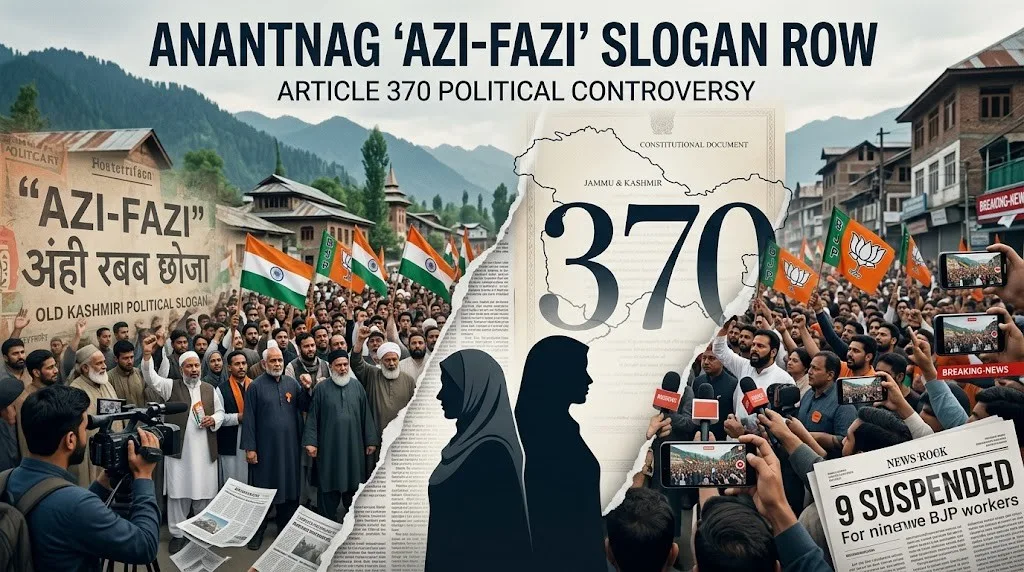
A political controversy has erupted in Jammu and Kashmir after some BJP workers allegedly altered a well-known National Conference slogan linked to Article 370 during an event in south Kashmir’s Anantnag.
The incident took place during events marking the seventh anniversary of the 2019 constitutional changes in Jammu and Kashmir. A video showing BJP workers chanting and dancing to the altered slogan subsequently attracted widespread criticism on social media and from political parties. Click Here To Follow Our WhatsApp Channel
The BJP later distanced itself from the remarks and said the slogans did not represent the party’s official position.
The controversy also resulted in disciplinary action against nine BJP workers in Anantnag.
At the centre of the dispute is the meaning and political history of the “Azi-Fazi” slogan, which has been used in Kashmir for years as part of political messaging around Article 370.
What happened at the Anantnag event?
The controversy emerged during a BJP event in south Kashmir’s Anantnag on 5 August 2026, the seventh anniversary of the Union government’s 2019 decision concerning Article 370.
The event was part of BJP activities marking what the party considers a major constitutional and political change in Jammu and Kashmir.
During the programme, some BJP workers were filmed raising slogans that appeared to modify a traditional slogan associated with the National Conference.
The original slogan has been reported as:
“Aze hund izat te Faze hund izat 370”
The phrase can broadly be understood as saying that the honour of Azi and Fazi is Article 370.
According to The Times of India, the workers changed the wording to:
“Moklev Fazi hund te Azi hund izat”
The altered version was reported as meaning that the honour of Fazi and Azi had ended.
It was this change that turned an otherwise political slogan into a wider controversy.
Who are Azi and Fazi?
Azi and Fazi are women’s names commonly heard in Kashmir.
Their importance in this controversy comes from the way the names have been used in political language.
The original slogan associated the names with Article 370 and the idea of protecting the dignity and interests of people in Jammu and Kashmir.
The names therefore became symbolic rather than simply referring to two particular individuals.
Opponents of the BJP’s slogan argued that changing the wording to suggest that the honour of Azi and Fazi had ended could be understood as derogatory towards Kashmiri women.
The BJP, however, maintained that the words were used by individuals and did not represent its official position.
Why is the slogan connected with Article 370?
Article 370 was not simply a constitutional provision in Jammu and Kashmir’s political history.
For decades, it was also a major political symbol.
The National Conference and other regional political groups frequently used Article 370 in campaigns concerning Jammu and Kashmir’s constitutional position, political identity and rights.
The “Azi-Fazi” slogan became part of that political language.
By connecting the honour of women with Article 370, the slogan turned an abstract constitutional question into a message that could be understood at the household and community level.
It was therefore used to argue that the constitutional arrangement was connected with the interests and dignity of ordinary people.
What changed in 2019?
The political background to the controversy goes back to August 2019.
On 5 August 2019, the Union government announced major constitutional changes relating to Jammu and Kashmir.
Article 370 was effectively rendered inoperative, and the former state was subsequently reorganised into the Union Territories of Jammu and Kashmir and Ladakh.
The decision fundamentally changed Jammu and Kashmir’s constitutional relationship with the Union.
For the BJP, the move represented the completion of a long-standing political objective and greater constitutional integration.
For the National Conference and other regional parties, the decision represented the loss of the region’s previous constitutional position.
This difference remains one of the most important political divisions in Jammu and Kashmir.
Why did the modified slogan trigger backlash?
The controversy was largely about the meaning attached to the names Azi and Fazi.
Critics argued that political criticism of Article 370 is legitimate, but that language referring to the honour of women crosses a different line.
National Conference spokesperson Tanvir Sadiq said the names represented the dignity and respect associated with Kashmiri mothers and sisters.
PDP spokesperson Syed Tajamul Islam also argued that political and ideological differences should not lead to language that demeans women.
These statements represent the opposition parties’ interpretation of the incident and should be distinguished from the BJP’s position.
BJP rejects responsibility for the slogans
The BJP did not defend the controversial wording.
Instead, the party publicly distanced itself from the slogans.
J&K BJP spokesperson Altaf Thakur said that individuals may have raised slogans based on their own thinking or emotions, but that the remarks did not represent the BJP’s official position or the views of the leaders who led the rally.
He also said the party did not endorse defamatory or derogatory remarks against anyone.
BJP general secretary (organisation) Ashok Koul similarly stressed the party’s position on women’s dignity and empowerment.
According to the BJP, the remarks should therefore be treated as the actions of individual workers rather than as an authorised party message.
Nine BJP workers face disciplinary action
The controversy went beyond a political exchange when the BJP took disciplinary action against workers in Anantnag.
Nine party workers were suspended, according to reports on the disciplinary action.
The action included removal from organisational positions and suspension of primary party membership pending further inquiry.
The move was significant because it showed that the party leadership was attempting to prevent the controversial slogans from becoming associated with its official position.
The disciplinary process also shifted part of the controversy from political criticism to an internal party matter.
Who are the suspended workers?
Reports identified nine BJP workers facing disciplinary action in connection with the Anantnag controversy:
- Nisar Ahmad Bhat
- Khursheed Ahmad Sofi
- Aabida Rafiq
- Irshad Ahmad Malik
- Mohd Maqbool Ganie
- Waheed Ahmad Itoo
- Nisar Ahmad Hakeem
- Feroz Ahmad Hajam
- Sabrooza Akhter
The reported action was taken pending further inquiry.
The suspensions should not be confused with criminal convictions or findings of guilt by a court.
They are an internal political party disciplinary measure.
Was the rally officially authorised?
Another part of the controversy concerns the organisation of the event itself.
The BJP said the Anantnag rally was not authorised by its district unit and that the organisers had not obtained the necessary permission from the district administration.
This gave the party an additional basis for distancing itself from the event.
In other words, the BJP’s response involved two separate issues:
- It rejected the controversial slogans as an expression of official party policy.
- It questioned the authorisation and organisation of the rally itself.
What about senior BJP leaders present at the event?
Reports also drew attention to the presence of former BJP MLC Sofi Yousuf at the event.
His presence became relevant because the controversial slogans were reportedly raised during the programme.
However, the reported disciplinary action was directed at nine party workers.
Presence at an event, by itself, does not establish that an individual personally created, approved or raised a particular slogan.
That distinction is important when assessing responsibility for the incident.
Political parties react
The controversy quickly spread across Jammu and Kashmir’s political landscape.
The National Conference and PDP criticised the language used at the rally.
Their central argument was that political competition should focus on policies and constitutional issues rather than language that could be perceived as insulting women.
The BJP, on the other hand, sought to establish that the remarks were not its official position.
This created an unusual situation in which the ruling party and opposition parties agreed that the slogans were inappropriate, although they differed sharply over the wider political context.
The women’s dignity argument
At the heart of the controversy is a broader question about political language.
Political parties regularly use slogans to simplify complex issues and mobilise supporters.
However, slogans can also carry meanings that go beyond their literal words.
In this case, the original slogan used the names Azi and Fazi as political symbols.
Changing the slogan changed its political meaning.
Critics viewed the altered wording as a reference to the supposed loss of women’s dignity.
The BJP viewed it as the personal expression of individuals rather than an official party message.
The distinction between those two interpretations is central to understanding the controversy.
Article 370 and Kashmir’s political identity
The incident also highlights why Article 370 remains such a sensitive issue in Jammu and Kashmir.
Seven years after the 2019 changes, political parties continue to have fundamentally different views about what those changes mean.
The BJP presents the 2019 decision as a historic step towards national integration and a new political framework.
Regional parties continue to focus on questions of statehood, political rights and Jammu and Kashmir’s former constitutional position.
As a result, Article 370 remains more than a historical constitutional subject.
It continues to influence political campaigns, speeches, protests and public debates.
Why the controversy matters beyond one rally
The Anantnag incident could easily have remained a local political dispute.
Instead, the video circulated online and transformed the episode into a broader discussion about political language, women and Kashmir’s political history.
There are three separate issues involved.
1. The political meaning
The altered slogan was clearly connected to the long-running debate over Article 370.
2. The question of dignity
Because the slogan used women’s names as symbols, critics argued that the altered wording crossed from political criticism into derogatory language.
3. Party accountability
The BJP’s decision to suspend nine workers raised a separate question about discipline and responsibility within political organisations.
Looking at all three dimensions gives a more complete picture of the controversy.
What is confirmed and what remains disputed?
A careful reading of the available reporting separates established developments from political interpretation.
Reported facts
- The controversy arose during an Article 370-related BJP event in Anantnag.
- BJP workers were reported to have modified a traditional NC slogan.
- Video of the slogans circulated publicly.
- The BJP distanced itself from the remarks.
- BJP leaders said the slogans did not represent the party’s official position.
- Nine workers were reportedly suspended.
- Opposition parties criticised the wording.
Political interpretation
Whether the modified slogan should be understood primarily as an attack on Kashmiri women, a political taunt aimed at the National Conference, or both remains a matter of political interpretation.
The available reporting clearly establishes the controversy and the BJP’s response, but the intention of every individual who participated in the chanting cannot automatically be established from a video alone.
Was an FIR registered?
This point also requires careful wording.
Political leaders demanded that an FIR be registered against those responsible.
However, a demand for police action is not the same as confirmation that an FIR has actually been registered.
Unless police authorities officially confirm a case, reports should describe an FIR as a demand rather than an established development.
Similarly, the BJP’s internal suspension of nine workers should not be described as a criminal punishment.
It is a party disciplinary action.
The wider debate over political decency
The controversy raises a larger question about how political parties conduct campaigns.
Strong political disagreement is normal in a democracy.
Article 370, statehood and Jammu and Kashmir’s political future remain legitimate subjects for intense debate.
But political parties also have a responsibility for the language used by their workers at public events.
The BJP’s decision to suspend nine workers suggests that the party leadership recognised the potential political damage caused by the slogans.
At the same time, the incident demonstrates the difficulty of controlling every slogan raised at a large political gathering.
The bigger picture
The “Azi-Fazi” controversy is ultimately about more than two slogans.
It brings together three powerful themes in Jammu and Kashmir politics: Article 370, Kashmiri identity and women’s dignity.
The original slogan had been used to defend a particular political narrative.
The altered version was used in an event celebrating the removal of the constitutional arrangement that the original slogan supported.
That reversal explains much of the political sensitivity surrounding the incident.
The controversy also shows that political language from the Article 370 era continues to have resonance in Kashmir.
Conclusion
The Anantnag slogan controversy has become one of the more notable political disputes surrounding the seventh anniversary of the 2019 changes to Article 370.
What began with slogans raised by BJP workers developed into a wider debate over political culture, women’s dignity and Kashmir’s constitutional history.
The BJP has clearly distanced itself from the controversial wording and taken disciplinary action against nine workers.
Opposition parties have argued that the altered slogan crossed a line by invoking the dignity of Kashmiri women.
At the same time, it is important to distinguish between what was said, who said it, what political meaning others attached to it, and what the BJP officially endorsed.
That distinction matters in any responsible account of a politically sensitive story.
The larger significance of the episode lies in what it reveals about Jammu and Kashmir’s politics seven years after the 2019 constitutional changes: Article 370 may have changed in law, but its political language, symbolism and emotional resonance remain very much alive.