From 1 Tonne to 12 Tonnes: How Khudwani Transformed Kashmir’s Rice Production
By : Shah Sagar South Kashmir
For generations, rice has been far more than a crop in Kashmir. It is a staple food, an important part of rural livelihoods and a key component of the Valley’s agricultural economy. Click Here To Follow Our WhatsApp Channel
But Kashmir’s ability to produce rice has changed dramatically over the past several decades.
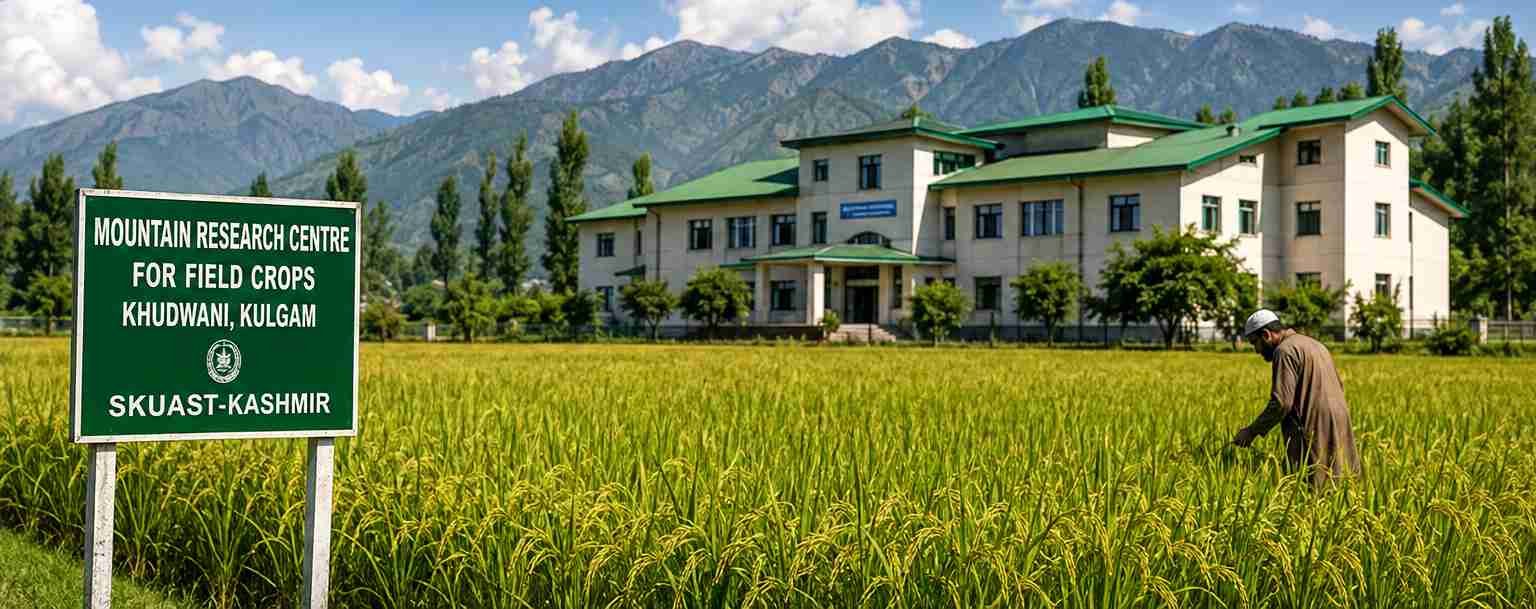
At the centre of that transformation is the Mountain Research Centre for Field Crops (MRCFC), Khudwani, in south Kashmir’s Kulgam district. What began as a rice research station has evolved into one of the most important centres for rice breeding, disease resistance, climate adaptation and crop-management research in the Himalayan region.
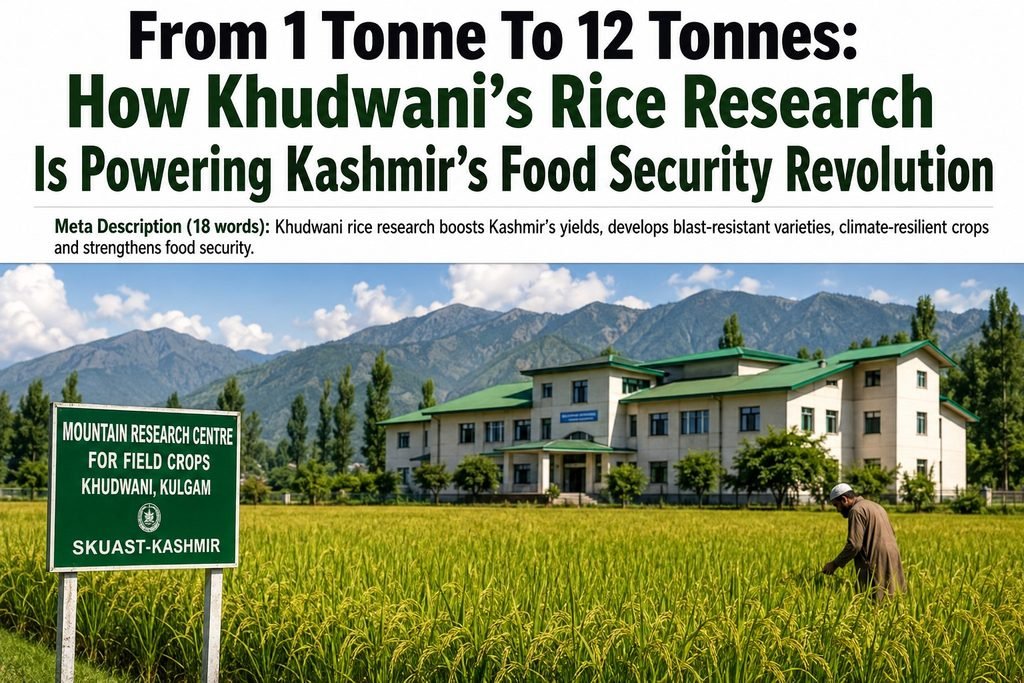
During a recent visit to the centre, SKUAST-K Vice Chancellor Prof (Dr) Nazir Ahmad Ganai highlighted the scale of that transformation, saying research over the past three to four decades had pushed the potential productivity of rice from around one tonne per hectare to as much as 10-12 tonnes per hectare, or 120 quintals in promising new material.
The development is significant because Kashmir’s agricultural land is under growing pressure from population growth, urbanisation, land conversion and climate change. Increasing production from every hectare has therefore become central to the region’s food-security strategy.
From one tonne to 10-12 tonnes
The story of Khudwani’s rice research goes back much further than the recent high-yielding varieties.
Rice improvement work in Jammu and Kashmir began in the early 1950s, when a Rice Research and Regional Station was established at Khudwani, then in Anantnag district. Its mandate was to develop rice varieties suited to Kashmir’s distinctive environment, particularly varieties that could mature early and withstand the cold and other stresses of the Valley.
The station later came under the newly established Sher-e-Kashmir University of Agricultural Sciences and Technology of Kashmir (SKUAST-K) and was eventually redesignated as the Mountain Research Centre for Field Crops.
According to ICAR material on the centre, the station covers about 20 hectares, with around 15 hectares available for research and seed-production activities. A high-altitude rice research sub-station was also established at Larnoo in 1978 to address the needs of farmers cultivating rice at higher elevations.
The early challenge was formidable.
Rice productivity in Kashmir once hovered around one to 1.5 tonnes per hectare. The introduction of improved material, followed by locally bred varieties, gradually changed the picture. The station’s breakthrough varieties included K-332, developed as a cold-tolerant variety for high-altitude conditions, and K-78, also known as Barkat.
The first major high-yielding variety developed specifically for the plains was K-39, released in 1982. Jhelum and Chenab subsequently became important varieties, with improved varieties and better agronomic practices enabling farmers to achieve yields of around 8-10 tonnes per hectare under suitable conditions.
The Shalimar series changes Kashmir’s rice fields
Khudwani’s work later produced the widely cultivated Shalimar series of rice varieties.
Shalimar Rice-1, Shalimar Rice-2 and Shalimar Rice-3 were developed for different ecological conditions, including areas affected by waterlogging, cold and differences in altitude.
The series helped bring high-yielding rice varieties into a wider range of Kashmir’s agricultural environments.
One of the important later releases was Shalimar Rice-4 (SKUA-408). It is an early-maturing, cold-tolerant indica variety with resistance to blast disease and is recommended for irrigated lower areas of the Kashmir Valley up to around 1,700 metres above sea level.
Research literature puts its yield potential at around 8.5-9 tonnes per hectare, with maturity in approximately 135-140 days.
ICAR’s climate-resilience material has also identified Shalimar Rice-4 as an important technology for areas vulnerable to drought, heat and cold stress, with a potential yield in the range of 8-10 tonnes per hectare under suitable conditions.
More than 80 per cent of Valley rice area linked to Khudwani varieties
The influence of Khudwani extends beyond its research plots.
A detailed account of the centre’s work reported that more than 80 per cent of the rice area in the Valley was covered by varieties released from the centre.
The station has developed around 17 rice varieties for different ecologies, helping farmers grow improved crops across Kashmir’s plains, intermediate areas and higher-altitude zones.
This is particularly important because Kashmir does not have one uniform rice-growing environment.
Altitude changes the length of the growing season, temperature and maturity period. A variety that performs well in a lower area may not mature properly at a higher elevation.
For this reason, Khudwani’s scientists have worked on varieties specifically adapted to low, medium and high-altitude environments.
Kashmir’s rice biodiversity is also being preserved
Khudwani’s contribution is not limited to producing high-yielding modern varieties.
The centre also serves as an important repository of Kashmir’s rice biodiversity.
A 2022 exhibition at the centre displayed more than 1,500 rice accessions, including traditional landraces and older varieties such as Mushk Budji, Zag, Larbeuol, Nunbeuol and Kamad, alongside varieties such as K-39, K-332 and the Shalimar series.
Researchers have also collected and conserved rare rice germplasm from different parts of Kashmir and deposited material in national gene banks. Research on Kashmir’s rice biodiversity records the conservation of hundreds of accessions through the National Bureau of Plant Genetic Resources and other repositories.
This genetic diversity is extremely valuable because traditional varieties can contain traits that modern breeding programmes may need in the future, including resistance to disease, cold tolerance, nutritional characteristics and adaptability to local environments.
Saving Mushk Budji from disease
One of the most interesting examples is Mushk Budji, a traditional aromatic rice associated with Kashmir.
The variety is highly valued for its distinctive characteristics but became vulnerable to rice blast disease.
Khudwani scientists have worked to restore Mushk Budji by introducing blast resistance through breeding.
The work has now progressed to genetically improved blast-resistant versions of the traditional variety. Research has demonstrated that the original Mushk Budji is highly susceptible to prevalent blast isolates, while newly developed gene-pyramided lines can show strong resistance under controlled and field hotspot conditions at Khudwani.
This work matters because it attempts to achieve two objectives at the same time: preserve a traditional Kashmiri variety while making it more suitable for modern cultivation.
Khudwani’s national role in rice blast research
Rice blast is one of the most destructive diseases affecting rice.
Khudwani has developed into an important national centre for screening rice material against the disease and is regarded as a major blast research hotspot.
According to Prof Ganai’s latest remarks, the centre functions as a National Blast Reference Centre, where rice varieties released across India can be evaluated for resistance.
The significance is considerable. Blast can cause extremely severe yield losses under favourable conditions, and the centre’s research has focused on identifying resistant material and incorporating resistance into improved varieties.
Scientists at Khudwani have also worked with international and national research programmes to understand the disease and develop resistant rice lines.
The birth of Kashmir’s own aromatic rice
Another major milestone came with the development of Kashir Basmat, also known as Shalimar Sugandh-1.
It is described as Kashmir’s first fine-grained aromatic rice variety.
Unlike conventional Basmati associated mainly with the plains, Kashir Basmat was developed specifically for Kashmir’s growing conditions.
The variety has a reported yield potential of around 7-8 tonnes per hectare, while retaining desirable grain and aroma characteristics.
Its grain is about 8 mm long, with a length-to-breadth ratio of around 3.8. After cooking, kernel length can reach approximately 12.5 mm, while its kernel elongation ratio is around 1.5.
The variety has reported milling recovery of about 70 per cent and head-rice recovery of around 55 per cent, with an amylose content of approximately 24 per cent. It also shows resistance to important biotic stresses, including rice blast.
Farmers have already started growing Kashir Basmat
The development has moved beyond laboratory and research plots.
During the 2023 Kharif season, around 25 hectares were brought under Kashir Basmat through the Jammu and Kashmir Agriculture Department.
Researchers reported a strong response from farmers and expected the area to increase as more growers became familiar with the variety.
The economic potential is another important part of the story.
According to research published on the variety, Kashir Basmat has a reported benefit-cost ratio of around 3, while its straw is also considered valuable as cattle fodder.
Researchers have suggested that investment in milling, packaging and branding could help turn the variety into a higher-value agricultural product and increase returns for Kashmir’s farmers.
Direct-Seeded Rice could reduce labour and water use
Increasing yield is only one part of the challenge.
Rice cultivation can require considerable quantities of water and labour, while Kashmir’s fragmented landholdings can make mechanisation difficult.
Khudwani has therefore also been working on alternative establishment methods, including Direct-Seeded Rice (DSR).
Unlike conventional transplanted rice, DSR eliminates the need to raise seedlings in a nursery and transplant them into puddled fields.
SKUAST-K has been promoting DSR as a resource-conserving technology capable of reducing labour and water requirements.
Research conducted at MRCFC Khudwani has examined direct seeding, irrigation management, weed control and nitrogen use under Kashmir’s temperate conditions.
Recent experiments at the centre have also compared transplanted rice and DSR under different irrigation systems, including alternate wetting and drying approaches, as researchers look for ways to increase water productivity without sacrificing yields.
Research goes beyond rice
Although rice remains the centre’s most prominent research area, MRCFC Khudwani works on other field crops as well.
Its work includes wheat, rapeseed, mustard and other oilseeds, alongside research in plant breeding, plant pathology, agronomy, entomology and soil science.
Scientists have also worked on natural farming, botanical insecticides and fungicides, micronutrient biofortification and resource-conserving technologies.
This broader research portfolio is important because farmers in Kashmir need profitable crop rotations and diversified farming systems rather than dependence on a single crop.
Why the 100-quintal figure matters
Prof Ganai’s latest statement that Kashmir’s rice productivity is now above 100 quintals per hectare needs to be understood in the context of the centre’s research achievements and the performance potential of improved varieties.
The figure is far above the official region-wide average reported in government statistics.
The J&K Economic Survey 2025-26 reports average rice yield in Kashmir at 26.78 quintals per hectare in 2024-25, while the India-wide figure in the same year was roughly 29.29 quintals per hectare according to Ministry of Agriculture data.
Other recent reporting based on J&K agricultural data has shown the Valley’s average yield increasing substantially over the longer term, but still below the 100-quintal level.
The distinction is therefore important: research-station yields, variety potential and yields achieved under improved farming practices should not automatically be treated as the average yield of every rice field in Kashmir.
What is not in doubt is the scale of the improvement in genetic potential.
Research at Khudwani has taken varieties from a historical productivity level of roughly one tonne per hectare to improved varieties capable of producing 8-10 tonnes, with the latest research targeting around 10-12 tonnes per hectare under suitable conditions.
A pipeline of still higher-yielding varieties
The next stage of Khudwani’s work is focused on varieties that combine several characteristics rather than simply producing more grain.
Researchers are looking for rice that is:
- high-yielding;
- resistant to blast and other diseases;
- tolerant to temperature and climate stresses;
- suitable for Kashmir’s different altitudes;
- less dependent on pesticides;
- economical for farmers;
- efficient in water use; and
- compatible with labour-saving cultivation methods.
Prof Ganai has said that a new variety under development at the centre has a potential yield of close to 12 tonnes, or 120 quintals, per hectare.
If achieved consistently under field conditions, that would represent an extraordinary productivity level and would put the variety among the world’s highest-yielding rice materials.
Khudwani’s connection with global rice research
The centre’s work is not isolated from the international rice research community.
ICAR documentation records the use of Khudwani’s rice material in coordinated national trials and highlights varieties such as K-39 and K-78/Barkat as important sources of cold-tolerance traits.
Some Khudwani-developed material has also been used as reference material and genetic donors in rice research, while varieties developed at the centre have found cultivation beyond India, including in Nepal and Bhutan.
Prof Ganai has compared the research importance and resources of Khudwani with those associated with the International Rice Research Institute (IRRI) in the Philippines, reflecting the university’s ambition to position the centre as an internationally relevant research facility.
From research station to postgraduate agricultural campus
The transformation is no longer limited to crop research.
Khudwani is now being developed into an important South Kashmir agricultural education campus.
In 2026, the centre was upgraded towards a Faculty of Agriculture, South Campus, creating a dedicated agricultural academic presence in South Kashmir.
Plans include postgraduate programmes in areas such as:
- agronomy;
- plant breeding;
- plant pathology;
- entomology; and
- soil science.
Reports have indicated an initial intake of around 40 postgraduate students, with Master’s and PhD programmes being introduced as the academic infrastructure develops.
The move is significant because South Kashmir has a large agricultural base but historically lacked a dedicated agricultural faculty comparable to SKUAST-K’s main agricultural campus at Wadura.
New academic and laboratory infrastructure
The university is developing an academic and laboratory block at Khudwani, along with separate hostel facilities for male and female students.
SKUAST-K’s own website also lists infrastructure works at MRCFC Khudwani, including augmentation of the centre’s electrical infrastructure.
The aim is to turn the existing research facility into a broader Centre of Excellence, where research, teaching, field demonstrations and technology transfer can operate together.
That could create a direct link between scientists and farmers: problems identified in Kashmir’s fields can be taken into laboratories and experimental plots, while successful technologies can then return to farmers through extension programmes.
The larger food-security challenge
Khudwani’s importance becomes clearer when viewed against Kashmir’s changing agricultural landscape.
The area available for paddy cultivation has declined over time because of urbanisation, land conversion and competing uses.
A recent analysis of agricultural data found that Kashmir’s paddy area had fallen from around 162,309 hectares in 2012-13 to 134,067 hectares, while production increased from around 621,640 metric tonnes to approximately 966,630 metric tonnes. The corresponding average yield rose from 38.03 to 72.01 quintals per hectare in the dataset examined.
This illustrates the central challenge facing Kashmir agriculture: less land has to produce more food.
That makes crop breeding, improved seed, better water management, disease resistance and climate-resilient agriculture increasingly important.
The next challenge is getting research yields into farmers’ fields
The biggest test for Khudwani’s next phase may not be producing a 10-12 tonne variety inside a research station.
It will be getting those varieties and technologies adopted widely by farmers while ensuring that production remains profitable.
Frontline demonstrations with Shalimar Rice-4 have already shown that improved varieties and recommended practices can increase yields and returns.
In one farmer-participatory programme conducted in lower Kashmir, demonstrations of Shalimar Rice-4 produced an average 73.8 quintals per hectare, compared with 63.9 quintals under farmers’ existing practices. The improved approach also generated higher net returns and a better benefit-cost ratio.
That gap between potential yield and actual farm yield is now one of the most important areas for agricultural extension.
Why Khudwani matters for Kashmir’s future
The story of MRCFC Khudwani is ultimately much larger than rice.
It is a story about how agricultural science can respond to shrinking land, changing climate, disease pressure, labour shortages and rising food requirements.
Over decades, scientists at the centre have:
- developed high-yielding and cold-tolerant rice varieties;
- created the Shalimar series for different Kashmir ecologies;
- helped move rice productivity far beyond historical levels;
- developed blast-resistant material;
- worked to revive traditional varieties such as Mushk Budji;
- conserved thousands of rice accessions and local genetic resources;
- developed Kashmir’s fine-grained aromatic Kashir Basmat;
- promoted direct-seeded and water-saving rice cultivation;
- researched varieties for different elevations;
- worked on climate resilience and resource conservation; and
- begun transforming Khudwani into a postgraduate agricultural education and research campus.
The journey from roughly one tonne of potential yield to varieties approaching 10-12 tonnes per hectare represents decades of breeding, pathology, agronomy and field research.
But the next chapter may be even more important.
For Kashmir, the question is no longer simply whether scientists can develop a higher-yielding rice variety. The real challenge is whether those varieties can be produced economically, adopted widely, withstand a changing climate and help farmers earn more from increasingly limited agricultural land.
If Khudwani succeeds in that transition, its contribution will extend well beyond rice research. It could become one of the foundations of Kashmir’s future food security and agricultural economy.
You Might Also Like:
Amarnath Yatra 2026 Concludes on Raksha Bandhan
J&K Weather: Hot and Humid Conditions Likely, Heavy Rain Forecast on August 31 and September 1
Aga Ruhullah Mehdi Says He Will Resign as Srinagar MP and Quit National Conference on November 3