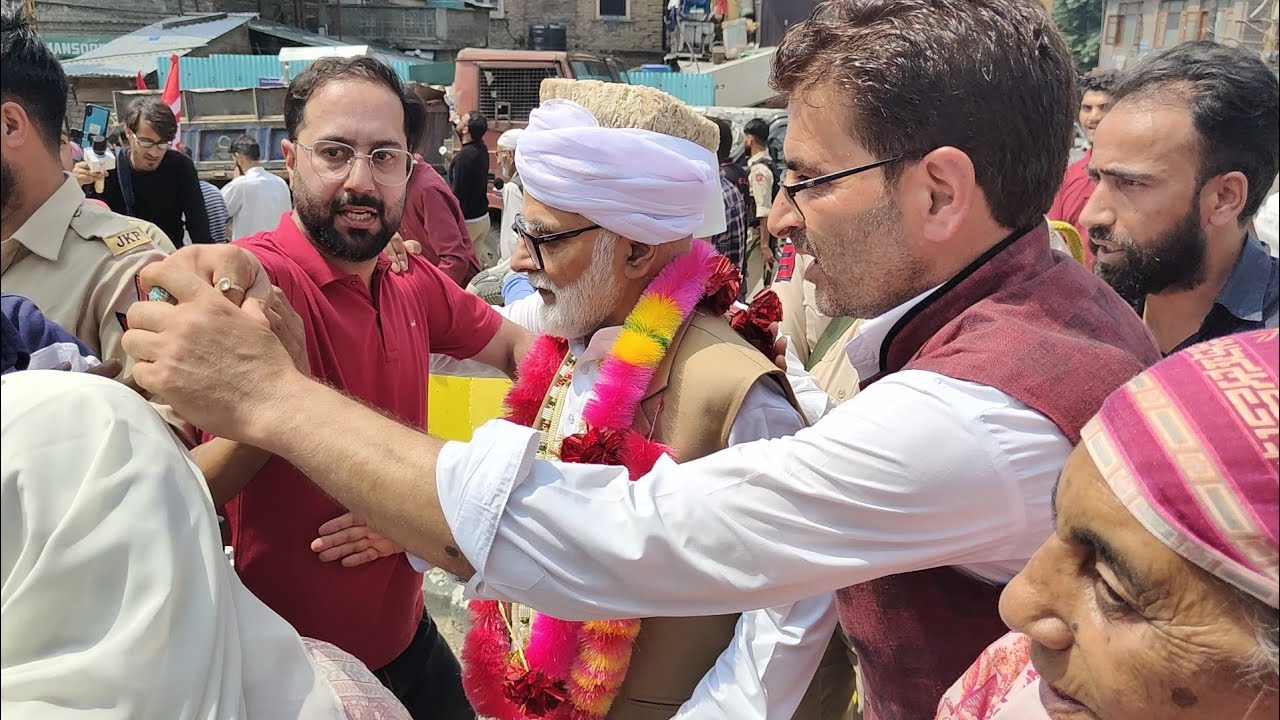
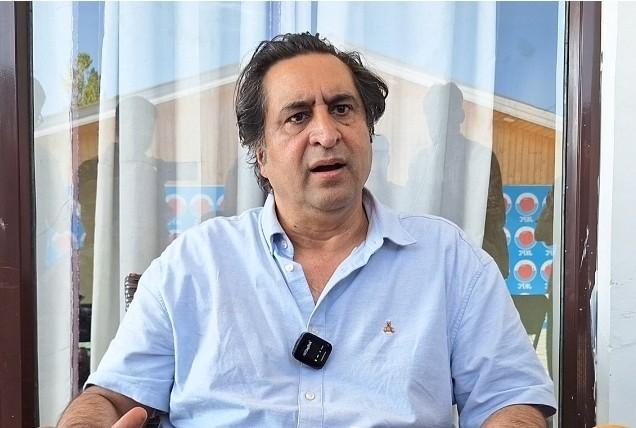
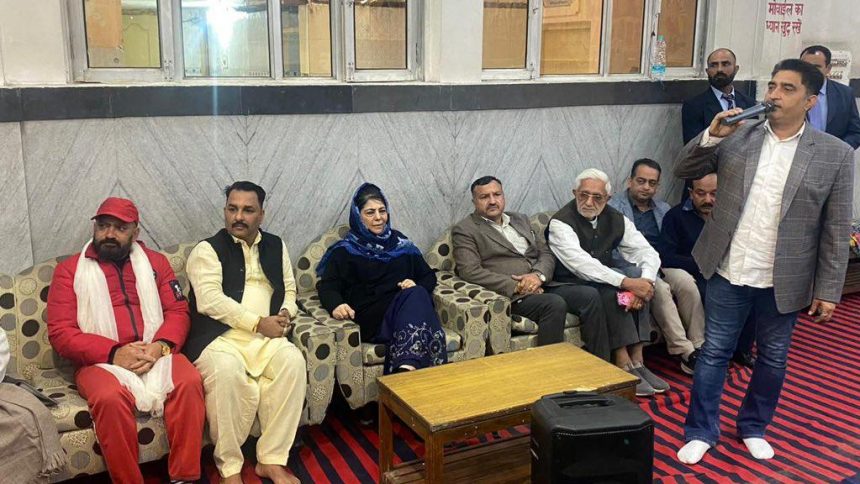
Mehar Ali, the son of National Conference senior leader and Member Parliament Mian Altaf, Monday filed his nomination papers from Kangan Assembly while as NC vice president Omar Abdullah stated he was confident of Mehar’s victory given the fact his the family’s fourth generation taking part in polls.
“In Mehar Ali, it will be the Mian family’s fourth generation taking part in elections from Kangan. I am sure he will follow his ancestors and father in serving the people. He will carry forward the legacy,” said Omar while accompanying Mehar to the office of Returning Officer where he filed his nomination papers.
Omar Abdullah said that he was confident of Mehar’s victory. Speaking to reporters, about Ram Madhav’s silent visits to J&K, he said Madhav has been close to PDP only and seems he is still in touch with the party. “He was the man behind stitching the PDP-BJP alliance in 2015,” he said.
About the increasing number of liquor shops in Kashmir, Omar said NC will look into the “rampant openings of liquor shops in Kashmir” post elections. “Let elections complete,” he said—(KNO)
In a landmark event for Baba Ghulam Shah Badshah University (BGSBU), Prof. Akbar Masood, the Vice Chancellor, proudly released the university’s inaugural strategic plan. This pivotal document is designed to steer the institution towards enhanced operational efficiency, informed decision-making, and overall progress.
Strategic Plan as a Guiding Light
During the unveiling ceremony, Prof. Akbar Masood emphasized the significance of the Strategic Plan, describing it as a crucial instrument for guiding the university. He highlighted that this plan is not merely a collection of goals but a comprehensive framework intended to illuminate the path forward for the institution. It will serve as a reference point for aligning various university activities with its long-term objectives.
The strategic plan is crafted to address several key areas:
Operational Efficiency: By providing a clear roadmap, the plan aims to streamline processes and optimize resource utilization across the university.
Decision-Making: It is designed to assist university leadership in navigating competing priorities and making informed choices that align with the institution’s vision and mission.
Progress and Prosperity: The ultimate goal is to chart a course that fosters growth, innovation, and success, setting the stage for the university to thrive in the competitive educational landscape.
Key Attendees and Support
The strategic plan’s release was attended by several notable figures from within the university community. Dr. A.A. Shah, Associate Dean of Academic Affairs, along with Associate Deans from various schools of study, and the Controller of Examination, were present at the ceremony. Their participation underscored the collaborative effort involved in developing the plan and their collective commitment to its successful implementation.
The presence of these key stakeholders reflects the plan’s broad impact across different facets of the university. Each department and office will play a role in executing the strategies outlined, ensuring that the entire institution moves cohesively towards the shared goals.
Future Outlook
The introduction of this strategic plan marks a significant milestone for BGSBU. It represents a proactive approach to navigating the challenges and opportunities of modern higher education. By setting clear objectives and establishing a framework for achieving them, the university is poised to enhance its academic and operational performance, thereby securing its place as a leading institution in the region.
As BGSBU embarks on this strategic journey, the university community and stakeholders will be keenly watching how effectively the plan is implemented and how it contributes to the institution’s growth and success in the coming years.
Former MLC Yasir Reshi, who recently announced his departure from the Peoples Conference is set to join Er Rasheed led Awami Ithehad Party in Srinagar today.
Yasir Reshi confirmed that he will join the AIP today and the decision has been taken after consulting his supporters.“Talks are on with AIP, and I may join today or tomorrow,” Reshi said.
On August 27, he disassociated himself from the People’s Conference . Earlier, some reports suggested that Reshi may return People’s Democratic Party following his disassociation from the PC. Reshi had resigned from the PDP in 2021 and later joined the PC—(KNO)
In a surprising turnout and set back to the People’s Democratic Party (PDP), the Spokesperson of the party, Tahir Syeed is all set to leave the party, citing dissatisfaction with the party decisions.
PDP’s spokesperson Tahir Syeed is all set to leave the party, ending his decade long affiliation with the People’s Democratic Party, lead by Mehbooba Mufti, the former CM of J&K.
The development came quickly after the party announced to field senior party worker Mohammad Afzal Wani as its candidate for the Trehgam constituency in Kupwara district, of which Syeed was hopeful of contender.
Syeed, also intended his quitting the party, thus ending a decade long terms with the PDP. However, he didn’t reveal details at the immediate.
It’s noteworthy, Syeed is not the only who is quitting the party, but there are several others who announced their resignation post party’s announcement of their candidates for the upcoming erections. The leaders include Bandipora’s zonal head besides several workers including Fayaz Ahmed Malik and Mehraj u Din Sheikh from Rafiabad belt—(KNO)
Peoples Democratic Party Youth President and Assembly Candidate for Pulwama Constituency Waheed Ur Rehman Parra on Sunday said that if Jamaat-e-Islami had approached the PDP President Mehbooba Mufti, She would have accommodated Jamaat-e-Islami candidates and given them tickets.
Parra emphasized that the PDP has always prioritized inclusive politics and engagement with diverse groups, regardless of their ideological affiliations, to ensure the broadest possible representation of the people of Jammu and Kashmir.
He emphasized that Mehbooba Mufti has always believed in dialogue, reconciliation, and inclusion. If Jamaat-e-Islami had reached out to PDP, we would have considered seat allocations to bring together all voices within the democratic framework. Even if it meant sacrificing many seats, we would have accommodated them.
Parra asserted that the PDP’s commitment is to the people of Jammu and Kashmir, and we believe that every group, party and especially those representing significant sections of society, deserves a place at the table.
He added that the PDP’s approach has always been to bridge divides and ensure that all communities, irrespective of their backgrounds, have a say in shaping the future of the region. If Jamaat-e-Islami wants to contest elections, it is a positive development. Democracy is a battle of ideas. The government should lift the ban on it. We would have accommodated them and provided sufficient space, seats, and opportunities to contest.
Parra added that if our party comes to power, we will lift the ban on Jamaat-e-Islami. He reiterated that such an inclusive approach is essential for lasting peace, tranquility, prosperity, and stability in Jammu and Kashmir. (KNS)
National Conference Vice President Omar Abdullah on Thursday said that he has never taken election easy, adding that he hope People of Ganderbal will elect him again.
Speaking to reporters here at Ganderbal Omar said that they are standing against the BJP with a united front and there was need to have alliance for Pir Panjal areas to keep BJP out.
According to KNS correspondent, On accusations that he has sacrificed his principles for power, Omar said that the people who are making such accusations are his own relatives.
“If they were bound by their own principles, then they should have stayed out of this as well”, he added.
He further said that while he believes the current assembly lacks the strength it should have, “we can only strengthen this assembly through this assembly.
Responding to a question that the Chief Minister cannot even transfer an MP, he said, “I will not go into that. But today, we are not electing a Chief Minister. We want to make him an MLA first, and then we will decide who will be the Chief Minister after October 4.”
Regarding concerns raised by the National Investigation Agency (NIA) that Er Rashid could influence witnesses and tamper with evidence, he said, “A voter does not decide on a bail. Bail is decided in court.”
He added that the Enforcement Directorate (ED) had similarly opposed the withdrawal of the case against Farooq Abdullah, but “the court decided, and the case was withdrawn.”
He also said the court will decide on September 4. “I think the NIA will fail their argument, just like the ED did.”(KNS)
National Conference (NC) Vice President Omar Abdullah accused the People’s Democratic Party (PDP) of “imitating” their manifesto and asked the Mehbooba Mufti-led party to not field candidates against the NC.
Addressing the public in Ganderbal, Omar Abdullah said, “They (PDP) should’ve made a different manifesto, we spoke of 200 units of electricity, and they also did. We spoke of one lakh jobs, and they also did. We spoke about the reopening of blocked roads, which is also there in their manifesto.
We spoke of open dialogue, which is also there in their manifesto. Everything in the National Conference’s manifesto is present in their (PDP’s) manifesto also.”
Omar Abdullah also urged the PDP to not field candidates against the NC-Congress alliance. Abdullah’s remarks come after Mehbooba Mufti showed willingness to support the NC-Congress alliance provided they support PDP’s agenda.
Omar Abdullah said, “They (PDP) said that if NC and Congress agree with their manifesto, then they will not launch their candidates. Now that all of our agenda is in your manifesto, there is no difference between our agendas, then you should remove your candidates from the election.
Earlier Mehbooba Mufti said that if the Congress-NC alliance are ready to accept PDP’s agenda they are ready to support them.
“The people of Jammu and Kashmir have given an answer to the BJP government from the Lok Sabha polls that there are issues in Jammu and Kasmir and by removing Article 370, it has become more complicated.
Whenever we allied with any party we had a motive, an agenda, what we have to do. That’s why I said that if they (Congress) are ready to accept our agenda, we are ready to support them,” Mufti said.
NC’s manifesto envisaged the restoration of the political and legal status of the Union Territory and said that the party would strive to restore Article 370-35A and statehood before August 5, 2019.
NC Manifesto has also promised free electricity for upto 200 units, a comprehensive job package for youth, and to encourage dialogue between India and Pakistan.
PDP released its manifesto after NC and along the same lines. PDP also mentioned the restoration of Articles 370 and 35A and diplomatic initiatives between India and Pakistan and ensure the dignified return of Kashmiri Pandits to the valley.
Polling in Jammu and Kashmir will be conducted in three phases on September 18, 25, and October 1, according to the Election Commission of India. The counting of votes will take place on October 4.
These are the first assembly elections to be held in Kashmir after the abrogation of Article 370. (ANI)
Former Kashmir Chamber of Commerce and Industry (KCCI) President Shiekh Ashiq is likely to contest Assembly Elections 2024 from Srinagar on AIP seat, sources on Sunday said.
Sources confirmed to Different News Agencies that Shiekh Ashiq will join active politics and talks are underway between Awami Ithehad Party led by Jailed MP Er. Rasheed.“Talks are going on between Engineer Rashid’s party and Sheikh Ashiq who is prominent trade leader and former President of KCCI,” he said.
Sources further said in comming days, Shiekh Ashiq will join AIP in presence of senior leaders of the party. It will help AIP also for strong base in Srinagar city,” he said.
The Jamaat-e-Islami Jammu and Kashmir is set to field its former members as Independent candidates in several seats in the upcoming Assembly polls, The Indian Express has learnt.
Jamaat leaders had earlier said they are waiting for the Centre to lift the ban, in place under the UABASHAARAT MASOOPA since February 2019, with sources saying several rounds of talks had happened with the government. However, on Friday, the UAPA upheld the orders passed by the MHA declaring the Jamaat as an unlawful association under the Act.
Sources in the Jamaat said that following a meeting of its top body, it has been decided to field its former members as Independent candidates. “We have decided to field 10-12 members as Independents,” said a source from the organisation. “These will be in seats where we believe we have considerable support.”
In the first phase, the banned organisation is looking at around half a dozen seats, including Kulgam, Devsar, Bijbehara, Zainpora, Tral, Pulwama and Rajpora in south Kashmir.“We had a threadbare discussion on three options. The first was to form a front and fight under its banner; the second option was to be part of an alliance; and the third was to contest as Independents,” a source privy to the meeting said.
“While being part of any alliance was ruled out, the members were of the opinion that a front can’t be registered within a short time, and in any case such candidates will have to contest as Independents. So we went with the third option,” the source said, adding that those contesting will be former rukn or registered members of the Jamaat.
While the Jamaat has stayed away from the election since 1987, when they last participated under the banner of the Muslim United Front, it is eager to return to electoral politics to show its willingness to enter the mainstream.
“We are called a terror organisation, anti-democracy. We can’t contest elections as Jamaat members but we want to show that we believe in democracy, in the Constitution,” the source said.
“In the coming days, we will also take a decision on seats we will contest in the second and third phases.” A final call on candidates is awaited, sources said.
“We know we have very little time at hand, and by Sunday, we expect to come out with a list of candidates,” said the source. “We don’t know how state will react – whether they will accept the nomination or not.” (Indian Express)
As nomination process continues in Anantnag District, one candidate filed his nomination papers today for the 44-Anantnag Assembly constituency, here.
Dr Mehboob Beg from JKPDP submitted his nomination papers in the office of Returning Officer 44-Anantnag AC. This was the first nomination filed so far in the district Anantnag.
The district comprises of seven (07) Assembly Constituencies, nominations for which can be filed till 27th August, 2024.
As the election commission of India announced the dates of the state assembly elections in Haryana and Jammu and Kashmir, Leader of opposition in Lok Sabha and Congress leader Rahul Gandhi along with Congress Rajya Sabha MP Mallikarjun Kharge will be holding a meeting with the party workers of Jammu and Kashmir on Thursday.
Security has been heightened outside the hotel where Rahul Gandhi and Congress chief Mallikarjun Kharge will be holding a meeting with party workers today.
Arshid Tantary a Congress youth leader said ” As you can see when Rahul Gandhi came to Srinagar yesterday, people were excited from the airport to the hotel. We have a worker’s meeting today. Around 500 workers are meeting him today. everyone wants to vote for the Congress”.
Asif Beigh Congress Youth Gen secretary of Jammu and Kashmir said on the occasion “We were with Rahul Gandhi toll 3 AM, then we started preparing for the event. we are filled with enthusiasm as our leader Rahul Gandhi is here. Rahul Gandhi will spread his ‘Mohabbat ka dukan’ in Jammu and Kashmir and will form ties with secular forces”.
Congress is likely to ally with the Jammu and Kashmir National Conference ahead of the polls. The two parties had contested the Lok Sabha polls in alliance.
On August 18, Jammu and Kashmir National Conference (JKNC) Vice President Omar Abdullah said that his party has started preparing for the Assembly elections.
“Give us some time, we have begun our preparations. On August 20, the notification will be issued for the first phase. Following this, we will announce the names of our candidates and hope for a victory.
It would be better if the BJP doesn’t talk about over-confidence. We only said that we were hoping to receive the support of the people and get a chance to form the government. We are not counting the number of seats. The BJP has always counted the number (seats) here,” Omar said.
Omar Abdullah also launched the Party manifesto that includes some huge promises like- restoration of Article 370, 35-A and statehood, redrawing the Jammu and Kashmir Reorganisation Act, 2019 and return and rehabilitation of Kashmiri Pandits.
The first guarantee of the NC’s manifesto envisages the restoration of the political and legal status of the Union Territory and said that the party would strive to restore Article 370-35A and statehood prior to August 5, 2019.
The polling in the Union Territory will be held in three phases on September 18, 25, and October 1, as per the Election Commission of India. The counting of the votes will take place on October 4. These are the first elections to be held in Kashmir after the abrogation of Article 370.
The election body has directed the enforcement agencies to be impartial and transparent for smooth and fair polling, ensuring a level playing field.
There are a total of 90 assembly constituencies, of which 74 are general, nine are ST, and seven are SC. There are 87.09 lakh total electors, including 44.46 lakh are male, 42.62 lakh are female, 169 are transgender, 82,590 PwDs, 73943 are very senior citizens, 2660 are centenarians, 76092 are service electors, and 3.71 lakh are first-time voters.
Jammu and Kashmir will witness elections after a gap of ten years, as the last assembly election was held in 2014.
The PDP-BJP coalition government fell in June 2018 when the latter withdrew support to the then-Chief Minister, Mehbooba Mufti. In December of last year, the Supreme Court directed the Centre to conclude the election process by September 30, 2024. (ANI)
Congress President Mallikarjun Kharge and Leader of Opposition in Lok Sabha Rahul Gandhi will visit Jammu and Srinagar for key meetings in preparation for the upcoming assembly elections, Congress General Secretary KC Venugopal said on Tuesday.
“On 21st and 22nd August, Hon’ble Congress President Shri Mallikarjun @kharge ji and Leader of Opposition Shri @RahulGandhi ji will be visiting Jammu and Srinagar for key meetings in preparation for the upcoming assembly elections,” Venugopal said in a post on X.
Whether Congress and the JKNC will partner in the state elections remains to be seen. Both parties are constituents of the INDIA bloc and contested the Lok Sabha polls in an alliance.
On August 18, Jammu and Kashmir National Conference (JKNC) Vice President Omar Abdullah said that his party has started preparing for the Assembly elections.
“Give us some time, we have begun our preparations. On August 20, the notification will be issued for the first phase. Following this, we will announce the names of our candidates and hope for a victory.
It would be better if the BJP doesn’t talk about over-confidence. We only said that we were hoping to receive the support of the people and get a chance to form the government. We are not counting the number of seats. The BJP has always counted the number (seats) here,” Omar said.
Omar Abdullah also launched the Party manifesto that includes some huge promises like- restoration of Article 370, 35-A and statehood, redrawing the Jammu and Kashmir Reorganisation Act, 2019 and return and rehabilitation of Kashmiri Pandits.
The first guarantee of the NC’s manifesto envisages the restoration of the political and legal status of the Union Territory and said that the party would strive to restore Article 370-35A and statehood prior to August 5, 2019.
The polling in the UT will be held in three phases on September 18, 25, and October 1, as per the Election Commission of India. The counting of the votes will take place on October 4. These are the first elections to be held in Kashmir after the abrogation of Article 370.
The election body has directed the enforcement agencies to be impartial and transparent for smooth and fair polling, ensuring a level playing field. There are a total of 90 assembly constituencies, of which 74 are general, nine are ST, and seven are SC.
There are 87.09 lakh total electors, including 44.46 lakh are male, 42.62 lakh are female, 169 are transgender, 82,590 PwDs, 73943 are very senior citizens, 2660 are centenarians, 76092 are service electors, and 3.71 lakh are first-time voters.
Jammu and Kashmir will witness elections after a gap of ten years, as the last assembly election was held in 2014. The PDP-BJP coalition government fell in June 2018 when the latter withdrew support to the then-Chief Minister, Mehbooba Mufti.
In December of last year, the Supreme Court directed the Centre to conclude the election process by September 30, 2024. (ANI)
Apni Party vice president, Zafar Iqbal Manhas along with his son Tuesday resigned from the Apni Party and are likely to join Congress tomorrow.Zafar Iqbal Manhas confirmed that he has resigned from the Apni Party and further course of action will be decided after feedback from his workers.
Meanwhile, sources said workers meeting is going on at his residence and final decision is expected soon.They said that Manhas will join the Congress on Wednesday in the presence of senior party leader Rahul Gandhi.
Manhas was one of the founding members of the Apni Party after he parted ways with the Peoples Democratic Party.His son Irfan Manhas is currently vice chairperson of DDC Council Shopian—(KNO)
Former Jammu and Kashmir Pradesh Congress Committee (JKPCC) President Vikar Rasool Wani has alleged that a conspiracy is underway to prevent him from assuming the role of Chief Minister of Jammu and Kashmir.
Rasool’s accusations follow his recent removal from the JKPCC leadership, with Tariq Hameed Karra now taking over the position. This change in leadership comes just weeks before the Assembly elections scheduled for 18th September. Speaking at a public meeting, Rasool, according to news agency KDC, accused certain factions within the party of plotting to obstruct his path to the Chief Minister’s office. He stated, “I want to be clear that various forces have been working behind the scenes to ensure that Vikar Rasool does not become CM of J&K,” and suggested that biases related to his identity as a Gujjar or Pahadi might be influencing these actions.
Rasool’s remarks follow his absence from a party event in Srinagar meant to welcome Karra, which was explained by Karra as due to travel from Banihal. Notably, senior party members Tara Chand and Raman Bhalla were present at the event from Jammu.
Jammu and Kashmir Pradesh Congress Committee (PCC) chief Tariq Hameed Karra Monday said that the Congress party was open to forge alliance with like-minded people or parties and that the National Conference has approached the Congress Central leadership for a pre-poll alliance.
“As far as the alliance, we are open to like-minded people or the parties to forge an alliance with them,” Karra said addressing a gathering at PCC headquarters in Srinagar after his return from New Delhi. He was recently appointed as the J&K PCC chief by the party high command in Delhi.
About NC, he revealed that the party leadership has approached central leadership in Delhi for a pre-poll alliance. “If parties are of the ideas that we have to defeat divisive forces and BJP, they will definitely ally with the Congress. And we will definitely succeed,” Karra said—(KNO)
Ahead of the assembly elections in Jammu and Kashmir, former minister and a prominent Gujjar leader, Choudhary Zulfikar Ali Sunday joined the Bharatiya Janata Party in Jammu.
According to news agency—Kashmir News Observer (KNO), union minister and election in charge G K Reddy along with other senior leaders welcomed him and his supporters into the party fold.
The development comes days after the Election Commission of India announced schedule for assembly polls in Jammu and Kashmir, starting September 18.
Choudhary Zulfikar, who has previously been associated with various political parties including the Peoples Democratic Party (PDP), has held significant positions like cabinet minister in the erstwhile state of Jammu and Kashmir.
He was also a founding member of Altaf Bukhari-led Apni Party, where he served as vice president. A prominent Gujjar leader, Zulfikar hails from Rajouri and has strong footing in Pir Panjal region.
A day ahead of joining the BJP, he met home minister Amit Shah in New Delhi on Saturday—(KNO)
In a significant development, former chief minister and Democratic Progressive Alliance Party (DPAP) chief patron, Ghulam Nabi Azad is likely to return to the Congress ahead of the assembly polls in Jammu and Kashmir, sources said on Sunday.
A close confidante of Ghulam Nabi Azad told news agency KNO that the Gandhis have approached Azad in a bid to persuade him to rejoin the grand old party.
He said that the deliberations are on as senior Gandhis have approached Azad to weed out past differences that popped up particularly after the latter disassociated himself from the party and resigned from all positions in 2022.
“Deliberations are still on between the top leadership of the Congress and Ghulam Nabi Azad. He will think and decide to rejoin the grand old party,” the close associate of the former chief minister said.
Azad left the Congress in August 2022 and soon after came up with his own political outfit – Democratic Progressive Alliance Party – along with other Congress leaders in Jammu and Kashmir, who also quit the grand old party in his support.
On Saturday, former legislator and senior leader Taj Mohi-Ud-Din, who was also one of the founding members of the Azad-led DPAP, announced that he will return to the Congress along with several other senior leaders.
Meanwhile, Azad’s close associate told KNO that he (Azad) was hurt by the humiliation due to statements made by some Congress leaders soon after he quit the party. “Now top leadership of the party is in touch with him and working out the modalities to facilitate his return to party and weed out the differences. He will take a final call in coming days,” he said.
“The party has started taking steps that Azad had suggested two years back perhaps in a bid to persuade him to join back,” he added.
The development comes at a time when the Election Commission of India announced the schedule for assembly polls in Jammu and Kashmir, starting September 18—(KNO)
Targeting Jammu and Kashmir Lieutenant Governor, Manoj Sinha amid an increase in terror attacks, National Conference leader and former Chief Minister Omar Abdullah said on Sunday that after the killing of our 55 soldiers, LG suddenly decided to hold a meeting.
“There are forces in our neighboring country that do not want friendship between these two countries, they will not stop their activities but somewhere there is negligence on our part too. 55 of our soldiers were killed, today after one year, LG Sahab suddenly decided to hold a meeting.
He should have held the meeting from the first day itself and should have tried to control the situation,” Abdullah said.
Jammu and Kashmir Lieutenant Governor Manoj Sinha on Saturday chaired a high-level meeting with Army Chief, various heads of security and law enforcement agencies on the security situation in Jammu division.
Chief of the Army Staff, General Upendra Dwivedi; DG BSF, DG CRPF, DGP J-K, Heads of Intelligence Agencies and other senior officials of the army, CAPFs, and J-K Police attended the meeting.
The Lieutenant Governor asked the Army, CAPFs, and the Jammu Kashmir Police to pro-actively conduct coordinated counter-terrorism operations in Jammu Division.
“We must launch meticulous and well-planned counter-terrorism operations with greater synergy between all the agencies to wipe out terrorists and those aiding and abetting them,” the Lieutenant Governor said.
The Lieutenant Governor also directed that the security grid should be further strengthened to ensure zero cross-border infiltration.
Meanwhile, given the infiltration of highly trained Pakistani terrorists in the Jammu region, the Indian Army is readjusting its deployments in the area as per intelligence inputs and security requirements.
The Indian Army has deployed around 500 Para Special Forces commandos in the area to hunt down the 50-55 terrorists from Pakistan who have entered the region to revive terrorism there, defence sources told ANI.
Four Indian Army soldiers, including Captain Brijesh Thapa, were killed in action during an encounter with terrorists in Jammu and Kashmir’s Doda district on July 16. (ANI)
The Delhi’s Patiala House Court Tuesday deferred by five days the hearing into a bail plea moved by Abdul Rashid Sheikh, aka Er. Rashid – the winning candidate from Baramulla Parliamentary constituency.
Additional Sessions Judge Patiala House Court, Chander Jit after hearing exhaustive arguments from counsels on both sides, as per GNS, decided to defer the next hearing to June 23 (Sunday).The NIA counsel, as learnt by GNS, pleaded that if the accused (Er. Rashid) is granted (interim) bail, ‘it will open the way for others facing similar accusations.’
The 56-year-old politician who has been in Delhi’s Tihar jail on accusations of militant funding under Unlawful Activities Prevention Act (UAPA) for over five years now, emerged victorious on Baramulla Lok Sabha constituency, which among others had JKNC’s Omar Abdullah, JKPC’s Sajjad Gani Lone and JKPDP’s Fayaz Ahmad Mir in fray.
Notably, the first Parliament session is scheduled to start from June 24 and conclude on July 3.The election for the Lok Sabha Speaker post, on the other hand, is scheduled to be held on June 26.This is an emerging report and will be updated accordingly. (GNS)
The Life and Legacy of Maharaja Hari Singh: From Independence to Exile
Hari Singh, born in September 1895 at the Amar Mahal palace in Jammu, was the sole surviving son of Raja Amar Singh and Bhotiali Chib. In 1923, upon the death of his uncle, he ascended to the throne as the Maharaja of Jammu and Kashmir. During India’s independence in 1947, Singh initially wished for Jammu and Kashmir to remain independent. However, faced with an invasion by tribal forces and the Pakistan Army, he signed the Instrument of Accession to India on 26 October 1947, securing military assistance from Indian troops. Despite remaining the titular Maharaja until 1952, the Indian government abolished the monarchy, and Singh spent his final years in Bombay, passing away on 26 April 1961.
Singh’s reign was marked by considerable turmoil. He faced a significant agitation in Kashmir in 1931 and rebellions in Poonch and Gilgit-Baltistan. Controversially, he was also involved in the 1947 Jammu massacres. Educated at Mayo College and later at the British-run Imperial Cadet Corps in Dehradun, Singh was well-prepared for leadership. In 1915, he was appointed commander-in-chief of the State Forces, and by 1926, he ascended the throne following his uncle Pratap Singh’s death, under British intervention.
Hari Singh’s coronation in February 1926 was an elaborate affair, divided into religious and official ceremonies. As a ruler, Singh initiated significant reforms, including free elections and the establishment of the Praja Sabha, Jammu and Kashmir’s Legislative Assembly. He implemented progressive laws under the Ranbir Penal Code, promoted compulsory primary education, banned child marriage, and opened places of worship to lower-caste individuals.
In 1930, Singh attended the First Round Table Conference in London, advocating for an All-India Federation and equal status for Indians within the British Commonwealth. Following India’s independence, Singh’s initial stance of independence for Jammu and Kashmir shifted due to escalating violence and invasion threats. His appeal to India for military aid led to the state’s accession to India and subsequently the first Indo-Pakistan War.
Under pressure from Indian leaders Nehru and Patel, Singh appointed his son Karan Singh as Prince Regent in 1949, and later as ‘Sadr-e-Riyasat’ in 1952, marking the end of the monarchy. Despite his contentious relationships with both Nehru and Kashmiri leader Sheikh Abdullah, Singh’s legacy continued through various commemorations, including statues and parks in his honor.
After his exile from Jammu and Kashmir post-accession, Singh lived in Bombay until his death. His ashes were spread across Jammu and Kashmir, in accordance with his wishes. Hari Singh’s life was also marked by personal scandals, including a notable blackmail case in 1921 and his lavish spending habits. Despite his four marriages, only his last wife, Tara Devi Sahiba of Kangra, bore him a son, Karan Singh.
Singh’s legacy is remembered through various memorials and statues, celebrating his contributions and reforms in Jammu and Kashmir. His birth anniversary on 23 September is now a public holiday in the region, reflecting his enduring influence on its history.
The Legacy of Bakshi Ghulam Mohammed: Architect of Modern Kashmir
Bakshi Ghulam Mohammed served as the Prime Minister of Jammu and Kashmir for eleven years, from 1953 to 1964. His tenure was marked by remarkable administrative skills, courage, and practical wisdom, leading to significant progress in the state.
Born in 1907, Bakshi Ghulam Mohammed received his education at C.M.S Tyndale Biscoe School. He began his career as a school teacher in remote areas like Skardu and Leh and later worked with the Kashmir branch of the All India Spinners’ Association. In 1927, he joined Sheikh Mohammed Abdullah in advocating for the civic and political rights of the Muslim population under the Dogra rulers, which led to the formation of the Muslim Conference in 1930.
Bakshi’s organizational skills and dedication were evident during the struggle. He formed unions for students and workers and endured several imprisonments, including a harsh sixteen-month term in Reasi sub-Jail. His bravery earned him the title “Khalid-e-Kashmir,” reminiscent of the famed Muslim general Khalid-bin-Walid.
By 1938, the movement for responsible government had gained support across communities, leading to the renaming of the Muslim Conference to the National Conference. During this time, Bakshi operated underground to evade the state police. In 1946, amid the “Quit Kashmir” movement, he fled to British India when a warrant was issued for his arrest. He traveled extensively to garner support for the Kashmir cause, returning home after the warrant was withdrawn following Mahatma Gandhi’s visit to Kashmir.
In October 1947, Sheikh Mohammed Abdullah was released from prison and became Prime Minister, appointing Bakshi as Deputy Prime Minister with the Home portfolio. In 1948, during Sheikh Abdullah’s absence, Bakshi served as Chief Administrator. In August 1953, after Sheikh Abdullah’s dismissal and arrest, Bakshi became the Prime Minister and President of the National Conference through a majority vote.
As Prime Minister, Bakshi was a transformative leader, earning the moniker “Architect of Modern Kashmir” for his developmental work. He connected deeply with people at the grassroots level, fostering significant popularity across the state. His efforts laid the foundation for a prosperous “Naya Kashmir,” earning widespread acclaim.
Politically, Bakshi faced challenges from the Plebiscite Front, formed in 1955, but maintained firm control over state affairs. In May 1963, following Congress’s losses in several by-elections, the AICC under the Kamaraj plan recommended that certain ministers resign to strengthen party work. Despite not being a Congress member, Bakshi offered a token resignation, which was accepted along with those of other ministers.
Bakshi’s eleven-year tenure as Prime Minister is considered the Golden Period in Jammu and Kashmir’s post-independence history. He staunchly defended the state’s special status within India and was the last to hold the title of Prime Minister of Kashmir.
In 1964, Bakshi led the opposition against Chief Minister Ghulam Mohammed Sadiq. Later that year, despite having majority support in the Assembly, he was arrested and detained under the Defence of India Rules. He was released on health grounds in December 1964 and announced his retirement from politics in June 1965. However, his popularity persisted, and in 1967, he was elected to the Lok Sabha on a National Conference ticket, defeating the Congress nominee by a significant margin. He served in the Lok Sabha until 1971.
Bakshi Ghulam Mohammed passed away in July 1972, leaving behind a legacy of modernizing Kashmir and freeing it from ignorance, hunger, poverty, and backwardness.
Ghulam Mohammed Sadiq: From Prime Minister to Chief Minister of Jammu and Kashmir
Ghulam Mohammed Sadiq, an alumnus of Islamia College in Lahore and Aligarh Muslim University, played a significant role in Jammu and Kashmir’s political landscape. Initially serving in Sheikh Abdullah’s cabinet from 1947 to 1953, he later led the National Conference party from 1957 to 1961 before joining the Indian National Congress. In 1964, he was elected Prime Minister of Jammu and Kashmir. The following year, the J&K Constitution was amended, replacing the position of Prime Minister with Chief Minister, making Sadiq the state’s first Chief Minister under the new title in 1965.
Tragically, Sadiq died in office from a heart attack on December 12, 1971, at the age of 50. His death occurred in a Chandigarh hospital, where he had been receiving treatment for jaundice for three weeks. At the time, Indian and Pakistani forces were engaged in conflict within the state.
Sadiq had a long and varied political career. He first served in the state legislature of Jammu and Kashmir in 1934 under British rule and became chairman of the state’s Muslim Conference in 1939. After the 1947 partition, he was appointed Minister of Development in the Indian-administered part of Kashmir and later held positions as president of the Constituent Assembly and Minister of Health and Education. His leadership of the National Conference party lasted from 1957 to 1961.
Known for his honesty and good intentions, Sadiq faced challenges in pushing for a more democratic administration due to the sensitive nature of Kashmir’s political situation, where the aspirations of the Muslim population were often viewed as a challenge to Indian authority.
Earlier in 1971, the Jammu and Kashmir police uncovered a plot to assassinate Sadiq and kidnap other ministers, allegedly organized by Pakistan through the Plebiscite Front, an outlawed opposition group. Despite these challenges, Sadiq’s commitment to his duties remained steadfast until his untimely death.
Syed Mir Qasim: Champion of Kashmir’s Democratic Movement and Political Leader
Syed Mir Qasim (1921 – 12 December 2004) was a prominent Indian politician who served as the Chief Minister of Jammu and Kashmir from 1971 to 1975. His political journey began during the British Raj, where he emerged as a leader of the non-sectarian, pro-democracy Quit Kashmir movement, advocating against the monarchical rule of Maharaja Hari Singh, which led to his imprisonment.
Following India’s independence, Qasim played a key role in drafting the Constitution of Jammu and Kashmir and held various important positions at both the state and union levels. He was instrumental in establishing the Indian National Congress in Kashmir. After the death of Ghulam Mohammed Sadiq, Qasim took over as the Chief Minister of Jammu and Kashmir. In 1975, he resigned to facilitate the return of Sheikh Abdullah, following an accord between Abdullah and the Indian Government.
Qasim detailed his experiences and the broader struggle of Kashmiris in his autobiography, “My Life and Times,” published in September 1992. The book offers valuable insights into the Quit Kashmir movement and the complex issues surrounding Kashmir’s accession to India instead of joining Pakistan.
Syed Mir Qasim passed away in an ambulance near India Gate in New Delhi on 12 December 2004, at the age of 83. Honoring his wishes, he was buried in his birthplace, Dooru in Kashmir, where thousands attended his funeral peacefully. In 2005, he was posthumously awarded the Padma Bhushan, India’s third-highest civilian award, by President APJ Abdul Kalam.
Sheikh Mohammad Abdullah: A Key Figure in Jammu and Kashmir’s Political Landscape
Sheikh Mohammad Abdullah (5 December 1905 – 8 September 1982) was an influential Indian politician who played a pivotal role in the politics of Jammu and Kashmir. He was the founding leader of the All Jammu and Kashmir Muslim Conference, which later became the Jammu and Kashmir National Conference. Abdullah served as the first elected Prime Minister of Jammu and Kashmir after its accession to India, advocating for self-rule and opposing Maharaja Hari Singh’s regime.
Abdullah’s tenure as the first elected Prime Minister of Jammu and Kashmir was marked by significant political turbulence. His advocacy for self-rule and democratic governance led to his eventual imprisonment by the Indian government, citing his alleged support for insurgent activities. On 8 August 1953, he was dismissed from his position, and Bakshi Ghulam Mohammad replaced him. In 1965, the titles ‘Sadr-i-Riyasat’ and ‘Prime Minister’ were changed to ‘Governor’ and ‘Chief Minister’, respectively. Abdullah returned to power as Chief Minister in 1974 after reaching an accord with Prime Minister Indira Gandhi and remained in office until his death in 1982.
Early Life
Born on 5 December 1905 in Soura, a suburb of Srinagar, Abdullah faced early challenges, losing his father two weeks after his birth. In his autobiography, Aatish-e-Chinar, he claims his great-grandfather was a Hindu Brahmin who converted to Islam under the influence of a Sufi preacher. Abdullah’s father was a middle-class manufacturer and trader of Kashmiri shawls. Abdullah, the youngest of six siblings, started his education at a traditional school or maktab, learning Quranic recitation and basic Persian texts. He later attended several schools, culminating in his matriculation from Punjab University in 1922.
Higher Studies
After completing his matriculation, Abdullah joined Shri Pratap (S. P.) College, aiming initially for a medical career but later shifted to general science at Prince of Wales College in Jammu, where he was denied admission. He then attended Islamia College, Lahore, and graduated from there. In 1930, Abdullah obtained an M.Sc. in Chemistry from Aligarh Muslim University. His time at Aligarh exposed him to liberal and progressive ideas, shaping his future political ideology.
Political Beginnings
In the 1920s, political associations were banned, but Abdullah was part of the Islamia School Old Boys Association and later the Fateh Kadal Reading Room Party, where he discussed political issues with peers. This group gained recognition after presenting their views on government recruitment policies to the Regency Council in 1930.
Muslim Conference
Influenced by Molvi Abdullah, a Kashmiri polymath, Abdullah and his colleagues formed the Kashmir Muslim Conference in 1932, which later became the National Conference in 1939. This change aimed to include all oppressed sections of society, not just Muslims. The National Conference became a significant political force under Abdullah’s leadership, advocating for the rights of all communities.
Electoral Politics
The 1931 agitation led to the establishment of the Praja Sabha in 1934, an elected legislative assembly, but real power remained with the Maharaja. In 1951, Abdullah’s government held elections to a Constituent Assembly, marking the beginning of democratic governance in the state. His close relationship with Jawaharlal Nehru, leader of the Indian National Congress, further strengthened his political position.
Quit Kashmir Agitation and Arrest
In 1946, Abdullah launched the Quit Kashmir agitation against Maharaja Hari Singh, leading to his imprisonment. He was released in 1947, just before the accession of Jammu and Kashmir to India. Appointed head of an emergency administration, he played a crucial role during the tumultuous period following the accession.
Dismissal and Reconciliation
In 1953, Abdullah was dismissed and imprisoned on charges of conspiracy. He was released in 1964 and later worked as a bridge between India and Pakistan. His efforts to resolve the Kashmir issue through dialogue marked a significant phase in his political career.
Later Years and Legacy
After his release, Abdullah returned to power as Chief Minister following the 1974 Indira-Sheikh accord. He served in this capacity until his death in 1982. Abdullah’s life and work significantly impacted Jammu and Kashmir’s political landscape, earning him the title “Sher-e-Kashmir” (Lion of Kashmir).
Abdullah’s legacy is commemorated in various institutions and landmarks, such as the Sher-e-Kashmir University of Agricultural Sciences and Technology and the Sher-i-Kashmir Institute of Medical Sciences. His life has been documented in works like The Flame of the Chinar, a 1998 documentary, and he remains a central figure in the region’s history.
Dr Farooq Abdullah
Dr. Farooq Abdullah (born October 21, 1937) is an esteemed Indian politician who currently serves as the President of the Jammu & Kashmir National Conference. Throughout his career, he has held the position of Chief Minister of Jammu and Kashmir multiple times since 1982 and served as the Union Minister for New and Renewable Energy from 2009 to 2014. He is the son of Sheikh Abdullah, the first elected Chief Minister of Jammu and Kashmir, and the father of Omar Abdullah, a former Chief Minister of the state.
ANI_20240511152
Early Life and Education
Farooq Abdullah was born to Sheikh Abdullah, a prominent statesman and leader of the National Conference, and Begum Akbar Jehan Abdullah. He received his early education at Tyndale Biscoe School before earning an MBBS degree from SMS Medical College, Jaipur. He later traveled to the UK to practice medicine.
Family
Farooq Abdullah is married to Molly, a British-origin nurse. They have one son, Omar, and three daughters, Safia, Hinna, and Sara. Omar Abdullah has been active in state and national politics, serving as a member of the Lok Sabha and as Chief Minister of Jammu and Kashmir. Sara was married to Congress leader Sachin Pilot, though they have recently divorced.
Political Career
Farooq Abdullah entered politics by being elected to the Lok Sabha unopposed from the Srinagar constituency in the 1980 General Election.
Chief Minister: 1982–1984
Farooq Abdullah stepped into the political arena of Jammu and Kashmir as a novice when he was appointed president of the National Conference in August 1981, largely due to being Sheikh Abdullah’s son. After his father’s death in 1982, he became the Chief Minister. However, his government collapsed in 1984 when his brother-in-law Ghulam Mohammad Shah led a faction of the National Conference to break away, with Congress support.
1984–1996
In 1986, after the communal riots in South Kashmir, G.M. Shah’s government was dismissed, and a new National Conference-Congress government was formed with Farooq Abdullah as Chief Minister following the Rajiv-Farooq accord. The 1987 elections, which were marred by allegations of rigging, saw the National Conference-Congress alliance win, but the period was marked by increased militancy and the exodus of Kashmiri Pandits. Abdullah resigned in protest after Jagmohan was appointed governor and subsequently moved to the UK.
Chief Minister: 1996–2002
Returning to India, Abdullah won the 1996 Legislative Assembly elections and served a full six-year term as Chief Minister. In 1999, the National Conference joined the Atal Bihari Vajpayee-led National Democratic Alliance, and Omar Abdullah was appointed as a Union Minister of State for External Affairs.
Subsequent Political Career
In the 2002 Legislative Assembly elections, Farooq Abdullah aimed to continue his political career at the central level while Omar Abdullah led the National Conference. The party lost, and a coalition government headed by Mufti Mohammad Sayeed took office. Farooq Abdullah was subsequently elected to the Rajya Sabha in 2002 and re-elected in 2009, later resigning to win a Lok Sabha seat from Srinagar. He served as the Cabinet Minister of New and Renewable Energy in the UPA government.
In the 2014 General Election, Abdullah contested the Srinagar seat but was defeated by PDP candidate Tariq Hameed Karra. However, in a 2017 by-election, he won the seat again by defeating PDP candidate Nazir Ahmed Khan.
Detention and Recent Developments
On September 16, 2019, Abdullah was detained under the Public Safety Act following the revocation of Article 370. He was released after seven and a half months on March 13, 2020. In 2022, he was proposed as the Opposition’s candidate for the President of India by several leaders, including Mamata Bannerjee, but he declined to remain active in politics and focus on issues concerning the Kashmir Union Territory.
Mufti Mohammad Sayeed
Mufti Mohammad Sayeed (January 12, 1936 – January 7, 2016) was a prominent Indian politician who served as the Chief Minister of Jammu and Kashmir twice, from November 2002 to November 2005 and again from March 2015 to January 2016. He held significant positions, including Minister of Tourism in Rajiv Gandhi’s cabinet and Home Minister of India in V. P. Singh’s cabinet. Initially part of the National Conference under G. M. Sadiq, he eventually joined the Indian National Congress before moving to Janata Dal in 1987 and later founding the People’s Democratic Party (PDP). His daughter, Mehbooba Mufti, currently leads the PDP.
Early Life
Mufti Sayeed was born on January 12, 1936, in Bijbehara, Anantnag district, within the princely state of Jammu and Kashmir in British India. He hailed from a Kashmiri Muslim family of clerics. Sayeed completed his early education in Srinagar and obtained a law degree and a postgraduate degree in Arabic from Aligarh Muslim University before entering politics.
Political Party Affiliations
Sayeed began his political career in the 1950s with the Democratic National Conference, a splinter group of the Jammu & Kashmir National Conference led by Ghulam Mohammed Sadiq. He was appointed district convenor of the party, which later merged back into the National Conference in 1960. In 1962, he was elected to the Legislative Assembly from Bijbehara and became a Deputy Minister after Sadiq became Chief Minister in 1964. The National Conference merged with the Indian National Congress in 1965, making Sayeed a Congress member.
In 1972, he became a cabinet minister and president of the state Congress unit. He joined Rajiv Gandhi’s government in 1986 as Minister of Tourism. In 1987, he left Congress to join V. P. Singh’s Jan Morcha, becoming the first Muslim Home Minister in the Union Cabinet of India from 1989 to 1990. He rejoined Congress under P. V. Narasimha Rao but left again in 1999 to form the Jammu and Kashmir People’s Democratic Party with his daughter, Mehbooba Mufti. The PDP won 18 assembly seats in the 2002 elections and formed a coalition government with Congress, with Sayeed serving as Chief Minister for three years.
During his tenure, Sayeed merged the autonomous Special Operations Group with the Jammu and Kashmir Police. His leadership coincided with a peace process led by Indian Prime Ministers Atal Bihari Vajpayee and Manmohan Singh and Pakistani President Pervez Musharraf, resulting in the opening of the Line of Control (LOC) for trade and bus services.
Chief Minister: Second Tenure (2015–2016)
In the 2014 Jammu and Kashmir Legislative Assembly election, the PDP emerged as the largest party but fell short of a majority. Sayeed became Chief Minister again in 2015 following a coalition agreement between the PDP and the BJP.
Union Minister for Home Affairs
In 1989, shortly after becoming Union Home Minister, Sayeed’s third daughter, Rubaiya, was kidnapped and later released under pressure. His tenure witnessed the exodus of Kashmiri Hindus and multiple attacks on his life by Kashmiri separatists.
Death
Mufti Mohammad Sayeed was admitted to AIIMS hospital in New Delhi on December 24, 2015, with neck pain and fever. His condition worsened, leading to multi-organ failure, and he passed away on January 7, 2016, just days before his 80th birthday. His death prompted reactions from Prime Minister Narendra Modi, Home Minister Rajnath Singh, and the 14th Dalai Lama. Sayeed was buried with state honors at his ancestral burial ground in Bijbehara. Former Chief Ministers Omar Abdullah and Ghulam Nabi Azad attended his funeral. Condolences poured in from various political leaders, including former President Pranab Mukherjee and Delhi Chief Minister Arvind Kejriwal. Following his death, the PDP supported Mehbooba Mufti as the next Chief Minister, a decision the coalition ally BJP did not oppose.
Mufti Mohammad Sayeed was laid to rest in Dara Shikoh Garden, Bijbehara.
Absolutely, here’s the article you requested:
The Enigmatic Legacy of Syed Ali Shah Geelani: Champion of Kashmiri Separatism
Syed Ali Shah Geelani, a towering figure in the tumultuous landscape of Kashmir, left an indelible mark on the region’s history. Born in 1929, Geelani’s journey from the classrooms of Sopore to the corridors of power in Kashmir was marked by fervent advocacy for the Kashmiri cause.
Early Years and Ideological Foundations
Geelani’s educational pursuits in Sopore and later theological studies in Lahore laid the groundwork for his unwavering commitment to the Islamist ideology of Jamaat-e-Islami. Influenced profoundly by the teachings of Maulana Abul A’la Maududi, Geelani emerged as a prominent member of Jamaat-e-Islami Kashmir in the 1950s, setting the stage for his future political endeavors.
Political Ascendancy and Struggle
Entering the political arena in the 1970s, Geelani found himself navigating the complex landscape of Kashmiri politics. His three terms in the Jammu and Kashmir Legislative Assembly on a Jamaat-e-Islami ticket showcased his early foray into electoral politics. However, disillusioned by allegations of electoral malpractice, Geelani resigned in 1989, signaling a shift towards a more confrontational approach.
Architect of Separatist Movements
In 1993, Geelani played a pivotal role in the formation of the All Parties Hurriyat Conference (APHC), a coalition of Kashmiri separatist groups. Despite initial leadership roles, his staunch pro-Pakistan and pro-jihadist stance led to fractures within the alliance, culminating in the formation of his own faction of the Hurriyat Conference. Geelani’s fiery rhetoric and unwavering commitment to Kashmir’s accession to Pakistan galvanized support among segments of the populace, while drawing the ire of Indian authorities.
Controversy and Confrontation
Geelani’s uncompromising stance on Kashmir’s status as an integral part of Pakistan made him a lightning rod for controversy. Accused by Indian authorities of fomenting violence and acting as a proxy for Pakistan, he became a polarizing figure in the region. His calls for strikes and protests, coupled with his perceived role in the rise of militancy, further cemented his status as a controversial figure.
Legacy and Ongoing Debate
Geelani’s death in 2021 marked the end of an era, yet his legacy continues to reverberate across Kashmir and beyond. While some laud him as a valiant champion of Kashmiri self-determination, others decry him as a radical ideologue whose actions exacerbated violence in the region. The debate surrounding Geelani’s legacy underscores the complexities of Kashmir’s political landscape and serves as a poignant reminder of the enduring struggle for autonomy and identity.
In Conclusion
Syed Ali Shah Geelani’s enigmatic legacy epitomizes the multifaceted nature of Kashmiri separatism. His unwavering commitment to the Kashmiri cause, coupled with his controversial methods, ensures that his impact on the region’s history will be debated for generations to come. As Kashmir continues to grapple with its political destiny, Geelani’s legacy serves as a poignant reminder of the enduring quest for justice and self-determination in the Valley.