NASA’s IXPE Solves Long-Standing Mystery of X-Ray Origins in Black Hole Jets

NASA

NASA’s Imaging X-ray Polarimetry Explorer (IXPE) has helped astronomers solve a decades-old mystery about the origin of X-rays from powerful jets produced by supermassive black holes. The findings were published on November 11 in The Astrophysical Journal Letters by the American Astronomical Society.

An international team of scientists carried out IXPE’s longest-ever observation of a single object, studying the Perseus Cluster for more than 600 hours over a 60-day period between January and March. This also marked the first time IXPE observed a galaxy cluster.

At the center of the Perseus Cluster lies 3C 84, an active galaxy known for its bright X-ray emissions. Researchers focused on measuring the polarization of X-rays from this galaxy, which provides key clues about how the radiation is produced. To separate the galaxy’s signal from the surrounding hot gas, scientists combined IXPE data with observations from NASA’s Chandra X-ray Observatory, NuSTAR, and the Neil Gehrels Swift Observatory.

“While measuring the polarization of 3C 84 was one of the key science goals, we are still searching for additional polarization signals in this galaxy cluster that could be signatures of more exotic physics,”said Steven Ehlert project scientist for IXPE and astronomer at NASA’s Marshall Space Flight Center in Huntsville.

The study found a net X-ray polarization of about 4%, closely matching polarization levels seen in optical and radio observations. These results strongly support the synchrotron self-Compton model, in which X-rays are produced when lower-energy light from the same jet interacts with highly energetic particles.

Scientists say the findings rule out alternative explanations and confirm how X-rays are generated in black hole jets. Further analysis of IXPE data from other regions of the Perseus Cluster is ongoing

Bloodbath at Bondi Beach: Hanukkah Celebration Turns Deadly as 12 Killed, 29 Injured in Terror Attack”

Bloodbath at Bondi Beach

Sydney, December 14, 2025 — Australia has been shaken by a deadly terrorist attack at Bondi Beach, one of the country’s most famous public places, during a Hanukkah celebration organised by Chabad of Bondi. Authorities have confirmed that the Jewish community was deliberately targeted.

The attack happened on the first night of Hanukkah, a time usually marked by prayer, family gatherings and joy. Families, children and community members were present when gunmen opened fire, turning a peaceful event into a scene of panic and tragedy..Click Here To Follow Our WhatsApp Channel

What Happened

According to police, two attackers dressed in black arrived near the celebration area and began shooting at the crowd using shotguns. Witnesses reported hearing dozens of gunshots, with people running for safety, hiding behind structures, or even jumping into the water to escape.

One of the attackers was shot dead by police during a gunfight. The second attacker was seriously injured and taken into custody. There are also reports that a brave bystander helped stop one attacker by tackling and disarming him.

Police are investigating whether a third person may have been involved. A nearby vehicle was searched, and suspicious items, possibly explosive materials, were found.

Casualties and Injuries

Authorities confirmed that at least 12 people were killed, including one of the attackers.
Around 29 people were injured, among them:

  • Two police officers, both in serious condition
  • A child, whose condition is being closely monitored

Emergency teams acted quickly, with ambulances, helicopters and hospitals placed on high alert across Sydney.

Official Response

New South Wales Police and Premier Chris Minns officially declared the incident a terrorist attack, stating it was a clear act of hatred aimed at the Jewish community.

Prime Minister Anthony Albanese said the scenes were “shocking and distressing” and offered his full support to the victims and their families. He praised emergency responders for their fast action and said there is no ongoing threat to the public.

Security was tightened across Sydney, especially around religious places and public gatherings.

Community and Global Reaction

Jewish leaders in Australia strongly condemned the attack, calling it a targeted act of antisemitism. Many said the attack reflects growing concerns about hatred against Jewish communities worldwide.

International leaders, including officials from Israel, expressed outrage and solidarity with Australia. Messages of support poured in from around the world.

A Rare but Tragic Event

This is being described as Australia’s deadliest mass shooting since the 1996 Port Arthur massacre. Australia is known for strict gun laws and very low levels of gun violence, making this attack especially disturbing for the nation.

Investigation Ongoing

Police say the investigation is still underway. The motive, full network of those involved, and final casualty numbers are still being confirmed. Authorities have urged the public to avoid spreading rumours and to rely only on official updates.


Deadly Shooting at Brown University: 2 Students Killed, 9 Injured; Suspect Remains at Large

Brown University

A tragic mass shooting rocked the prestigious Ivy League campus of Brown University on Saturday afternoon, leaving two students dead and nine others injured. The incident occurred amid final exams, turning a routine academic day into one of horror and chaos.Click Here To Follow Our WhatsApp Channel

The shooting took place around 4:05 p.m. ET inside the Barus & Holley building, which houses the School of Engineering and Physics Department. According to university officials and Providence police, the attack happened during a review session for a Principles of Economics final exam in a first-floor classroom. Multiple exams were scheduled in the building that day, with exterior doors reportedly unlocked to accommodate students.

Brown University President Christina Paxson confirmed late Saturday that all victims—two killed and at least nine injured—were students. Of the injured, several were in critical but stable condition at Rhode Island Hospital, while one suffered non-life-threatening injuries from fragments.

Providence Mayor Brett Smiley described the event as “a deeply tragic day,” noting that the shooter entered the building and opened fire before fleeing on foot via the Hope Street exit. Police described the suspect as a male in his 30s, dressed in all black or dark clothing, possibly wearing a mask or hat. Surveillance video released by Providence police shows a person of interest walking away from the scene, though the face is not clearly visible.

A massive manhunt involving over 400 law enforcement officers—including local police, Rhode Island State Police, FBI, and ATF—continued into the night and early Sunday. The campus and surrounding neighborhoods remained under a shelter-in-place order for hours, with students hiding in darkened rooms, libraries, and gyms. Many relied on informal student chats for updates after initial confusing alerts, including a retracted message claiming a suspect was in custody.

Eyewitness accounts painted a picture of panic: students barricading doors, turning off lights, and whispering in fear. One student in a nearby lab described hearing sirens and rushing to shelter. The university canceled all final exams scheduled for Sunday and announced counseling services for the community.

President Donald Trump stated he was briefed on the incident, and Rhode Island Governor Dan McKee called it “unthinkable.” This marks the first school shooting in Rhode Island since at least 2008, amid a year with over 150 gunfire incidents on U.S. school campuses.

Authorities have urged anyone with information to contact the FBI tip line at 1-800-CALL-FBI. The motive remains unknown, and the investigation is ongoing.

The Brown community mourns the loss, with tributes pouring in for the victims. This incident underscores the ongoing crisis of gun violence in American educational institutions.

UN Expert Warns Pakistan Over Imran Khan’s Detention Conditions, Raises Torture Concerns

Imran Khan

Alice Jill Edwards, the UN Special Rapporteur on torture and other cruel, inhuman or degrading treatment or punishment, issued a strong statement urging Pakistan to immediately improve the detention conditions of former Prime Minister Imran Khan.

She warned that his treatment could amount to torture or inhuman/degrading punishment, violating international human rights standards.Click Here To Follow Our WhatsApp Channel

Imran Khan

Key Concerns Highlighted by the UN Expert

  • Prolonged solitary confinement: Khan has reportedly been confined for up to 23 hours a day in his cell since his transfer to Adiala Jail in Rawalpindi on September 26, 2023, with constant camera surveillance and highly restricted access to the outside world. Prolonged solitary confinement beyond 15 days is considered psychological torture under international law.
  • Poor physical conditions: His small cell lacks natural light, adequate ventilation, and proper climatic protection, leading to extreme temperatures, foul odors, insect infestations, nausea, vomiting, and significant weight loss.
  • Health issues: At age 73, Khan has pre-existing conditions (spinal injury from 2013 and gunshot wounds from a 2022 assassination attempt) and has reportedly been denied adequate medical care, including visits by personal physicians.
  • Restricted visits: Meetings with lawyers and family are frequently interrupted or prematurely ended; he is denied outdoor exercise, interaction with other inmates, or communal prayers.

Edwards has formally communicated these concerns to the Pakistani government and will continue monitoring the situation.

Background and Political Context

Imran Khan, founder of the Pakistan Tehreek-e-Insaf (PTI) party, has been detained since August 2023 on multiple charges (including corruption and inciting violence), which his supporters describe as politically motivated to sideline him after his 2022 ouster via a no-confidence vote. His imprisonment remains a flashpoint in Pakistan’s polarized politics, with ongoing PTI protests demanding his release and allegations of a broader crackdown on the party.

Recent developments include:

  • Protests outside Adiala Jail by PTI supporters, family members, and even the Khyber Pakhtunkhwa Chief Minister (denied access multiple times).
  • Government rebuttals asserting Khan receives facilities per prison rules (better than standard B-class privileges) and has had hundreds of meetings since 2023.
  • Heightened tensions, including resolutions in provincial assemblies calling for PTI bans and warnings of treason cases against Khan.

This UN intervention adds international pressure amid domestic turmoil, with Khan’s family (including ex-wife Jemima Goldsmith) and PTI amplifying claims of inhumane treatment and political persecution. The Pakistani government maintains all actions are lawful.

Chinese Tourist Hu Congtai Deported for Violating Visa Rules After Entering Ladakh and J&K

Hu Congtai

A Chinese national who entered Ladakh and Jammu Kashmir in violation of his visa conditions has been deported to Hong Kong, officials said, according to multiple media reports on Thursday.According to officials cited by The Hindu, Hu Congtai, 29, who was detained in Srinagar last week, was flown to New Delhi on the evening of December 10 for onward deportation.Click Here To Follow Our WhatsApp Channel

Congtai had arrived in Delhi on November 19 on a tourist visa that allowed travel only to Buddhist sites in Varanasi, Agra, New Delhi, Jaipur, Sarnath, Gaya and Kushinagar. Instead, he took a flight to Leh on November 20 and failed to register at the Foreigners Regional Registration Office counter at Leh airport.He was taken into custody in Srinagar after landing there from Delhi on December 1.

Afghan Islamic Scholars Declare Foreign Fighting Illegal as Taliban Reaffirm Ban on Cross-Border Militancy

Afghan Islamic Scholars

A major gathering was held at Kabul University where more than one thousand Afghan Islamic scholars, religious leaders, and political figures came together to discuss the issue of security and foreign militancy. At the end of this meeting, a joint declaration was released, and its message was very clear: no Afghan is allowed to leave the country to take part in armed fighting abroad.Click Here To Follow Our WhatsApp Channel

Clear Message from Afghan Religious Leaders

The declaration stated that going outside Afghanistan for military operations is not permitted under Islamic law. The scholars stressed that anyone who tries to travel to another country for fighting is acting against the teachings of Islam and the rules of the Afghan state.

In the fourth point of the declaration, the scholars strongly urged the Islamic Emirate — the Taliban government — to take firm and necessary action to stop such individuals. They also called for anyone who breaks this rule to be labelled as a rebel and someone who disobeys the authority of the Islamic Emirate.

This part of the declaration is seen as especially important because it directly concerns cross-border militancy. Neighbouring countries, such as Pakistan, have long raised concerns that armed groups use Afghan soil to plan or launch attacks. The joint statement appears to respond to these concerns by publicly confirming that such activities must not be allowed.

Taliban Supreme Leader Reinforces the Ban

The Taliban’s supreme leader, Hibatullah Akhundzada, has spoken many times about this issue. He has clearly said that fighting outside Afghanistan cannot be called jihad. Instead, he describes it simply as war — and such war is forbidden.

Afghanistan’s Defence Minister, Mohammad Yaqoob Mujahid, repeated this message during a televised address to the country’s security forces. He explained that if any individual leaves Afghanistan to fight in another country without the direct permission of the Amir-ul-Mu’mineen (Supreme Leader), then this action is not considered jihad. Instead, it is an act of disobedience against the Islamic Emirate.

His message was firm: no Afghan fighter should cross the border for armed operations without official approval, and doing so brings harm to both the country and its laws.

Part of International Assurances

The Taliban’s position on foreign fighting is also connected to their commitments to the international community. Since taking control of Afghanistan in 2021, the Taliban have repeatedly promised countries such as Pakistan, China, Iran, and the United States that Afghan territory will not be used by militant groups to harm other nations.

Although these assurances exist, many nations have argued that enforcement remains inconsistent. Various governments and organisations have expressed doubts about whether the Taliban are fully capable of controlling all militant groups operating within Afghanistan.

Even so, this new declaration from both scholars and political leaders is seen as an attempt to strengthen Afghanistan’s official policy and show the world that the Taliban leadership does not support cross-border violence.

Importance for Regional Peace

The statement from Kabul University is viewed as part of a wider effort to bring stability to the region. Afghanistan is located in a sensitive geographical area, sharing borders with Pakistan, Iran, China, and Central Asian countries. Any movement of fighters across these borders can quickly lead to tension, conflict, or diplomatic pressure.

By openly declaring that foreign fighting is illegal, the Afghan scholars aim to reduce misunderstandings and to reassure neighbouring countries. Regional peace can only be maintained if Afghanistan itself prevents any group from using its land to start conflicts elsewhere.

A Step Toward Internal Control

Inside Afghanistan, this decision is also seen as a move to strengthen the government’s authority. By labelling unauthorised fighters as rebels, the Taliban are trying to stop internal groups from acting independently. The government wants to show that only the central leadership has the right to make decisions about national security and military matters.

This approach may help the Islamic Emirate bring more discipline within its ranks and reduce the influence of independent armed groups.

Conclusion

The joint declaration by Afghan scholars, combined with repeated instructions from the Taliban leadership, marks an important moment in Afghanistan’s security policy. The message is simple: no Afghan is allowed to take part in armed operations outside the country. Those who do so without permission will be treated as disobedient rebels.

Whether this policy will be fully enforced remains a question, but it is seen as a significant step toward improving regional peace and shaping Afghanistan’s future direction.

Australia Enforces World-First Law Blocking Social Media Access for Children Under 16

Social Media

Australia has officially become the first country in the world to enforce a nationwide minimum age of 16 years for using major social media platforms. The new rules came into effect on 10 December 2025, marking a major shift in how governments regulate online spaces for children.

The law, known as the Online Safety Amendment (Social Media Minimum Age) Act 2024, was passed in late November 2024. It requires major platforms—including TikTok, Instagram, Facebook, YouTube, Snapchat, X (Twitter), Threads, Reddit, Twitch, and Kick—to take “reasonable steps” to stop children under 16 from creating or keeping accounts.Click Here To Follow Our WhatsApp Channel

If platforms fail to follow the law, they could face huge penalties of up to A$49.5 million (about USD 33 million).


Why Australia Introduced This Law

Prime Minister Anthony Albanese described the new law as a “landmark moment” for families. He said that the government wants to give parents more control and protect children from growing online risks such as:

  • Cyberbullying
  • Online addiction
  • Predatory behaviour
  • Exposure to violent or inappropriate content
  • Mental health impacts caused by social media pressure

The law has received strong public support, especially from parents and child safety groups.

social media

How Platforms Are Enforcing the Rule

To follow the law, companies must verify users’ ages. Many platforms have started to introduce:

  • Facial age estimation technology
  • ID-based age checks
  • Automated account detection
  • Manual review systems

Some platforms, like Meta (Instagram, Facebook, Threads), even began removing underage accounts earlier in December 2025.

Importantly, children and parents will not be punished. Only platforms are held responsible for allowing underage users.


Criticism and Concerns

While many support the law, some groups have raised concerns:

  • Privacy risks: Age-verification tools may collect sensitive data.
  • Enforcement difficulties: Tech experts say children might still find ways around the checks.
  • Impact on vulnerable youth: Some young people—especially those in rural areas or LGBTQ+ teens who rely on online communities—may feel isolated.
  • Possible overreach: Digital rights groups argue that the law gives too much power to the government and tech companies to monitor users.

There have already been “teething problems”, with some under-16 accounts still active or bypassing barriers. However, the government and the eSafety Commissioner say these systems will improve over time.


Global Reaction

Australia’s move is being closely watched around the world. Countries such as Malaysia, Denmark, Norway, and several EU nations are considering similar age restrictions. If the model succeeds, it could inspire more countries to adopt stronger child-safety regulations online.


A New Phase of Online Safety

With this law, Australia has positioned itself as a global test case for age-based internet regulation. Supporters believe it will create a safer digital world for children. Critics warn that it may raise new challenges around privacy and access.

Either way, the law marks a historic shift—and signals that governments are becoming more willing to regulate big tech to protect young users.

Imran Khan’s Sisters Denied Jail Visit, Stage Late-Night Protest as Police Use Water Cannons in Freezing Cold

Imran Khan’s Sisters

On 9 December 2025, a tense situation unfolded outside Adiala Jail in Rawalpindi after the sisters of former Prime Minister Imran Khan were denied permission to meet him. His sisters — Aleema Khan, Uzma Khanum and Noreen Niazi — arrived at the jail for a scheduled family meeting but were stopped by officials, who said they had reached after visiting hours.Click Here To Follow Our WhatsApp Channel

The family, however, argued that a court order clearly allows meetings on Tuesdays and Thursdays, and accused authorities of violating legal instructions.

Sit-in Protest Until Late Night

After being refused entry, Khan’s sisters sat on the road outside the jail in protest. They were soon joined by senior PTI leaders — including lawyers like Salman Akram Raja — and dozens of supporters. They demanded immediate access to see Imran Khan, who has been in jail since August 2023.

Aleema Khan said her brother was being kept in “illegal isolation” and that the family had been denied visits many times before. She also alleged that Khan was facing “torture” in custody.

The protest continued for several hours, stretching well past midnight and into the early hours of 10 December. Roads around the jail were sealed and police deployed in large numbers.

Water Cannons Used in Freezing Weather

As negotiations failed and the crowd refused to disperse, police reportedly used water cannons to break up the protest — despite extremely cold winter temperatures. Videos shared online showed PTI supporters running as police sprayed water on them.

Several people were detained, while PTI strongly criticised the government for using force on what they called a “peaceful protest.”

Background

Imran Khan has been in prison for over two years on multiple cases. In the past, authorities have suspended family meetings, accusing visitors of discussing politics inside the jail, which they say violates prison rules.

Just a week earlier, Khan’s sister Uzma was allowed a rare meeting and reported that he looked physically stable but was under “mental pressure.”

PTI leaders have called the repeated denial of family meetings “political victimisation,” while the government insists it is simply following rules.

Tension Continues

The late-night confrontation has further increased political tension in Pakistan. PTI has demanded Khan’s immediate release and better treatment in jail, while supporters are planning more protests if restrictions continue.

Authorities have not yet commented on whether future family visits will be allowed.

Trump Threatens Shock Tariffs on Indian Rice — A Trade War Twist That Could Hit Your Grocery Bill Next

trump

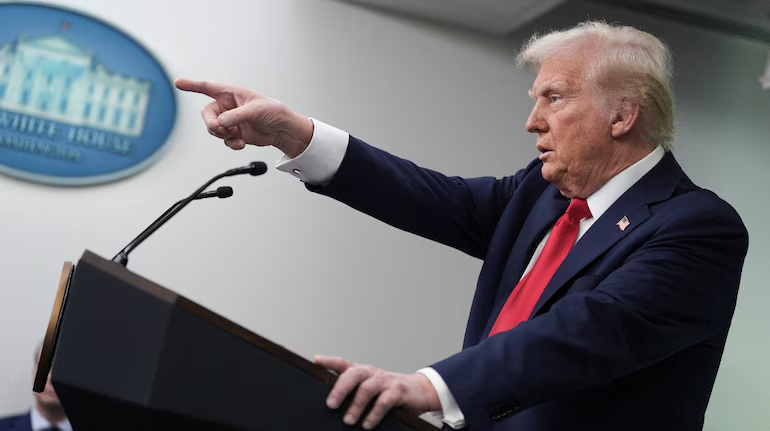
President Donald Trump used a White House roundtable on agricultural support to flag the possibility of fresh tariffs on rice imports from India, accusing exporters of “dumping” cheap rice into the U.S. market and promising to “take care of it.” The announcement was made as the administration unveiled a $12 billion farmer relief package aimed at offsetting pressure on U.S. producers. Reuters+1

This article breaks down what Trump said, why U.S. rice producers are alarmed, how tariffs could be implemented, and what the move — if pursued — would mean for markets and U.S.–India ties.Click Here To Follow Our WhatsApp Channel

What happened at the roundtable

At the White House event, Trump highlighted complaints from domestic farmers — particularly rice producers in the Gulf South — about an influx of low-priced imports that they say undercut U.S. prices. He pressed Treasury Secretary Scott Bessent on whether India had an “exemption” from tariffs for rice, declared that countries “should not be dumping” rice into the United States, and signaled the administration could respond with duties. The announcement came alongside details of a $12 billion “Farmer Bridge Assistance” package intended to cushion producers. NDTV Profit+2Reuters+2

The president also mentioned potential “very severe tariffs” on other agricultural inputs — notably Canadian fertilizers such as potash and phosphate — as part of a broader effort to boost domestic agricultural resilience. Analysts saw the comments as both a political signal to farm constituencies and a practical warning to trading partners that tariff tools remain on the table. news.bloombergtax.com+1

Why U.S. rice producers are concerned

U.S. rice production is concentrated in states such as Arkansas, Louisiana, Texas and California. Growers and millers say sustained inflows of low-priced basmati and non-basmati rice from major exporters (India, Thailand, Vietnam) have compressed margins and reduced market share for domestic brands — a trend producers describe as “devastating.” Industry representatives at the roundtable pointed to changed retail ownership (including Indian firms owning leading U.S. retail rice brands) and alleged government supports abroad that lower export prices. Those producers have pushed for anti-dumping or countervailing duties as a remedy. dtnpf.com+1

Market data published around the same period showed U.S. rice futures had moved higher this year amid global supply concerns; domestic producers contend that duty-free or low-duty imports worsen price swings by adding cheap supply to the U.S. market. dtnpf.com

How tariffs or trade remedies would work (the mechanics)

The two principal U.S. trade remedies used to counter “dumping” or subsidies are anti-dumping (AD) and countervailing duty (CVD) cases. Under U.S. law, domestic producers file petitions alleging imports are sold at less than fair value or receive prohibited subsidies; the Department of Commerce investigates pricing or subsidy margins and the U.S. International Trade Commission (ITC) determines whether U.S. industry has suffered material injury. If both agencies rule for relief, additional duties are imposed. Separate measures — such as emergency national-security tariffs under Section 232 or presidential proclamations — have also been used historically, though they carry different legal and political risks. Trade.gov+2USITC+2

That process can take months (or longer, if appealed), but national administrations can also use broader tariff proclamations or temporary measures to signal intent — a tactic Trump explicitly favored in the roundtable when he said “tariffs… solves the problem in two minutes.” NDTV Profit

Immediate market and corporate reactions

News of the president’s comments triggered immediate market attention. Shares of Indian rice exporters and listed companies tied to the rice trade saw intraday weakness on concerns that duties, if imposed, would cut U.S. shipments and revenue. Media and trading platforms flagged vocal responses on X (formerly Twitter) and rapid social-media distribution of the roundtable clips. Domestically, farm groups largely welcomed a tough stance on imports while some trade groups warned of higher food costs for consumers. NDTV Profit+1

Analysts cautioned that if a tariff were implemented unilaterally and without careful WTO-compatibility or solid anti-dumping findings, it could trigger retaliation or cross-border disputes and risk destabilizing other agricultural trade flows. A Washington Post opinion piece and other commentators argued that recurring tariff escalations can create a policy environment that raises costs for both producers and consumers. The Washington Post+1

Political and diplomatic stakes

Trade actions that single out India — especially after earlier rounds of U.S. tariffs and reciprocal measures in 2025 — risk complicating broader U.S.–India negotiations on market access, energy, and strategic cooperation. New duties on rice would be interpreted in New Delhi as pressure within a larger, sometimes contentious, negotiating framework and could complicate cooperation on other geopolitical priorities. Indian media and officials publicly signaled concern and framed Washington’s comments as leverage in stalled talks. The Times of India+1

For the U.S. administration, the calculus is political as much as economic: protecting farm-state voters is a clear priority, but so is maintaining stable strategic ties with India — a partner on regional security and supply-chain initiatives. That balance will shape whether the administration proceeds with formal investigations or opts for targeted remedies. Politico

Who stands to gain — and who would lose

  • Short-term winners (domestic): U.S. rice producers and millers could see relief from cheaper imports if duties raise landed prices; a targeted tariff could act as a rapid cushion for margins. dtnpf.com
  • Short-term losers (consumers & importers): Higher import duties generally translate into higher retail prices for rice and rice-containing products, affecting consumers, foodservice operators and downstream processors. Investopedia
  • Exporters (India and others): Major exporters that rely on the U.S. market could face reduced shipments and downward pressure on stock valuations if access is disrupted. News outlets reported immediate share-price sensitivity for leading Indian exporters after the president’s remarks. NDTV Profit

Legal and procedural constraints

Even where political appetite exists, AD/CVD cases require evidentiary showing that dumping or subsidies have caused material injury. The Commerce Department and ITC must follow statutory timelines and legal standards; adverse decisions can be appealed domestically or at the WTO. If the administration were to attempt broader tariff actions outside the AD/CVD framework (for example, national-security-based tariffs), it would likely face legal challenges and diplomatic blowback. These procedural realities mean the most definitive responses usually take time, even if presidential rhetoric is immediate. USITC+1

What to watch next

  1. Formal petitions or investigations: Watch for AD/CVD petitions from U.S. rice industry groups and any subsequent Commerce/ITC case filings. These are the clearest path to enforceable duties. Trade.gov
  2. Outcomes from the December 10 trade talks: A U.S. delegation was due to visit India around the time of the announcement; any progress (or lack thereof) in talks could affect the administration’s next move. Reuters
  3. Market signals: Share-price movement at listed exporters, futures volatility in rice and related commodities, and import statistics (monthly customs data) will all indicate whether flows are shifting. NDTV Profit+1
  4. Diplomatic responses: Official statements from India’s commerce and foreign-affairs ministries, and whether New Delhi pursues WTO consultations or retaliatory measures, will be important for gauging escalation risk. The Times of India

Bottom line

President Trump’s December 8 roundtable comments underscore a policy posture that treats tariffs as a frontline tool for protecting U.S. agriculture. The rhetoric reflects genuine distress among U.S. rice producers, but translating that concern into sustained, WTO-compatible trade remedies requires formal investigations and legal findings — a process that takes time and invites diplomatic maneuvering. If duties are imposed, the short-term winners would likely be domestic growers; the short-term losers would include consumers and exporters to the U.S., and the move could ratchet up tensions in an already complicated U.S.–India relationship. Policymakers will have to weigh immediate political pressure against the economic and geopolitical costs of escalation.

Chinese Embassy to Launch Online Visa Application System in India from December 22

Chinese Embassy

The Chinese Embassy in India is set to launch the online visa application system on December 22, Chinese Ambassador to India, Xu Feihong said on Monday.

Sharing the details in a post on X, he said that the applicants could fil out the form and upload application materials online by visiting https://visaforchina.cn/DEL3_EN/qianzhengyewu

“Notice Regarding Online Visa Processing Approval- China Online Visa Application System will be officially launched by the Chinese Embassy in India on December 22, 2025. Applicants could enjoy convenience of filling out the form and uploading application materials online by visiting https://visaforchina.cn/DEL3_EN/qianzhengyewu. Welcome to visit this website for more details.
Chinese Visa Application Service Center in New Delhi.Click Here To Follow Our WhatsApp Channel

Business Hours: Monday to Friday 9:00-15:00
Call: +91-9999036735
Address: Concourse floor, Shivaji Stadium Metro Station, Baba Kharak Singh Marg, Connaught Place, New Delhi 110001”
https://x.com/China_Amb_India/status/1997914771270799822?s=20

Earlier on November 26, the Ministry of External Affairs confirmed that the visa regime for tourism and business purposes for Chinese nationals is now “fully functional, “marking the end of a five-year suspension imposed after the 2020 border clashes.

MEA spokesperson Randhir Jaiswal, addressing the weekly media briefing, said, “Visas for tourists are being given to Chinese nationals and business visas were being given earlier. So you know, all those visas are now in place. The visa regime of tourism and business, etc, is fully functional.”

India officially resumed issuing tourist visas to Chinese nationals worldwide in November 2025, expanding on a limited reopening that began in July 2025. Business visas were already being issued prior to this recent announcement, and that process remains in place.

The resumption of visas is part of a series of “people-centric” confidence-building measures agreed upon by both sides in 2025, which also included the resumption of direct commercial flights in October 2025 and the revival of the Kailash Manasarovar Yatra pilgrimage.

This decision is expected to boost tourism and trade and enhance people-to-people exchanges between the two most populous countries in the world. (ANI)