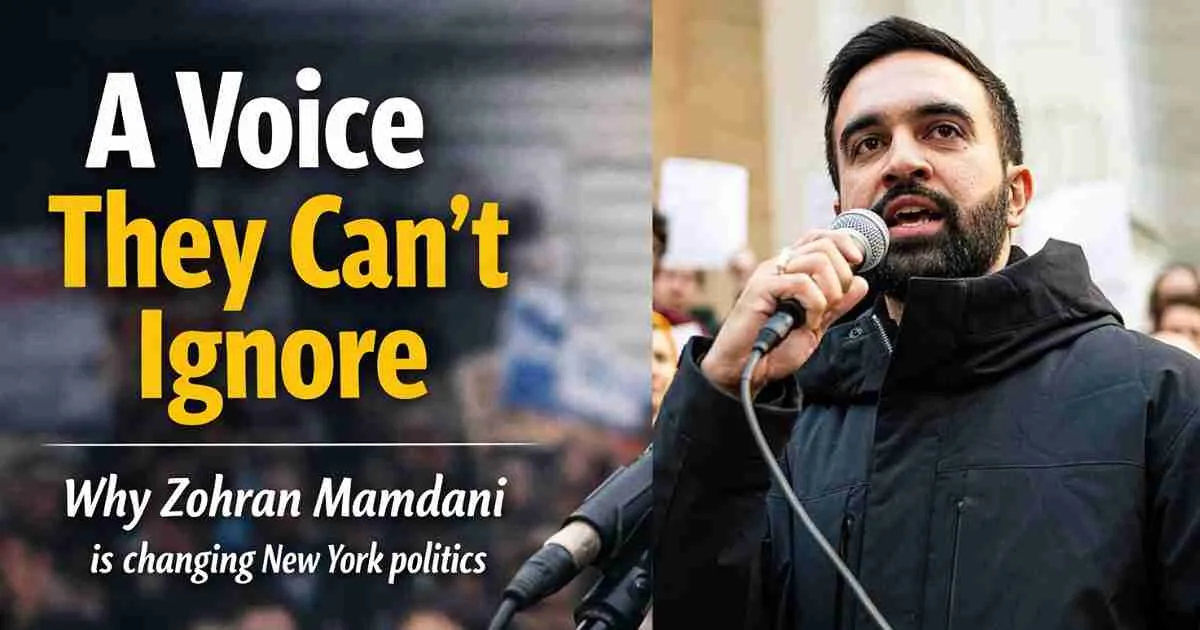
Zohran Mamdani has quickly become one of the most talked-about young politicians in the United States. Known for his clear words, people-first politics, and fearless stand on global and local issues, Mamdani represents a new generation of leadership in New York.Click Here To Follow Our WhatsApp Channel
Early Life and Background
Zohran Mamdani was born to a family deeply connected to culture, education, and social awareness. Raised in New York, he grew up seeing both opportunity and inequality side by side. These early experiences shaped his political thinking and pushed him towards public service.
He studied in the US and became active in community organising before entering formal politics. From the beginning, his focus was clear: justice, dignity, and fairness for ordinary people.
Rise in New York Politics
Mamdani is a member of the New York State Assembly, representing parts of Queens. His campaign stood out because it was people-powered, not driven by big money. Volunteers, students, workers, and immigrant families formed the backbone of his support.
His success showed that voters were ready for honest leadership that speaks directly about real problems like:
High rent and housing insecurity
Rising cost of living
Healthcare access
Workers’ rights
Climate responsibility
A Leader Who Speaks Without Fear
What makes Zohran Mamdani different is his willingness to speak openly, even when the topic is uncomfortable. Whether it is foreign policy, human rights, or social justice, he does not soften his words for political convenience.
Recently, his strong public statements on international conflicts and US foreign actions brought him national and global attention. Supporters praised his courage, while critics challenged his views — but no one ignored him.
Zohran Mamdani / Image Credit To Yahoo.com
Why His Statements Resonate
Mamdani’s words resonate because they connect global events to local lives. He often explains how decisions made far away affect families living in New York — immigrants, refugees, workers, and students.
He consistently reminds people that:
War and conflict impact local communities
Foreign policy is not separate from daily life
Moral responsibility matters in leadership
This approach has made him especially popular among young voters and minority communities.
Support From Young and Working-Class Voters
Zohran Mamdani has strong support among:
Young voters
Immigrant families
Muslim and minority communities
Workers and renters
Many see him as someone who understands struggle, not just talks about it. His speeches avoid complex language and focus on simple, human truths — a key reason his message spreads widely online.
Media Attention and Growing Influence
Major media outlets and social platforms now regularly quote Mamdani. His posts on X and public speeches often go viral because they are direct, emotional, and grounded in values.
In an age where many politicians avoid clear positions, Mamdani’s clarity makes him stand out.
Why Zohran Mamdani Matters Beyond New York
Although he is a state-level leader, Mamdani’s influence goes beyond New York. He represents a wider shift in American politics — where young leaders demand accountability, fairness, and moral clarity.
For many observers, he is not just a politician, but a sign of where future US politics may be heading.
Conclusion
Zohran Mamdani is more than a rising political figure. He is a voice for those who often feel unheard. Whether people agree with him or not, his impact is undeniable.
In a world full of careful silence, Mamdani chooses clear speech — and that is exactly why so many people are listening.
New York City, often hailed as the world’s financial capital, witnessed a political earthquake on 5 November 2025. In the race for the 36th District State Assembly seat, 33-year-old Social Democrat Zohran Mamdani not only secured re-election but also defeated his rival by an astonishing 30-point margin, setting a new benchmark in the city’s political history.Click Here To Follow Our WhatsApp Channel
This victory was not merely about winning a seat — it was a clear message to New York’s real estate magnates, Wall Street power brokers, and tech billionaires:
“Your era is over.”
When Money Lost the Battle
The coalition of wealthy donors formed against Mamdani turned this contest into one of the costliest primaries in American history. The Real Estate Board of New York (REBNY), along with billionaire donors such as LinkedIn founder Reid Hoffman, Quicken Loans’ Dan Gilbert, and Ripple’s Chris Larsen, poured over $2 million into Mamdani’s opponent’s campaign.
As the New York Post summed it up:
“Billionaires bet big to stop a socialist – and lost bigger.”
But when the final votes were counted, the message was unmistakable — Money lost, and the people won.
In his victory speech, Mamdani addressed the billionaire class directly:
“They thought democracy could be bought with money. Tonight, the people of Brooklyn, Queens, and Manhattan proved that our voices cannot be silenced.”
Real Estate Lobby in Panic
Mamdani’s triumph has sent shockwaves through New York’s real estate elite, who now describe him as “the greatest threat to New York’s economy.” His agenda, however, is straightforward and people-centred:
Mandatory rent stabilisation for all apartments
Passing the “Good Cause Eviction” bill to protect tenants
Imposing higher taxes on vacant properties to raise $10 billion for social housing
Introducing the “Pied-à-terre” tax on luxury second homes
REBNY president James Whelan quickly warned:
“This will be disastrous for New York’s economy.”
Meanwhile, The New York Times reported that the real estate lobby has begun pressuring Assembly Speaker Carl Heastie to remove Mamdani from the Housing Committee.
Wall Street’s Fury and Media Backlash
Outlets like Bloomberg News, Fox News, and the New York Post have branded Mamdani a “dangerous socialist.” One billionaire donor, speaking anonymously to The Intercept, admitted:
“We did everything we could to defeat him. Now he’s in the Assembly, and he’s about to raise our taxes. This is a death sentence for our business.”
Reid Hoffman went so far as to declare that he would “never again support socialist candidates” and demanded his political contributions be returned.
Democratic Establishment on Edge
State Governor Kathy Hochul and New York City Mayor Eric Adams — both known for their close ties with real estate interests — have labelled Mamdani an “extremist.” At a press conference, Hochul remarked:
“Our city needs a business-friendly environment, not socialism.”
But the public sentiment tells a different story. Following Mamdani’s victory, #MamdaniWave began trending across social media, as young people, workers, and tenants throughout New York took to the streets in celebration of what they see as a new dawn for the working class.
The Beginning of a New Era
Zohran Mamdani’s victory is not just an electoral win — it marks the start of a new political era in New York, where money and lobbying power are being challenged by grassroots people’s movements.
In his closing remarks, Mamdani said:
“This victory is not mine. It belongs to every tenant who sleeps in fear of eviction. To every student buried under debt. To every worker juggling two jobs and still struggling to get by. Tonight, we proved that New York is no longer the city of billionaires — it’s the city of its people.”
New York’s billionaire class may have lost more than an election — they’ve lost their comfort. And perhaps, this fear is only the beginning.
US President Donald Trump has reacted to New York City mayor-elect Zohran Mamdani’s victory speech, saying the 34-year-old Democrat should build a new understanding with Washington or risk facing setbacks.Click Here To Follow Our WhatsApp Channel
Responding to a Fox News reporter’s question, Trump appeared to soften his tone, stating that he wanted Mamdani “to do well” as he “loved New York,” but repeated his earlier remarks calling the mayor-elect a “communist.”
“You know, I’m so torn because I would like to see the new mayor do well because I love New York. I really love New York. When I left New York for Washington, New York was doing really well. But there were some bad signs. The bad sign was a guy named Bill de Blasio. So the signs of de Blasio, that was the beginning and it was bad. This one we’re going to look for a thousand years. Communism has not worked,” Trump said.
Referring to Mamdani’s victory speech in Brooklyn on Tuesday night, Trump described it as “a very angry speech” and said the mayor-elect should maintain a positive working relationship with the President.
“I thought it was a very angry speech, certainly angry toward me and I think he should be very nice to me as I am the one that sort of has to approve a lot of things coming to him, so he’s off to a bad start,” Trump told Fox News.
During his victory address, Mamdani had directly mentioned Trump, saying, “To get to any of us, you will have to get through all of us.” He further added, “I have four words for him: Turn the volume up.”
Mamdani, a Democrat, won the New York City mayoral race in a record voter turnout of over two million. He defeated independent candidate and former New York Governor Andrew Cuomo, who had backing from Trump and Elon Musk, alongside Republican nominee Curtis Sliwa.
The victory gave Democrats a significant boost ahead of the 2026 midterm elections.
Following the election, Trump said the United States had lost its “sovereignty” after Mamdani’s win. Speaking at a business event in Miami, he claimed that New York City was heading toward communism and vowed to “take care of it,” without elaborating further.
Addressing supporters in Miami a day later, Trump remarked that Miami “will soon be the refuge for those fleeing communism in New York.”
“The decision facing all Americans could not be more clear: We have a choice between communism and common sense,” Trump said, adding that the country must choose between an “economic nightmare” and an “economic miracle.” (ANI)
In a fiery pre-election statement, U.S. President Donald Trump has warned that New York City will face a “complete and total economic and social disaster” if Democratic candidate Zohran Mamdani wins the mayoral race. Trump, who took to his Truth Social platform on Monday night, described Mamdani as a “Communist” and claimed that the city’s “survival” would be at risk under his leadership.Click Here To Follow Our WhatsApp Channel
Trump’s post came just hours before polls opened across the United States on November 4, as New Yorkers prepare to elect their next mayor. In a surprising move, Trump also officially endorsed former New York governor Andrew Cuomo, urging voters to rally behind him to “save” the city.
“If Communist candidate Zohran Mamdani wins the election for mayor of New York City, it is highly unlikely that I will be contributing federal funds, other than the very minimum as required, to my beloved first home,” Trump wrote. “This once-great city has zero chance of success, or even survival, with a Communist at the helm.”
The president said that sending funds to a city led by Mamdani would be “throwing good money after bad,” insisting that as president, his duty was to safeguard national interests — not to subsidise what he described as “failed ideologies.”
Trump Endorses Cuomo, Rejects Republican Nominee
Trump’s endorsement of Andrew Cuomo, who is running as an independent, stunned many political observers. Despite being a lifelong Republican, Trump said he would rather support a Democrat with a record of governance than a “Communist with no experience.”
“Whether you personally like Andrew Cuomo or not, you really have no choice,” Trump said. “You must vote for him and hope he does a fantastic job. He is capable of it — Mamdani is not.”
The former president dismissed the Republican nominee Curtis Sliwa, saying that “a vote for Sliwa is a vote for Mamdani.” He added humorously that Sliwa “looks much better without the beret,” referencing the Guardian Angels leader’s trademark red cap.
Who Is Zohran Mamdani?
Zohran Mamdani, 34, is a New York State Assembly member and self-described Democratic Socialist, running for mayor on a progressive platform. Born in Uganda and raised in New York City, Mamdani is the son of acclaimed Indian filmmaker Mira Nair and Ugandan scholar Mahmood Mamdani.
Mamdani gained national attention after defeating Cuomo in the Democratic primary in June, a victory that reshaped the city’s political landscape. His campaign has focused on housing affordability, rent control, and social equality, promising to “lower costs and make life easier” for working-class New Yorkers.
He has pledged to freeze rent for all stabilised tenants, expand public housing projects, and redirect city funds toward affordable housing and social services.
However, critics — including Trump — have painted him as too radical for New York’s fragile post-pandemic economy.
“His principles have been tested for over a thousand years, and never once have they been successful,” Trump said. “He ranked at the bottom of his class, and as mayor of what was once the greatest city in the world, he has no chance to bring it back.”
Election Day and Political Climate
The New York City mayoral election is taking place amid heightened political tension. Current mayor Eric Adams, plagued by corruption scandals, withdrew from the race in September, leaving Mamdani, Cuomo, and Sliwa as the main contenders.
According to the New York City Board of Elections, more than 735,000 people voted early, nearly four times higher than during the 2021 election — a sign of strong voter interest.
Polls have indicated that Mamdani holds a slight lead over Cuomo, with Sliwa trailing in third place. Analysts believe that Trump’s last-minute endorsement could sway moderate and conservative voters toward Cuomo, potentially reshaping the race’s final outcome.
Trump’s Broader Message
Trump’s remarks fit within his broader campaign narrative portraying himself as a defender of economic stability and traditional values. In a recent CBS 60 Minutes interview, he reiterated his concerns about Mamdani’s ideology.
“If you have a Communist running New York, all you’re doing is wasting the money you’re sending there,” Trump said. “Between a bad Democrat and a Communist, I’ll pick the bad Democrat every time.”
The statement underscores Trump’s strategy to appeal beyond his Republican base, positioning himself as a pragmatic leader willing to cross party lines to oppose what he sees as the threat of “radical socialism.”
Conclusion
As New York voters head to the polls, Trump’s endorsement of Cuomo and his harsh warning against Mamdani have added fresh drama to an already unpredictable race.
Whether this late intervention helps or hurts Cuomo’s chances remains to be seen. What’s certain, however, is that Trump’s comments have thrust the New York mayoral race into the national spotlight — turning a local contest into a flashpoint in America’s broader ideological divide between progressivism and populism.
Former President Donald Trump unleashed a scathing personal attack on Zohran Mamdani, the Indian-American Democratic socialist who emerged victorious in New York City’s Democratic mayoral primary. In a series of posts on his Truth Social platform, Trump labeled Mamdani a “100% Communist Lunatic,” criticized his appearance, voice, and intelligence, and framed his win as a dangerous shift in the Democratic Party’s direction. The remarks, made as Trump traveled back from a NATO summit in The Hague, reflect a broader Republican strategy to portray Mamdani as a symbol of Democratic extremism ahead of the November 2025 general election.
Mamdani’s Historic Primary Victory
Zohran Mamdani, a 33-year-old state assemblyman from Astoria, Queens, delivered a stunning upset by defeating former New York Governor Andrew Cuomo in the Democratic primary. With approximately 43% of first-choice votes in the ranked-choice voting system, Mamdani’s lead prompted Cuomo’s concession, though final results are pending due to the ranked-choice process. If elected in November, Mamdani would become New York City’s first Muslim and Indian-American mayor, as well as its youngest in over a century.
Mamdani’s campaign galvanized younger, progressive voters with a bold platform centered on affordability and social justice. Key proposals include freezing rents on stabilized apartments, making public buses free, establishing city-run grocery stores, and funding these initiatives through a $10 billion tax increase on corporations and wealthy residents. His campaign’s savvy social media presence and extensive volunteer network helped him overcome Cuomo’s name recognition and establishment backing, which included endorsements from figures like former President Bill Clinton and Representative Jim Clyburn.
Mamdani’s victory is seen as a referendum on the Democratic Party’s direction, particularly after its losses in the 2024 presidential election. His progressive policies and outspoken criticism of Israel’s actions in Gaza—calling them a “genocide” and supporting the Boycott, Divestment, and Sanctions (BDS) movement—have made him a polarizing figure, even within his own party.
Trump’s Fiery Response
Trump’s reaction to Mamdani’s win was swift and vitriolic. In his Truth Social posts, he wrote, “It’s finally happened, the Democrats have crossed the line. Zohran Mamdani, a 100% Communist Lunatic, has just won the Dem Primary, and is on his way to becoming Mayor. We’ve had Radical Lefties before, but this is getting a little ridiculous.” He went on to attack Mamdani personally, stating, “He looks TERRIBLE, his voice is grating, he’s not very smart,” and mocked his supporters, including Representative Alexandria Ocasio-Cortez (AOC), whom he referred to as part of “AOC+3, Dummies ALL.” Trump also falsely claimed Senate Minority Leader Chuck Schumer, who is Jewish, was a “Great Palestinian Senator” groveling over Mamdani.
In a second post, Trump sarcastically suggested that Democrats nominate Representative Jasmine Crockett for president in 2028, with AOC and other progressive “Squad” members—likely Ilhan Omar, Ayanna Pressley, and Rashida Tlaib—in cabinet roles. He concluded, “Added together with our future Communist Mayor of New York City, Zohran Mamdani, and our Country is really SCREWED!” These remarks align with Trump’s long-standing tactic of using inflammatory rhetoric to paint political opponents as extreme and unfit.
Broader Political Context
Mamdani’s win has sparked intense debate within and beyond the Democratic Party. Progressives, including Ocasio-Cortez and Senator Bernie Sanders, celebrated his victory as a “seismic shift” toward policies prioritizing working-class New Yorkers. Ocasio-Cortez praised Mamdani’s “dedication to an affordable, welcoming, and safe New York City,” noting that his campaign overcame millions in opposition funding from billionaires and lobbyists. The Working Families Party echoed this sentiment, calling the result a sign that voters are “fed up with the status quo.”
However, moderate Democrats expressed concern that Mamdani’s socialist platform could alienate voters in swing districts, complicating efforts to regain congressional control in the 2026 midterms. Representative Laura Gillen (D-NY) called Mamdani “too extreme to lead,” arguing his policies, such as higher taxes, are “the last thing New York needs.” The group Republicans Against Trumpism warned that Mamdani’s prominence could be weaponized by Republicans to hurt moderate Democrats in competitive races.
Republicans, meanwhile, seized on Mamdani’s victory as political ammunition. Trump’s adviser Stephen Miller linked Mamdani’s win to “unchecked migration,” invoking white nationalist rhetoric. Conservative media and influencers have also targeted Mamdani’s Muslim faith, with some falsely linking him to 9/11 or labeling him a “terrorist sympathizer” due to his pro-Palestinian stance. Such attacks have drawn criticism for their Islamophobic undertones.
Mamdani’s Background and Platform
Born in Uganda to Indian parents, Mamdani is the son of filmmaker Mira Nair and academic Mahmood Mamdani. He moved to New York City at age seven and later graduated from Bowdoin College with a degree in Africana studies. Before entering politics, he worked as a housing counselor and hip-hop musician. Elected to the New York State Assembly in 2020 after defeating a four-term incumbent, Mamdani has focused on housing reform, transportation, and energy policy, securing $100 million for subway service and launching a fare-free bus pilot.
His mayoral platform addresses New York’s affordability crisis, with proposals like universal childcare, a $30 minimum wage, and “baby baskets” for newborns. Mamdani’s foreign policy views, particularly his pledge to arrest Israeli Prime Minister Benjamin Netanyahu if he visits New York (citing 2024 ICC arrest warrants), have drawn ire from pro-Israel groups, who accuse him of antisemitism. Mamdani has denied these claims, emphasizing his commitment to protecting Jewish New Yorkers and increasing funding to combat hate crimes.
The Road to November
Mamdani now faces a competitive general election against incumbent Mayor Eric Adams, running as an independent, and Republican candidate Curtis Sliwa. Adams, who called Mamdani a “snake oil salesman” on Fox & Friends, has positioned himself as a moderate alternative, emphasizing crime reduction and support for police. Cuomo has not ruled out an independent run, which could further complicate the race. Given New York’s liberal leanings, the Democratic nominee typically has an advantage, but Mamdani’s progressive agenda and polarizing rhetoric may face scrutiny in the diverse, complex city.
Trump’s intervention signals that the race will draw national attention, with Republicans likely to frame Mamdani as emblematic of a Democratic Party veering too far left. Meanwhile, Mamdani’s campaign continues to resonate with voters frustrated by rising costs and inequality, as evidenced by his ability to build a multiracial, youth-driven coalition. As one X user quipped in response to Fox News’ coverage of Mamdani’s “socialist promises,” “Nothing says ‘radical’ like being able to eat and have a kid without needing to live in a tent.”
Conclusion
Donald Trump’s attack on Zohran Mamdani underscores the high stakes of the 2025 New York City mayoral race, which has become a flashpoint in the broader struggle over the Democratic Party’s identity. Mamdani’s rise reflects a growing appetite for progressive change among urban voters, but it also invites fierce opposition from conservatives and moderates alike. As the general election approaches, Mamdani’s ability to navigate personal attacks, unify Democrats, and appeal to a broad electorate will determine whether he can make history as New York’s next mayor.