
Professor Mohammad Sanaullah al-Nadawi, a well-known Indian Arabic scholar and former Head of the Department of Arabic at Aligarh Muslim University (AMU), recently represented India at a major international conference held in London. The two-day event was organised by the prestigious Al-Furqan Islamic Heritage Foundation and focused on “Early Traditions of Translation in Islamic History.”
Keynote Lecture on India’s Influence on Medieval Baghdad
During the conference, Professor Sanaullah delivered an important keynote lecture titled “India’s Role in the Formation of Medieval Baghdad.”
In his talk, he explained how large numbers of Indian (especially Sanskrit) books on medicine, astronomy, philosophy, mathematics, and literature were translated into Arabic during the Abbasid period in Baghdad.
Click Here To Follow Our WhatsApp Channel
He highlighted that:
- Sanskrit scientific works greatly influenced the development of Islamic knowledge.
- Abbasid rulers and the famous Barmakid ministers strongly supported translation projects.
- Indian ideas helped shape Baghdad’s intellectual and scientific culture in the medieval period.
His lecture received appreciation from scholars and participants for shedding light on India’s long-standing contribution to global learning.
Strong Role in Al-Tilmeez Research Journal
Professor Sanaullah is also the Vice Chief Patron of the International Research Journal Al-Tilmeez, one of the leading Arabic journals published from Jammu & Kashmir under the Chief Editorship of Dr Meraj Nadvi.
His guidance and international experience have helped the journal grow in academic quality and global recognition.
Visits to London’s Historic and Academic Centres
During his visit, Professor Sanaullah also toured several iconic places in London, including:
- The Royal Palaces
- University of London
- The British Museum
- The British Library
- The Athenaeum Club
- Caxton Hall
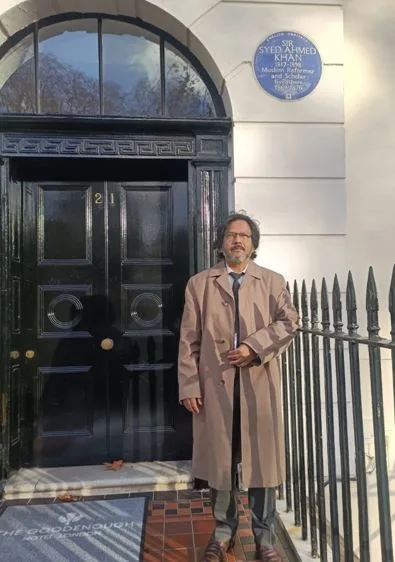
- 21 Mecklenburg Square
The Athenaeum Club and 21 Mecklenburg Square hold great historical value, as they are linked to Sir Syed Ahmad Khan, the founder of Aligarh Muslim University, who stayed there during 1869–70.
Engagements at Oxford and Cambridge
After the London conference, Professor Sanaullah visited the Universities of Oxford and Cambridge, where he met prominent scholars such as:
- Professor Julia Bray, Bodleian Chair of Medieval Arabic Literature at Oxford
- Professor Tahera Qutbuddin, award-winning scholar of Arabic oratory
- Scholars from the Oxford Centre for Islamic Studies, including Dr Mohammad Akram Nadwi, founder of the Al-Salam Institute in London
He also met Dr Wafaa Abdul Razzaq, a distinguished literary figure and nominee for the Nobel Prize in Literature.
A Proud Moment for Indian Scholarship
Professor Sanaullah’s participation in this international conference and his interactions with leading academics have been widely appreciated in India’s academic community. His visit highlighted the important historic links between India and the Islamic world and strengthened India’s presence in global scholarly discussions on Islamic heritage.
You Might Also Like:
Islam’s Unique Civilisation: Unity of Faith, Culture and History
Iran Offers Condolences to India Over Delhi Red Fort Blast, NIA Launches Full Terror Probe
Is Crowdfunding and Taking Loans Allowed in Islam? Understanding Help, Tawakkul and Riba