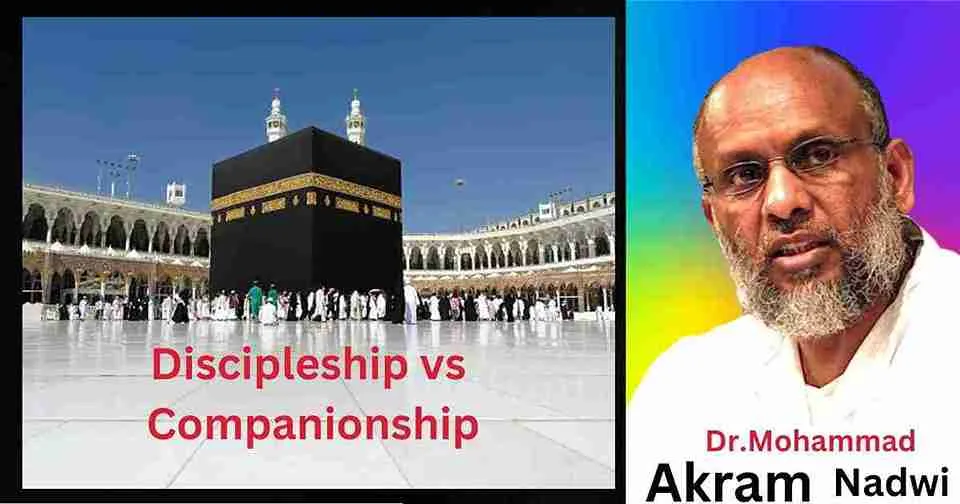
The distinction between a disciple and a companion is not merely terminological, but reflects two fundamentally different conceptions of knowledge, authority, and moral agency. Throughout intellectual and religious history, discipleship has commonly denoted a hierarchical relationship in which the student’s primary obligation is the faithful reproduction of the master’s teachings. By contrast, the Islamic notion of ṣuḥbah (companionship), most fully embodied in the relationship between the Prophet Muhammad ﷺ and his companions (aṣḥāb), represents a markedly different pedagogical and ethical paradigm. This model does not aim simply at the transmission of information or the replication of ritual practice, but at the formation of individuals capable of understanding, applying, and extending knowledge across the full range of human life. Click Here To Follow Our WhatsApp Channel
Within the conventional model of discipleship, the disciple functions within narrowly defined limits established by the master. Action is permitted only with explicit authorisation, and the exercise of independent judgement in matters of doctrine, terminology, or application is largely prohibited. The disciple’s task is fundamentally imitative rather than interpretive. Even minor adjustments in expression or practice are regarded as illegitimate unless the master has formally conferred authority upon the disciple, often by appointing him as a successor or recognising him as an independent teacher. Until such recognition is granted, the disciple remains intellectually dependent, entrusted with preservation rather than development.
This restrictive understanding of authority is reflected in the limited scope of discipleship. Instruction tends to be confined to personal discipline, ritual observance, and symbolic practices such as dress, prayer, and associated devotional acts. These teachings are frequently detached from the ordinary affairs of life. Matters such as commerce, governance, warfare, marriage, and social organisation are not treated as intrinsic components of moral or spiritual formation. They become objects of concern only insofar as they affect the psychological or spiritual condition of the disciple. Consequently, discipleship often produces individuals skilled in ritual conformity yet ill-equipped to address the ethical and practical complexities of social life.
Companionship, by contrast, presupposes a fundamentally different relationship between teacher and learner. Companions are not treated as passive recipients of instruction but as active participants in an intellectual and moral enterprise. The teacher regards them as fellows, and his role is not simply to transmit conclusions but to cultivate in them the capacity to learn, to reason, and to teach others. The emphasis shifts from the preservation of fixed formulations to the acquisition of skills, including ethical discernment, contextual judgement, and principled reasoning. These skills are imparted gradually and internalised, enabling companions to act independently while remaining faithful to the aims and spirit of the teaching.
In this pedagogical framework, authority is not monopolised but deliberately shared. Companions are trained to apply what they have learned to new and varied circumstances without compromising its foundational principles. Their legitimacy does not depend upon constant recourse to the master’s explicit permissions, but upon demonstrated competence, sound judgement, and moral integrity. Companionship thus produces not perpetual students but individuals who are themselves capable of mastery, able to extend the teaching beyond the immediate presence and lifetime of the teacher.
The educational practice of the Prophet Muhammad ﷺ exemplifies this model of companionship in its most comprehensive form. His teaching encompassed all dimensions of human life, integrating devotion to God with responsibility in social, economic, legal, and political spheres. He instructed his companions in worship and personal conduct, but also in commerce, family relations, conflict, governance, and the organisation of community life. None of these domains was treated as morally neutral or religiously peripheral. At the same time, he did not attempt to regulate every contingency through exhaustive prescriptions. Rather, he cultivated in his companions an understanding of principles and purposes that enabled them to exercise sound judgement in circumstances he could not directly address.
It is this approach that explains the companions’ capacity, after the Prophet’s death, to confront unprecedented challenges with confidence and coherence. They governed expanding societies, adjudicated complex legal cases, and engaged with diverse cultures while remaining anchored in the Prophetic ethos. Their authority was not derived from mechanical imitation, but from a deep internalisation of the Prophet’s method of teaching and learning.
A defining feature of this companionship was its inclusivity. Both men and women were regarded as companions and were educated accordingly. While the practical content of instruction varied considering differing social responsibilities and lived realities, the foundational principles governing their relationship with God and their ethical formation were identical. Women were not confined to private or ritual instruction; they participated actively in learning, teaching, transmitting knowledge, and issuing legal judgements. This demonstrates that companionship was defined not by gender or social role, but by intellectual engagement, moral responsibility, and participation in the Prophetic project.
The contrast between discipleship and companionship thus reveals two divergent educational and moral visions. Discipleship prioritises control, preservation, and limitation, producing followers whose primary virtue is conformity. Companionship emphasises trust, mastery, and comprehensive engagement with life, producing individuals capable of translating enduring principles into changing realities. The Prophetic model of companionship remains distinctive in its integration of knowledge with moral agency and in its refusal to separate spirituality from the practical demands of human existence. It is this model that enabled the companions to carry forward the Prophetic legacy not as static imitators of the past, but as living embodiments of wisdom, judgement, and ethical leadership.
You Might Also Like:
At 13, This Kashmiri Boy Built 31 Apps and AI Tools
Delhi Court Convicts Kashmiri Separatist Asiya Andrabi in UAPA Case
Pahalgam Railway Line Is About Future, Not Fear—Connectivity Is Development