Bangladesh Ex-PM Sheikh Hasina Sentenced to Death by War Crimes Tribunal

Sheikh Hasina

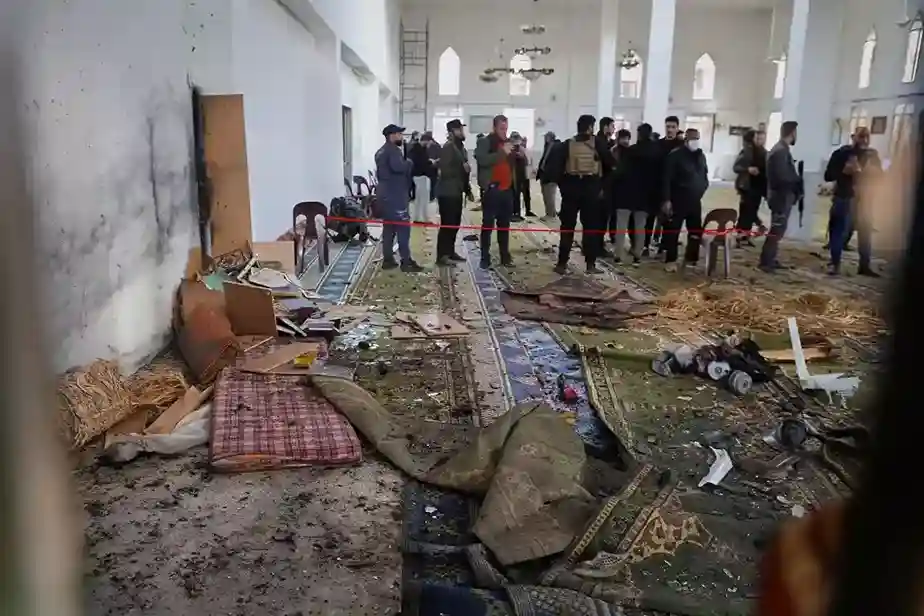
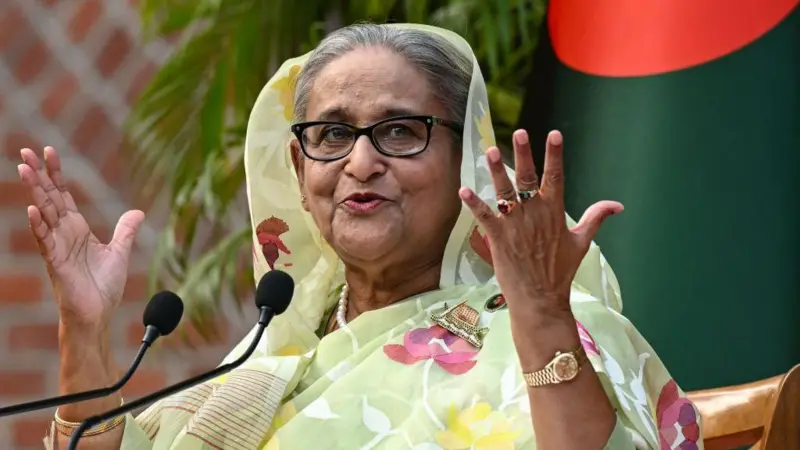
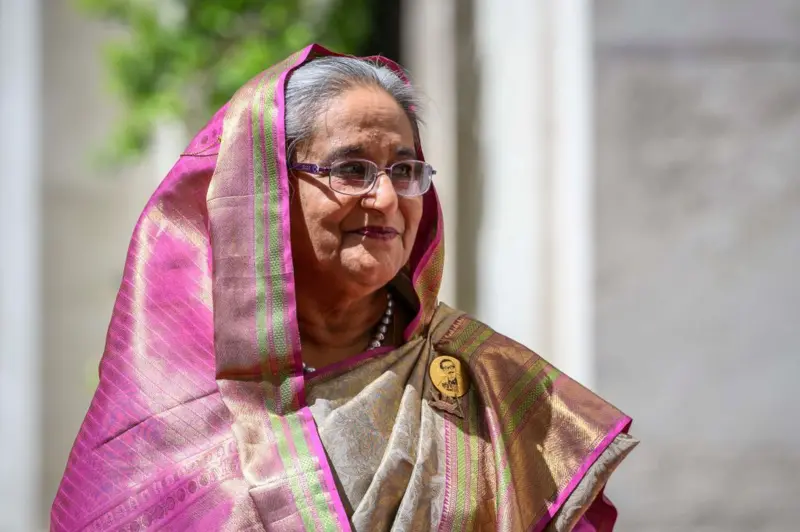
Bangladesh’s International Crimes Tribunal has sentenced former Bangladesh Prime Minister Sheikh Hasina to death in a case over alleged crimes against humanity. The court found Hasina guilty on three counts, concluding a months-long trial that found her guilty of ordering a deadly crackdown on a student-led uprising last year that led to the fall of her Awami League government.

The three-member tribunal, headed by Justice Mohd Golam Mortuza Majumder, also pronounced its judgement against Hasina’s two aides, former Home Minister Asaduzzaman Khan Kamal and former police chief Chowdhury Abdullah Al-Mamun, over the same charges.

The court said the three accused acted in connivance with each other to commit atrocities in order to kill protesters throughout the country. However, it pardoned the former police chief, who “sought an apology from the tribunal and the people of the country”.

Hasina and Kamal have been declared fugitives and tried in absentia, while Mamun initially faced trial in person before turning approver.

What Court Said
The court noted that the Hasina government did not pay heed to students’ demands, and instead of listening to the students, the then prime minister undermined the movement and made derogatory remarks pointing towards the students and terming them ‘Razakars’, a derogatory term used in Bangladesh.

In the aftermath of the derogatory remarks, students, including females, burst into a rage, the court noted, adding that Sheikh Hasina then ordered the “elimination of protesting students”.

The judges noted that the prosecution’s witnesses proved that the attack on Dhaka University students was by Awami League wings, including the Chhatra League and Yuva League.

“Sheikh Hasina ordered law enforcement agencies to use drones to locate congregating protesters and helicopters and lethal weapons to kill them,” the court said.

It added that former Home Minister Asaduzzaman Khan Kamal and former police chief Chowdhury Abdullah Al-Mamun committed crimes against humanity by their abetment in the use of drones and lethal weapons and helicopters by abetment and failure to prevent atrocities and are liable to be punished.

However, Abdullah Al-Mamun was given a pardon for making full disclosure related to the crime, and he admitted his involvement.

Convicting Hasina and Kamal, the court said their abscondence was suggestive of their guilt.

Hasina was “found guilty on three counts”, including incitement, ordering to kill, and inaction to prevent the atrocities, Judge Golam Mortuza Mozumder read to the packed court in Dhaka.

“We have decided to inflict her with only one sentence — that is, the sentence of death.”

Charges Against Hasina
Hasina, Kamal and Mamun faced five charges, including murder, attempted murder, torture and other inhumane acts. A key charge accused Hasina of ordering the “extermination” of protesters. She was also accused of making inflammatory remarks and directing the use of deadly weapons against students behind a mass uprising that forced her out of office in August 2024. A UN rights office report estimates that up to 1,400 people were killed between July 15 and August 15 during the “July Uprising” as her government ordered a sweeping security crackdown.

Hasina, 78, is currently living in exile in India, after defying the tribunal’s orders to face trial for ordering a deadly crackdown on a student-led uprising on August 5, 2024.

Chief Prosecutor Mohammad Tajul Islam has described Hasina as the “mastermind and principal architect” of the alleged atrocities during the protests. Her supporters, however, maintain the charges are politically motivated.

Hasina’s Extradition
Hasina fled Bangladesh on August 4, 2024, amid intensifying unrest and has since been residing in India. Kamal is also believed to have taken refuge in India. The interim government led by Muhammad Yunus has sought Hasina’s extradition, but India has yet to respond.

Unrest In Bangladesh
Security has been heightened nationwide ahead of the verdict. Dhaka Metropolitan Police Commissioner Sheikh Md Sajjat Ali on Sunday evening issued shoot-at-sight orders against anyone involved in arson, explosions or attempts to harm police and civilians.

The now-disbanded Awami League had called a two-day shutdown ahead of the judgement. Army troops, Border Guard Bangladesh personnel and riot police have been deployed around the ICT-BD complex, with streets in the capital largely deserted amid fears of violence.

45 Telangana Umrah Pilgrims Die in Saudi Bus Fire, Only One Survivor

45 Telangana Umrah

Forty-five Indian Umrah pilgrims from Hyderabad and other parts of Telangana died, and only one survived in a devastating bus fire near Medina in Saudi Arabia, Hyderabad Police Commissioner VC Sajjanar said on Monday, confirming one of the most tragic overseas incidents involving pilgrims from the state in recent years.

Addressing the media, Sajjanar said the group was travelling from Makkah to Madinah when their bus collided with an oil tanker nearly 25 km before Medina, causing an explosion that engulfed the vehicle within minutes.

“The fire spread rapidly, leaving no time for most passengers to escape,” he said.

According to details shared by the Commissioner, a total of 54 pilgrims from Hyderabad left for Jeddah on November 9 as part of an Umrah tour scheduled from November 9 to 23. Of them, four individuals proceeded to Madinah separately by car, while another four remained in Makkah due to personal reasons. The remaining 46 pilgrims boarded the bus involved in the fatal crash.

Out of the 46 passengers, 45 died at the scene after the bus was completely burnt. Only one individual, Md Abdul Shoaib, survived the fire. He has been admitted to a Saudi hospital ICU and is in critical condition.

Meanwhile, Defence Minister Rajnath Singh on Monday expressed condolences over the tragic bus accident that occurred late last night near Madinah, Saudi Arabia, which claimed the lives of several Indian pilgrims and left others injured.

In a post shared on X, the Defence Minister said, “Saddened by the tragic accident involving a bus carrying Indian pilgrims in Saudi Arabia. My condolences to the families who have lost their loved ones.”

He further assured that the Indian government is actively engaged in providing all necessary support. “Indian officials are in close coordination with the Saudi authorities to ensure the injured receive proper care and that every possible support reaches the affected families in this hour of grief,” Singh further said on X.

Further, the Consulate General of India in Jeddah has set up a 24×7 control room following a tragic bus accident late last night involving Umrah pilgrims near Madinah, Saudi Arabia.

The Consulate General of India, Jeddah, has provided multiple contact numbers for assistance, including 8002440003 (toll-free), 00966122614093, 00966126614276, and 00966556122301 (WhatsApp), urging family members to reach out for immediate support.

In its statement, the Indian Consulate expressed its “deepest condolences to the bereaved families.”

“Embassy in Riyadh and the Consulate in Jeddah are also in touch with the Saudi Haj and Umrah Ministry, and other local authorities. They are also in touch with the concerned Umrah operators,” the statement added.

A team of Consulate staff and Indian community volunteers is on the ground at various hospitals and sites. The press release added that both the Embassy and the Consulate are “extending fullest support” and “are also in touch with the concerned officials of the State of Telangana to coordinate with the concerned families.”

Earlier in the day, External Affairs Minister S Jaishankar said that he was “deeply shocked” by the bus accident near Madinah, Saudi Arabia.

“Deeply shocked at the accident involving Indian nationals in Medinah, Saudi Arabia. Our Embassy in Riyadh and Consulate in Jeddah are giving fullest support to Indian nationals and families affected by this accident. Sincere condolences to the bereaved families. Pray for the speedy recovery of those injured,” he wrote.

Telangana Chief Minister A Revanth Reddy also expressed shock after preliminary reports indicated that several victims were from Hyderabad.

According to an official statement, the Chief Minister has contacted officials in New Delhi and instructed them to coordinate closely with the Indian Embassy in Riyadh for updated information.

Telangana Chief Secretary, A Santhi Kumari, alerted Resident Commissioner Gaurav Uppal in New Delhi, directing him to immediately gather details on how many passengers from Telangana were on the bus and ensure timely support. A control room has also been activated at the state Secretariat to monitor the situation.

Hyderabad Lok Sabha MP and AIMIM chief, Asaduddin Owaisi, also expressed grief after the accident in Saudi Arabia and urged the Centre to bring back the bodies.

Owaisi told ANI that he had spoken to Abu Mathen George, Deputy Chief of Mission at the Indian Embassy in Riyadh, and also contacted two Hyderabad-based travel agencies, sharing the passengers’ details with the Riyadh Embassy and the Foreign Secretary.

He said that there were 42 people on the bus that was involved in the accident. Local reports said the bus was travelling from Mecca to Madinah when the accident occurred. Details on casualties and survivors are awaited. (ANI)

Iran Offers Condolences to India Over Delhi Red Fort Blast, NIA Launches Full Terror Probe

Iran Offers Condolences

Iran on Wednesday offered formal condolences to India over the tragic blast near Delhi’s iconic Red Fort on Monday evening that claimed atleast eight lives and left several injured.

In a statement, Esmail Baqaei, Spokesman for Iran’s Ministry of Foreign Affairs, conveyed the sympathy of the Islamic Republic of Iran to the government and people of India, with special regard to the families of the victims.Click Here To Follow Our WhatsApp Channel

“In the aftermath of the explosion in New Delhi, Esmail Baqaei, Spokesman for the Ministry of Foreign Affairs, conveyed the condolences and sympathy of the Islamic Republic of Iran to the government and people of India, particularly to the families of the victims,” the Iranian Foreign Ministry posted on X.

“He expressed wishes for the swift recovery of those injured in this tragic incident,” the ministry added.

The message by Iran’s Ministry of Foreign Affairs comes amid growing global solidarity with India following the tragic blast in the national capital, which claimed atleast eight lives and left several injured.

Authorities are investigating the incident as a possible terror incident.

Following the blast, the National Investigation Agency (NIA) has constituted a “dedicated and comprehensive” investigation team to probe the recent Delhi car blast incident – a terrorist attack executed by a Jaish-e-Mohammad module unearthed by Indian agencies, top sources said.

The team will operate under the supervision of senior officers, including those of the rank of Superintendent of Police and above, ensuring a coordinated and in-depth investigation into the case.

The move comes a day after the Ministry of Home Affairs (MHA) formally handed over the investigation to the NIA, citing a terror angle behind the explosion.

Following the transfer, the NIA promptly registered a case and launched a detailed investigation to identify those responsible and uncover any broader network involved.

Sources added that the agency is also coordinating with other central and state security units as part of its ongoing probe.

The NIA team will investigate several angles, including “whether the explosion was intentional or accidental”.

The explosion, which occurred around 7 pm on Monday near the Subhash Marg traffic signal close to the Red Fort, involved a slow-moving Hyundai i20 car and caused damage to several nearby vehicles, according to Union Home Minister Amit Shah.

The explosion, which struck one of Delhi’s busiest heritage zones, has prompted a nationwide security alert. (ANI)

Islamabad Court Blast: 12 Killed, 27 Injured in Suicide Attack Claimed by Pakistani Taliban

Islamabad Court Blast

At least 12 people were killed and 27 others injured in a powerful suicide bomb attack outside a court complex in Islamabad’s G-11 sector on Tuesday afternoon. The explosion, which targeted a police van stationed near the court premises, has sent shockwaves across Pakistan’s capital and raised fresh security concerns amid an uptick in militant violence.


The Attack

According to Islamabad Police, the attacker arrived at the District and Sessions Court around 12:30 pm, attempting to enter the court building. When denied access by security personnel, the bomber reportedly waited outside for nearly 10 to 15 minutes before detonating his explosive vest next to a police vehicle.

The blast was so strong that it shattered windows of nearby buildings and damaged several parked cars. Eyewitnesses described scenes of chaos, with people running for cover and ambulances rushing to the site.

CCTV footage has reportedly captured the attacker moments before the explosion, which police say will help in identifying his movements and possible handlers.


Casualties and Rescue Operations

Islamabad police officials confirmed that the 12 deceased include police officers, lawyers, and civilians, while 27 others were injured, some critically. The injured were immediately taken to Pakistan Institute of Medical Sciences (PIMS) hospital, where emergency has been declared.

Hospital authorities said several victims sustained serious burns and shrapnel injuries, while forensic experts collected body parts of the bomber to confirm his identity through DNA testing.


Government and Political Reaction

Prime Minister Shehbaz Sharif expressed deep sorrow over the loss of lives and directed the Interior Ministry to submit a full report. He also visited PIMS hospital to meet the injured and assured that the government would “not rest until the masterminds are punished.”

Interior Minister Mohsin Naqvi, while speaking to reporters at the blast site, said:

“This was not a small explosion. The attacker carried a high-intensity explosive device. We are examining every detail carefully. Such cowardly attacks will not break our resolve.”

President Asif Ali Zardari and Defence Minister Khawaja Asif strongly condemned the attack, calling it a “message from Kabul,” hinting at cross-border militant support from Afghanistan. Both leaders blamed the Afghan Taliban for sheltering Tehrik-i-Taliban Pakistan (TTP) operatives, who they said were behind the growing violence inside Pakistan.


Claim of Responsibility

A few hours after the explosion, the Pakistani Taliban (TTP) claimed responsibility in a statement circulated to local journalists. The group said the attack targeted “court officials and police personnel” involved in cases against its members.

Security officials believe the attack was planned and coordinated from across the Afghan border, as part of the TTP’s renewed campaign against Pakistani law enforcement agencies and judiciary institutions.


Investigation and Security Measures

Following the attack, police and bomb disposal squads cordoned off the area, while forensic teams collected evidence from the site. Initial investigations confirm that the attacker was wearing a suicide vest containing high-grade explosives mixed with ball bearings to maximize casualties.

Authorities have also increased security across Islamabad and Rawalpindi, especially near courts, police stations, and government offices. Entry and exit points of the capital have been sealed for intensive checking.


Background

Pakistan has witnessed a resurgence of militant violence in recent months, particularly in Khyber Pakhtunkhwa and Balochistan, where security forces have been battling TTP-linked groups. Just a day earlier, on 10 November, security forces foiled a major attack on an army college in South Waziristan, killing two militants.

The Islamabad court blast marks one of the deadliest attacks in the capital since the 2014 F-8 district court bombing, underscoring the militants’ ability to strike even in high-security zones.

Trump Reacts to Zohran Mamdani’s Victory Speech, Warns New NYC Mayor to Build Ties with Washington

Zohran Mamdani

US President Donald Trump has reacted to New York City mayor-elect Zohran Mamdani’s victory speech, saying the 34-year-old Democrat should build a new understanding with Washington or risk facing setbacks.Click Here To Follow Our WhatsApp Channel

Responding to a Fox News reporter’s question, Trump appeared to soften his tone, stating that he wanted Mamdani “to do well” as he “loved New York,” but repeated his earlier remarks calling the mayor-elect a “communist.”

“You know, I’m so torn because I would like to see the new mayor do well because I love New York. I really love New York. When I left New York for Washington, New York was doing really well. But there were some bad signs. The bad sign was a guy named Bill de Blasio. So the signs of de Blasio, that was the beginning and it was bad. This one we’re going to look for a thousand years. Communism has not worked,” Trump said.

Referring to Mamdani’s victory speech in Brooklyn on Tuesday night, Trump described it as “a very angry speech” and said the mayor-elect should maintain a positive working relationship with the President.

“I thought it was a very angry speech, certainly angry toward me and I think he should be very nice to me as I am the one that sort of has to approve a lot of things coming to him, so he’s off to a bad start,” Trump told Fox News.

During his victory address, Mamdani had directly mentioned Trump, saying, “To get to any of us, you will have to get through all of us.” He further added, “I have four words for him: Turn the volume up.”

Mamdani, a Democrat, won the New York City mayoral race in a record voter turnout of over two million. He defeated independent candidate and former New York Governor Andrew Cuomo, who had backing from Trump and Elon Musk, alongside Republican nominee Curtis Sliwa.

The victory gave Democrats a significant boost ahead of the 2026 midterm elections.

Following the election, Trump said the United States had lost its “sovereignty” after Mamdani’s win. Speaking at a business event in Miami, he claimed that New York City was heading toward communism and vowed to “take care of it,” without elaborating further.

Addressing supporters in Miami a day later, Trump remarked that Miami “will soon be the refuge for those fleeing communism in New York.”

“The decision facing all Americans could not be more clear: We have a choice between communism and common sense,” Trump said, adding that the country must choose between an “economic nightmare” and an “economic miracle.” (ANI)

Trump Warns NYC Faces “Total Disaster” if Zohran Mamdani Wins, Endorses Andrew Cuomo for Mayor

Zohran Mamdani

In a fiery pre-election statement, U.S. President Donald Trump has warned that New York City will face a “complete and total economic and social disaster” if Democratic candidate Zohran Mamdani wins the mayoral race. Trump, who took to his Truth Social platform on Monday night, described Mamdani as a “Communist” and claimed that the city’s “survival” would be at risk under his leadership.Click Here To Follow Our WhatsApp Channel

Trump’s post came just hours before polls opened across the United States on November 4, as New Yorkers prepare to elect their next mayor. In a surprising move, Trump also officially endorsed former New York governor Andrew Cuomo, urging voters to rally behind him to “save” the city.

“If Communist candidate Zohran Mamdani wins the election for mayor of New York City, it is highly unlikely that I will be contributing federal funds, other than the very minimum as required, to my beloved first home,” Trump wrote. “This once-great city has zero chance of success, or even survival, with a Communist at the helm.”

The president said that sending funds to a city led by Mamdani would be “throwing good money after bad,” insisting that as president, his duty was to safeguard national interests — not to subsidise what he described as “failed ideologies.”


Trump Endorses Cuomo, Rejects Republican Nominee

Trump’s endorsement of Andrew Cuomo, who is running as an independent, stunned many political observers. Despite being a lifelong Republican, Trump said he would rather support a Democrat with a record of governance than a “Communist with no experience.”

“Whether you personally like Andrew Cuomo or not, you really have no choice,” Trump said. “You must vote for him and hope he does a fantastic job. He is capable of it — Mamdani is not.”

The former president dismissed the Republican nominee Curtis Sliwa, saying that “a vote for Sliwa is a vote for Mamdani.” He added humorously that Sliwa “looks much better without the beret,” referencing the Guardian Angels leader’s trademark red cap.


Who Is Zohran Mamdani?

Zohran Mamdani, 34, is a New York State Assembly member and self-described Democratic Socialist, running for mayor on a progressive platform. Born in Uganda and raised in New York City, Mamdani is the son of acclaimed Indian filmmaker Mira Nair and Ugandan scholar Mahmood Mamdani.

Mamdani gained national attention after defeating Cuomo in the Democratic primary in June, a victory that reshaped the city’s political landscape. His campaign has focused on housing affordability, rent control, and social equality, promising to “lower costs and make life easier” for working-class New Yorkers.

He has pledged to freeze rent for all stabilised tenants, expand public housing projects, and redirect city funds toward affordable housing and social services.

However, critics — including Trump — have painted him as too radical for New York’s fragile post-pandemic economy.

“His principles have been tested for over a thousand years, and never once have they been successful,” Trump said. “He ranked at the bottom of his class, and as mayor of what was once the greatest city in the world, he has no chance to bring it back.”


Election Day and Political Climate

The New York City mayoral election is taking place amid heightened political tension. Current mayor Eric Adams, plagued by corruption scandals, withdrew from the race in September, leaving Mamdani, Cuomo, and Sliwa as the main contenders.

According to the New York City Board of Elections, more than 735,000 people voted early, nearly four times higher than during the 2021 election — a sign of strong voter interest.

Polls have indicated that Mamdani holds a slight lead over Cuomo, with Sliwa trailing in third place. Analysts believe that Trump’s last-minute endorsement could sway moderate and conservative voters toward Cuomo, potentially reshaping the race’s final outcome.


Trump’s Broader Message

Trump’s remarks fit within his broader campaign narrative portraying himself as a defender of economic stability and traditional values. In a recent CBS 60 Minutes interview, he reiterated his concerns about Mamdani’s ideology.

“If you have a Communist running New York, all you’re doing is wasting the money you’re sending there,” Trump said. “Between a bad Democrat and a Communist, I’ll pick the bad Democrat every time.”

The statement underscores Trump’s strategy to appeal beyond his Republican base, positioning himself as a pragmatic leader willing to cross party lines to oppose what he sees as the threat of “radical socialism.”


Conclusion

As New York voters head to the polls, Trump’s endorsement of Cuomo and his harsh warning against Mamdani have added fresh drama to an already unpredictable race.

Whether this late intervention helps or hurts Cuomo’s chances remains to be seen. What’s certain, however, is that Trump’s comments have thrust the New York mayoral race into the national spotlight — turning a local contest into a flashpoint in America’s broader ideological divide between progressivism and populism.

Taliban Interior Minister Sirajuddin Haqqani warns Pakistan against border violations

Sirajuddin Haqqani

Afghanistan’s acting Minister of Interior Affairs, Sirajuddin Haqqani, delivered a forceful message to Pakistan, accusing it of repeated violations of Afghan sovereignty along their shared border. In remarks reportedly shared with internal Taliban cadres, Haqqani cautioned that any further provocation would provoke a “devastating response,” urging Islamabad not to “test our patience.”Click Here To Follow Our WhatsApp Channel

Key Details from the Statement

  • Context: The warning comes amid escalating clashes along the Durand Line, the disputed 2,640 km border between the two nations. Recent incidents include Pakistani airstrikes and cross-border incursions targeting alleged Taliban hideouts, which Kabul views as aggressive encroachments.
  • Haqqani’s Emphasis: Sources close to the Taliban indicate Haqqani highlighted their strategic constraints—such as limited access to long-range missiles or advanced weaponry—but underscored their resolve through asymmetric tactics. These could include proxy militias, improvised explosive devices (IEDs), suicide bombings, or guerrilla operations rather than conventional warfare.
  • Broader Implications: The minister framed the message as a call for continued resistance against perceived repression, including arrests of Taliban sympathizers in Pakistan. This rhetoric signals a potential shift toward heightened militancy if diplomatic channels fail.
Taliban Rejects U.S.

Background on Tensions

Relations between the Taliban-led Afghan government and Pakistan have deteriorated since the Taliban’s 2021 takeover in Kabul. Key flashpoints include:

  • Militant Safe Havens: Pakistan accuses the Taliban of harboring anti-Pakistani groups like the Tehrik-i-Taliban Pakistan (TTP), responsible for a surge in attacks inside Pakistan (over 1,500 fatalities in 2024 alone, per Pakistani reports).
  • Border Clashes: Sporadic firefights and deportations of Afghan refugees (over 1.7 million since 2023) have fueled mutual distrust.
  • Historical Echoes: The phrase “don’t test our patience” has been flipped in past exchanges—Pakistan’s Foreign Ministry used it against the Taliban in November 2024 to demand action on militants. Similar warnings have appeared in unrelated contexts, like Indian Defence Minister Rajnath Singh’s 2025 remarks toward Pakistan.

Reactions and Outlook

  • On X (formerly Twitter): The story gained traction with posts amplifying the threat, including one from user @KaamnaShar3400 speculating on Taliban capabilities like suicide bombings to target major Pakistani cities. Discussions highlight fears of urban instability in Islamabad, Rawalpindi, Karachi, and Lahore.
  • Diplomatic Fallout: No official Pakistani response has been issued as of October 31, 2025, but analysts warn of a cycle of retaliation that could destabilize the region further. India, meanwhile, has ramped up quiet engagement with Kabul on aid and infrastructure to counterbalance Pakistani influence.

This episode underscores the fragile security dynamics in South Asia, where unresolved border disputes and proxy conflicts risk broader escalation. For the latest developments, monitoring official statements from both sides is advised.”

Trump Calls Modi a “Killer” Praises Pakistan Leaders; Repeats Claim of Stopping India-Pakistan War

trump modi meeting

Former US President Donald Trump has once again sparked controversy in South Asia after making bold remarks about Indian Prime Minister Narendra Modi and praising Pakistan’s top leadership. Speaking at a gathering of Asia-Pacific business leaders in South Korea on 28 October 2025, Trump described Modi as a “nice-looking guy” who appears like a “kind father”, but also a “killer” and “very tough”. He even imitated Modi’s accent while narrating his version of events.Click Here To Follow Our WhatsApp Channel

Trump then shifted his praise toward Pakistan, calling Prime Minister Shehbaz Sharif a “great guy” and Army Chief General Asim Munir a “great fighter”. He also repeated the claim that he prevented a full-scale war between India and Pakistan in May 2025 by threatening both countries with massive 250% tariffs.


The Claim: Trump Says He “Saved Millions of Lives”

Trump’s story centres on the four-day clash that followed a deadly terror attack in India earlier this year. India launched Operation Sindoor, targeting militant bases in Pakistan-administered areas using drones and airstrikes. Pakistan said it shot down several Indian fighter jets, while India strongly denied suffering heavy losses.

Trump claims he stepped in after seven Indian planes were reportedly downed, calling both sides with a strong warning:

“I told them—250% tariffs. I mean it. And suddenly everything calmed down.”

He said that after his call, India agreed to stop, although he portrayed Modi as initially unwilling.

Trump has shared this story dozens of times in campaign speeches and interviews, often presenting himself as the one who “stopped World War III”.


Different Narratives: India Disagrees, Pakistan Celebrates

There is no agreement between the two South Asian neighbours about Trump’s involvement.

CountryPosition
IndiaClaims ceasefire was negotiated directly between the armies. No role for the US. Trump’s story seen as exaggerated.
PakistanPublicly thanks Trump. Sharif calls him a “peacemaker”. Media and government highlight his remarks.
United StatesNo formal confirmation of Trump’s exact role. Officials call the situation “diplomatic de-escalation”. Critics say Trump loves being the hero.

Political and Public Reactions

Trump’s dramatic storytelling has drawn intense reactions.

In India:

  • No latest official comment yet from Modi or the Ministry of External Affairs.
  • Opposition figures like Rahul Gandhi say the remarks are insulting and demand a clear response.
  • Some Modi supporters argue being called a “killer” proves strong leadership.

Indian newspapers criticised Trump for mocking Modi’s accent and undermining India’s pride.

In Pakistan:

  • Leaders proudly shared Trump’s praise across media.
  • Supporters celebrated General Munir’s reputation as a “great fighter”.
  • Commentators credited Trump for helping restore calm.

On social media, Indians called the remarks embarrassing, while Pakistanis cheered.


Why Trump is Saying This Now

Trump increasingly connects his claim about stopping a South Asian war to:

  • His image of being tough on peace
  • Trade diplomacy
  • His role in global crises

He also wants to show that his presence in the White House makes the world safer.


Impact on US-India-Pakistan Relations

Despite Trump’s words, the US and India remain strategic partners. Recent cooperation includes:

  • Defence technology sharing
  • Indo-Pacific security
  • Countering China’s influence

However, Trump’s trade pressure—especially demands over India’s oil imports from Russia—could create new friction.

With Pakistan, his warm remarks boost goodwill, especially as Pakistan faces economic pressure and complex regional security challenges.


A Style That Divides Opinions

Trump’s approach is familiar:

  • Praise one side
  • Pressure the other
  • Take credit for peace

This strategy may win applause in Pakistan but frustrates many in India, who prefer handling Pakistan matters independently.

As Trump continues his Asia tour, Indian observers believe a sharper official response may soon be required, especially if he keeps repeating the story publicly.


Conclusion

Trump’s latest comments show how international relations can be shaped by personal styles and bold storytelling. Whether accurate or not, his claims have revived debate about May’s clashes and highlighted the ongoing tension between India and Pakistan.

Young Indian Worker Aas Mohammad Ansari in Saudi Arabia Dies by Suicide During Video Call with Wife

Aas Mohammad Ansari

In a deeply distressing incident, a 24-year-old man from Uttar Pradesh, India, named Aas Mohammad Ansari, took his own life while on a video call with his wife, Sania, on Ascertain that the incident occurred on October 26, 2025, in Riyadh, Saudi Arabia, where Ansari was working. The heartbreaking event has left his family, friends, and community in shock, raising concerns about mental health support for migrant workers abroad.Click Here To Follow Our WhatsApp Channel

What Happened?

Aas Mohammad Ansari, originally from Muzaffarnagar district in Uttar Pradesh, had moved to Riyadh about two and a half months earlier to work and support his family. He had married Sania, aged 21, on April 7, 2025, and the couple had been living apart due to his job overseas. On the evening of October 26, 2025, during a video call with Sania, the couple got into a heated argument. Tragically, the dispute escalated, and Sania witnessed her husband hang himself from a ceiling fan in his residence. The horrifying moment unfolded live on the call, leaving Sania in a state of utter shock.

Sania immediately contacted relatives in Saudi Arabia, including Ansari’s brother, Nazar Mohammad, and his uncle, Ikram Ansari. They rushed to his accommodation but found him unresponsive and already deceased. The loss of such a young life, especially so soon after his marriage, has left the family devastated. The exact details of the argument remain unclear, but it’s evident the emotional toll of the situation was overwhelming.

Police Response and Investigation

The Muzaffarnagar police have confirmed the suicide and are conducting a thorough investigation to understand the circumstances that led to this tragedy. Authorities are looking into the nature of the argument between Ansari and his wife to piece together what may have triggered such an extreme action. While no specific details about the dispute have been publicly shared, the police have assured a detailed probe to uncover the full context of the incident. They are working to ensure all aspects of the case are carefully examined.

Family’s Grief and Repatriation Efforts

The loss has been particularly painful for Ansari’s family, given the couple’s recent marriage and the hopes they had for their future together. Relatives in Saudi Arabia and India are coordinating with the Indian Embassy in Riyadh to arrange for Ansari’s body to be brought back to India for burial. The necessary documentation is being prepared to facilitate this process. Additionally, local MP Harendra Malik has reached out to India’s Ministry of External Affairs to seek assistance in ensuring the repatriation is handled smoothly and respectfully.

Broader Implications

This tragic event has sparked conversations about the emotional and psychological challenges faced by migrant workers who often endure long periods of separation from their loved ones. The strain of being far from home, coupled with the pressures of work and personal relationships, can take a significant toll on mental health. Ansari’s death has highlighted the urgent need for better mental health support and resources for Indian workers abroad, who often face isolation and stress in unfamiliar environments.

The incident serves as a stark reminder of the importance of checking in on loved ones, especially those living far away, and ensuring they have access to support systems. The grief felt by Ansari’s family, particularly his young wife, Sania, underscores the profound impact of such a loss on a close-knit community.

Moving Forward

As the investigation continues, the focus remains on supporting the family through this unimaginable loss. The process of bringing Ansari’s body home is underway, and the community in Muzaffarnagar is rallying around Sania and her relatives during this difficult time. The tragedy has left many reflecting on how to better protect and support those working abroad, ensuring they feel connected and cared for despite the distance.

This heartbreaking story is a call to action for greater awareness of mental health challenges and the need for accessible resources to prevent such tragedies in the future.

Pakistan-Afghanistan Peace Talks Fail in Istanbul as Islamabad Blames Kabul Over Cross-Border Militancy

Pakistan-Afghanistan Peace Talks Fail

Peace talks between Pakistan and Afghanistan have failed in Istanbul after four days of negotiations, Pakistan’s information minister said before dawn Wednesday, accusing the Taliban government in Kabul of refusing to act against militants blamed for deadly cross-border attacks.

The talks followed an earlier round in Doha that produced a ceasefire on October 19 after deadly border clashes between the two sides left dozens dead, including soldiers, civilians and militants.Pakistan accuses the Taliban of harboring militants linked to a surge in attacks, while Kabul denies its territory is being used against Pakistan.Click Here To Follow Our WhatsApp Channel

Before dawn on Wednesday, Pakistan’s Information Minister Attaullah Tarar took to social media platform X, saying the dialogue “failed to bring about any workable solution,” despite mediation by Qatar and Turkey.

There was no immediate comment from Kabul about Tarar’s remarks.

The latest development came hours after the state media in both countries said there was an impasse in the talks, with the state media from the both sides blaming each other for the failure to reach a deal.

Tarar said Pakistan at the request of brotherly countries Qatar and Turkey gave peace a chance and engaged with the Afghan Taliban government first in Doha and then in Istanbul.

He accused the Taliban of being “indifferent to Pakistan’s losses” even though “Pakistan has always desired, advocated and immensely sacrificed for peace and prosperity for the people of Afghanistan.”

Tarar said Pakistan is thankful to Qatar and Turkey for facilitating this dialogue, which was part of a broader diplomatic push to ease months of heightened tension between Islamabad and Kabul over cross-border attacks and militant safe havens — issues that have strained relations since the Taliban’s return to power in Afghanistan four years ago.

He said that “since the Taliban regime bears no responsibility towards the people of Afghanistan and thrives on war economy, it desires to drag and mire the Afghan people into a needless war.”

Tarar said “Pakistan’s patience has run its course,” and warned that Islamabad would “continue to take all possible measures necessary to protect our people from the menace of terrorism.”

Earlier, on Tuesday, three Pakistani security officials who had direct knowledge of the negotiations told The Associated Press that there was a deadlock in the talks in Istanbul over the reluctance of Kabul in accepting demands about assurances that Afghan soil not be used against Pakistan.

The officials spoke on condition of anonymity because they were not authorised to speak to the media. They said the host country was trying to end the deadlock so that the final round of the talks could resume as soon as possible.

According to the Pakistani officials, the Taliban delegation was “not fully willing” to accept Pakistan’s proposals and continued to seek guidance from Kabul before making decisions.

Afghanistan-controlled media RTA made similar accusations against the Pakistani side, saying Kabul “made every effort to hold constructive talks,” but that the “Pakistani side does not seem to have this intention.”

As the latest round of the talks was underway in Turkey, US President Donald Trump on Sunday pledged to help resolve the crisis between the two neighbours very quickly.

The recent fighting prompted Qatar to host the initial round of talks, which produced a ceasefire that both sides say is still holding despite the stalemate in Istanbul.

Islamabad-based security analyst Syed Mohammad Ali on Tuesday said Afghanistan’s strategy at the talks was to slow the diplomatic process and shift focus to other bilateral issues. He noted Afghanistan’s “reluctance to give clear, unambiguous and internationally verifiable commitment to act against Afghanistan-based Pakistani Taliban and other militants.”

Pakistan has seen a surge in militant attacks in recent years, mostly blamed on the Pakistani Taliban, or Tehrik-e-Taliban Pakistan, a group closely allied to the Taliban in Afghanistan. Islamabad says the group is being sheltered in Afghanistan since the Taliban seized power in 2021.

Authorities in Pakistan have said the country’s military earlier this month targeted hideouts of the TTP in Afghanistan. It triggered deadly clashes between the two countries until Qatar brokered the ceasefire.

All border crossings between the two sides have remained shut for more than two weeks, with trucks carrying goods stranded pending the reopening of key trade routes.