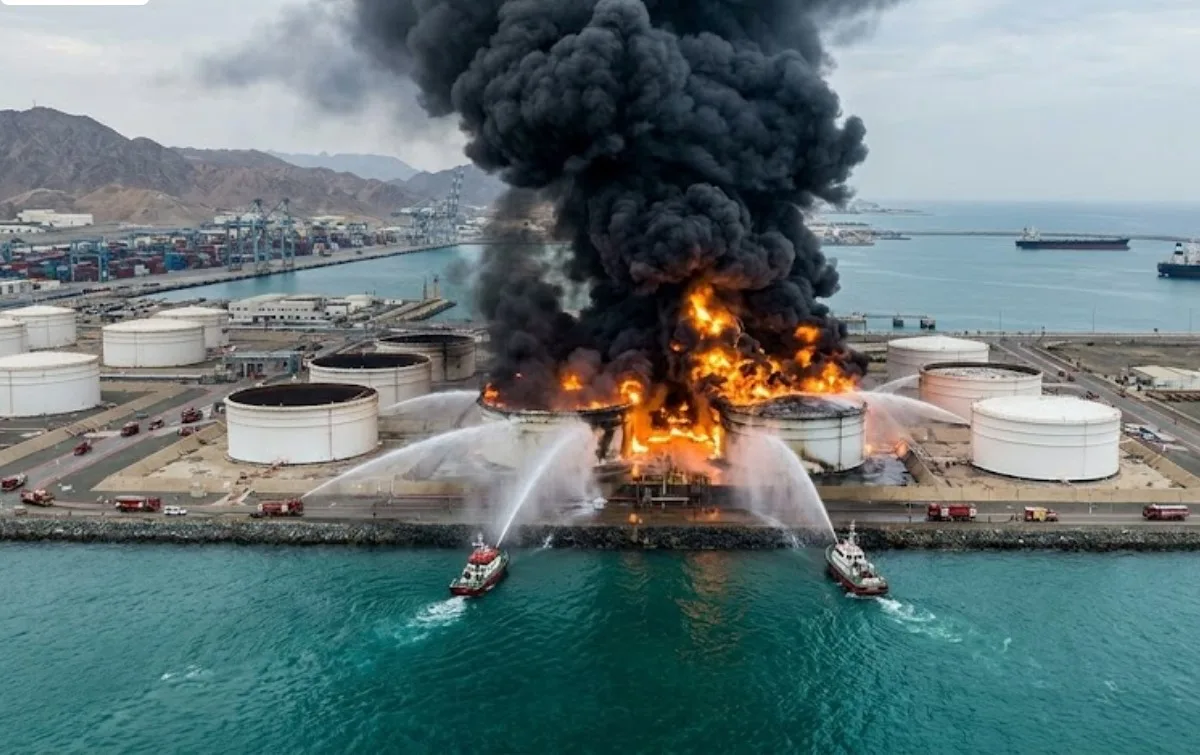
US Strikes Iran’s Kharg Island as Drone Fire Hits UAE Fujairah Port
The growing US–Israel–Iran conflict entered a more dangerous stage on March 14, 2026, after the United States launched major airstrikes on Kharg Island, Iran’s most important oil export hub. Only a few hours later, a drone incident caused a fire at the Port of Fujairah in the United Arab Emirates, raising fears of further escalation in the Gulf region. Click Here To Follow Our WhatsApp Channel
The two events happened within hours of each other and have increased concerns about energy security, global oil supply, and stability in the Middle East.
US Airstrikes on Iran’s Kharg Island
The United States military confirmed that its forces carried out a large precision strike on Kharg Island, targeting Iranian military facilities.
Kharg Island is located in the northern Persian Gulf and handles nearly 90 percent of Iran’s crude oil exports. Because of its importance to Iran’s economy, the island is often described as the heart of Iran’s oil export system.
According to the United States Central Command, more than 90 Iranian military targets were destroyed during the operation. These included:
- Naval mine storage sites
- Missile storage facilities
- Air defence systems
- Other military installations
US officials said the attack focused only on military targets and avoided damage to oil export infrastructure.
Trump Says Oil Facilities Were Intentionally Spared
US President Donald Trump said the strikes were among the most powerful bombing raids carried out in the region.
He stated that US forces deliberately avoided hitting Iran’s oil infrastructure, including storage tanks and export terminals.
However, Trump warned that if Iran interferes with ships passing through the Strait of Hormuz, the United States may target oil facilities in future strikes.
The Strait of Hormuz is one of the most important oil shipping routes in the world, carrying a large share of global energy supplies.
Iran Says Oil Operations Continue
Iranian state media confirmed that the strikes took place but said oil export operations were not affected.
Officials reported that military areas were hit, but the main oil infrastructure on Kharg Island remained operational. Some tanker loading activity reportedly resumed shortly after the attacks.
However, thick smoke was seen rising from areas where military facilities were destroyed.
Drone Incident Sparks Fire at UAE Fujairah Port
Only hours after the Kharg Island strikes, another major incident occurred at Port of Fujairah, one of the world’s largest oil storage and refuelling centres.
The port lies outside the Strait of Hormuz and is a key energy hub for global oil trade.
Authorities in the United Arab Emirates said air defence systems intercepted an incoming drone. Debris from the drone reportedly fell near oil-related facilities and caused a fire, sending thick black smoke into the air.
Emergency teams quickly responded and managed to contain the blaze, and initial reports indicated no casualties.
However, some oil-loading operations were temporarily suspended while safety checks were carried out.
Rising Regional Tensions
The incident came amid warnings from Islamic Revolutionary Guard Corps (IRGC) that US-linked facilities in the Gulf region could become targets if Iranian assets were attacked.
Iranian media also reported warnings advising residents near major UAE ports, including Jebel Ali in Dubai and Khalifa Port in Abu Dhabi, to remain cautious amid fears of further escalation.
Impact on Global Oil Markets
The events have increased fears of disruptions to global energy supplies. Oil traders and governments are closely watching developments because any attack on oil infrastructure or shipping routes in the Gulf could significantly affect global oil prices.
The uncertainty has already pushed Brent crude prices higher, as markets react to the possibility of wider conflict.
A Conflict That Could Expand
The latest incidents show how the US–Israel–Iran conflict is spreading beyond direct battle zones and affecting important energy facilities across the region.
With threats of further retaliation and military action, the situation remains highly volatile.
Experts warn that if attacks begin targeting major oil infrastructure or shipping routes, the world could face a serious energy crisis and further geopolitical instability in the coming weeks.
You Might Also Like:
Man Tries to Kill Farooq Abdullah at Jammu Event, Arrested by Security
Supreme Court Grants Bail to Shabir Shah in 2017 Terror-Funding Case, Cites Delay in Trial