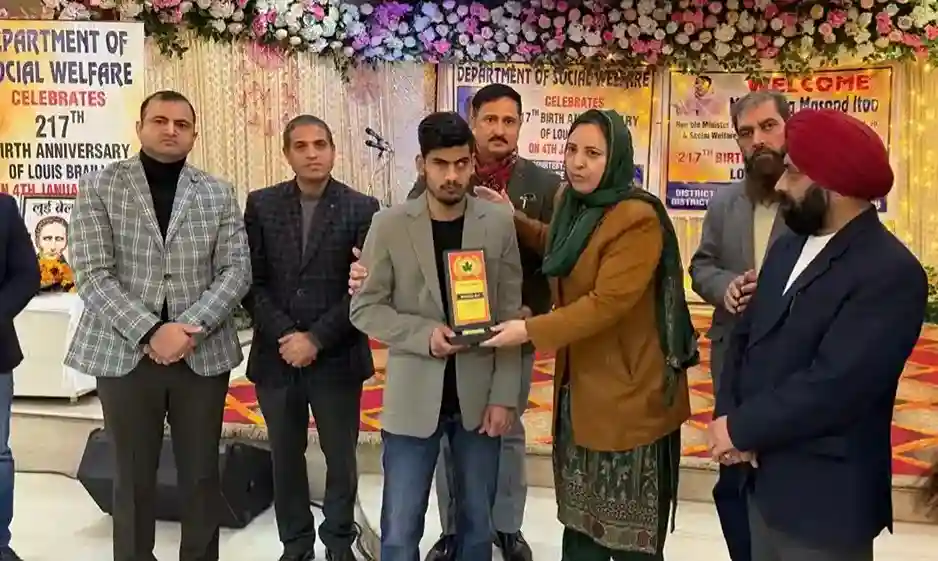
Minister for Social Welfare, Education, Health and Medical Education Sakeena Itoo on Sunday addressed the 217th birth anniversary celebrations of Louis Braille in Jammu, paying tribute to the inventor of the tactile reading system that has transformed the lives of visually impaired people across the world.Click Here To Follow Our WhatsApp Channel
Several senior officials attended the programme, including Secretary Social Welfare Bashir Ahmad Khan, Director Social Welfare Jammu Ranjeet Singh, Programme Officer ICDS, District Social Welfare Officer Jammu, and the Superintendent of the Rehabilitation Centre for the Speech and Visually Impaired (RSVI), Jammu. Parents and a large number of visually impaired children were also present.
Addressing the gathering, Minister Sakeena Itoo said the event was important as it was linked to a strong social cause. She said visually impaired children possess immense talent, which needs proper guidance and support to help them build a successful future. She stressed that a society’s real progress is measured by how it treats and uplifts its most vulnerable sections.
The Minister reaffirmed the government’s commitment to social justice and inclusive development, with special focus on the welfare and empowerment of specially abled children. “Every child is gifted in their own way. It is our collective responsibility to identify their strengths, nurture their abilities and ensure no child is left behind,” she said.
Sakeena Itoo called for a joint and compassionate approach towards supporting specially abled children. She said they need not only financial help but also emotional support, quality education, skill development opportunities and a supportive environment to achieve their full potential.
She also highlighted various initiatives of the Social Welfare Department aimed at early intervention, rehabilitation, inclusive education and livelihood support for persons with disabilities. The Minister urged parents, teachers, civil society groups and the wider community to work closely with the government to create a more caring and inclusive system.
The Minister said Jammu and Kashmir is a welfare state and that the Social Welfare Department plays a key role in ensuring support reaches every section of society. She appreciated the efforts of the department and RSVI for building confidence among children and enabling them to perform confidently at different platforms.
Referring to the leadership of Omar Abdullah, Sakeena Itoo said the government remains fully committed to the welfare of specially abled persons. Strengthening the social welfare framework and promoting inclusive growth, she added, remain central goals of the administration.
Paying rich tributes to Louis Braille, the Minister said that observing his birth anniversary is a way of remembering a great individual who brought light into the lives of visually impaired people by introducing the Braille system, allowing them to read and write through touch.
On the occasion, the Minister also felicitated visually impaired children who have won medals and honours in various sports championships across the country. She further honoured students who performed exceptionally well in different academic examinations, praising their hard work and determination.
You Might Also Like:
Iran Issues Chilling Warning to Trump and Israel as Protests Turn Deadly
Zohran Mamdani: The Fearless New York Leader Speaking Truth When Others Stay Silent
NYC Mayor Zohran Mamdani Calls Maduro’s Capture an Act of War, Warns of Legal and Human Impact
Louis Braille (1809–1852) was a French educator and inventor who revolutionized the lives of the blind by creating Braille, a tactile system of reading and writing.His invention remains the global standard for blind literacy nearly 200 years later.
Early Life and Tragedy
Born in Coupvray, France, Braille was not born blind. At the age of three, while playing in his father’s leather workshop, he accidentally struck one of his eyes with a sharp tool called an awl. The wound became severely infected, and the infection spread to his other eye (a condition likely known as sympathetic ophthalmia).By age five, he was completely blind.
The Invention of the System
Braille was a brilliant student and received a scholarship to the National Institute for Blind Youth in Paris. At the time, blind students read by tracing large, embossed letters—a process that was slow and made writing nearly impossible.
When he was 12, he learned about a military code called “night writing,” developed by Captain Charles Barbier. It used 12 raised dots to allow soldiers to communicate silently in the dark. Braille recognized its potential but found it too complex. He spent the next three years simplifying it:
- The 6-Dot Cell: He reduced the 12-dot system to a six-dot cell ($2 \times 3$ grid).
- Finger-Friendly: This size was crucial because a person’s fingertip could feel the entire cell at once without moving.
- Versatility: By age 15, he had perfected the system to include the alphabet, punctuation, and even music and mathematics.
Resistance and Legacy
Despite its efficiency, the Braille system faced significant pushback from sighted teachers who feared they would become obsolete if blind students could read independently. It was not officially adopted in France until 1854—two years after Louis Braille died of tuberculosis at the age of 43.