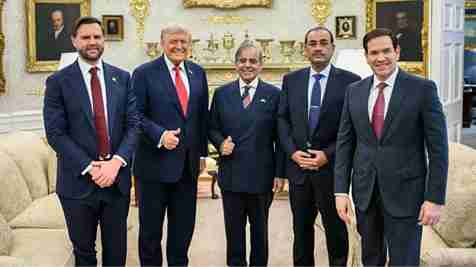
U.S. President Donald Trump welcomed Pakistan’s Prime Minister Shehbaz Sharif and Chief of Army Staff (now Field Marshal) Asim Munir to the White House Oval Office—the first such visit by a Pakistani prime minister in six years. This high-profile meeting has sparked global curiosity, with public reports shedding light on diplomatic overtures, economic deals, and geopolitical shifts. While the headlines are clear, the behind-the-scenes dynamics hint at a transactional reset in U.S.-Pakistan relations, with implications for the Middle East, resource strategies, and regional power balances. Here’s what the world knows—and what might be simmering beneath the surface.
Trump’s Gaza Plan: Pakistan’s Surprising Endorsement
During a White House press briefing on September 29, Trump praised Sharif and Munir as “incredible” for their “early and full support” of his 20-point proposal to end the Israel-Hamas war in Gaza. The plan, described as a roadmap to a “deradicalized, terror-free zone,” includes a 72-hour ceasefire, hostage/prisoner exchanges, staged Israeli withdrawals, and Hamas’s demilitarization—without explicit commitments to a Palestinian state or East Jerusalem as its capital. Pakistan’s endorsement marks a notable shift, positioning it as a key ally in Trump’s Middle East vision, potentially tied to expanded Abraham Accords normalizing ties with Israel.
Behind the Scenes: This move has stirred controversy in Pakistan, where public sentiment traditionally supports Palestine. Critics on platforms like X have accused Sharif and Munir of “surrendering” to U.S. pressure, possibly to secure economic relief amid Pakistan’s financial struggles. The endorsement may reflect a pragmatic trade-off: diplomatic alignment with Washington in exchange for economic and political leverage on the global stage.
Economic “Trump Cards”: Rare Earth Minerals and Trade
A centerpiece of the meeting was Pakistan showcasing samples of rare earth minerals (like bastnaesite and monazite, rich in cerium, lanthanum, and neodymium) to Trump, signaling untapped reserves as a bargaining chip. This ties into a $500 million Memorandum of Understanding (MoU) signed on September 8 between Pakistan’s Frontier Works Organisation and U.S. Strategic Metals for mining, processing, and exporting these minerals—aimed at reducing U.S. reliance on China, which controls roughly 80% of global supply.
Additionally, a July 2025 deal lowered U.S. tariffs on Pakistani imports to 19% (compared to India’s 50% for Russian oil imports), paired with U.S. investments in Pakistan’s energy, mining, and agriculture sectors. Bilateral trade reached $10.1 billion in 2024, up 6.3% year-over-year, with Trump pledging further collaboration on Pakistan’s oil reserves. Discussions also reportedly touched on cryptocurrency and tech transfers, hinting at deeper economic-security linkages.
Behind the Scenes: These deals are likely a lifeline for Pakistan’s economy, strained by IMF pressures, while securing U.S. access to critical resources. The focus on rare earths and oil suggests a strategic U.S. push to counter China’s influence in Pakistan, possibly alongside covert agreements on military logistics or basing rights in the region.
Geopolitical Ripples: India and Regional Dynamics
India is closely watching this U.S.-Pakistan rapprochement, with its policy circles questioning America’s reliability as a partner. The tilt toward Pakistan could strain the Quad (U.S.-India-Australia-Japan) and Indo-Pacific strategies against China, especially given Pakistan’s recent defense pact with Saudi Arabia, which includes mutual defense clauses. Analysts describe U.S.-Pakistan ties as “transactional and cyclical,” driven by immediate needs like logistics in West and Central Asia, rather than a full pivot away from India.
Behind the Scenes: The U.S. may be leveraging Pakistan to balance India’s growing ties with Russia and its reluctance to align fully with Western policies. However, this risks alienating New Delhi, particularly if U.S. pressure mounts on issues like tariffs or regional security alignments.
What’s Really Cooking?
The public narrative—diplomatic praise, mineral deals, and trade agreements—masks a deeper, pragmatic reset. Pakistan gains economic relief and global relevance, while the U.S. secures a pliable ally for its Middle East and resource strategies. However, the costs are evident: domestic backlash in Pakistan over the Gaza stance and regional tensions with India. As one X post put it, the Sharif-Munir-Trump summit reflects “elite sellout” for short-term gains, with long-term consequences still unfolding.
For real-time updates, follow White House briefings or discussions on X. The world is watching, but the full recipe of this deal remains behind closed doors.
Click Here To Follow Our WhatsApp Channel
You Might Also Like:
Leh Apex Body Halts Talks with Home Ministry Until Normalcy Returns in Ladakh
Kargil Democratic Alliance Demands Release of Sonam Wangchuk, Urges Justice
Former Masjid al-Haram Imam Dr. Sheikh Saleh Al-Talib Released After 7 Years Detention
Baramulla Police File Charge Sheets Against Tehreek-e-Hurriyat, J&K National Front in Unlawful Activities Cases