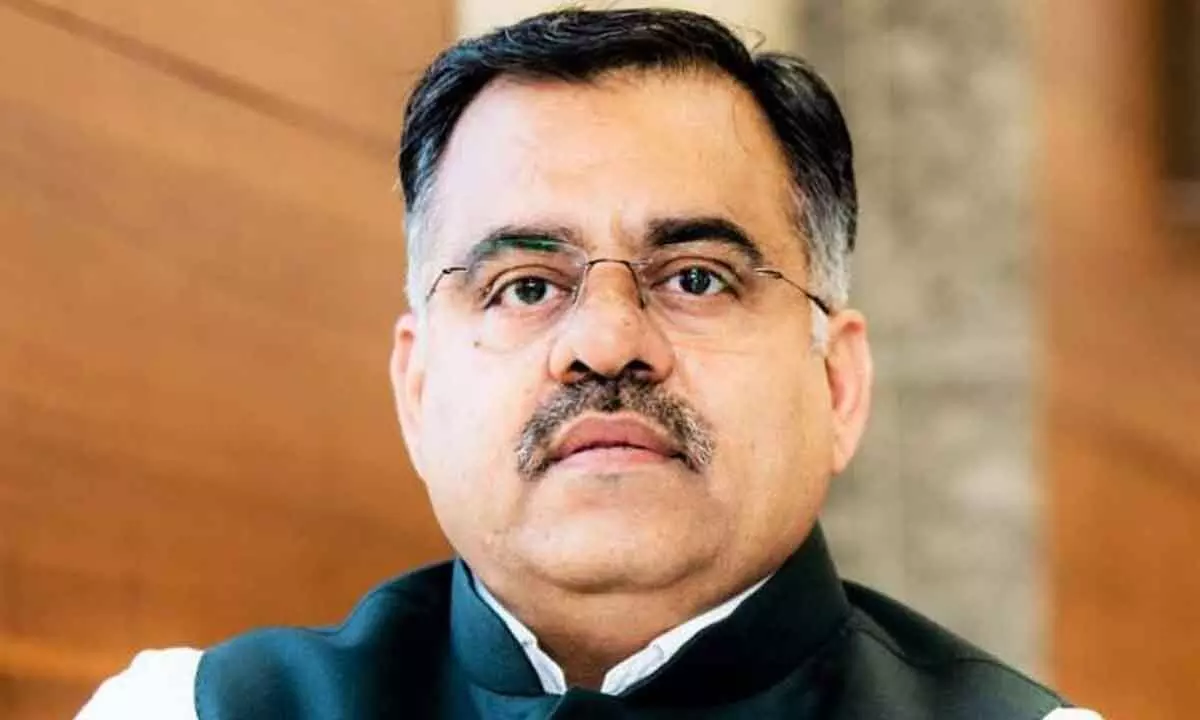
BJP National General Secretary Tarun Chugh launched a scathing attack on former Jammu and Kashmir Chief Minister Farooq Abdullah, accusing him of indulging in communal and divisive politics allegedly at the behest of Pakistan’s intelligence agency ISI.
Reacting sharply to Abdullah’s criticism of the Modi government’s development and peace initiatives in the Union Territory, Chugh said, “Farooq Abdullah should not forget how Hindus were ousted from the Valley during his tenure as Chief Minister. He has no moral ground to question the present government’s efforts.”
“Dancing to ISI’s Tunes”: Chugh’s Strong Accusations
Tarun Chugh alleged that Abdullah has a history of aligning with Pakistan’s interests, saying, “He has always been secretly dancing to the tunes of Pakistan’s ISI. That is why he never stood by Hindu tourists or civilians who were gunned down by Pakistan-sponsored terrorists.”
He further claimed that Abdullah and his party have historically failed to condemn terrorism with sincerity, especially when it affected minorities and non-Muslim communities in Jammu and Kashmir.
Post-370 Progress Irks Abdullahs, Says Chugh
Chugh stated that the revocation of Article 370 in August 2019 marked the beginning of true democracy and development in the region — something the Abdullah family is uncomfortable with.
“Till Article 370 was in place, it was a very juicy period for the Abdullahs. Now that J&K is witnessing unprecedented peace and progress, they have a problem,” Chugh remarked.
He added, “For the first time, democracy has reached the hinterlands of J&K. Panchayats are active, corruption is under control, and infrastructure is growing — unlike during the dynastic regimes of the past.”
In a significant spiritual and symbolic gesture, BJP National General Secretary Tarun Chugh met with His Holiness the 14th Dalai Lama on Tuesday in Ladakh. The meeting, steeped in reverence and mutual respect, underscored India’s enduring civilisational commitment to peace, compassion, religious freedom, and the preservation of Buddhist heritage.
A Meeting of Souls and Civilisations
The encounter between Chugh and the Dalai Lama was more than a political or ceremonial visit—it reflected India’s timeless role as a sanctuary for seekers of truth, ahimsa (non-violence), and karuna (compassion). The Dalai Lama, who has been living in exile in India since 1959, acknowledged this bond during the meeting.
“Since coming into exile from Tibet in 1959, we have received immense support and assistance from the Government of India. It is thanks to India’s generosity that we have been able to preserve our unique identity, language, and cultural heritage, deeply rooted in the principles of ahimsa and karuna,” the Dalai Lama stated in a heartfelt message.
Chugh: “India’s Spiritual DNA Reflects in the Dalai Lama”
Tarun Chugh described the Dalai Lama as not only a globally respected spiritual leader but also a “living embodiment of India’s civilisational values.”
“His message of compassion, universal brotherhood, and spiritual strength resonates with the soul of India,” said Chugh. “Meeting him in Ladakh is a reminder that India’s strength lies not only in its economy or military, but in its unwavering moral and spiritual foundation.”
Modi’s Leadership and the Preservation of Buddhist Legacy
Chugh went on to praise Prime Minister Narendra Modi for his commitment to safeguarding and promoting India’s Buddhist heritage, both domestically and on the global stage.
“Under PM Modi’s leadership, India has stood firm on its ancient promise of being a sanctuary for seekers of truth and justice,” he said. “Modi Ji is not only working to uplift the lives of citizens but also ensuring the protection of our Buddhist legacy, keeping alive the values of Bhagwan Buddha for generations to come.”
Citing PM Modi’s initiatives like the revival of Buddhist pilgrimage sites, international conferences on Buddhism, and infrastructural support in regions like Ladakh, Chugh said India is living up to its civilisational dharma, not just a policy mandate.
Ladakh: A Sacred Frontier
Chugh also highlighted the unique role of Ladakh as a confluence of Buddhist wisdom, national pride, and strategic importance.
“Ladakh is not just a frontier on the map—it is a spiritual heartland where Indian civilisation meets Buddhist thought. This region reflects the soul of India, where silence is sacred and every monastery echoes centuries of wisdom,” he noted.
Reaffirming India’s Role in a Troubled World
Emphasizing the broader implications of his meeting with the Dalai Lama, Chugh said that India has a timeless duty to protect torchbearers of truth, ahimsa, and dharma in a world increasingly plagued by violence, polarization, and spiritual emptiness.
“This meeting is not merely symbolic—it is a reaffirmation of our civilisational promise to protect spiritual heritage, stand with oppressed communities, and offer light in dark times,” he said.
Conclusion
The meeting between Tarun Chugh and the Dalai Lama in Ladakh stands as a reminder that India’s greatest contributions to the world are not material, but moral and spiritual. As global challenges mount—from violence and war to climate crisis and cultural erasure—India continues to uphold the flame of non-violence, inclusivity, and spiritual resilience.
The message was clear: In the land of the Buddha, under the gaze of the Himalayas, India reaffirms its eternal role as a beacon of peace and protector of the sacred.
BJP National General Secretary Tarun Chugh on Sunday met BJP’s candidate for the upcoming Ludhiana West Bypoll, Jeewan Gupta, and gave a call to the voters to expose the theatrical actions of the AAP government..
Speaking to the media, Chugh said the upcoming bypoll is a litmus test for Punjab, which is currently suffering under AAP’s chaotic and directionless governance. “Punjab is facing a grave law and order crisis and due to complete financial mismanagement, the state is reeling under a debt of more than ₹4 lakh crores,” Chugh said.
He added that Ludhiana, once hailed as the industrial capital of India, is now battling lack of basic infrastructure, a surge in organized crime, and rampant drug abuse. Investors are fleeing to other states, while the youth of Punjab feel betrayed by AAP’s empty promises of jobs and prosperity.
Chugh hit out at Chief Minister Bhagwant Mann, calling him a puppet in the hands of Arvind Kejriwal and his failed, on-bail associates. “Just like the people of Delhi rejected Kejriwal, the people of Punjab will do the same to Bhagwant Mann in 2027,” he said.
Jeewan Gupta, while thanking the party leadership for entrusting him with this opportunity, said he is hopeful and determined. He added that the business community in Punjab is particularly suffering under the Mann regime due to the absence of a clear, consistent industrial policy.
He assured that with public support, he will raise every voice that AAP has silenced in Punjab.
The Modi government has transformed Jammu & Kashmir into a region of opportunity and growth, fulfilling the aspirations of its people.
Highlighting the government’s commitment to multi-faceted development, Tarun Chugh emphasized that the establishment of a new railway division and the expansion of the rail network up to Baramulla will revolutionize commuting, freight movement, business opportunities, and job creation in the Union Territory.
Tarun Chugh, National General Secretary, BJP & Prabhari, J&K BJP, said, “Prime Minister Sh. Narendra Modi has ushered in an era of development in Jammu & Kashmir by strengthening its road and rail infrastructure, which has directly bolstered tourism. His visionary approach has transformed J&K from a terrorism capital to a tourism capital, supported by liberal funding and strategic planning.”
He noted that the inauguration of the new railway division would generate significant employment opportunities for local youth and provide a much-needed boost to trade and the regional economy.
“The development of road and rail networks has not only enhanced the commuting experience but also improved freight movement between destinations, reducing costs and transportation time,” Sh. Tarun Chugh said. He added that efficient transportation of perishable goods, such as fruits and vegetables, will curb hoarding and black marketing while stabilizing the prices of essential goods across various cities, especially during challenging times.
Highlighting the project’s economic potential, Sh. Tarun Chugh stated, “The rail network, with an estimated investment of ₹40,000 crore, will catalyze the development of Jammu and Srinagar as twin economic hubs, opening new avenues for businesses and accelerating existing ventures. Additionally, multiple small business hubs will emerge at various train halts, further stimulating the region’s economy.”
The Modi government’s unwavering commitment to Jammu & Kashmir’s holistic development continues to bring tangible benefits to the region, setting it on the path of unprecedented growth and prosperity.