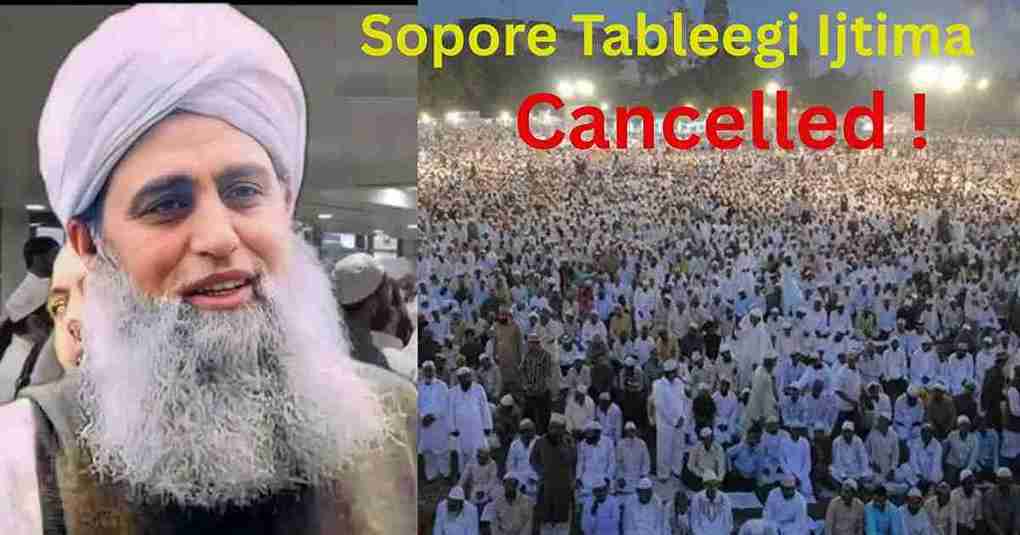
The Tablighi Ijtema, an annual Islamic congregation organized by the Tablighi Jamaat, stands as one of the largest Muslim gatherings worldwide—second only to the Hajj in size and spiritual influence. Known for attracting millions of participants in South Asia and beyond, these events focus on spiritual revival, da’wah (inviting others to Islam), and tabligh (conveying the message of Islam) through sermons, collective prayers, and communal reflection.
In 2025, Jammu and Kashmir was poised to host its first major Ijtema in nearly four decades. Scheduled for September 5–7, 2025, in Warpora village, Sopore (Baramulla district), the gathering was seen as historic, with thousands expected to participate. However, just days before commencement, the event was abruptly cancelled, leaving devotees disappointed and sparking speculation over the reasons.
This article examines the key reasons and wider context surrounding the cancellation.
Background of the Sopore Ijtema
The Tablighi Jamaat, founded in 1926 by Maulana Muhammad Ilyas Kandhlawi in Mewat, India, encourages Muslims to return to the Prophet’s teachings and engage in grassroots missionary work. Its Ijtemas are considered pillars of the movement, with major ones held in Bhopal (India), Raiwind (Pakistan), and Tongi (Bangladesh) drawing millions of participants annually. The Bishwa Ijtema in Bangladesh is among the largest gatherings of Muslims in the world.
The Sopore congregation was to be a landmark, as the last major Ijtema in Kashmir had taken place in 1988 in Srinagar. Preparations were led by the Nizamuddin Markaz faction of Tablighi Jamaat under Maulana Muhammad Saad, with months of coordination involving local volunteers and administrative bodies. It was expected to revive the movement’s influence in the valley and strengthen religious unity.
Official Reason for Cancellation
According to organizers and social media announcements, the denial of permission by local authorities was the direct cause of cancellation. While the Jammu and Kashmir administration has not released a detailed public statement, the lack of approval for such a large gathering is widely accepted as the decisive factor.
The absence of clarity has led to speculation. In Kashmir, where security and law-and-order concerns are paramount, any event drawing tens of thousands of participants is subject to close scrutiny. Authorities may have judged that the timing and scale of the Sopore Ijtema posed logistical and security risks, especially in light of ongoing challenges in the region.
Weather and Logistical Challenges
The cancellation came amid severe floods and heavy rainfall across Jammu and Kashmir in late August 2025. The region was experiencing one of the heaviest monsoons in decades, causing landslides, damaged highways, school closures, and the suspension of pilgrimages like Vaishno Devi.
In such circumstances, hosting a massive outdoor congregation in Sopore, which requires stable infrastructure, medical facilities, and safe transport, was increasingly impractical. Authorities engaged in disaster relief operations may have considered it unsafe to allow tens of thousands to gather while resources were stretched thin.
Security Concerns
Beyond natural disasters, security considerations have long shaped the administration’s stance on mass gatherings in Kashmir. Large congregations—religious or otherwise—are often restricted to prevent potential unrest or infiltration by troublemakers.
Historical precedents reinforce this: in 2019, for example, the J&K government barred major Eid gatherings citing security fears. In a region marked by decades of militancy, insurgency, and political sensitivities, the prospect of hosting a congregation under international spotlight could have been deemed a risk.
Internal Dynamics within Tablighi Jamaat
The internal rift within Tablighi Jamaat further complicates the picture. Since 2015, the movement has been divided between:
- The Nizamuddin Markaz faction led by Maulana Muhammad Saad.
- The Aalami Shura (world council) led by senior elders in India, Pakistan, and Bangladesh.
Maulana Saad’s leadership has been controversial, with critics arguing he lacks the traditional credentials of senior elders. These disputes have sometimes spilled into violence, such as clashes at Tongi, Bangladesh, in late 2024.
Because the Sopore Ijtema was under the Saad-led faction, authorities may have hesitated to approve it. Factional tensions within the movement can complicate crowd management and create risks of confrontation or disorder.
Socio-Political Context in Jammu and Kashmir
Since the revocation of Article 370 in 2019, Jammu and Kashmir has been governed under heightened security oversight. Any large-scale religious or political gathering is carefully monitored.
While Tablighi Jamaat is apolitical, authorities remain cautious due to past allegations—however contested—linking the movement’s networks with some militant groups. Reports such as those from the South Asia Terrorism Portal have historically highlighted overlaps between some former Tablighi members and extremist outfits, influencing how security agencies view the group.
Moreover, in India’s wider political climate, groups like the VHP have opposed Tablighi gatherings in the past, accusing them of threatening communal harmony. Although no such protests were recorded in Sopore, the broader atmosphere may have influenced the decision-making process.
Community and Organizer Reactions
Organizers and supporters reacted with disappointment and sorrow. Posts on social media described the cancellation as “heartbreaking” and an “unfortunate restriction on religious freedom.” Many had anticipated the event as a spiritual revival for the valley after nearly four decades.
The lack of transparency from authorities further fueled frustration, as neither a detailed explanation nor an alternative plan was communicated. For participants who had already prepared for travel, the abrupt decision came as a major setback.
Broader Implications
The cancellation of the Sopore Ijtema illustrates several deeper issues:
- Challenges of Religious Gatherings in Conflict Zones – Organizing mass congregations in Kashmir remains fraught with logistical, political, and security obstacles.
- The Jamaat’s Global Position – Despite being a spiritual movement, the Tablighi Jamaat’s large-scale activities are often scrutinized in the context of security and communal concerns.
- Impact of Internal Divisions – Factionalism within the Jamaat hampers its ability to present a united front, complicating its relationship with authorities.
- Regional Religious Dynamics – For Kashmir, the cancellation reflects how religious identity and political sensitivities are closely intertwined.
Conclusion
The Tablighi Ijtema 2025 in Sopore was cancelled primarily because local authorities denied permission, likely due to a combination of severe floods, logistical challenges, and security considerations. The decision came as a disappointment to thousands who had hoped to witness the revival of the Ijtema in Kashmir after 37 years.
Adding to this were internal rifts within the Tablighi Jamaat, factional disputes, and the sensitive socio-political environment of Jammu and Kashmir, all of which shaped administrative caution.
While the movement continues to hold major Ijtemas in other parts of the world, the Sopore episode underscores the difficulty of organizing such events in politically sensitive regions. Moving forward, greater internal unity and proactive engagement with authorities will be essential if the Tablighi Jamaat is to successfully revive its historic gatherings in Kashmir.
Click Here To Follow Our WhatsApp Channel
You Might Also Like:
Kashmir Fruit Growers Face Heavy Losses as Highway Closure Disrupts Transport
From Boom to Bust: How the April 22 Terror Attack Shattered Pahalgam’s Tourism Dream
11 Dead in Ramban and Reasi Weather Tragedies as Landslides and Cloudburst Devastate Jammu