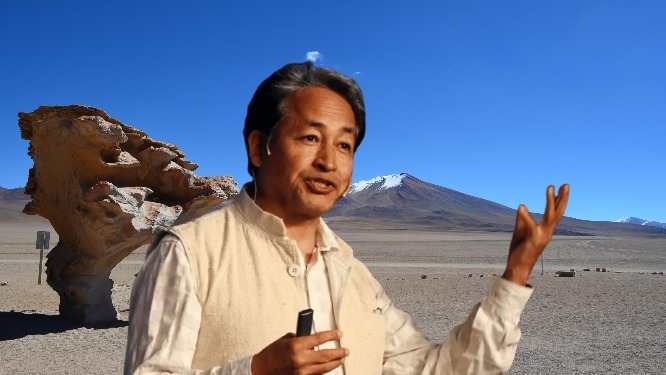
“Instigating in Sensitive Border Zone”: Centre Defends Sonam Wangchuk’s Detention to Supreme Court

Sonam wangchuk

The central government told the Supreme Court on Monday that Ladakhi activist and education reformer Sonam Wangchuk was detained for “instigating people in a border area,” emphasizing the heightened sensitivity of the region adjacent to Pakistan and China. The submission was made during a hearing on a petition challenging Wangchuk’s detention earlier this year.

Solicitor General Tushar Mehta, representing the Centre, urged the apex court to exercise caution. “This court is dealing with a person who is instigating people in a border area, adjacent to Pakistan and China, where regional sensitivity is involved,” Mehta told a bench comprising Justices B.R. Gavai and Sandeep Mehta.

The government’s argument pivoted squarely on national security, framing the ongoing protests in Ladakh—which Wangchuk has come to symbolise—as a potential threat to stability in a strategically critical region. Ladakh has been a focal point of military standoffs with China since 2020 and has a long-standing territorial dispute along the Line of Control with Pakistan.

Context: The Ladakh Protests

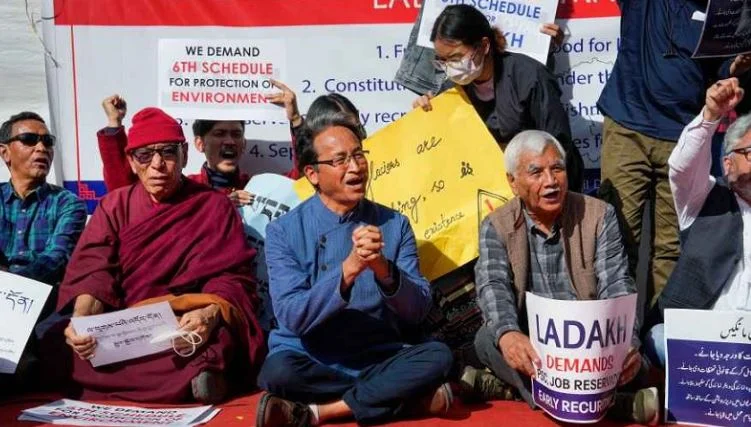
Wangchuk’s detention in March followed his participation in a 21-day “climate fast” in sub-zero temperatures in Leh. The fast was part of a larger, months-long public movement demanding two key constitutional safeguards for Ladakh: full statehood and inclusion under the Sixth Schedule of the Constitution.

The protests erupted from a deep-seated anxiety among Ladakh’s residents following the region’s reorganization in August 2019. When the erstwhile state of Jammu and Kashmir was bifurcated, Ladakh was carved out as a separate Union Territory without a legislative assembly. This change stripped the region of its limited autonomies and direct democratic voice, raising fears about the unchecked exploitation of its fragile ecosystem, the loss of control over land and resources, and the erosion of its distinct tribal culture.

Wangchuk, a Ramon Magsaysay awardee widely known as the inspiration for the character Phunsukh Wangdu in the film 3 Idiots, emerged as the articulate and prominent face of this grassroots agitation. His calls for peaceful democratic protest, including a planned march to the China border, drew national attention.

The Court’s Scrutiny

The Supreme Court, however, sought tangible evidence to support the government’s grave allegations. The bench posed pointed questions, moving beyond the broad security argument to examine the specifics of the protest’s conduct.

Justice B.R. Gavai notably asked, “What is wrong with him asking people to preserve their culture?” This query directly challenged the government’s characterisation of Wangchuk’s actions as mere “instigation.”

The court directed the government to provide more concrete details. It asked:

  • Were the protests led by Wangchuk fundamentally peaceful?
  • Was there any material to show they triggered violence or damage to public property?
  • What were the specific actions or speeches that constituted a threat to public order and security?

The bench underscored that the constitutional right to protest and the demand for cultural preservation must be weighed carefully against the state’s claims of disruption.

Analysis: Security vs. Democratic Rights

The hearing highlighted a classic, tense dichotomy in Indian jurisprudence and governance: the state’s imperative to ensure national security versus the citizens’ fundamental rights to expression, assembly, and dissent.

The Centre’s stance reflects a long-standing policy of applying heightened scrutiny to political activities in border states, where it argues that civilian unrest can be exploited by adversarial nations. The reference to Pakistan and China was a deliberate invocation of this security paradigm.

On the other side, activists and legal experts argue that branding legitimate, constitutionally protected demands for autonomy and environmental protection as “instigation” sets a dangerous precedent. They contend it risks conflating peaceful democratic mobilization with sedition, especially in regions where the central government’s policies are being contested.

What Happens Next?

The Supreme Court has adjourned the hearing, giving the central government time to file a more detailed affidavit substantiating its claims. The response will be crucial. It must demonstrate a direct and imminent link between Wangchuk’s peaceful calls for protest and a tangible threat to the region’s security, beyond the general sensitivity of the location.

The outcome of this legal battle will have significant repercussions. It will not only determine the fate of the specific allegations against Sonam Wangchuk but could also establish important contours for the scope of democratic protest and the limits of state power in India’s sensitive frontier regions. The nation now awaits the government’s detailed evidence and the Supreme Court’s subsequent interpretation of this delicate balance.

Click Here To Follow Our WhatsApp Channel

Who Is Sonam Wangchuk: The Innovator, Educator, and Voice of Ladakh

Sonam Wangchuk is not merely an individual; he is a living symbol of transformative change, resilience, and visionary leadership from the high-altitude desert of Ladakh. Born in 1966 in the remote village of Uleytokpo, his journey from a student struggling with conventional education to becoming an internationally acclaimed innovator and social reformer is a testament to his belief in contextual, compassionate, and sustainable solutions.

Trained as a mechanical engineer, Wangchuk’s true education began with the stark realities of Ladakh. Witnessing the challenges of his homeland—harsh climate, educational disconnect, and environmental degradation—he co-founded the Students’ Educational and Cultural Movement of Ladakh (SECMOL) in 1988. Its mission was radical: to reform an educational system that was failing Ladakhi youth by making it relevant to their culture, environment, and needs. The success of this model became globally renowned, inspiring the core narrative of the blockbuster Bollywood film 3 Idiots, where the character of “Phunsukh Wangdu” was loosely based on his pioneering work.

However, Wangchuk’s legacy extends far beyond educational reform. He is the mind behind the Ice Stupa Artificial Glacier, a breathtakingly simple yet revolutionary invention that addresses acute water scarcity. By freezing stream water into conical ice structures during winter, he created slow-melting reservoirs that provide water for irrigation in the critical spring planting season, empowering villages and greening barren landscapes. This innovation earned him the Rolex Award for Enterprise in 2016 and cemented his status as a climate resilience pioneer.

Today, Wangchuk embodies a broader role: that of a fearless civic leader and environmental activist. Following Ladakh’s transition to a Union Territory in 2019, he has emerged as the articulate and Gandhian face of a mass movement demanding constitutional safeguards for the region. He advocates for statehood and inclusion under the Sixth Schedule to protect Ladakh’s fragile ecology, tribal culture, and democratic autonomy from unchecked industrialization and bureaucratic control.

His activism, marked by peaceful fasts and passionate appeals, has brought the aspirations of Ladakh to the national forefront. Yet, it has also placed him at the center of legal and political scrutiny, with authorities recently labeling his calls for democratic protest as “instigation” in a sensitive border zone—a charge he faces as a testament to his unwavering commitment to his people’s future.

In essence, Sonam Wangchuk is a multifaceted force: an engineer who speaks the language of ice and mountains, a teacher who reshapes destinies, and a civic leader courageously navigating the complex intersection of ecological survival, cultural preservation, and democratic rights in one of the world’s most geopolitically sensitive landscapes.

At 13, This Kashmiri Boy Built 31 Apps and AI Tools

Delhi Court Convicts Kashmiri Separatist Asiya Andrabi in UAPA Case

Supreme Court Delays Hearing on Sonam Wangchuk’s Detention Case Until January 8

Sonam wangchuk

The Supreme Court of India on Wednesday postponed the hearing of a plea challenging the detention of climate activist Sonam Wangchuk. The case will now be heard on January 8.

The plea was filed by Wangchuk’s wife, Gitanjali J Angmo, who has questioned his detention under the National Security Act (NSA). A bench led by Justice Aravind Kumar said more time was needed to go through the case properly. Senior advocate Kapil Sibal, appearing for Wangchuk, agreed to the delay.Click Here To Follow Our WhatsApp Channel

Gitanjali Angmo

Earlier, the court had sought responses from the Centre and the Ladakh administration. The government has accused Wangchuk of inciting violence following protests in Ladakh that demanded statehood and Sixth Schedule status. These protests turned violent in September, leaving four people dead and several others injured.

In the amended plea, Angmo argued that the detention is illegal and based on old and unclear police reports. She said there is no direct link between Wangchuk and the violence. The plea also pointed out that Wangchuk has publicly condemned the violence and called for peaceful protest.

The petition claims that using preventive detention in this case is an abuse of power and violates fundamental rights. Under the NSA, a person can be detained for up to 12 months, although the order can be withdrawn earlier.

Sonam Wangchuk: The Engineer, Educator, and Activist from Ladakh

Sonam Wangchuk

Sonam Wangchuk is one of the most inspiring figures to come out of Ladakh in recent decades. He is best known as an engineer, innovator, teacher, and environmental activist who has worked to improve education and water management in the Himalayan region. Over time, he has also become a strong voice for Ladakh’s people and their demands for sustainable development and political recognition.
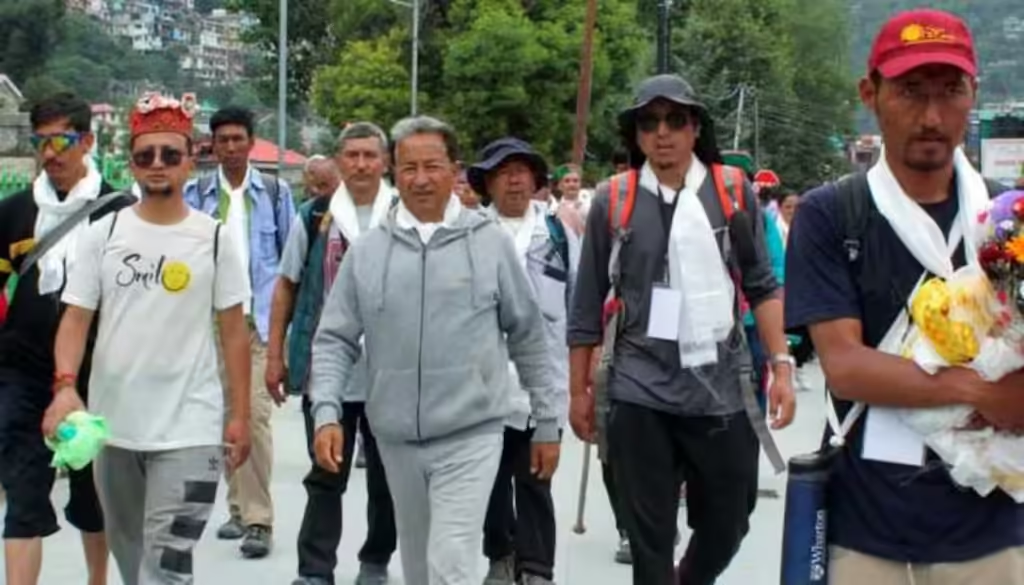

Sonam Wangchuk

Early Life and Struggles

Born on 1 September 1966 in a small Ladakhi village, Wangchuk grew up in a region with very limited schools and resources. As a child, he struggled with a system that often did not understand the needs of Ladakhi students. Many of them were forced to study in languages and formats that had little connection with their lives in the mountains.

This early experience left a strong mark on him. He realised that education should not just be about memorising textbooks but about practical learning that helps students solve real-life problems.
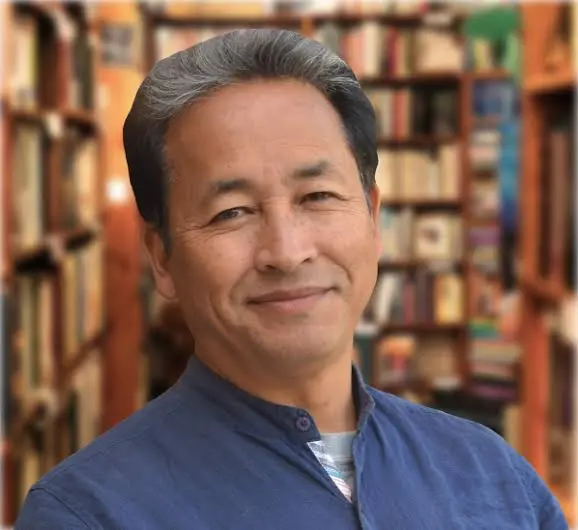

Founding SECMOL: A Student-Led Movement

In 1988, Wangchuk and a group of like-minded young people started the Students’ Educational and Cultural Movement of Ladakh (SECMOL). This was not just another NGO but a movement to change how education worked in the region.

SECMOL focused on helping “failures” of the system – students who could not pass standard exams – by teaching them in simple, local ways. The SECMOL campus itself is eco-friendly, powered by solar energy, and designed for hands-on learning. Over the years, the campus has trained thousands of Ladakhi youth in practical skills, communication, and confidence-building.


The Ice Stupa: A Cool Innovation

One of Wangchuk’s most famous inventions is the Ice Stupa, an artificial glacier shaped like a cone. The idea was simple but powerful: store water in the form of ice during winter and let it melt slowly in spring when farmers need it most.

This low-cost technique became a game-changer in Ladakh, where climate change has caused glaciers to melt earlier than before. Today, the Ice Stupa model has been tested not only in Ladakh but also in places like Switzerland.
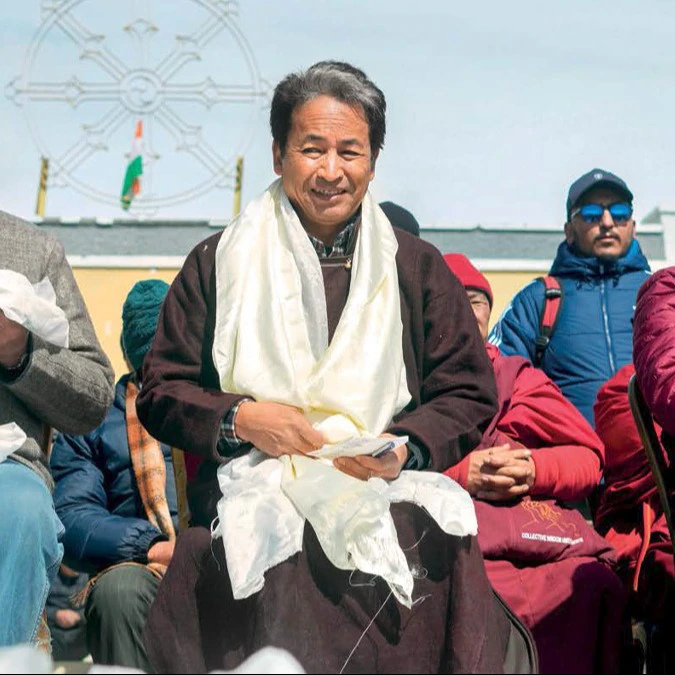

Awards and Recognition

For his work, Wangchuk has received international recognition. The biggest honour came in 2018, when he was awarded the Ramon Magsaysay Award, often called Asia’s Nobel Prize. He has also been celebrated by groups like Rolex and featured in global media for his unique approach to education and climate adaptation.

Interestingly, after the Bollywood film 3 Idiots became a hit in 2009, many people saw Wangchuk as the inspiration for Aamir Khan’s character “Phunsukh Wangdu”. While he has said the connection is not exact, the film definitely brought him into the spotlight.


Activism and Recent Controversies

In recent years, Wangchuk has become a strong supporter of Ladakh’s demand for statehood and constitutional safeguards. His speeches and campaigns have drawn huge crowds, especially among the youth.

However, this activism has also brought him into conflict with the government. In September 2025, the Home Ministry cancelled the FCRA registration of SECMOL, citing “repeat violations” of rules on foreign donations. Officials accused the NGO of financial irregularities, such as depositing cash into foreign-funding accounts and receiving money “against the national interest.”

The cancellation came just a day after violent protests in Ladakh, where the government blamed Wangchuk’s speeches for provoking unrest. Investigations by the Central Bureau of Investigation (CBI) are also ongoing. Wangchuk and his supporters, however, maintain that the organisation has worked honestly and that these actions are politically motivated.

Legacy and Future

No matter the current controversies, Sonam Wangchuk’s contribution to Ladakh cannot be ignored. Through SECMOL, the Ice Stupa project, and the Himalayan Institute of Alternatives (HIAL), he has shown that local problems can be solved with local solutions.

He stands as a rare combination of teacher, innovator, and activist – someone who speaks not only for education and environment but also for the rights of his people.

As the situation unfolds, Wangchuk’s story reminds us that individuals with strong ideas can bring about big changes, but they also face equally big challenges.


Police Personnel Shafaqat Ahmad from Bandipora Dies of Heart Attack at Home

Violence Erupts in Leh as Protesters Clash with Police Amid Statehood Movement in Ladakh

UK, Canada and Australia Recognise Palestinian State, Defying Israel and US to Revive

Oxford Presentation School Anantnag Hosts IIMUN 2025 in South Kashmir, Fostering Leadership and Diplomacy


Centre Blames Sonam Wangchuk’s ‘Provocative Statements’ for Ladakh Violence, Says Talks Making Progress

Centre Blames Sonam Wangchuk

The Centre on Wednesday alleged that the mob violence in Ladakh was guided by the “provocative statements” of activist Sonam Wangchuk, and certain “politically motivated” individuals were not happy with the progress made in the ongoing talks between the representatives of the government and Ladakhi groups.

In a statement, the Union Home Ministry said barring a few unfortunate incidents that happened early on Wednesday, the situation was brought under control by 4 pm, and asked everyone not to circulate old and provocative videos in the media and social media.

“The government stands committed to the aspiration of the people of Ladakh by providing adequate constitutional safeguards,” the statement said.

The Home Ministry said the hunger strike was started by Wangchuk on September 10, pressing the demand for Ladakh’s inclusion in the Sixth Schedule and return to statehood.

“It is well known that the Government of India has been actively engaged with the Apex Body Leh and Kargil Democratic Alliance. A series of meetings was held with them through formal channels of the High Powered Committee, as well as sub-committee and multiple informal meetings with leaders,” the statement said.

The Home Ministry said the process of dialogue through this mechanism had yielded phenomenal results by increasing reservations for the Ladakh Scheduled Tribe from 45 percent to 84 percent, providing one-third of women’s reservations in the councils, and declaring Bhoti and Purgi as official languages.

With this, the process for the recruitment of 1800 posts was also commenced.

“However, certain politically motivated individuals were not happy with the progress made under HPC and have been trying to sabotage the dialogue process,” the statement said.

The next meeting of the High Powered Committee has been scheduled on October 6, while meetings are also planned on September 25 and September 26 with the leaders from Ladakh.

The Home Ministry said the demands on which Wangchuk was on hunger strike are an integral part of the discussion in HPC.

In spite of many leaders urging him to call off the hunger strike, he continued with it while “misleading the people through provocative mention of Arab Spring-style protest and references to Gen Z protests in Nepal”.

“On September 24, at around 11:30 am, a mob motivated by his provocative speeches left the venue of the hunger strike and attacked a political party office as well as the Government office of the CEC Leh. They also put these offices on fire, attacked the security personnel, and torched the Police vehicle,” the statement said

“The unruly mob attacked the Police personnel, in which more than 30 Police and CRPF personnel were injured,” it said.

The Home Ministry said the mob continued to destroy public property and attack the Police personnel, and in self-defence, the Police had to resort to firing, in which, unfortunately, some casualties were reported.

“It is clear that the mob was guided by Wangchuk through his provocative statements. Incidentally, amidst these developments, he called off his hunger strike,” it said.

Police Personnel Shafaqat Ahmad from Bandipora Dies of Heart Attack at Home

Violence Erupts in Leh as Protesters Clash with Police Amid Statehood Movement in Ladakh

UK, Canada and Australia Recognise Palestinian State, Defying Israel and US to Revive

Oxford Presentation School Anantnag Hosts IIMUN 2025 in South Kashmir, Fostering Leadership and Diplomacy

Ladakh Activist Sonam Wangchuk and 150 Protesters Detained Again After Release

Sonam Wangchuk

Climate activist Sonam Wangchuk, along with 150 other protesters from Ladakh, continued their indefinite fast on Wednesday, despite being in detention. They expressed feeling their rights were “trampled upon” on Gandhi Jayanti, a day that symbolises peace and democracy.

Wangchuk was leading the ‘Delhi Chalo Padyatra’, which began a month ago from Leh, when they were detained on Monday night. On Wednesday morning, Jigmat Paljor, Coordinator of the Apex Body, issued a statement calling the detention illegal, as it had exceeded 24 hours without them being presented before a magistrate.

“We, the ‘padyatris’, find ourselves in a concerning situation. We have been detained for more than 24 hours, and this detention is unlawful, as we should have been produced before a magistrate by now,” Paljor said.

He added that some groups had been released just before the 24-hour period ended, only to be returned to the police station later. “Last night, the police attempted to forcibly relocate us to an unknown location, but we resisted and stood our ground,” he explained.

The protestors’ phones have been confiscated at the Bawana Police Station, cutting them off from the outside world, Paljor further mentioned.

However, Delhi Police stated that the ‘padyatris’ had been released on Tuesday night but were detained again when they attempted to march towards central Delhi. According to a senior police officer, Wangchuk and others were allowed to leave but were adamant about continuing their march, leading to their second detention.

The ‘padyatris’ began their journey from Leh on 1st September, marching most of the way except through Haryana, where they boarded buses due to election restrictions. They were stopped at Delhi’s Singhu border on Monday night and taken to various police stations, where they began their indefinite fast.

“All the ‘padyatris’ have been fasting for 36 hours. On October 2nd, Gandhi Jayanti, we had planned to visit Gandhi Samadhi to pay our respects, but instead, we find our rights crushed on a day dedicated to peace and democracy,” Paljor said.

“This situation raises grave concerns about the current state of democracy in our country. We urge everyone to stand in solidarity with us during this critical time,” he added.

The march was organised by the Leh Apex Body (LAB), which, along with the Kargil Democratic Alliance (KDA), has been campaigning for the last four years. They are demanding statehood for Ladakh, inclusion under the Sixth Schedule of the Constitution, timely recruitment processes, a public service commission for Ladakh, and separate Lok Sabha constituencies for Leh and Kargil districts.

Wangchuk, along with a few others, is being held at the Bawana police station, while others are being detained at police stations in Narela Industrial Area, Alipur, and Kanjhawala, according to Paljor.

You May Like:

Jamaat e Islami Kashmir Stayed Away From Polls Since 1987 to Protest The Rigging of Elections: Hafiz Mohammad Sikander

Jammu & Kashmir Assembly Polls 11.60% voter turnout recorded upto 9:00 am in Last Phase

Climate Activist Sonam Wangchuk and Supporters Begin Indefinite Fast After Detention at Delhi Border

Assembly Elections Jammu & Kashmir Update: Over 44.08% Voter Turnout Recorded Upto 1:00 PM

Climate Activist Sonam Wangchuk and Supporters Begin Indefinite Fast After Detention at Delhi Border

Sonam Wangchuk

Sonam Wangchuk, a prominent climate activist, along with approximately 120 supporters, has initiated an indefinite fast after being detained at the Delhi border during their march to demand Sixth Schedule status for Ladakh. The march, named ‘Delhi Chalo Padyatra,’ commenced from Leh a month ago. Wangchuk and his group were apprehended on Monday night for violating prohibitory orders.

Organized by the Leh Apex Body (LAB) and the Kargil Democratic Alliance (KDA), this movement has been advocating for statehood for Ladakh, inclusion under the Sixth Schedule of the Constitution, a streamlined recruitment process, and separate Lok Sabha seats for the districts of Leh and Kargil for the past four years.

According to a police spokesperson, the group was detained for breaching Section 163 of the Bharatiya Nyaya Sanhita, which prohibits gatherings of five or more individuals in the national capital. Despite attempts to persuade them to disperse, the activists remained resolute.

Wangchuk was reportedly taken to Bawana police station, where concerns were raised about his access to legal counsel. A representative from the group mentioned that the activists had sought official permission for their march, even reaching out to Prime Minister Narendra Modi and Union Home Minister Amit Shah, but claimed this information was misused for their detention.

Ladakh MP Mohmad Haneefa reported that among the detainees, around 30 women were held with male protesters, which has raised concerns about their treatment. He noted that approximately 60-70 individuals from Kargil who attempted to join the march at Singhu border were also stopped by police.

While police stated that women protesters were not detained, Haneefa confirmed that the situation was different on the ground, highlighting ongoing tensions surrounding the demands for Ladakh’s rights.

You May Like:

Jamaat e Islami Kashmir Stayed Away From Polls Since 1987 to Protest The Rigging of Elections: Hafiz Mohammad Sikander

Jammu & Kashmir Assembly Polls 11.60% voter turnout recorded upto 9:00 am in Last Phase