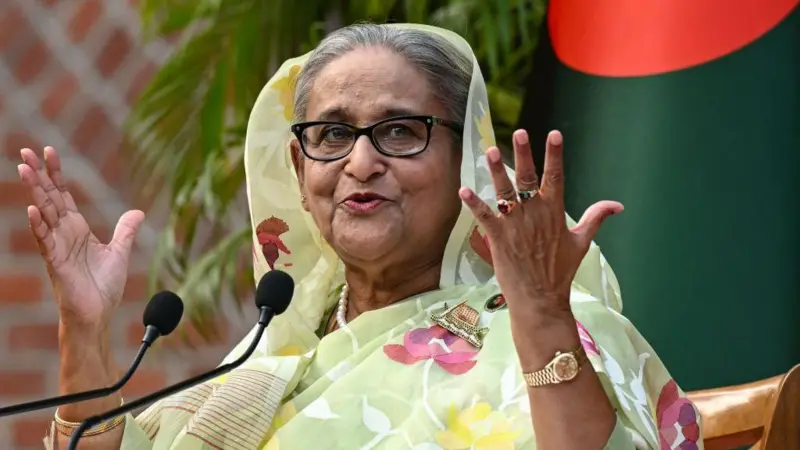
Sheikh Hasina Slams Yunus Regime Over Minority Torture in Christmas Speech Amid Bangladesh Violence

Sheikh Hasina

Amid growing concerns over violence against religious minorities in Bangladesh, ousted Prime Minister Sheikh Hasina has launched a sharp attack on the interim Yunus-led administration, accusing it of illegally seizing power and subjecting minorities to what she described as “unspeakable torture”.Click Here To Follow Our WhatsApp Channel

In her Christmas address, Hasina extended greetings to citizens of Bangladesh and reflected on the country’s past, saying it had long been a “shining example of communal harmony”. She recalled that the country’s founding vision was rooted in secularism and coexistence.

“The father of the nation dreamed of a non-communal Bangladesh. The Bangladesh Awami League ensured peaceful and dignified lives for people of all religions to realise that dream,” she said.

However, Hasina expressed deep concern over the current political situation, alleging that the present ruling group had come to power illegally and was now undermining religious freedom.

“It is sad to say that the current ruling group that has seized illegal power is interfering with the freedom of people of all religions and communities to practice their own religion,” she stated.

Lynching Incidents Heighten Tensions

Her remarks come against the backdrop of heightened tension following the brutal lynching of Dipu Chandra Das, a factory worker in Mymensingh. Das was reportedly accused of blasphemy by a co-worker, after which he was beaten, his body hanged, and later set on fire. The incident sparked outrage and fear among minority communities across the country.

Referring to such cases, Hasina alleged that non-Muslims were being systematically targeted under the current regime. “Religious minorities are being subjected to unspeakable torture. We are seeing horrifying examples, including the burning of minorities,” she said.

She concluded her speech on a hopeful note, saying she believed the people of Bangladesh would not allow the situation to deteriorate further. Hasina added that the spirit of Christmas could help strengthen harmony between Christians and followers of other religions.

“May dawn break through the darkness,” she said.

Another Minority Death Reported

Meanwhile, violence continued to make headlines. Local media reported that another Hindu man, identified as Samrat, was beaten to death only days after the killing of Dipu Chandra Das. According to reports by The Daily Star, local residents claimed Samrat was the leader of a criminal gang known as ‘Samrat Bahini’, allegedly involved in extortion and other illegal activities.

Samrat had reportedly fled Bangladesh after Hasina’s ouster last year and had recently returned to his native village of Hosendanga in Kalimohor Union, where the fatal assault took place.

The back-to-back incidents have intensified debate over law and order and minority safety in Bangladesh, drawing both domestic and international attention as political tensions continue to rise.

Al-Tilmeez: A Pioneering Arabic Literary Journal from Jammu and Kashmir

Professor Mufti Abdul Ghani Azhari: Scholar, Sufi, Historian, and Social Reformer of Kashmir

Mirwaiz Mohammad Ahmad son of Mufasir-e-Quran Moulana Mohammad Yousuf Shah Dies in Islamabad, Pakistan

Bangladesh Ex-PM Sheikh Hasina Sentenced to Death by War Crimes Tribunal

Sheikh Hasina

Bangladesh’s International Crimes Tribunal has sentenced former Bangladesh Prime Minister Sheikh Hasina to death in a case over alleged crimes against humanity. The court found Hasina guilty on three counts, concluding a months-long trial that found her guilty of ordering a deadly crackdown on a student-led uprising last year that led to the fall of her Awami League government.

The three-member tribunal, headed by Justice Mohd Golam Mortuza Majumder, also pronounced its judgement against Hasina’s two aides, former Home Minister Asaduzzaman Khan Kamal and former police chief Chowdhury Abdullah Al-Mamun, over the same charges.

The court said the three accused acted in connivance with each other to commit atrocities in order to kill protesters throughout the country. However, it pardoned the former police chief, who “sought an apology from the tribunal and the people of the country”.

Hasina and Kamal have been declared fugitives and tried in absentia, while Mamun initially faced trial in person before turning approver.

What Court Said
The court noted that the Hasina government did not pay heed to students’ demands, and instead of listening to the students, the then prime minister undermined the movement and made derogatory remarks pointing towards the students and terming them ‘Razakars’, a derogatory term used in Bangladesh.

In the aftermath of the derogatory remarks, students, including females, burst into a rage, the court noted, adding that Sheikh Hasina then ordered the “elimination of protesting students”.

The judges noted that the prosecution’s witnesses proved that the attack on Dhaka University students was by Awami League wings, including the Chhatra League and Yuva League.

“Sheikh Hasina ordered law enforcement agencies to use drones to locate congregating protesters and helicopters and lethal weapons to kill them,” the court said.

It added that former Home Minister Asaduzzaman Khan Kamal and former police chief Chowdhury Abdullah Al-Mamun committed crimes against humanity by their abetment in the use of drones and lethal weapons and helicopters by abetment and failure to prevent atrocities and are liable to be punished.

However, Abdullah Al-Mamun was given a pardon for making full disclosure related to the crime, and he admitted his involvement.

Convicting Hasina and Kamal, the court said their abscondence was suggestive of their guilt.

Hasina was “found guilty on three counts”, including incitement, ordering to kill, and inaction to prevent the atrocities, Judge Golam Mortuza Mozumder read to the packed court in Dhaka.

“We have decided to inflict her with only one sentence — that is, the sentence of death.”

Charges Against Hasina
Hasina, Kamal and Mamun faced five charges, including murder, attempted murder, torture and other inhumane acts. A key charge accused Hasina of ordering the “extermination” of protesters. She was also accused of making inflammatory remarks and directing the use of deadly weapons against students behind a mass uprising that forced her out of office in August 2024. A UN rights office report estimates that up to 1,400 people were killed between July 15 and August 15 during the “July Uprising” as her government ordered a sweeping security crackdown.

Hasina, 78, is currently living in exile in India, after defying the tribunal’s orders to face trial for ordering a deadly crackdown on a student-led uprising on August 5, 2024.

Chief Prosecutor Mohammad Tajul Islam has described Hasina as the “mastermind and principal architect” of the alleged atrocities during the protests. Her supporters, however, maintain the charges are politically motivated.

Hasina’s Extradition
Hasina fled Bangladesh on August 4, 2024, amid intensifying unrest and has since been residing in India. Kamal is also believed to have taken refuge in India. The interim government led by Muhammad Yunus has sought Hasina’s extradition, but India has yet to respond.

Unrest In Bangladesh
Security has been heightened nationwide ahead of the verdict. Dhaka Metropolitan Police Commissioner Sheikh Md Sajjat Ali on Sunday evening issued shoot-at-sight orders against anyone involved in arson, explosions or attempts to harm police and civilians.

The now-disbanded Awami League had called a two-day shutdown ahead of the judgement. Army troops, Border Guard Bangladesh personnel and riot police have been deployed around the ICT-BD complex, with streets in the capital largely deserted amid fears of violence.