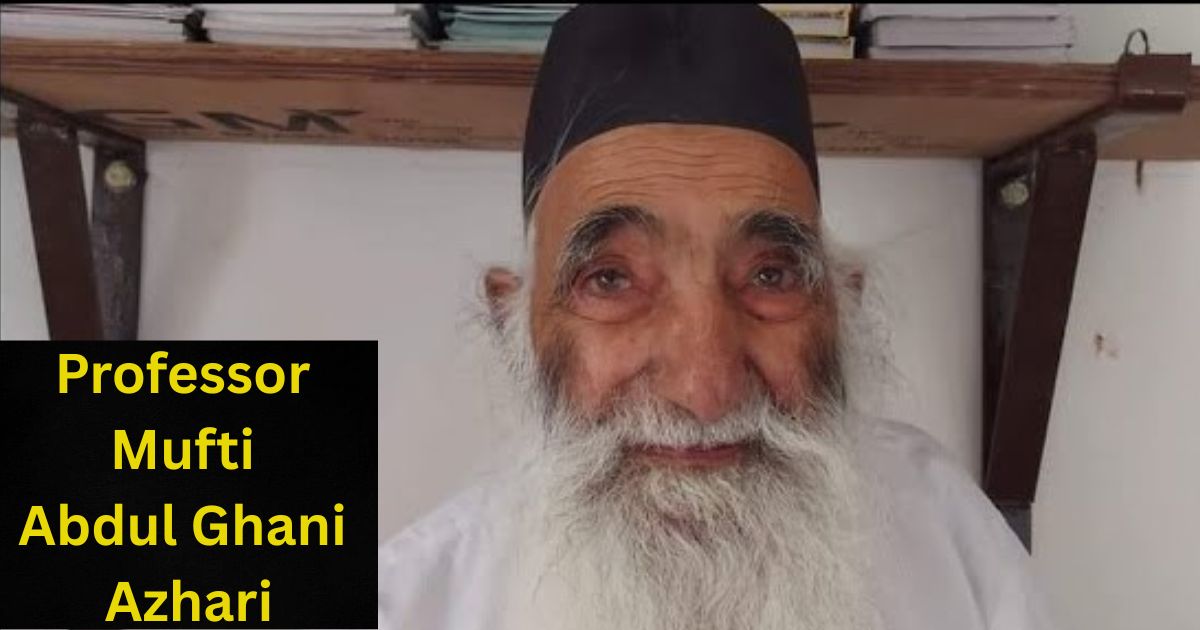
Professor Mufti Abdul Ghani Azhari (1922–2023), also known as Abdul Ghani Shah al-Shashi, was one of India’s most respected Islamic scholars, Sufi teachers, historians, and community reformers. Born in Poonch, Jammu and Kashmir, he belonged to the Gujjar community, a group often marginalised in society. Over his long life of nearly 100 years, he dedicated himself to spreading Islamic knowledge, guiding people spiritually, and uplifting the poor through education and support. His work touched the lives of thousands, especially Gujjar Muslims in Kashmir and across South Asia, leaving a lasting legacy of compassion, wisdom, and unity.
Early Life
Abdul Ghani Azhari was born in 1922 in Poonch, a hilly region of Jammu and Kashmir, to Ali Miyan Shashi. Growing up in the Gujjar community, he saw the challenges faced by his people, including poverty and lack of education. From a young age, he loved learning and had a deep respect for Islamic teachings. His grandfather, Maulana Abdul Halim al-Shashi, a well-known Gujjar scholar of the Quran, played a big role in shaping his early years, encouraging his passion for knowledge and faith. Later, Azhari moved to Sogam, Kokernag, in Anantnag, where he spent much of his life.
Education
Azhari’s thirst for knowledge took him to some of the world’s top Islamic institutions, where he studied under great scholars and gained expertise in many fields:
- Darul Uloom Deoband (1943): At this famous Islamic school in India, Azhari studied under Hussain Ahmad Madani, a scholar and freedom fighter who taught him key Islamic texts like Sahih al Bukhari and Sunan al Tirmidhi. Madani’s passion for India’s freedom also inspired Azhari to serve his country and community.
- Mazahir Uloom Saharanpur (1949): Here, he learned from Muhammad Zakariyya Kandhlawi, a leading expert in Hadith (sayings of the Prophet Muhammad). He studied important books like Bulugh al Maram and Mishkat al Masabih, which deepened his understanding of Islamic teachings and spirituality.
- Al-Azhar University, Cairo (1966): Azhari earned a PhD in Hadith studies with a thesis called Al Imam Al Muslim Wa Manhajuhu Fi Al Hadith Riwayatn Wa Dirayatan (The Methodology of Imam Muslim in Hadith Narration and Analysis). He also gained a diploma in psychology, which helped him combine religious and modern knowledge. His teachers included Abdel-Halim Mahmoud and Abdul Wahhab Abdul Latif, both renowned scholars.
Azhari was also influenced by Maulana Abul Kalam Azad, India’s first education minister, who encouraged blending traditional Islamic learning with modern ideas. This mix made Azhari a unique scholar who could connect with both religious and academic audiences.
Academic and Teaching Career
After his studies, Azhari became a teacher, sharing his knowledge with students and communities. He first taught at Madinatul Uloom in Hazratbal, Srinagar, where he made complex Islamic ideas easy to understand. Later, he became head of the Arabic Department at the University of Kashmir, a role he held until he retired in 1997. His teaching style was clear and inspiring, helping students from all backgrounds learn about Islam, Arabic, and more.
Azhari was a master of many Islamic sciences, including:
- Quranic Interpretation (Tafsir): He explained the Quran’s meanings, often teaching Tafsir Jalalayn, a well-known commentary.
- Hadith: As a muhaddith (Hadith scholar), he certified others to teach Hadith and had a chain of transmission going back to Shah Waliullah Dehlawi, a famous 18th-century scholar. He gave famous lectures, like teaching Sahih al Bukhari in just 13 days in Kuwait and at Masjid-e-Nabawi in Madinah.
- Islamic Law (Fiqh): He was an expert in both Hanafi and Shafi’i schools of Islamic law, teaching books like Bahr al Raiq (Hanafi) and Al Umm (Shafi’i).
- Sufism (Tasawwuf): As a Naqshbandi Sufi, he guided people towards spiritual growth and inner peace.
He believed the Quran should be read with understanding in any language and urged Muslims to follow its teachings as their guide. He also taught that Hadith should be studied for its own sake, not twisted to fit personal views, following the approach of great scholars like Muhammad Yunus Jaunpuri.
Sufi Teachings
As a follower of the Naqshbandi Sufi order, Azhari focused on the spiritual side of Islam. He believed in:
- Inner Purification: Remembering Allah to cleanse the heart and soul.
- Following the Quran and Sunnah: Living by the teachings of the Prophet Muhammad with sincerity.
- Unity and Peace: Bringing Muslims together and building good relations with other communities.
His sermons were heartfelt and easy to understand, inspiring people to live with love, kindness, and tolerance. His diploma in psychology helped him understand the human heart, making his spiritual guidance even more powerful. He followed the teachings of Imam Ghazali, a famous Sufi scholar, and was seen as a Jamiul Salasil (someone who combined all Sufi orders). He held the title of Amir al Shari‘ah and Sadr al Muftiyeen (chief jurist) of Jammu and Kashmir, showing his high standing as a spiritual leader.
Institutions Founded
Azhari believed education could change lives, especially for those who were poor or marginalised. He set up several schools and seminaries to provide free education, food, and clothing, focusing on the Gujjar community and others in need. These institutions followed the principles of Ahl-i Sunnat wal Jama‘at (Sunni Islam) and taught subjects like Arabic, Persian, Urdu, and logic. Some of his key institutions include:
- Maktabah Anwar al Uloom (Kokernag, 1950s): Co-founded with Maulana Hafiz Muhammad Chiragh Qasmi, this centre helped Gujjar students learn about their faith and culture.
- Maktabah al Azhariya (1960, later a Darul Uloom in 1980): A major hub for Islamic learning in Kashmir, serving as the heart of Azhari’s work.
- Darul Uloom Kawthariya (New Theed, Harwan, 1990): Built near Zabarwan Hills in Srinagar for advanced Islamic studies.
- Darul Uloom Shah Wali Allah (Donipawa, Anantnag, 2003): A centre for Islamic law and spirituality.
- Darul Uloom Nizamiyya Madinatul Islam (Badshahibagh, Saharanpur): A leading seminary with an open school up to the 10th standard, serving both poor and privileged students.
- Seminaries in Jammu: Set up in areas like Nagrota, Sidrah, and Tandah to reach more people.
These schools gave thousands of students, especially from the Gujjar community, a chance to learn and grow, breaking the cycle of poverty through education.
Books and Writings
Azhari wrote several important books that are still used by students and scholars. His works cover Islamic teachings, Sufism, and the history of the Gujjar community. Some of his most notable books include:
- Qadim Tarikh-e-Gujjar: A detailed history of the Gujjar people, showing their important role in South Asia’s culture and history. This book helped Gujjars feel proud of their heritage and fought against feelings of inferiority. It also had an impact abroad, challenging atheistic ideas in places like Russia.
- Ma La Budda Minh: An Urdu translation of a book by Mir Syed Ali Hamdani, a great Sufi saint, covering key Islamic beliefs like faith, worship, and kindness.
- Noor-i Irfan: A collection of Naqshbandi Sufi teachings and letters by Peer Muhammad Sharifuddin, explaining spiritual practices and the lives of Sufi leaders.
- Gulzar-i Marifat: A book in Punjabi about Sufism and spiritual growth.
- Urdu Translation of Amir Kabir Mir Syed Ali Hamdani’s Works: Making the teachings of this Sufi saint available to more people.
- Talimat-e Qur’an: Unfinished writings on the Quran’s teachings, showing his deep love for the holy book.
These books helped preserve Gujjar culture, spread Islamic knowledge, and guide people towards a spiritual life.
Social Work and Gujjar Upliftment
Azhari spent over 70 years helping the poor, especially orphans and those from marginalised groups like the Gujjars. He provided clothing, shelter, and education to anyone in need, regardless of their background. His work gave hope to the Gujjar community, who faced social and economic challenges. By writing about their history and setting up schools, he helped them gain confidence and respect.
Azhari also worked to bring people together, promoting peace between Muslims and other communities. His efforts were praised by scholars like Emmanuel David Singh, who noted his role in fostering harmony in South Asia. Inspired by freedom fighters like Hussain Ahmad Madani and Abul Kalam Azad, Azhari believed in serving both his faith and his country, working to make India a better place for all.
Final Years and Legacy
In his later years, Azhari lived in Sogam, Kokernag, and Saharanpur, Uttar Pradesh, where he continued teaching and guiding people. He passed away on 19 January 2023 in Saharanpur at the age of about 100. His funeral, led by Moulana Mohammad Aaqil, was attended by thousands, showing the love and respect he had earned. Leaders like Farooq and Omar Abdullah paid tributes, calling him a great scholar and spiritual guide.
Professor Abdul Ghani Azhari’s legacy lives on through his schools, books, and the many lives he changed. He was a scholar who made complex ideas simple, a Sufi who spread love and peace, a historian who gave the Gujjars pride, and a reformer who fought for equality and education. For the people of Kashmir and beyond, his work continues to inspire, proving that one person’s dedication can make a difference for generations.
(Writer: Sheikh Mohammad Isa Kashmir)
Click Here To Follow Our WhatsApp Channel
You Might Also Like:
Faith, Family & the Future: Navigating Chaos with Purpose
Kashmir Fruit Growers Face Heavy Losses as Highway Closure Disrupts Transport
From Boom to Bust: How the April 22 Terror Attack Shattered Pahalgam’s Tourism Dream
11 Dead in Ramban and Reasi Weather Tragedies as Landslides and Cloudburst Devastate Jammu