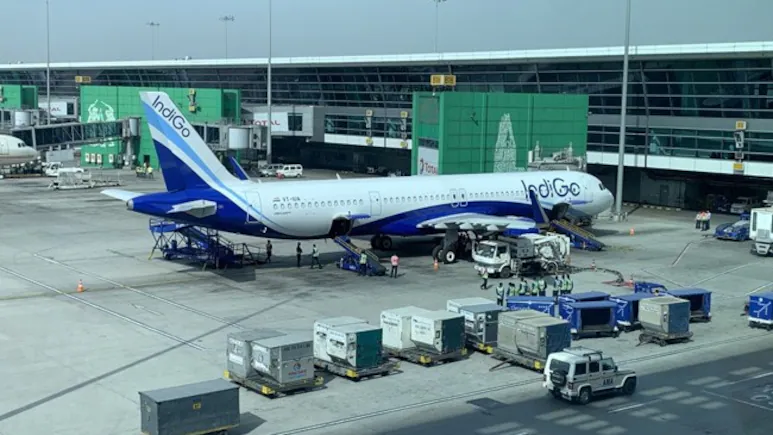
India witnessed one of its most significant aviation meltdowns in recent years when IndiGo — the country’s largest airline — was forced to cancel hundreds of flights and delay thousands more across major airports. The disruption, which unfolded over two consecutive days, left terminals overcrowded, passengers stranded, and schedules in complete disarray.
While weather and seasonal congestion played a role, the crisis was primarily the result of regulatory changes, operational vulnerabilities, crew shortages and technical failures converging at the same moment. Here is an in-depth breakdown of what led to the chaos and why IndiGo, more than other carriers, was hit the hardest.Click Here To Follow Our WhatsApp Channel
1. Acute Crew Shortages Triggered by New Duty-Time Rules
The most immediate cause of disruption was the sudden shortage of pilots and cabin crew after the implementation of the new Flight Duty Time Limitations (FDTL) on November 1.
The revised rules sharply limited:
- Daily flight hours
- Weekly duty time
- Number of permitted night landings
- Minimum rest periods
For IndiGo, which runs over 2,200 flights daily, even a slight reduction in crew utilisation created a domino effect. Several pilots who were originally rostered became legally ineligible to operate flights due to insufficient rest under the stricter norms.

This triggered rotation failures:
- Flights could not depart due to no available crew
- Entire network sequences collapsed
- Delays snowballed as rotations started late or were cancelled
Aviation sources said IndiGo underestimated the manpower needed to comply with the new rules, resulting in immediate crew deficits across its busiest routes.
2. New FDTL Norms: Stricter, Safer, but Disruptive
The DGCA’s updated FDTL norms aim to curb pilot fatigue, which has been a long-standing global safety concern. Key changes include:
Tighter Rest Requirements
- Weekly rest periods expanded
- Minimum rest now 10 hours within any 24-hour window
- Rest time must be double the length of duty hours worked
Reduced Night Landings
- Cut from 6 to only 2 allowed in a certain timeframe
- Airlines with large overnight networks face immediate scheduling challenges
Limits on Flight Time
- 8 hours per day
- 35 hours per week
- 125 hours per month
- 1,000 hours per year
The new requirements increased the number of pilots needed per aircraft. For IndiGo — with one of the highest aircraft utilisation rates in Asia — this meant the airline suddenly needed hundreds of additional pilots to maintain its pre-existing schedule.
3. Technical Glitches at Major Airports Added Fuel to the Fire
Just as IndiGo was grappling with crew shortages, airport systems in Delhi, Pune and some other metros malfunctioned on Tuesday.
This included failures in:
- Departure Control Systems
- Check-in software
- Baggage handling integration
These failures caused long queues, delayed boarding, and missed departure slots across multiple IndiGo flights.
Since IndiGo operates a tightly wound schedule with short turnaround times, even a one-hour delay on a few flights rippled across the entire network, grounding rotations throughout the day.
4. Winter Congestion and Fog Pressure
Peak winter operations are already challenging in India due to:
- Low visibility at northern airports
- Heavy passenger traffic
- Slot restrictions
- Congested runways
IndiGo’s dense network structure amplifies this vulnerability.
As delays mounted, aircraft missed allocated slots, forcing them to wait in long queues for takeoff clearances — worsening turnaround delays and increasing cancellations.
5. Why Other Airlines Were Not Hit as Badly
Although the new rules affected all carriers, IndiGo faced disproportionate disruption due to four structural characteristics:
1. Sheer Scale
IndiGo operates a majority of India’s domestic flights.
A 10% problem in IndiGo equals a 50% problem in the sector.
2. Large Overnight Network
IndiGo relies heavily on night flying, which became severely restricted under new FDTL caps.
3. Tight Utilisation Model
The airline’s low-cost model depends on:
- Maximum crew hours
- Minimum downtime
- Ultra-tight rotations
When regulations changed, this model buckled.
4. Complexity of Network Realignment
Smaller airlines like Akasa or Vistara can reshuffle crews more easily. IndiGo’s massive web of interdependent connections made realignment slow and difficult.
6. Impact on Passengers
Government data showed IndiGo’s on-time performance plummeted to just 35%, meaning over 1,400 of its flights were delayed in a single day.
Passengers faced:
- Long queues
- Missed connections
- Last-minute cancellations
- Unreachable customer service lines
- Crowded terminals and confusion
The DGCA reported 1,232 IndiGo flights cancelled in November alone.
7. IndiGo’s Response: Controlled Cancellations and Crew Redeployment
In its public statement, IndiGo cited:
“unforeseen operational challenges, technology glitches, weather-related stress, congestion, schedule changes and updated rostering rules.”
The airline is now implementing:
- Calibrated schedule reductions
- Rerouting pilots to high-density sectors
- Temporary cancellations to stabilise operations
- Night schedule adjustments
- Rebuilding duty rosters from scratch
IndiGo expects operations to stabilise within 48–72 hours, though some delays may persist longer.
Conclusion: A Perfect Storm of Structural and Regulatory Pressures
IndiGo’s massive disruption was not caused by a single failure but a convergence of:
- New safety-first duty rules
- Systemic crew shortages
- Scheduling inflexibility
- Airport technical failures
- Seasonal congestion
These factors exposed how tightly India’s aviation system — especially low-cost carriers — operates, leaving little room for absorbing sudden regulatory or operational shocks.
While the new FDTL norms are crucial for safety, airlines will need time, manpower, and structural adjustments to adapt. The IndiGo crisis is a reminder that in aviation, safety upgrades and operational resilience must evolve hand in hand.
You Might Also Like:
Islam’s Unique Civilisation: Unity of Faith, Culture and History
Iran Offers Condolences to India Over Delhi Red Fort Blast, NIA Launches Full Terror Probe
Is Crowdfunding and Taking Loans Allowed in Islam? Understanding Help, Tawakkul and Riba