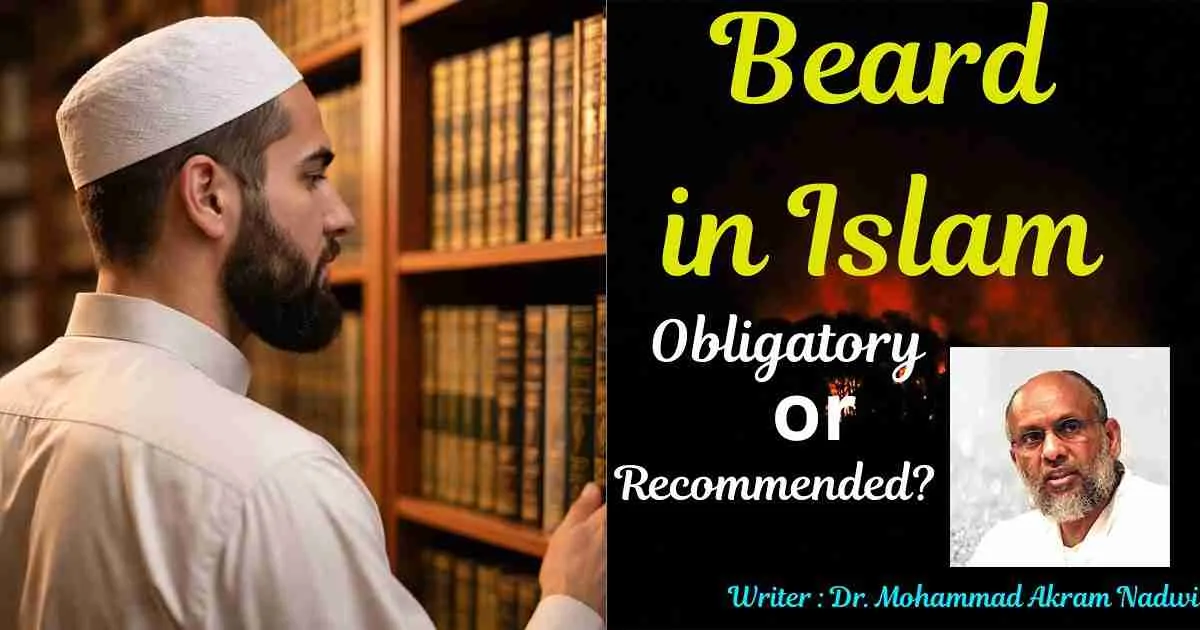
The legal ruling concerning the beard in Islam has long been a subject of juristic discussion and recognised scholarly disagreement. This divergence arises from differing interpretations of the Prophetic instructions concerning the beard and the extent to which such instructions convey binding legal force. While it is universally acknowledged that the Prophet ﷺ maintained a beard and encouraged its preservation, Muslim jurists have differed as to whether this encouragement constitutes a legal obligation or a recommended practice within the broader framework of personal grooming and customary conduct.Click Here To Follow Our WhatsApp Channel
Islamic sources consistently affirm that the Prophet ﷺ did not shave his beard. Authentic narrations describe his careful attention to its appearance, as he would trim from its sides and upper portions in a manner that enhanced its neatness and ensured harmony with his facial features and overall demeanour. He also maintained its cleanliness by washing, combing, and running his fingers through it. The Companions, may Allah be pleased with them, followed the Prophet ﷺ in these practices, emulating both his outward conduct and his personal choices. This continuity of practice underscores the beard’s recognised place within the Prophetic way of life, while also demonstrating that its maintenance was accompanied by care, moderation, and attention to appearance.
The principal textual evidences informing the juristic discourse on this matter are found in well-established Prophetic traditions. Among the most frequently cited is the narration reported by al-Bukhārī and Muslim from Ibn ʿUmar, in which the Prophet ﷺ stated: “Act contrary to the polytheists: trim the moustaches closely and let the beards grow.” Another narration recorded by Muslim from ʿĀʾishah includes the beard among the practices of the fiṭrah, alongside other acts related to cleanliness and personal hygiene, such as trimming the nails, using the tooth-stick, and cleansing the body. These narrations clearly demonstrate the Prophet’s encouragement of maintaining the beard; however, they do not, in themselves, decisively establish its precise legal classification in terms of obligation or recommendation.
On the basis of these texts, classical jurists articulated two principal legal positions. The Ḥanafī and Mālikī schools, together with a view adopted by later Ḥanbalī scholars, held that the Prophetic command indicates obligation and therefore ruled that shaving the beard is unlawful. This position rests upon the established principle of Islamic legal theory that a command fundamentally denotes obligation unless a contextual indicator diverts it from this meaning. Moreover, the command is explicitly linked to opposing the polytheists, and imitation of non-Muslims in distinctive practices is generally regarded as impermissible. On this basis, authoritative jurists from these schools explicitly stated that shaving the beard is prohibited.
In contrast, the Shāfiʿī school, in its relied-upon position, along with a considerable number of scholars across the legal schools, maintained that letting the beard grow is a recommended Sunnah rather than a binding obligation. According to this view, shaving the beard is disliked but does not rise to the level of prohibition. Scholars who held this position argued that the beard belongs primarily to the realm of customary practices and personal appearance rather than acts of ritual worship. Consequently, the Prophetic command is understood as guidance and moral instruction aimed at promoting dignified appearance and conformity with sound social norms, rather than as a legally binding injunction.
This interpretation is supported by well-established juristic principles concerning commands related to etiquette, hygiene, and refinement of conduct. Scholars such as Ibn Ḥajar al-ʿAsqalānī explained that when commands pertain to manners and commendable behaviour, they are often interpreted as recommendation rather than obligation, particularly when contextual indicators are present. The rationale of opposing the polytheists, while meaningful, does not by itself necessitate legal obligation, as opposition to non-Muslims is binding only in matters of belief and distinctive religious identity, not in all outward customs and social practices.
Further support for this view is found in the inclusion of the beard among the practices of the fiṭrah. These practices are widely understood by scholars to be recommended acts that promote cleanliness, beauty, and physical well-being. Since such matters are already encouraged by natural human disposition, the Sharīʿah did not impose them as strict legal obligations. Jurists have also observed that legal prohibition and obligation are generally reserved for matters involving clear moral harm or public interest, whereas issues of personal grooming typically remain within the sphere of recommendation unless accompanied by explicit and unequivocal evidence.
Closely related to this discussion is the question of the size or length of the beard. The overwhelming majority of scholars did not stipulate a legally defined minimum length for what constitutes a beard. Rather, the beard is understood according to customary recognition (ʿurf), meaning that whatever is commonly regarded by people as a beard is considered as such in legal terms. Islamic law does not prescribe a specific measurement or fixed standard in this regard. This understanding is consistent with the broader treatment of customary matters in jurisprudence, wherein definitions are left to social convention rather than rigid legal quantification. The Prophet’s own practice of trimming and grooming further supports the view that the Sharīʿah did not intend to impose a particular length, but rather to encourage a dignified and recognisable appearance.
Modern scholars have reinforced this understanding by situating the issue of the beard within the context of social custom and cultural norms. Prominent contemporary jurists have argued that matters of dress and personal appearance, including the beard, fall within the domain of social convention and should reflect what is considered appropriate and dignified within a given society, so long as no fundamental religious principle is compromised. This approach has been widely adopted by many contemporary scholars, particularly among the scholars of al-Azhar, both in their legal reasoning and lived practice.
In conclusion, the ruling on the beard represents a well-established area of juristic disagreement within Islamic law. While some scholars consider letting the beard grow to be obligatory and regard shaving it as prohibited, others view it as a recommended Sunnah and deem shaving merely disliked. Likewise, no definitive legal standard exists regarding its length, as the matter is governed by customary recognition rather than textual specification. As such, this issue belongs to the category of subsidiary legal matters in which valid scholarly disagreement exists. In accordance with the principles of Islamic jurisprudence, there is no basis for condemnation or censure in such matters, as reproach is reserved only for issues upon which there is clear and uncontested scholarly consensus.

You Might Also Like:
At 13, This Kashmiri Boy Built 31 Apps and AI Tools
Zohran Mamdani: The Fearless New York Leader Speaking Truth When Others Stay Silent
NYC Mayor Zohran Mamdani Calls Maduro’s Capture an Act of War, Warns of Legal and Human Impact