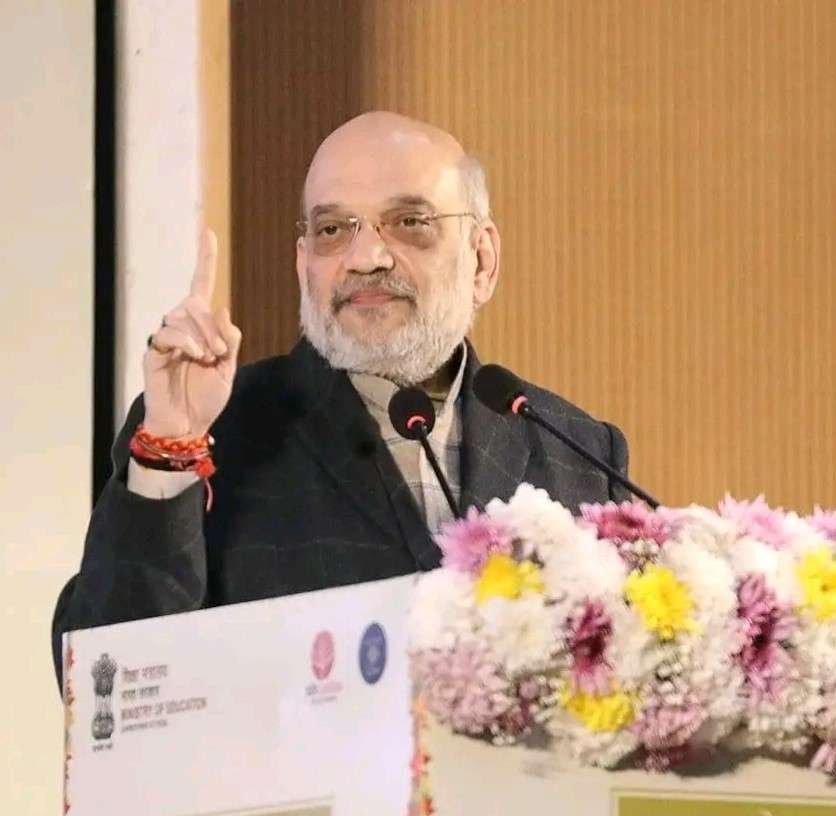
Stating that a common anti-terrorism squad (ATS) structure for the police across the country is extremely essential, Home Minister Amit Shah on Friday asked the Director Generals of Police of all States and UTs to implement it at the earliest.Click Here To Follow Our WhatsApp Channel
“All agencies of the Government of India and the state police should come together to form a ‘Team India’ that works effectively for national security,” said Shah while inaugurating the two-day-long ‘Anti-Terrorism Conference-2025’ in New Delhi.
He said that for the coming generations, we must build an impenetrable and strong ‘anti-terrorism grid’ capable of facing every challenge.
Shah said that all states’ ATS units should get into the habit of using NIDAAN and NATGRID. “Using NIDAAN and NATGRID in investigations ensures that cases are not investigated in isolation, but also brings to light the invisible links in the cases. The use of NATGRID should be made mandatory in certain types of investigations, and the use of NIDAAN should be made mandatory in certain types of cases,” he said.
According to Shah, the common ATS structure and operational uniformity give us an advantage in prosecuting terrorists. “Unless we achieve operational uniformity, we cannot make an accurate assessment of threats, make proper use of intelligence sharing, or carry out coordinated counteractions. We must ensure uniformity from investigation to prosecution and counter-action,” he said.
“We are bringing an action plan to launch a 360-degree strike on organized crime. Only through operational uniformity can we achieve accurate assessment of threats, proper utilization of intelligence sharing, and coordinated counter-action,” he said.
Stating that the landscape of terrorism in the world is now changing due to the use of technology in terrorist incidents alongside technological advancements, Shah said, “We too must prepare to prevent this. It is the national responsibility of this conference to anticipate invisible future challenges and to prevent them.”
Shah launched an updated crime manual prepared by the NIA during the conference. He requested all Director Generals of Police from the states to form a team in their respective states and ensure that they study this manual for investigation and prosecution purposes.
Shah also released a database on organized crime networks. He said that organized crime networks initially operate for the purpose of ransom and extortion, but when their leaders flee abroad and settle there, they automatically come into contact with terrorist organizations and then use the proceeds from ransom and extortion to spread terrorism within the country.
“Every state must, under the guidance of the NIA and CBI, with the cooperation of the IB, and by utilizing this database, eliminate it within their jurisdiction,” he emphasised.
Highlighting that for the first time, security forces punished those who planned the terrorist incident through Operation Sindoor and neutralized those who executed it through Operation Mahadev.
“The attack in Baisaran Valley was one that shook the entire country. Through this attack, the terrorists wanted to disrupt communal harmony in the country and deliver a blow to the new era of development and tourism that has begun in Kashmir. Based on extremely precise intelligence, our forces neutralized all three terrorists, delivering a stern message to Pakistan. This is the first terrorist incident in which those who planned the terrorist act were punished by us through Operation Sindoor, and those who carried out the act with the weapons provided to them were neutralized through Operation Mahadev,” he said.
The Home Minister said that at both ends, the Government of India, the Indian security forces, and the people of India have given a strong and befitting reply to Pakistan’s terrorist masters through our security forces and intelligence agencies.
“Our team has conducted a complete and successful investigation of the Pahalgam terrorist attack, which agencies around the world will study in the coming days. The results of the investigation into the Pahalgam terrorist attack will put Pakistan in the dock on international platforms,” he said.
Referring to the Delhi bomb blast incident, Shah said that the Jammu and Kashmir police conducted an excellent investigation into the explosion that occurred in Delhi.
“The incident in Delhi happened with 40 kilograms of explosives, while 3 tonnes of explosives were recovered before they could detonate, and the entire team involved in conspiring this plot was apprehended before the Delhi blast could take place. Investigation of this entire network was carried out very effectively by all our agencies. The investigations into the Pahalgam and Delhi blast cases are not examples of routine policing, but outstanding instances of watertight investigation. This also serves as a very significant example of how a constantly vigilant officer can save the country from such a massive crisis,” Shah said.
He said, “We have established a new standard of coordination, cooperation, and communication among the DGP Conference, Security Strategy Conference, N-CORD meetings, and the Anti-Terror Conference. And we cannot view these four pillars in isolation; running through them as a common thread is the Anti-Terrorism Conference.”
Shah said that as the country’s economy advances, we will have to enhance our vigilance accordingly.
“The preparations to ensure the country’s internal security do not begin at our borders; rather, the preparation to secure the borders must start many miles away,” he said.
Shah said that building a multi-layer security model and working with a ruthless approach against terrorism can keep us secure in the coming days.
He said that everyone should move forward with the principle of “Duty to Share” instead of “Need to Know”.
“The central agencies and state police have made good use of technology at their respective levels, but technology developed in silos and data collected in silos are like a gun without bullets. It is better if all data can communicate with each other and are created using the same technology. For this purpose, the Ministry of Home Affairs, NIA, and IB should hold discussions to develop a seamless national-level framework for technology and data, and should support the states in strengthening it,” Shah said.
The two-day conference is being organized by the National Investigation Agency (NIA).
Shah also unveiled NIA’s Lost and Looted, and Recovered Weapon Database.
The conference was attended by Union Ministers of State for Home Affairs Nityanand Rai and Bandi Sanjay Kumar, Union Home Secretary, Secretary R&AW, Director General of NIA and many other dignitaries.
The conference is being attended by senior police officers from States and UTs, officers from Central agencies and Departments dealing with issues related to Counter Terrorism and experts from related fields such as law, forensics, technology, etc.
You Might Also Like:
Al-Tilmeez: A Pioneering Arabic Literary Journal from Jammu and Kashmir
Professor Mufti Abdul Ghani Azhari: Scholar, Sufi, Historian, and Social Reformer of Kashmir