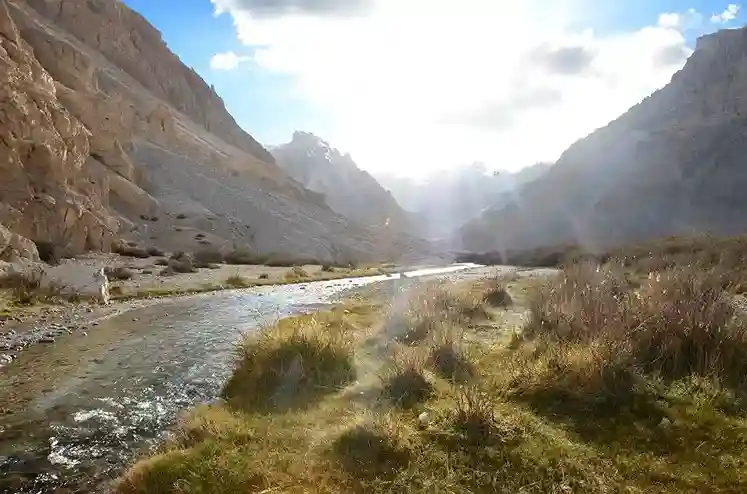
China has firmly rejected India’s claim over the Shaksgam Valley in Jammu and Kashmir, saying the area belongs to China and that development work there is fully justified.
On Monday, Chinese Foreign Ministry spokesperson Mao Ning said China has the right to build infrastructure in what it considers its own territory. She made the remarks while responding to questions on border issues and the China-Pakistan Economic Corridor (CPEC).Click Here To Follow Our WhatsApp Channel
“The territory you mentioned belongs to China. It is completely justified for China to carry out infrastructure construction on its own land,” Mao said.
She added that China and Pakistan signed a boundary agreement in the 1960s, under which borders between the two countries were demarcated. According to her, the agreement was a legitimate exercise of the rights of two sovereign nations.
Referring to a report by Global Times, Mao said the CPEC is an economic cooperation project aimed at boosting local development and improving people’s livelihoods. She stressed that both the boundary agreement with Pakistan and the CPEC do not change China’s long-standing position on the Kashmir issue.
The Shaksgam Valley lies in a strategically sensitive region. It borders China’s Xinjiang province to the north, Pakistan-occupied Jammu and Kashmir to the south and west, and the Siachen Glacier area to the east.
Earlier this month, India strongly objected to China’s infrastructure activity in the region. On January 9, New Delhi termed the CPEC projects in the Shaksgam Valley “illegal and invalid”, saying the area is an integral part of India.
During a weekly briefing, Ministry of External Affairs spokesperson Randhir Jaiswal said India has never recognised the 1963 China-Pakistan boundary agreement or the CPEC.
“Shaksgam Valley is Indian territory. We have never recognised the so-called China-Pakistan boundary agreement of 1963. The CPEC also passes through Indian territory under Pakistan’s illegal occupation,” he said.
Jaiswal further reiterated that the Union Territories of Jammu and Kashmir and Ladakh are an integral and inalienable part of India. He added that India has consistently raised objections with China and has reserved the right to take necessary steps to protect its interests.
India, he said, will continue to oppose any attempts to change the ground situation in the Shaksgam Valley.
Introduction of Shaksgam Valley
The Shaksgam Valley (also called Trans-Karakoram Tract) is a remote, rugged, high-altitude region in the Karakoram mountains, spanning about 5,180 sq km. North of the main watershed, it is drained by the Shaksgam River and features extreme terrain—glaciers, peaks over 4,500 m, and barren landscapes—making it largely uninhabited except for occasional herders.
Historically linked to Baltistan and Hunza, it was explored by British teams and featured in Eric Shipton’s expeditions. It remains disputed: India claims it as part of Jammu & Kashmir (Ladakh), rejecting the 1963 Sino-Pakistan Boundary Agreement as illegal; China administers it within Xinjiang, asserting sovereignty; Pakistan ceded control to China in 1963.
As of January 2026, China controls the valley and pursues infrastructure (including CPEC-linked projects), prompting Indian protests over attempts to alter the status quo in this strategically vital area near Siachen Glacier and key borders.
You Might Also Like:
At 13, This Kashmiri Boy Built 31 Apps and AI Tools
Zohran Mamdani: The Fearless New York Leader Speaking Truth When Others Stay Silent
NYC Mayor Zohran Mamdani Calls Maduro’s Capture an Act of War, Warns of Legal and Human Impact