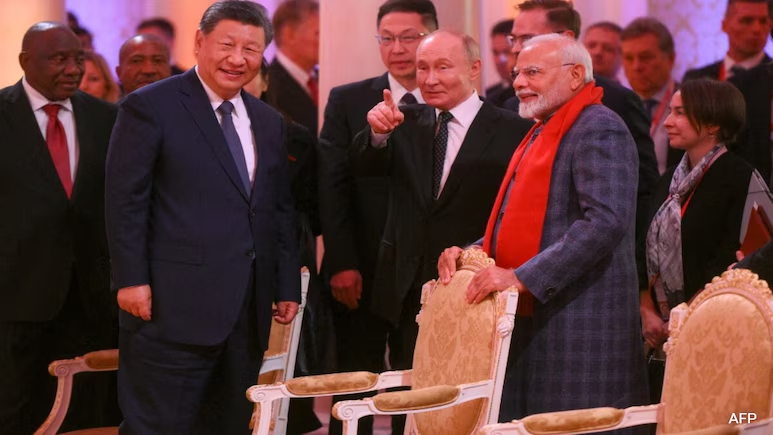
Chinese President Xi Jinping will welcome more than 20 world leaders to Tianjin next week for the Shanghai Cooperation Organisation (SCO) summit, marking the largest gathering in the bloc’s history. The two-day event, running from August 31 to September 1, is being framed as a powerful show of Global South solidarity at a time when the United States under President Donald Trump is tightening economic and diplomatic pressure on several member states.
Among the most closely watched moments will be Indian Prime Minister Narendra Modi’s first visit to China in more than seven years. His presence comes as New Delhi and Beijing attempt to stabilise relations after the deadly 2020 border clashes that left bilateral ties at their lowest point in decades. Russian President Vladimir Putin will also attend, giving Moscow another diplomatic stage despite continued Western isolation over the Ukraine war.
Why the Summit Matters
Analysts say Xi will use the summit to highlight what a post-American-led international order might look like. The SCO, which began in 2001 as a small Eurasian security forum, now has 10 permanent members and 16 dialogue and observer states. Its remit has expanded from counter-terrorism to trade, defence, and political cooperation, allowing China to present it as an “important force in building a new type of international relations.”
Eric Olander, editor-in-chief of The China-Global South Project, noted:
“Xi will want to show that despite Trump’s efforts to isolate China, Russia, and Iran, these countries remain central players. Just look at how BRICS unsettled Trump earlier this year—this summit aims to deliver the same message.”
India’s Delicate Balancing Act
India’s role is especially complex. On the one hand, New Delhi has resisted some SCO positions, such as refusing to endorse a joint defence statement earlier this year and rejecting the bloc’s condemnation of Israeli strikes on Iran. On the other hand, Modi’s government is facing mounting tariff pressure from Washington and is keen to keep momentum in its recent détente with China.
Observers expect Modi and Xi to hold a sideline meeting in Tianjin, with possible announcements of incremental trust-building measures. These could include further troop pullbacks along disputed border areas, the easing of trade barriers, and new cooperation in fields such as climate action and visa facilitation.
Optics Over Substance
While expectations for major policy breakthroughs remain low, experts stress the symbolism of the gathering. The summit underscores the SCO’s growing ability to convene a wide range of Global South leaders, even if its concrete security and economic achievements remain limited.
Manoj Kewalramani, an Indo-Pacific researcher at the Takshashila Institution, explained:
“The SCO’s vision is still fuzzy and its practical impact modest. But its convening power is undeniable, and in international politics, optics often matter as much as outcomes.”
Looking Ahead
Putin is set to remain in China after the summit to attend a World War II military parade in Beijing, his longest overseas trip in years. Modi, however, will depart immediately after the event, underscoring India’s cautious approach.
Even without sweeping announcements, the Tianjin summit signals that China, Russia, and their partners are determined to project unity against US dominance—and that India, despite its frictions with Beijing, is not prepared to stand outside that conversation.
Click Here To Follow Our WhatsApp Channel
You Might Also Like:
Kashmir Politics From Mahraja Hari Singh To Syed Ali Geelani
From Boom to Bust: How the April 22 Terror Attack Shattered Pahalgam’s Tourism Dream
Former Jamat-e-Islami Spokesperson Advocate Zahid Ali Surrenders to Jammu and Kashmir Police