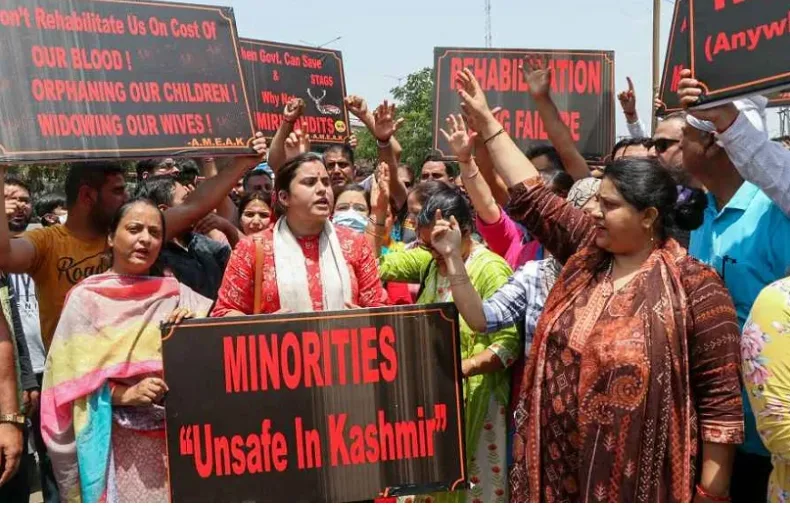
A recent Right to Information (RTI) reply has revealed a shocking reality about one of the government’s biggest rehabilitation schemes for displaced Kashmiri Pandits. Despite a budget of ₹1,618 crore, only three families have permanently returned to the Kashmir Valley under the 2009 Prime Minister’s Package.
The scheme was launched to help Kashmiri migrant families, mainly Pandits, who were forced to leave the Valley in the early 1990s due to violence and militancy.Click Here To Follow Our WhatsApp Channel
The RTI was filed by Congress leader Sanjay Sapru, who described the findings as “deeply troubling.” He said that while the package has been widely promoted over the years, its real impact on the ground appears extremely limited.
What Was the 2009 Package?
The rehabilitation package was approved during the UPA government in 2008–09. It aimed to support the safe and dignified return of displaced families to the Kashmir Valley.
Key benefits included:
- Up to ₹7.5 lakh financial help per family for housing
- Construction of transit accommodation
- Government jobs and self-employment opportunities
- Continued cash relief and student scholarships
- Support for farmers and waiver of loan interest
The goal was to encourage families to return to their homes and rebuild their lives.
What the RTI Revealed
According to official data from the Relief and Rehabilitation Commissioner’s office:
- Only three families have fully returned and settled permanently
- Many beneficiaries of jobs are still living in transit housing or government quarters
- The main aim — large-scale return of families — has not been achieved
Earlier reports had shown some progress in jobs and housing support, but most families have not gone back to their original homes.
Background: The Kashmiri Pandit Exodus
The migration of Kashmiri Pandits began in 1989–90 during rising insurgency in Jammu and Kashmir. Around 44,000 families were officially registered as displaced.
Over the years, different governments introduced several schemes, including:
- The 2008–09 rehabilitation package
- A follow-up package in 2015
- Job schemes that provided employment to thousands of migrant youths
However, full family resettlement in the Valley has remained very limited.
Ongoing Challenges
Many Kashmiri Pandit families still face major issues, such as:
- Security concerns in rural and remote areas
- Lack of trust in long-term peace
- Property disputes and encroachments
- Limited economic opportunities
Even those who accepted government jobs often live in protected transit colonies instead of returning to their villages.
Political Reactions
Sanjay Sapru has called for a full review of how the ₹1,618 crore package was used. He questioned why such a large investment has not resulted in meaningful rehabilitation.
Meanwhile, Jammu and Kashmir Chief Minister Omar Abdullah has said that the return of Kashmiri Pandits is only possible when a complete sense of safety is restored across the Valley.
What Lies Ahead?
The RTI findings have once again raised serious questions about long-term rehabilitation efforts. Many believe that future policies must focus not just on jobs and housing, but also on:
- Strong security guarantees
- Protection of properties and temples
- Sustainable economic support
For many in the Kashmiri Pandit community, the issue remains deeply emotional. Decades after displacement, the hope for a safe and dignified return is still waiting to become reality.
You Might Also Like:
US Rescues Downed Pilot from Iran in High-Risk Operation, Trump Declares “We Got Him”
Dr.Fatemeh Ardeshir-Larijani Ousted from Emory, Visa Revoked After Protests Over Iran Links