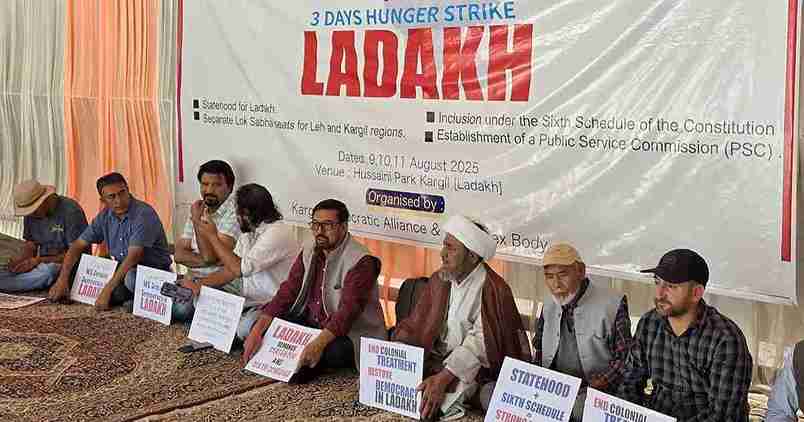
The Kargil Democratic Alliance (KDA), a coalition of political, religious, social, and trade organizations, alongside the Leh Apex Body (LAB), commenced a three-day hunger strike at Hussani Park in Kargil town on Saturday, August 9, 2025, to press for their long-standing demands for statehood, inclusion under the Sixth Schedule of the Indian Constitution, separate Lok Sabha seats for Kargil and Leh, and the establishment of a dedicated Public Service Commission (PSC) for Ladakh. The protest, set to conclude with a massive public rally on August 11, reflects growing frustration with the central government’s delays in addressing these demands, despite repeated assurances over the past five years.
Background of the Agitation
Since the abrogation of Article 370 in August 2019, which led to the bifurcation of Jammu and Kashmir into two Union Territories, Ladakh has been governed directly by the central government without a legislative assembly. While some initially welcomed the Union Territory status for its potential to drive development, many Ladakhis now feel disenfranchised due to the lack of local governance and legislative autonomy. The KDA and LAB, representing the diverse communities of Kargil (predominantly Shia Muslim) and Leh (largely Buddhist), have united over a four-point agenda to address these concerns:
- Statehood for Ladakh: Restoration of a legislative assembly to grant law-making powers and administrative autonomy.
- Sixth Schedule Inclusion: Constitutional safeguards to protect Ladakh’s tribal identity, land ownership, and cultural heritage through Autonomous District Councils (ADCs).
- Separate Lok Sabha Seats: Dedicated parliamentary representation for Kargil and Leh to ensure regional voices in national governance.
- Public Service Commission: A dedicated PSC to facilitate local recruitment and address unemployment in the region.
The two groups have been spearheading protests, including strikes, marches, and hunger strikes, since 2019, engaging in multiple rounds of talks with the Ministry of Home Affairs’ High-Powered Committee (HPC). However, the lack of progress on core demands—particularly statehood and Sixth Schedule status—has fueled discontent, culminating in the current hunger strike.
The Hunger Strike: A Call for Action
The three-day hunger strike began at 10 AM on August 9 at Hussani Park, a symbolic venue in Kargil, and is scheduled to run daily until 4 PM on August 11, concluding with a public rally to announce the next phase of the agitation. The protest has drawn significant participation from local residents, with prominent leaders such as KDA co-chairman Asgar Ali Karbalai, KDA leader Sajjad Kargili, KDA co-chairman Qamar Ali Akhoon, Member of Parliament for Ladakh Mohd Hanifa Jan, Chief Executive Councillor (CEC) Kargil Dr. Mohd Jaffar, and former CEC Feroz Ahmad Khan in attendance.
Protesters displayed large banners proclaiming, “Together, we can build a future where Ladakh governs Ladakh,” alongside placards with slogans like “End colonial treatment, restore democracy” and “Statehood – Sixth Schedule and strong Ladakh.” The event also featured cultural performances highlighting Ladakh’s unique heritage and speeches emphasizing the need for constitutional protections to safeguard the region’s fragile ecology and indigenous identity.
Asgar Ali Karbalai, addressing the gathering, accused the central government of employing “delaying tactics” despite promises made during a May 2025 meeting with Minister of State for Home Affairs Nityanand Rai and the Home Secretary. “We were assured that discussions on statehood and the Sixth Schedule would begin within a month, but no progress has been made. This forced us to launch this hunger strike,” Karbalai said, emphasizing the peaceful and democratic nature of the protest. He warned that the entire Ladakh region is prepared to escalate the agitation if the government fails to respond, with the KDA and LAB core committees set to meet soon to plan further actions.
Sajjad Kargili, another prominent KDA leader, echoed these sentiments, criticizing the government for failing to honor its commitments. “This colonial treatment must end, and democracy should be restored in Ladakh,” he said, urging immediate implementation of the Sixth Schedule to protect the region’s tribal communities and resources. Kargili stressed that the protest aims to unite Ladakh’s diverse communities, with an open invitation extended to LAB leaders to join the strike and present a unified front.
Historical Context and Previous Protests
The current hunger strike builds on a history of activism in Ladakh. In March 2024, climate activist Sonam Wangchuk led a 15-day hunger strike in Leh to highlight the region’s ecological concerns and demand Sixth Schedule protections. On March 20, 2024, the KDA organized a half-day strike and rally from Fatima Chowk to Hussani Park, with thousands participating in solidarity with Wangchuk’s protest. Shops and businesses shut down, and slogans echoed demands for statehood and constitutional safeguards. Wangchuk, in a video message during that protest, emphasized the impact of global warming and industrial activities on Ladakh’s glaciers, warning that their loss could render locals “climate refugees” and disrupt water supplies across northern India.
Despite multiple rounds of talks with the HPC, the KDA and LAB have expressed frustration over the government’s rejection of statehood and Sixth Schedule demands in March 2024, with the Centre citing a delimitation freeze until 2026 as a barrier to granting separate Lok Sabha seats. Issues related to domicile, reservations, and recruitment were reportedly resolved in earlier discussions, leaving statehood and the Sixth Schedule as the primary unresolved demands.
Broader Implications
The hunger strike carries significant implications for Ladakh and India’s federal structure. Ladakh’s strategic location, unique ethnic composition, and ecological fragility make its demands for autonomy and constitutional protections particularly urgent. The Sixth Schedule, currently applicable to tribal areas in Northeast India, would grant Ladakh’s communities control over land, resources, and cultural preservation, addressing fears of demographic shifts and environmental degradation due to unchecked development.
The protest also tests India’s commitment to inclusive governance and federalism, particularly in regions with distinct cultural identities. Political analysts, such as constitutional scholar Dr. Tashi Namgyal, have called the Sixth Schedule “a necessity, not a privilege” for Ladakh, arguing that the hunger strike is a legitimate democratic tool to demand constitutional rights. The movement has garnered support from figures like Communist Party of India-Marxist leader Mohammed Yousuf Tarigami, who emphasized the shared history and aspirations of Ladakh’s people and urged the government to address their grievances promptly.
Media and Public Engagement
The KDA and LAB have employed a robust media strategy to amplify their message, including live social media coverage, press releases, and hashtag campaigns such as #LadakhDemandsJustice and #KargilHungerStrike. Video documentaries and opinion pieces are also being produced to educate the public and pressure policymakers. The protest’s call for unity between Kargil and Leh aims to transcend historical regional and religious divides, fostering a collective identity in the fight for Ladakh’s rights.
What’s Next?
The hunger strike, concluding on August 11 with a public rally, is expected to draw thousands from across Ladakh, with organizers inviting participation from all communities. The KDA and LAB leadership plan to meet post-rally to outline the next phase of the agitation, which could include escalated protests if the government does not resume dialogue. The movement’s success hinges on its ability to maintain public momentum and pressure the Centre to act on its promises.
As Ladakh stands at a crossroads, the hunger strike serves as a powerful reminder of the region’s demand for dignity, autonomy, and constitutional recognition. The coming days will be critical in determining whether the voices of Ladakh’s people are heard or sidelined.
Click Here To Follow Our WhatsApp Channel
You Might Also Like:
CRPF Trooper Dies by Suicide in Anantnag, Police Launch Inquest
Kashmir’s 2025 Food Safety Crackdown: 3,500 kg Rotten Meat Seized
Huma Qureshi’s Cousin Asif Qureshi Murdered in Delhi Parking Dispute, Two Arrested
Kashmir Administration Officially Banned 25 Books including Maulana Maududi’s Al-Jihad fil Islam