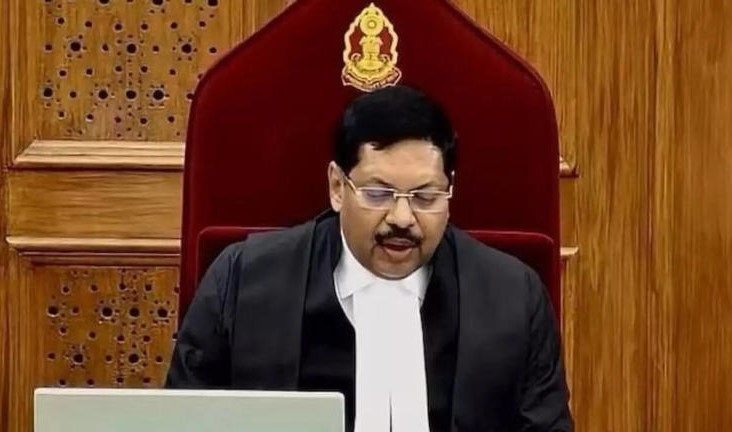
In a shocking moment of drama inside India’s Supreme Court, a lawyer attempted to hurl a shoe at Chief Justice of India (CJI) B.R. Gavai during court proceedings on Monday morning. The man, dressed in a lawyer’s robe, shouted slogans protesting what he called an “insult to Sanatan Dharma” before being swiftly removed by security. CJI Gavai stayed calm and composed, urging everyone to stay focused and not get distracted.
The incident, which lasted just a few minutes, has sparked widespread debate on social media and among legal circles. It comes just days after CJI Gavai’s remarks in a temple restoration case drew criticism for allegedly hurting religious feelings. Here’s a detailed look at what unfolded, why it happened, and the reactions so far.
The Shocking Courtroom Incident
The episode took place around 10:30 AM in Courtroom No. 1, where a bench led by CJI Gavai and Justice K. Vinod Chandran was hearing urgent mentions of cases by lawyers. According to eyewitnesses and reports from legal portals like Bar and Bench and Live Law, the lawyer – identified as Rakesh Kishore – suddenly approached the judge’s dais (the raised platform where the judges sit).
Dressed in a black coat and band typical of advocates, Kishore appeared agitated. He began removing one of his shoes, seemingly preparing to throw it towards CJI Gavai. Some witnesses said he also tried to hurl a rolled-up paper. Before he could act, alert security personnel and court staff rushed forward, restrained him, and escorted him out of the courtroom.
As he was being dragged away, Kishore raised his voice, shouting repeatedly: “Sanatan ka apmaan nahi sahenge” (We will not tolerate the insult to Sanatan Dharma). He also yelled variations like “Sanatan Dharma ka apmaan nahi sahega Hindustan” (India will not tolerate disrespect to Sanatan Dharma). The outburst caused a brief halt in proceedings, with lawyers and staff looking on in stunned silence.
The entire disruption lasted less than five minutes. Once order was restored, the bench continued with the day’s agenda without further ado.
CJI Gavai’s Calm and Collected Reaction
What stood out most was CJI Gavai’s poise under pressure. The 65-year-old judge, who took over as CJI in August 2025, did not raise his voice or show anger. Instead, he addressed the courtroom with a steady tone: “Don’t get distracted by all this. These things do not affect me.”
In another remark reported by those present, he added: “We have seen this… Let’s focus on the work at hand.” His words helped de-escalate the tension, and proceedings resumed smoothly. CJI Gavai’s response has been praised by many in the legal fraternity as a model of judicial dignity. One senior advocate told ANI: “In a heated moment, the CJI showed why he’s the leader of the judiciary – unflappable and professional.”
This isn’t the first time CJI Gavai has faced public scrutiny, but his handling of the incident has won him admirers even from those who disagree with his past comments.
The Trigger: Controversy Over a ‘Deity’ Remark in Temple Case
The lawyer’s outburst wasn’t random – it was a direct protest against CJI Gavai’s observations in a recent Supreme Court hearing on October 2, 2025. The case involved a public interest litigation (PIL) filed by advocate Rakesh Dalal, seeking the reconstruction and reconsecration of a damaged 7-foot-tall idol of Lord Vishnu at the ancient Javari Temple in Chhatarpur district, Madhya Pradesh.
The temple is part of the UNESCO-listed Khajuraho group of monuments, protected by the Archaeological Survey of India (ASI). The idol, believed to be from the 11th century, was reportedly beheaded and damaged over time. Dalal argued that as a “staunch devotee,” he wanted the idol restored to its original form to preserve Hindu heritage.
Dismissing the plea as “purely publicity interest litigation,” the bench refused to entertain it. CJI Gavai made a light-hearted but pointed remark: “Go and ask the deity itself to do something now. You say you are a staunch devotee of Lord Vishnu. So go and pray now. It’s an archaeological site and ASI needs to give permission etc.”
He emphasized that courts can’t interfere in matters of faith without proper procedure, adding that the legal system follows the rule of law, not “bulldozer justice.” The bench suggested the petitioner approach the ASI or lower courts first.
While meant as a procedural dismissal, the “go ask your deity” line went viral on social media. Critics, including some Hindu right-wing groups and online influencers, accused CJI Gavai of mocking Sanatan Dharma (the eternal Hindu way of life) and belittling devotees. Memes and posts flooded platforms like X (formerly Twitter), with hashtags like #CJIInsultsSanatan trending briefly.
Two days later, on October 4, CJI Gavai addressed the backlash in open court. He clarified: “I respect all religions. This happened on social media… Judicial activism must not become overreach.” He stressed that his words were not intended to hurt sentiments and reiterated his personal faith as a practicing Hindu.
Delhi Police, who took custody of Kishore after the incident, confirmed during initial questioning that the lawyer was “unhappy with the CJI’s remarks” in the Vishnu idol case. Kishore, a member of the Supreme Court Bar Association since 2011, has no prior record of such behavior, but the Bar has condemned the act as “sad and unacceptable.”
Aftermath: Police Action, Bar’s Response, and Broader Debate
- Legal Consequences: Kishore was handed over to Delhi Police and is being questioned for attempted assault and contempt of court. Under Supreme Court rules, disrupting proceedings can lead to fines, suspension, or even disbarment. The Bar Council of India has been informed, and an internal probe is underway.
- Bar Association’s Stance: The Supreme Court Bar Association issued a statement: “If a lawyer has committed or attempted to commit assault in a court, we strongly condemn it. He is a member of our bar… But it is a very sad incident.” They vowed to cooperate with authorities while emphasizing that protests must stay peaceful.
- Security Review: The Supreme Court has ramped up checks at entry points. CJI Gavai’s bench often hears high-profile cases, and this incident has prompted a review of courtroom security protocols.
The event has reignited discussions on free speech vs. courtroom decorum, the role of religion in judgments, and social media’s influence on the judiciary. Senior advocate and BJP leader Mahesh Jethmalani tweeted: “While the act is condemnable, it shows how deeply remarks can wound. Judiciary must tread carefully on faith matters.” On the other hand, constitutional expert Sanjay Hegde called it “an attack on institutions,” urging lawyers to channel grievances through proper channels.
What This Means for the Judiciary
India’s Supreme Court, as the guardian of the Constitution, deals with sensitive issues like religion, heritage, and rights daily. Incidents like this highlight the pressures on judges, especially when faith intersects with law. CJI Gavai, known for his “rule of law” mantra, has previously ruled against extrajudicial actions, like in bulldozer demolitions during communal tensions.
As investigations continue, the focus remains on restoring normalcy. For now, the Supreme Court marches on – a testament to the resilience CJI Gavai embodied in those tense moments. Will this lead to stricter guidelines on religious pleas or more sensitivity in benches? Only time will tell.
You Might Also Like:
Watch Dr. Tariq Rasool’s Message to Kashmir’s Apple Orchard Owners: Diseases, Causes
After Three Weeks of Restrictions, Mirwaiz Umar Farooq Addresses Congregation at Jama Masjid