Amir of Qatar Tamim Bin Hamad Al-Thani to Visit India for Bilateral Talks on February 17-18

Tamim Bin Hamad Al-Thani

Amir of Qatar, Tamim Bin Hamad Al-Thani, will pay a state visit to India on February 17-18 at the invitation of Prime Minister Narendra Modi, the Ministry of External Affairs (MEA) announced on Saturday.

The statement noted that the Amir will be accompanied by a high-level delegation, including Ministers, senior officials, and a business delegation. This will be his second visit to India, the first being in March 2015.

The Amir will be accorded a ceremonial welcome at Rashtrapati Bhawan on February 18. During his visit, he will hold discussions with President Droupadi Murmu, who will also host a banquet in his honour. He will also hold talks with Prime Minister Narendra Modi, covering bilateral relations, trade, investment, energy, and regional issues, the MEA mentioned.

India and Qatar have deep-rooted historical ties of friendship, trust and mutual respect.

Earlier this year, External Affairs Minister S Jaishankar visited Doha for his first diplomatic engagement of 2025, where he met Qatar’s Prime Minister and Foreign Minister Mohammed bin Abdulrahman Al Thani

Following the meeting in a post on X, Jaishankar said, “I am Delighted to meet PM and FM Mohammed bin Abdulrahman Al Thani in Doha today. This is my first diplomatic engagement in 2025. We will have a productive review of our bilateral cooperation and a wide-ranging discussion on recent regional and global developments.”

In recent years, the ties between the two countries including in the areas of trade, investment, energy, technology, culture and people-to-people ties have continued to strengthen, the MEA noted.

Further, the MEA in its statement added that the Indian community residing in Qatar forms the largest expatriate community of Qatar, and is appreciated for its positive contribution in the progress and development of Qatar. The visit of the Amir will provide further momentum to our growing multifaceted partnership. (ANI)

Humza Yousaf Condemns Trump’s Gaza Plan as “Ethnic Cleansing” and Criticizes Elon Musk’s Influence

Humza Yousaf

Humza Yousaf, the former Scottish First Minister, has been a vocal critic of both US political decisions and influential figures, including former President Donald Trump and billionaire entrepreneur Elon Musk. In a revealing interview with Al Arabiya News, Yousaf addressed two key topics: the controversial proposal by Trump to relocate Palestinians from Gaza and the growing influence of Musk on Western politics. His strong statements on these issues underline his concerns about racial injustice, the fragility of the Gaza ceasefire, and the impact of concentrated wealth on democratic systems.

Trump’s Gaza Plan and “Ethnic Cleansing”

One of the most significant comments made by Yousaf during his interview was his condemnation of Donald Trump’s proposal to relocate Palestinians from Gaza, labeling it as the “textbook definition of ethnic cleansing.” This remark came in response to a question about whether he believed Trump’s plan met the criteria for ethnic cleansing, given its aim to forcibly move Palestinians out of their homeland.

Trump’s proposal, which suggested relocating Palestinians from Gaza to other Arab countries, sparked global outrage and controversy. Yousaf was unequivocal in his criticism, emphasizing that such a move would forcefully displace an entire population, leading to an erasure of their history, identity, and cultural ties to the region.

“It’s the very textbook definition of ethnic cleansing,” Yousaf said, stressing the dire implications for the Palestinian people. He further expressed concerns about the international community’s failure to confront the issue head-on, particularly Western governments’ reluctance to label Trump’s plan as such.

Yousaf also expressed his unease regarding the fragility of the ceasefire between Israel and Hamas that had taken effect on January 19, noting that it was at significant risk of collapse. He warned that if the truce failed, innocent civilians would be the ones to suffer, rather than militants or terrorists. His remarks reflected a deep concern for the humanitarian crisis in Gaza and the ongoing conflict that continues to devastate the region.

Systemic Racism and Western Inaction

A major theme in Yousaf’s interview was the criticism of Western leaders for their failure to call out Trump’s Gaza plan as ethnic cleansing, something he attributed to entrenched racism. Yousaf argued that the global response would have been vastly different if Russian President Vladimir Putin had proposed a similar plan for Ukrainians, highlighting what he sees as a stark double standard.

“If the last 16 months have taught us anything, the stark reality is that Palestinian lives, Arab lives are not equal to the lives of Europeans and those in the West,” Yousaf stated. “And that is entrenched in systemic, institutionalized racism.”

This statement underscores Yousaf’s belief that the international community, particularly Western governments, fails to treat Palestinian lives with the same value and urgency as lives in Europe or the West. He pointed out that racism continues to shape political discourse and global policies, which leads to disproportionate reactions to crises involving marginalized communities.

Furthermore, Yousaf criticized the British government’s stance on the Israel-Palestine conflict. He accused London of being “complicit” in Israel’s military actions against Gaza through its continued arms sales to Israel. Yousaf’s remarks reflected growing frustration with what he perceives as a lack of accountability and moral leadership in addressing the situation.

Support for Palestinian Statehood

In addition to his condemnation of Trump’s Gaza plan, Yousaf also voiced his support for the recognition of Palestine as a sovereign state. He expressed frustration with countries that have not yet recognized Palestine as a state, arguing that this refusal undermines the legitimacy of any proposed two-state solution. He emphasized that the two-state solution cannot be a meaningful path forward if one of the states—the Palestinian state—is not even recognized by the international community.

Yousaf asserted that if Scotland had the legal authority to do so, it would recognize Palestine as an independent state. “You can’t say that you agree with a two-state solution but only choose to recognize one state,” he said, further highlighting the hypocrisy he perceives in international politics.

Elon Musk: The Most Dangerous Man on the Planet

While Yousaf’s comments on the Israel-Palestine conflict were significant, his remarks on Elon Musk, the CEO of Tesla and SpaceX, were perhaps even more provocative. Yousaf previously referred to Musk as “the most dangerous man on the planet,” and in his recent interview, he explained the reasoning behind this statement.

Yousaf’s criticism of Musk centers around the billionaire’s immense wealth and influence, particularly how it enables him to gain access to political leaders and sway public opinion. “I called him the most dangerous man on the planet given he was using his billions to buy unfettered access to arguably the most powerful man in the world—the president of the United States,” Yousaf explained.

Yousaf’s concern lies in the way Musk has leveraged his wealth and platforms to amplify far-right ideologies and influence political decisions. He accused Musk of aligning with far-right groups and holding White supremacist sympathies. This is particularly troubling for Yousaf, who sees Musk’s influence as a threat to the values of democracy and equality.

“Not only is Elon Musk Islamophobic, I think he is somebody who clearly has White supremacist, far-right sympathies,” Yousaf stated, further intensifying the critique. He also criticized Musk for his public attacks on British Prime Minister Keir Starmer and warned that the rise of far-right ideologies poses a significant threat to Western democracy.

The Rise of the Far-Right and the Threat to Democracy

Yousaf’s critique of Musk goes beyond personal attacks. He sees Musk’s influence as part of a broader, dangerous trend—the rise of far-right ideologies and anti-Muslim hatred. Yousaf believes that if this trend continues unchecked, Western democracy could face a serious collapse.

“The rise of the far-right, which is driven by predominantly anti-Muslim hatred, if we continue to allow this rising tide of the far-right to continue, if we don’t confront it, if we don’t confront those who support it, influence it and amplify it like Elon Musk, then I think western democracy is under threat of complete collapse,” Yousaf warned.

His concerns about Musk’s influence extend to the way billionaires can manipulate political systems. Yousaf questioned how true democracy can exist when wealthy individuals like Musk have the power to sway elections and political outcomes.

“How on earth can we have a true democracy when oligarchs like Elon Musk can buy elections?” Yousaf asked. “How can we have a democracy when the world’s richest man – through his money, wealth, platforms, influence – can overthrow or attempt to overthrow democratically elected heads of government?”

Conclusion

Humza Yousaf’s interview highlighted two of the most pressing issues of our time: the plight of the Palestinian people and the rising influence of powerful billionaires like Elon Musk. His condemnation of Trump’s Gaza plan as ethnic cleansing and his warning about the dangers of far-right ideologies and the manipulation of democracy by wealthy elites provide a powerful commentary on the state of global politics.

Yousaf’s call for greater recognition of Palestinian statehood, his criticism of Western leaders’ inaction, and his concerns about the future of democracy in the face of powerful corporate interests are reminders of the ongoing struggles for justice, equality, and political accountability in today’s world. His words are a call to action, urging both governments and individuals to confront these issues head-on and work toward a more equitable and just future for all.

Afghan Asylum Seeker Drives Into Munich Germany Crowd Ahead of Security Conference, 28 Injured

Afghan Asylum Seeker Drives Into Munich Germany Crowd Ahead of Security Conference, 28 Injured

Some 28 people were injured when a 24-year-old Afghan asylum seeker drove a car into a crowd of people in Munich in what the state premier said was probably an attack on Thursday, as the German city prepared to host a top-level security conference.

Police in the southern city said a car approached police vehicles stopped by a demonstration held by the Verdi union before speeding up and hitting people.The suspected attack throws security back into the spotlight before a federal election next week following several other violent attacks.

It also came hours before leading international figures, including US Vice President JD Vance and Ukrainian President Volodymyr Zelenskiy, were in the city for the high-profile Munich Security Conference, which starts on Friday.

“It was probably an attack,” Bavaria state premier Markus Soeder told reporters.Bavaria’s interior minister said he did not suspect there was a connection to the conference.Police said they had detained the driver and did not consider him to pose any further threat.

A passer-by said he witnessed the incident from a window of a neighbouring office building. The car, a Mini Cooper, had threaded its way between the police vehicles and then accelerated, he said.Another witness said she had seen part of the incident from a building. The car had accelerated and hit several people in the crowd, she said.

People in the crowd were taking part in a strike held by the Verdi public sector workers’ union whose leader, Frank Werneke, expressed shock but said he had no further details.Police set up a gathering point for witnesses in the Loewenbraeukeller, one of Munich’s oldest beer halls.The incident occurred around 1.5 kilometres (1 mile) from the security conference venue.

Turkish President Erdogan Arrives in Islamabad for Official Visit to Strengthen Pakistan-Turkey Relations

Turkiye President Erdogan

Turkish President Erdogan has landed in Islamabad on a two-day official visit at the invitation of Prime Minister Shehbaz Sharif.The Turkish president was warmly welcomed by top Pakistani officials at the Nur Khan Airbase in Rawalpindi in the wee hours of Thursday.

Upon his arrival, President Erdogan was greeted by Pakistan’s President Asif Ali Zardari, Prime Minister Shehbaz Sharif, First Lady Aseefa Bhutto, Deputy Prime Minister and Foreign Minister Ishaq Dar, Defence Minister Khawaja Muhammad Asif, Information Minister Attaullah Tarar, and other senior government figures.

A ceremonial 21-gun salute marked the Turkish leader’s arrival. Earlier, the Pakistan Air Force jets escorted his aircraft into the country’s airspace.President Erdogan, who was accompanied by a high-level delegation, was also joined by his wife, the First Lady of Turkiye.

Two children, attired in traditional dresses presented bouquet to the Turkish President and the First Lady.The airport reception also featured a performance by a military band, while children waved the flags of Pakistan and Turkiye, symbolising the strong ties between the two nations. 

His visit includes high-level engagements aimed at strengthening bilateral relations and economic cooperation between Pakistan and Türkiye.

President Erdogan arrived in the Pakistani capital accompanied by a high-level delegation comprising ministers, senior officials, and corporate leaders. He will be accorded a warm welcome upon arrival.

The visit comes days after President Asif Ali Zardari met President Erdogan during a brief stop at Istanbul Airport in Turkiye.In their meeting, the two leaders exchanged cordial remarks and discussed bilateral relations and matters of mutual interest.

During his visit, the Turkish president will co-chair the seventh meeting of the Pakistan-Turkiye High-Level Strategic Cooperation Council (HLSCC) alongside PM Shehbaz.

The meeting will conclude with a joint declaration, and several key agreements and Memorandums of Understanding (MoUs) are expected to be signed. The two leaders will also address a joint press conference.Additionally, President Erdogan will hold separate meetings with the prime minister and President Zardari.

He is also set to speak at the Pakistan-Turkiye Business and Investment Forum, which will be attended by leading investors, companies, and business figures from both countries.

The HLSCC is the highest decision-making platform between Pakistan and Türkiye, providing strategic direction to bilateral relations. It oversees multiple joint standing committees focused on trade, investment, banking, finance, culture, tourism, energy, defence, agriculture, transport, communications, IT, health, science and technology, and education.

Six HLSCC meetings have been held so far, with the last one taking place in Islamabad on 13-14 February 2020.Pakistan and Turkiye share historic and brotherly ties. President Erdogan’s visit and the seventh HLSCC session will further deepen these relations and enhance multi-dimensional cooperation between the two nations.

DeepSeek AI Models Offer Hope for Chinese Chipmakers to Compete with US Processors

Chinese deepseek

The rise of DeepSeek’s artificial intelligence (AI) models is seen providing some Chinese chipmakers such as Huawei a better chance to compete in the domestic market against more powerful US processors.

Huawei and its Chinese peers have for years struggled to match Nvidia in building top-end chips that could compete with the US firm’s products for training models, a process where data is fed to algorithms to help them learn to make accurate decisions.

However, DeepSeek’s models, which focus on “inference,” or when an AI model produces conclusions, optimise computational efficiency rather than relying solely on raw processing power.

That is one reason why the model is expected to partly close the gap between what Chinese-made AI processors and their more powerful US counterparts can do, analysts say.

Huawei, and other Chinese AI chipmakers such as Hygon, Tencent-backed EnFlame, Tsingmicro and Moore Threads have in recent weeks issued statements claiming products will support DeepSeek models, although few details have been released.

Huawei declined to comment. Moore Threads, Hygon EnFlame and Tsingmicro did not respond to Reuters queries seeking further comment.

Industry executives are now predicting that DeepSeek’s open-source nature and its low fees could boost adoption of AI and the development of real-life applications for the technology, helping Chinese firms overcome US export curbs on their most powerful chips.

Even before DeepSeek made headlines this year, products such as Huawei’s Ascend 910B were seen by customers such as ByteDance as better suited for less computationally intensive “inference” tasks, the stage after training that involves trained AI models making predictions or performing tasks, such as through chatbots.

In China, dozens of companies from automakers to telecoms providers have announced plans to integrate DeepSeek’s models with their products and operations.

“This development is very much aligned with the capability of Chinese AI chipset vendors,” said Lian Jye Su, a chief analyst at tech research firm Omdia.

“Chinese AI chipsets struggle to compete with Nvidia’s GPU (graphics processing unit) in AI training, but AI inference workloads are much more forgiving and require a lot more local and industry-specific understanding,” he said.

Nvidia still dominates

However, Bernstein analyst Lin Qingyuan said while Chinese AI chips were cost-competitive for inferencing, this was limited to the Chinese market as Nvidia chips were still better even for inference tasks.

While US export restrictions ban Nvidia’s most advanced AI training chips from entering China, the company is still allowed to sell less powerful training chips that Chinese customers can use for inference tasks.

Nvidia published a blog post on Thursday about how inference time was rising as a new scaling law and argued that its chips will be necessary to make DeepSeek and other “reasoning” models more useful.

In addition to computing power, Nvidia’s CUDA, a parallel computing platform that allows software developers to use Nvidia GPUs for general-purpose computing, not just AI or graphics, has become a crucial component of its dominance.

Previously, many Chinese AI chip companies did not directly challenge Nvidia by asking users to abandon CUDA but instead, claimed their chips were compatible with CUDA.

Huawei has been the most aggressive in its efforts to break away from Nvidia by offering a CUDA equivalent called Compute Architecture for Neural Networks (CANN), but experts said it faced obstacles in persuading developers to abandon CUDA.

“Software performance of Chinese AI chip firms is also lacking at this stage. CUDA has a rich library and a diverse range of software capability, which requires significant long-term investment,” said Omdia’s Su.

Trump Announces Peace Talks as Putin and Zelensky Express Desire to End War in Ukraine

Trump

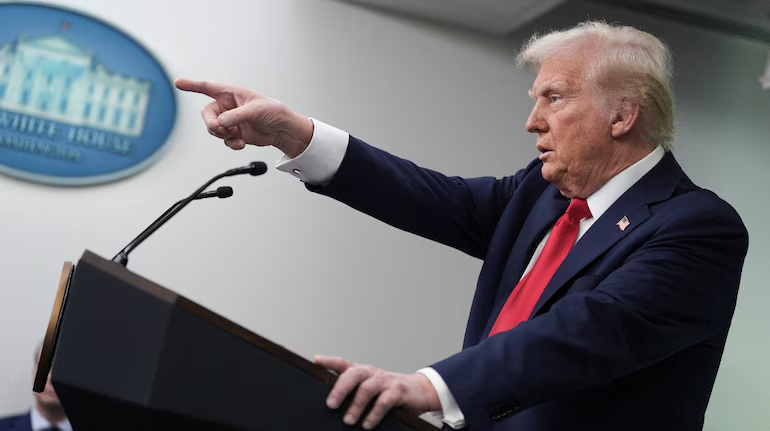
In a significant development, US President Donald Trump announced on Wednesday that Russian President Vladimir Putin and Ukrainian President Volodymyr Zelenskiy both expressed a desire for peace during separate phone calls, leading him to order top US officials to begin negotiations to end the war in Ukraine.

The development comes after Trump’s defence secretary indicated a major shift in Washington’s approach, saying that Kyiv must abandon its long-held goals of joining NATO and regaining territories seized by Russia.

The conversations came after Trump’s defence secretary earlier said Kyiv would have to give up its long-held goals of joining the NATO military alliance and regaining all of its territory seized by Russia, signalling a dramatic shift in Washington’s approach to the conflict.

After speaking with Putin for more than an hour, Trump said the Russian leader, who launched a full-scale invasion of Ukraine in 2022, wants the war to end, and they discussed “getting a ceasefire in the not-too-distant future.”

“He wants it to end. He doesn’t want to end it and then go back to fighting six months later,” Trump told reporters in the Oval Office.

“I think we’re on the way to getting peace. I think President Putin wants peace, President Zelenskyy wants peace, and I want peace. I just want to see people stop getting killed,” he added.

Trump has long said he would quickly end the war in Ukraine, without spelling out exactly how he would accomplish this.

The Kremlin earlier said Putin and Trump had agreed to meet, and Putin had invited Trump to visit Moscow. Trump said their first meeting would “probably” take place soon in Saudi Arabia.

In a post on his social media platform, he said Secretary of State Marco Rubio, CIA Director John Ratcliffe, National Security Adviser Michael Waltz, and Middle East envoy Steve Witkoff would lead negotiations on ending the war.

Trump and Zelenskyy spoke after Trump’s call with Putin, and Zelenskyy’s office said the conversation lasted for about an hour.

“I had a meaningful conversation with @POTUS. We… talked about opportunities to achieve peace, discussed our readiness to work together …and Ukraine’s technological capabilities… including drones and other advanced industries,” Zelenskyy wrote on X.

No Ukraine peace talks have been held since the early months of the conflict, now approaching its third anniversary. Trump’s predecessor, Joe Biden, oversaw billions of dollars of military and other aid to Kyiv and had no direct contact with Putin after Russia’s invasion.

Russia occupies around a fifth of Ukraine and has demanded Kyiv cede more territory and be rendered permanently neutral under any peace deal.

Ukraine demands Russia withdraw from captured territory and says it must receive NATO membership or equivalent security guarantees to prevent Moscow from attacking again.

‘Illusionary Goal’

Earlier on Wednesday, Defence Secretary Pete Hegseth delivered the new administration’s bluntest statement so far on its approach to the war, saying it was unrealistic for Kyiv to hope to recover all of Ukraine’s territory occupied by Russia since 2014, as was securing its membership in NATO.

“We want, like you, a sovereign and prosperous Ukraine. But we must start by recognising that returning to Ukraine’s pre-2014 borders is an unrealistic objective,” Hegseth told a meeting at NATO headquarters in Brussels. “Chasing this illusionary goal will only prolong the war and cause more suffering.”

Russia in 2014 annexed Crimea, which Ukraine and many Western countries consider to be occupied Ukrainian territory.

Hegseth said any durable peace must include “robust security guarantees to ensure that the war will not begin again”. But he said US troops would not be deployed to Ukraine as part of such guarantees.

Germany, France, Poland, Italy, Spain, the UK, and the European Union said in a joint statement Ukraine’s fate must not be decided without Kyiv’s active participation. They said they were ready to enhance support for Ukraine and put it in a position of strength.

Zelenskyy, hoping to keep Trump interested in continuing to support his country, has lately proposed a deal under which the United States would invest in minerals in Ukraine.

Trump’s Treasury Secretary Scott Bessent, in Kyiv on Wednesday on the first visit by a member of Trump’s cabinet, said such a mineral deal could serve as a “security shield” for Ukraine after the war.

Trump also said Rubio and Vice President JD Vance will hold talks about the war on Friday in Munich, where Ukrainian officials were expected to attend an annual security conference.

The new diplomacy followed a US-Russia prisoner swap that got under way on Tuesday, which the Kremlin said could help build trust between the two countries.

Russia on Tuesday freed American schoolteacher Marc Fogel, who was serving a 14-year sentence in a Russian prison, in exchange for a Russian cybercrime boss imprisoned in the US, according to an official

Meghan Markle and Prince Harry’s First Official Photo in Canada for Invictus Games Revealed

Meghan Markle and Prince Harry

The first official photo of Meghan Markle and Prince Harry has been released as they arrived in Canada for the Invictus Games. The photo, taken during the Opening Ceremony, was shared by the Invictus Games Foundation on X (formerly Twitter). Accompanied by a caption, the post read: “What a beautiful welcome to the competitors and their loved ones at the Family and Friends Reception at the Nation’s Home for #IG25!” The post also highlighted the tradition of participating nations coming together for a meal and to forge lasting friendships before the Opening Ceremony.

The photo marks a special moment for the couple, who are actively involved in supporting the Invictus Games and their competitors. Earlier reports revealed that Harry and Meghan arrived in Canada by private jet, flying in from Santa Barbara near their home in Montecito, California. The couple made their way to a five-star hotel in Vancouver ahead of the Games’ opening. Despite the long journey, Harry was all smiles as they arrived, showing excitement and support for the event.

Meghan and Harry’s visit to Canada comes as part of their continued efforts to champion the Invictus Games, an event founded by the Duke of Sussex to support wounded veterans. The couple’s presence in Canada also draws attention to their growing roles in various philanthropic endeavors, especially after relocating to North America. The couple’s warm reception at the event further emphasizes their commitment to both the Invictus Games and their broader charitable work.

Shocking! Do You Know Who Was Ex-Husband of Angelina Jolie

Angelina Jolie

During a Q&A session, the Angelina Jolie actress candidly discussed that she is still in contact with her former husband 26 years after their divorce.At the Santa Barbara International Film Festival, the Hollywood actress was shown a clip from her movie Hackers, which was released in 1995.

“I was just saying to somebody, it’s really funny because I think you’re starting with Hackers, right?” the two-time Oscar winner began by saying.Revealing that she is still in contact with her first ex-husband, Jonny Lee Miller, she continued, “Yeah, it’s Jonny. I just talked to him, I love that — I get to see my ex-husband with 2,000 people.”

Jolie and Miller starred in the crime-action movie, Hackers.“Amazing. It’s so nice to see it,” she said. “Actually, it’s funny, I don’t really watch my own films, and so I [don’t] think I’ve seen it since the premiere.”

Before concluding, the 49-year-old actress shared, “But I do have a wonderful relationship with Jonny, and he and I have sons the same age and I’m so happy.”For those unversed, the co stars tied the knot in 1996. After 18 month, Jolie filed for divorce from him.

Latifa Al-Droubi: The Secretive First Lady of Syria Who Just Shocked the World with Her Royal Appearances!

Latifa Al-Droubi

Latifa Al-Droubi, the wife of Syria’s interim government head Ahmad Al-Sharaa, has recently captured the public’s attention. Despite being largely unknown in public circles before, her presence alongside her husband on official visits to Saudi Arabia and Turkey has sparked media interest. This article delves into her background, family heritage, and her emerging role in Syria’s political landscape.

A Mysterious Public Debut

Latifa Al-Droubi first appeared in the public eye in early 2025 when she accompanied her husband, Ahmad Al-Sharaa, on official state visits. During their trip to Saudi Arabia, the couple performed Umrah, and the images from this religious pilgrimage quickly went viral on social media. Many people were curious about the identity of Syria’s First Lady, as little was known about her before these appearances.

Image Source Intagram

Following the Saudi visit, Ahmad Al-Sharaa and Latifa traveled to Turkey, where she met the Turkish First Lady, Emine Erdoğan. Their meeting focused on women’s empowerment, social cohesion, and education. The Turkish First Lady even shared a picture of their meeting on her official social media platform, further fueling public interest in Latifa Al-Droubi.

A Rich Historical and Religious Legacy

Latifa Al-Droubi hails from the historically significant Al-Droubi family, which has deep-rooted connections to Syria’s political and religious history. Her lineage can be traced back to the Ottoman era, making her a descendant of influential figures who played a role in shaping Syria’s past.

One of her most notable ancestors was Alaa Al-Din Al-Droubi, who served as Syria’s second prime minister in 1920 under King Faisal I. However, his tenure was tragically short-lived, as he was assassinated just 26 days after taking office. His legacy remains a crucial part of Syrian history, and Latifa’s connection to him adds to the intrigue surrounding her emergence on the national stage.

Latifa’s family is also known for its strong religious background. She is related to Sheikh Abdul Ghafar Al-Droubi, a revered Islamic scholar and Quranic reciter who passed away in Jeddah in 2009. This religious lineage adds to her influence, as she comes from a family respected for both its scholarly and political contributions.

Image Source / BBC URDU

Personal Life and Education

According to various reports, Latifa Al-Droubi was born in 1984 in the town of Al-Qaryatayn, located in the rural areas of Homs, Syria. She is a mother of three sons and holds a master’s degree in Arabic language and literature. This academic background suggests a deep appreciation for culture and heritage, which could shape her role as Syria’s First Lady.

Her husband, Ahmad Al-Sharaa, has revealed in interviews that due to political instability in Syria, they have had to live in remote areas, including mountainous regions, and frequently change residences. This challenging lifestyle has remained largely hidden from the public eye until now.

Social Media Buzz and Public Reactions

Since her first public appearance, Latifa Al-Droubi has become a trending topic on social media. Her images, particularly those from her visits to Saudi Arabia and Turkey, have led to widespread discussion. Some admire her elegance and presence, while others speculate about her influence in Syrian politics.

Discussions about her attire and public demeanor have also emerged, with some commentators debating whether she aligns more with conservative or modern ideals. However, others emphasize that her personal choices should not overshadow the significance of her role and background.

Latifa Al-Droubi’s Potential Role in Syria

Although little is known about her political stance or future ambitions, Latifa Al-Droubi’s heritage and recent public engagements suggest she may play a significant role in Syria’s evolving political and social landscape. If she chooses to take on an active role, she could focus on education, women’s rights, and cultural preservation, given her academic and familial background.

As Syria navigates its transitional phase, having a First Lady with strong historical ties and an intellectual background may serve as an asset to the administration. Whether she remains a reserved public figure or steps into an advocacy role remains to be seen.

Conclusion

Latifa Al-Droubi’s emergence as Syria’s First Lady has sparked widespread curiosity and debate. Coming from a historically and religiously significant family, she brings with her a legacy that intertwines with Syria’s past and present. As she takes on her new role, the world will be watching to see how she shapes her public image and contributes to Syria’s future.

Tunisian Court Sentences Rashid Al-Ghannouchi to 22 Years, Son to 35 Years, Daughter to 25 Years in Jail

Dr.Rashid Al-Ghannouchi

A Tunisian court has sentenced Rashid Al-Ghannouchi, the leader of the Ennahda Movement, to 22 years in prison on charges related to state security and alleged conspiracy against the government. Alongside him, his son Moaz Al-Ghannouchi has been given a 35-year prison sentence, while his daughter Soumaya Al-Ghannouchi has been sentenced to 25 years.

Background of the Case

The case dates back to October 2021, when Tunisian authorities launched an investigation into a company named “Anstalingo,” which specialized in content creation and digital communications. The authorities arrested several of its employees, including journalists, bloggers, freelancers, and politicians, accusing them of plotting against President Kais Saied and conspiring to undermine national security.

Investigations led to charges against multiple individuals, including Rashid Al-Ghannouchi and his family members. Authorities accused them of involvement in money laundering, exploiting professional and social networks for criminal activities, and attempting to alter the structure of the state. They were also charged with inciting violence, riots, and other unlawful acts within Tunisia.

Court Verdict and Sentences

The court handed down severe sentences to several high-profile figures in connection with this case:

  • Rashid Al-Ghannouchi – 22 years in prison
  • Moaz Al-Ghannouchi (his son) – 35 years in prison
  • Soumaya Al-Ghannouchi (his daughter) – 25 years in prison
  • Rafiq Bouchlaka (his son-in-law) – 34 years in prison
  • Hichem Mechichi (former Prime Minister) – 35 years in prison
  • Zouheir Loungou (former intelligence director) – 15 years in prison
  • Mohamed Ali Aroui (former Interior Ministry spokesperson) – 13 years in prison

Additionally, several journalists, bloggers, and media professionals were also given prison sentences in relation to the case.

Political Reactions and Implications

The sentencing of Rashid Al-Ghannouchi, a prominent opposition figure, has sparked strong reactions within Tunisia and beyond. His supporters argue that the trial was politically motivated and aimed at silencing opposition voices. Ennahda, the political movement he leads, has condemned the verdict, calling it an attack on democracy and freedom of expression.

International human rights organizations have also expressed concerns over the trial’s fairness, questioning whether due process was followed. Many observers believe that these verdicts reflect the increasing crackdown on political dissent in Tunisia under President Kais Saied’s rule.

Conclusion

The court’s decision marks a significant moment in Tunisia’s political landscape. With Rashid Al-Ghannouchi, his family members, and other key figures behind bars, the opposition faces a major challenge. Whether these sentences will stand or be overturned on appeal remains to be seen, but they undoubtedly add to the political turmoil in the country. As Tunisia continues to grapple with internal unrest and political uncertainty, the world will be watching how these events unfold.