Al-Ayyala Dance Sparks Backlash During Trump’s UAE Visit Over Cultural Norms and Religious Double Standards

Al-Ayyala Dance

A ceremonial dance meant to celebrate diplomacy has stirred deep controversy across parts of the Arab world. The Al-Ayyala dance, performed during former U.S. President Donald Trump’s visit to the United Arab Emirates (UAE) on May 15, 2025, has attracted both praise and sharp criticism, particularly on social media. While the UAE intended the performance to showcase its rich cultural heritage, critics—especially those from more conservative Islamic societies—see it as a symbol of double standards in religious and cultural enforcement.


What Is the Al-Ayyala Dance?

The Al-Ayyala is a centuries-old traditional performance widely practiced in the UAE and Oman. It involves rows of men chanting poetry and drumming in sync, while women, often dressed in long white gowns, perform rhythmic hair-flipping movements. The dance is recognised by UNESCO as intangible cultural heritage, symbolizing unity, hospitality, and tribal strength.

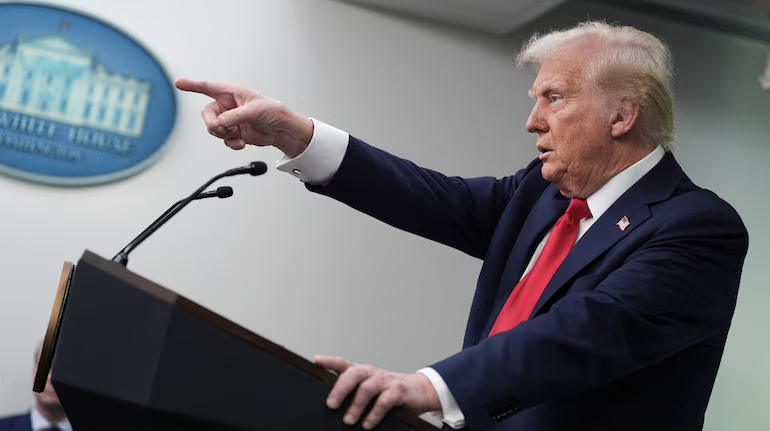
During Trump’s visit to Qasr Al Watan, the UAE’s presidential palace in Abu Dhabi, this dance was featured as part of a grand welcome ceremony. Footage of the event, including women flipping their uncovered hair in front of the former president, was widely circulated on social media by White House aides and local outlets.


Why the Backlash?

The performance received immediate backlash from conservative corners of the Arab world, particularly those aligned with Wahhabi-influenced interpretations of Islam, like Saudi Arabia and parts of Qatar. Critics pointed to what they see as hypocrisy and inconsistency in how Islamic and cultural norms are applied:

  • Strict rules for the public, flexibility for the elite: Many governments in the region, especially those influenced by Wahhabism, enforce strict modesty laws on everyday citizens. In countries like Saudi Arabia, women are expected to cover their hair in public and avoid public performances.
  • Cultural leniency for diplomacy: These same governments, however, appear to bend those rules when hosting foreign dignitaries. In this case, uncovered women performing in front of a male foreign leader was seen as contradictory to the religious values upheld domestically.

One viral post on X (formerly Twitter) described the performance as “a performance for the West, not for Islam.” Others called it “an embarrassment to Islamic values” or accused the UAE of “selling out tradition for political applause.”


The Wahhabi Context

Wahhabism, a strict interpretation of Sunni Islam originating in the 18th century, holds major influence in Saudi Arabia and, to a lesser extent, Qatar. It advocates for strict modesty, gender segregation, and public morality. Under such interpretations, public female performances—especially without hijab—are often viewed as religious violations.

In contrast, the UAE follows a more liberal interpretation of Islam, and it does not enforce hijab or restrict women’s public performances. However, the backlash stems not just from differences in theology, but from perceptions that Islamic values are applied unequally based on status, politics, or Western attention.


Trump’s Visit: A High-Stakes Diplomatic Stop

The context of Trump’s visit also added fuel to the controversy. The former U.S. President’s Middle East tour included major business deals—reportedly $100 billion in investments—and strategic discussions about Gulf security. His policies, especially toward Gaza and Iran, have drawn criticism from many in the region.

For critics, the UAE’s lavish welcome—including the Al-Ayyala dance—appeared to glorify a controversial Western figure while ignoring local sensitivities. Many questioned whether such a cultural performance would ever be allowed for the local public, especially if initiated by citizens rather than the state.


Cultural Heritage vs. Religious Norms

This event has reignited broader debates within Arab societies over the balance between cultural identity and religious conservatism.

  • Cultural Diplomacy: For the UAE, the Al-Ayyala dance is a diplomatic tool—showcasing national pride, unity, and modern openness.
  • Religious Integrity: For others, especially religious conservatives, such displays risk compromising Islamic values for the sake of political gain.

This divide is not new. Similar tensions arose during previous visits by Western leaders to Gulf countries, but Trump’s visit has become a flashpoint due to his polarizing global image and the scale of the performance.


Double Standards and Public Perception

Analysts point to a growing frustration across parts of the Arab world regarding double standards:

  • Elite exemption: Political elites and state-led events often bypass religious restrictions imposed on the public.
  • Selective enforcement: Cultural norms seem flexible when the global spotlight is on, but rigid in daily life.

This leads to public distrust and resentment, particularly among younger and more devout citizens who see a gap between official Islam and practical politics.


What Happens Next?

While the mainstream media in the region largely celebrated the event as a diplomatic success, online discourse suggests a widening generational and ideological rift. Whether the backlash leads to policy shifts or further cultural debates remains to be seen.

For now, the Al-Ayyala dance—meant to represent unity—has become a mirror reflecting the deep contradictions within Gulf societies as they navigate tradition, religion, diplomacy, and modernity.


Conclusion

The Al-Ayyala performance during Trump’s UAE visit was intended as a symbol of national pride and cultural hospitality. Instead, it has stirred a regional conversation on religious consistency, cultural authenticity, and political theatre. The criticism it sparked reveals that in many Arab societies today, how culture is performed—and for whom—matters as much as the culture itself.


Taliban’s Ibrahim Sadr in Delhi: Secret Visit Amid India-Pakistan Tensions Sparks Diplomatic Shockwaves

Taliban’s Ibrahim Sadr

In a stunning development that has sent shockwaves through diplomatic circles, Mullah Mohammad Ibrahim Sadr, a senior Taliban leader and acting Deputy Minister of Interior Affairs for Security in Afghanistan, reportedly made a clandestine visit to New Delhi around May 3, 2025. This secret trip, occurring just days after the deadly Pahalgam terror attack on April 22, 2025, and amidst the brief but intense 2025 India-Pakistan conflict, has sparked intense speculation about its motives and implications. Sadr, a hardline Taliban warlord known for his anti-Pakistan stance and close ties to Iran, is a key figure in the Taliban’s Kandahar faction. What was he doing in India during such a volatile period, and what secrets might he be hiding? This article delves into the context, significance, and potential motives behind Sadr’s mysterious visit, exploring its impact on regional geopolitics.

The Context: The 2025 India-Pakistan Conflict

The 2025 India-Pakistan conflict, a brief but high-stakes escalation, was triggered by the Pahalgam attack in Indian-administered Jammu and Kashmir, which killed 26 civilians, mostly Hindu tourists. The attack, claimed by The Resistance Front (TRF), an offshoot of Pakistan-based Lashkar-e-Taiba (LeT), intensified India’s accusations of Pakistan’s support for cross-border terrorism—allegations Pakistan vehemently denied. On May 7, 2025, India launched missile strikes on Pakistan under Operation Sindoor, targeting militant camps of Jaish-e-Mohammed and LeT. Pakistan claimed the strikes hit civilian areas, leading to border skirmishes and drone exchanges. A fragile ceasefire was announced on May 10, 2025, but mutual accusations of violations persisted, leaving the region on edge.

Amid this tense backdrop, India’s diplomatic maneuvers took an unexpected turn. Reports emerged that Sadr, a powerful Taliban figure, arrived in New Delhi, raising questions about India’s strategic outreach to the Taliban at a time when Pakistan-Taliban relations were deteriorating.

Who is Ibrahim Sadr?

Mullah Mohammad Ibrahim Sadr, born Khodaidad, is a formidable figure within the Taliban, known for his military prowess and hardline ideology. Hailing from Afghanistan’s Alakozai tribe in Kandahar province, Sadr fought as a mujahideen against Soviet forces during the Soviet-Afghan War (1979–1989). After the war, he taught in a madrassa in Peshawar, Pakistan, where students bestowed the title “Sadr” (meaning “president”). Joining the Taliban at its inception in 1994, he managed the group’s defense department during their 1996–2001 regime, overseeing Soviet-era aircraft and targeting enemies.

Following the 2001 U.S. invasion, Sadr became a key military strategist, orchestrating guerrilla tactics like suicide attacks and roadside bombings. His anti-Pakistan sentiment, fueled by Pakistan’s interference in Afghan affairs and the 2016 U.S. drone strike that killed his ally, Taliban leader Akhtar Mansour, made him a vocal critic of Islamabad. Sadr’s ties with Iran’s security apparatus and his wealth from opium and marble smuggling have bolstered his independence within the Taliban, making him both influential and controversial. As a close ally of Taliban supreme leader Hibatullah Akhundzada, he wields significant control over the group’s security apparatus.

The Secret Trip: What We Know

According to Indian media outlets like The Sunday Guardian and Republic World, Sadr arrived in New Delhi around May 3, 2025, just days after the Pahalgam attack and before India’s Operation Sindoor. Sources in Kabul, including an anonymous senior Taliban official, confirmed his presence, though neither the Indian government nor the Taliban issued official statements. The visit’s secrecy aligns with India’s cautious diplomacy and the Taliban’s preference for discreet international dealings.

Posts on X amplified the story, with users describing Sadr’s visit as a move that could “give Pakistani Generals viral fever,” highlighting his status as a trusted aide of Akhundzada and his anti-Pakistan stance. However, these posts, while reflecting public sentiment, remain inconclusive without official corroboration.

The timing of Sadr’s trip—during heightened India-Pakistan tensions and following India’s diplomatic outreach to Kabul—suggests a strategic motive. India’s Joint Secretary for Pakistan, Afghanistan, and Iran, M Anand Prakash, met Taliban Foreign Minister Amir Khan Muttaqi in Kabul on April 28, 2025, discussing regional developments and bilateral ties. This meeting, coupled with the Taliban’s condemnation of the Pahalgam attack, indicates a warming of India-Taliban relations.

What’s He Hiding? Potential Motives

Sadr’s secret trip has fueled speculation about its objectives. Several theories emerge based on regional dynamics and Sadr’s profile:

  1. Counterterrorism Cooperation: India may have sought Sadr’s assistance in addressing cross-border terrorism, particularly given his anti-Pakistan stance. With the Pahalgam attack linked to Pakistan-based groups, India could be exploring intelligence-sharing or joint efforts to curb militant activities emanating from Afghan soil. The Taliban’s condemnation of the attack and their strained relations with Pakistan over border disputes and refugee deportations make such cooperation plausible.
  2. Border Security and Regional Stability: The visit may have focused on securing Afghanistan’s borders to prevent militant infiltration into India, especially in Kashmir. Sadr’s control over the Taliban’s security apparatus positions him as a key player in such discussions. India’s condemnation of Pakistan’s air strikes on Afghanistan in early 2025, which killed civilians, aligns with the Taliban’s interests, creating a common ground for dialogue.
  3. Infrastructure and Economic Deals: India has a history of investing in Afghan infrastructure, such as the Chabahar Port in Iran, to bypass Pakistani ports. Sadr’s visit could involve negotiations for renewed Indian investment in Afghanistan, strengthening economic ties to counter Pakistan’s influence. The Taliban’s statement on expanding trade through Chabahar Port supports this theory.
  4. Backchannel Diplomacy Against Pakistan: Sadr’s anti-Pakistan sentiment and his influence within the Kandahar faction, which is wary of Pakistan’s sway, make him an ideal partner for India’s efforts to isolate Islamabad diplomatically. The visit could signal a strategic recalibration by New Delhi to engage with Taliban factions skeptical of Pakistan, especially as Pakistan-Taliban relations sour over issues like the Tehrik-i-Taliban Pakistan (TTP) insurgency.
  5. Internal Taliban Dynamics: The visit might reflect internal power struggles within the Taliban. Sadr’s independence and his rivalry with the Pakistan-aligned Haqqani faction could have prompted him to seek external allies like India to bolster his position. His trip may have been sanctioned by Akhundzada to explore new relationships, countering the Haqqani network’s reassurances to Pakistan.

While the exact agenda remains unclear, the visit likely involved a combination of these objectives, with India leveraging Sadr’s anti-Pakistan stance to advance its regional strategy.

Regional Implications

Sadr’s trip, if confirmed, has far-reaching implications:

  • India-Taliban Relations: The visit marks a significant shift in India’s approach to the Taliban, moving from cautious engagement to potential backchannel diplomacy with senior figures. This aligns with India’s recent meetings with Taliban leaders, including acting Defense Minister Mohammad Yaqub Mujahid in November 2024, and the appointment of a Taliban diplomat to the Afghan consulate in Mumbai.
  • Pakistan’s Isolation: Pakistan, once a key Taliban ally, faces growing estrangement due to border clashes, refugee expulsions, and the TTP insurgency. India’s outreach to the Taliban, particularly to anti-Pakistan figures like Sadr, could further corner Islamabad, undermining its “strategic depth” policy in Afghanistan.
  • Iran’s Role: Sadr’s ties with Iran, a regional player with influence over the Taliban, add complexity. India’s development of Chabahar Port and its condemnation of Pakistan’s strikes on Afghanistan align with Iran’s interests, suggesting a potential India-Iran-Taliban axis to counter Pakistan.
  • Geopolitical Buzz: The visit has created a “massive buzz” in diplomatic circles, as noted by Republic World, with speculation about India’s motives ranging from military coordination to economic partnerships. Pakistan’s military establishment, already jittery after the conflict, likely views this as a diplomatic coup by New Delhi.

What’s He Hiding?

The secrecy of Sadr’s visit fuels suspicion about hidden agendas. Is he concealing plans for a broader India-Taliban alliance against Pakistan? Could he be negotiating covert military or intelligence support to counter TTP or IS-Khorasan activities? Or is the visit a strategic bluff to unnerve Pakistan’s military brass? Without official confirmation, these questions linger, but Sadr’s hardline ideology and anti-Pakistan stance suggest his trip was not merely ceremonial. His history of close ties with Al-Qaeda and Iran raises concerns about the broader implications of his engagement with India, particularly for regional security.

Conclusion

Mullah Mohammad Ibrahim Sadr’s secret trip to India in May 2025, following the India-Pakistan conflict, is a geopolitical bombshell that underscores India’s bold diplomatic outreach to the Taliban. As a warlord with a storied past and a fierce critic of Pakistan, Sadr’s presence in New Delhi hints at a strategic alignment aimed at countering Islamabad’s influence. Whether the visit focused on counterterrorism, border security, economic deals, or backchannel diplomacy, it signals a new chapter in India-Taliban relations and a potential reshaping of regional dynamics. Until official details emerge, the question remains: what is Sadr hiding, and how will his visit alter the delicate balance of power in South Asia? One thing is certain—this clandestine move has left Pakistan’s generals on edge and the world watching closely.

Pakistan Signals Willingness to Discuss Indus Waters Treaty After India Suspends It Over Pahalgam Terror Attack

India Pakistan Flag

Pakistan has, for the first time, indicated a readiness to engage with New Delhi on the Indus Water Treaty.

India suspended the 1960 Indus Waters Treaty (IWT) in the wake of the April 22 terror attack in Pahalgam.Several media houses quoting official sources said that Pakistanís Water Resources Secretary, Syed Ali Murtaza, has responded to Indias formal communication regarding the suspension of the treaty.In his reply, Murtaza offered to hold discussions with India to address the specific provisions to which New Delhi had raised objections.

However, Murtazas communication also questioned the legal basis of Indias decision to unilaterally place the treaty in abeyance, noting that the agreement contains no exit clause.

This marks the first time Pakistan has signalled such willingness despite India issuing two earlier notices, one in January 2023 and another in September 2024, seeking a review and modification of the treaty. Islamabad had, until now, refrained from explicitly engaging with Indiaís concerns.

The shift comes after India suspended the treaty with ìimmediate effectî following the Pahalgam attack that killed 26 persons, mostly tourists.

In a letter dated April 24, just two days after the Pahalgam attack, Indian Express reported that Indiaís Water Resources Secretary Debashree Mukherjee conveyed the governmentís decision to her Pakistani counterpart.

ìThe obligation to honour a treaty in good faith is fundamental,î she wrote. ìBut what we have seen instead is sustained cross-border terrorism by Pakistan targeting the Jammu and Kashmir.î

Mukherjee argued that these security threats had directly impeded Indiaís ability to fully utilise its entitlements under the treaty.

ìPakistan has refused to respond to Indiaís request to enter into negotiations as envisaged under the treaty,î she said, accusing Islamabad of being in breach of its obligations. ìThe Government of India has hereby decided that the Indus Waters Treaty, 1960, will be held in abeyance with immediate effect.î

The Cabinet Committee on Security (CCS) on April 23 took this decision as part of a wider diplomatic and strategic response to the terror attack, including the downgrading of diplomatic ties with Pakistan.

On May 13, Ministry of External Affairs (MEA) spokesman Randhir Jaiswal reaffirmed Indiaís stance, underscoring the broader context of New Delhiís decision.

ìThe Indus Waters Treaty was concluded in the spirit of goodwill and friendship, Jaiswal said. ìHowever, Pakistan has consistently violated those principles through its support for cross-border terrorism. India will keep the treaty in abeyance until Pakistan credibly and irrevocably abjures its support for terrorism.î

He also pointed to evolving ground realities, citing ìclimate change, demographic shifts and technological changesî as factors necessitating a re-evaluation of the treaty.

The suspension of the treaty aligns with Prime Minister Narendra Modiís post-operation remarks, in which he declared, ìwater and blood cannot flow togetherî, a reference to Indiaís hardened stance following ëOperation Sindoorí.

Trump Tells Apple to Stop Building iPhones in India: What It Means for Apple, India, and U.S. Trade

Trump tells Apple

On May 15, 2025, U.S. President Donald Trump made headlines during a state visit to Qatar by urging Apple CEO Tim Cook to halt the company’s expanding manufacturing operations in India and shift iPhone production back to the United States. Trump’s directive, part of his broader “America First” trade policy, aims to boost domestic manufacturing and address high tariff barriers in countries like India. This move has sparked intense debate about its implications for Apple’s global supply chain, India’s ambitions as a manufacturing hub, and U.S.-India trade relations. This article explores the background, potential impacts, and broader consequences of Trump’s statement.

Background: Apple’s Manufacturing Shift to India

Apple’s manufacturing strategy has undergone significant changes in recent years, driven by geopolitical tensions, trade policies, and the need to diversify its supply chain. For nearly two decades, China was the epicenter of iPhone production, with over 80% of Apple’s products assembled there. However, U.S.-China trade tensions, exacerbated by tariffs as high as 145% on Chinese imports, prompted Apple to reduce its reliance on China. India emerged as a key alternative, offering lower tariffs (26% before a 90-day pause in April 2025) and a supportive government under Prime Minister Narendra Modi, which has provided production-linked incentives and proposed $2.7 billion in subsidies for electronics manufacturing.

In the fiscal year ending March 2025, Apple assembled $22 billion worth of iPhones in India, a 60% increase from the previous year. Foxconn, Tata Electronics, and Pegatron operate three factories in southern India, with two more under construction. In March 2025 alone, Apple exported nearly $2 billion worth of iPhones to the U.S., accounting for 97.6% of its Indian production. The company has reportedly planned to source all U.S.-bound iPhones from India by 2026, doubling its current output to over 60 million units annually. To preempt tariff hikes, Apple airlifted 600 tons of iPhones (approximately 1.5 million devices) to the U.S. in March 2025, using at least six cargo jets.

Trump’s Directive: Context and Motivation

Trump’s call to halt Apple’s Indian expansion aligns with his long-standing goal of repatriating manufacturing to the U.S. During his first term, he pressured Apple to produce iPhones domestically, though exemptions for smartphones softened the impact. In 2025, Trump reiterated this stance, criticizing India’s high tariff barriers, which he described as among the world’s highest, making it difficult to sell American products in India. He claimed India offered to drop tariffs on U.S. goods in ongoing trade negotiations, though details remain unclear.

Trump’s conversation with Cook, as reported by Bloomberg, included pointed remarks: “We are not interested in you building in India. India can take care of themselves.” He suggested that Apple would “up its production in the United States” following their discussion. The White House has cited Apple’s $500 billion investment commitment over the next four years, which includes servers for AI products, Apple TV productions, and 20,000 R&D jobs, as evidence of the company’s confidence in U.S. manufacturing. However, analysts note this investment does not explicitly include iPhone production.

Implications for Apple

Supply Chain Disruption

Apple’s pivot to India was a strategic response to U.S.-China trade tensions and the risks of over-reliance on a single manufacturing hub. Moving production to the U.S., as Trump demands, would disrupt this carefully calibrated strategy. Building new U.S. plants could take years and cost billions, given the complex supply chain Apple developed in Asia over decades. While India and Vietnam (which produces iPads and Apple Watches) face lower tariffs than China, U.S. production would likely increase costs due to higher labor wages and infrastructure expenses.

Cost and Pricing Pressures

Analysts estimate that an iPhone assembled in the U.S. could cost $3,500, compared to $1,008 in India or $938 in China for a $1,000 retail model. Such a price hike could erode Apple’s competitive edge in the U.S., its largest market, which accounted for 28% of global iPhone shipments in 2024. Even with tariffs, Apple has some flexibility to absorb costs, thanks to its high-margin services division, which generated $96 billion in revenue last year. However, prolonged tariffs or a forced U.S. shift could force Apple to raise prices, potentially dampening demand.

Strategic Realignment

Apple CEO Tim Cook, known as a “supply chain whisperer,” has navigated trade wars before. In 2025, Apple mitigated tariff impacts by ramping up Indian production and stockpiling inventory in the U.S. Cook’s recent earnings call emphasized diversification, stating, “Having everything in one location had too much risk.” Trump’s directive may push Apple to explore smaller-scale U.S. production (e.g., HomePods or AirTags) to secure tariff exemptions, but a full iPhone shift remains unlikely before 2028, according to Wedbush Securities analyst Dan Ives.

Implications for India

Setback for “Make in India”

India’s ambition to become a global manufacturing hub, championed by the “Make in India” initiative, relies heavily on Apple’s presence. The company’s $22 billion iPhone production in FY24 contributed to exports of nearly ₹1 lakh crore ($12 billion) between April and January 2025. Trump’s pressure threatens this momentum, as Apple’s potential retreat could deter other multinationals eyeing India as a China alternative. The Indian Electronics and Semiconductor Association has warned that U.S. tariffs, even at 26%, could disrupt trade flows and squeeze profit margins.

Economic and Employment Impacts

Apple’s Indian operations, primarily in Tamil Nadu and Karnataka, employ thousands directly and indirectly through suppliers like Foxconn and Tata. Foxconn’s Chennai plant, which produced 20 million iPhones in 2024, recently extended operations to Sundays to meet demand. A slowdown in Apple’s expansion could limit job creation and economic growth, particularly in southern India, where new factories are being built.

Trade Negotiations

Trump’s claim that India offered “zero tariffs” suggests ongoing bilateral trade agreement (BTA) talks could mitigate some pressures. India may leverage support from tech giants like Apple, Microsoft, and Google to strengthen its position in negotiations. However, India’s high tariffs on U.S. goods remain a sticking point, and any concessions could reshape its trade strategy.

Implications for U.S.-India Trade

Tariff Tensions

U.S.-India trade relations have been strained by reciprocal tariffs. The U.S. imposed a 26% tariff on Indian electronics in April 2025 (paused for 90 days), while India’s tariffs on U.S. goods average 13.5%. Trump’s rhetoric underscores his frustration with India’s trade barriers, but his acknowledgment of India’s tariff reduction offer signals potential for compromise. A successful BTA could lower tariffs and boost trade, but failure to reach an agreement may escalate tensions.

Broader Trade War Dynamics

Trump’s tariffs, targeting over 180 countries, aim to remake global trade by prioritizing U.S. manufacturing. While smartphones are currently exempt from the steepest tariffs, this could change, affecting Apple and other tech firms. India’s relatively lower tariffs compared to China (145%) and Vietnam (46%) give it an edge, but Trump’s push for domestic production could reduce India’s role as an export hub for U.S.-bound goods.

Economic Impacts

For the U.S., bringing iPhone production home could create jobs but risks higher consumer prices and reduced competitiveness for Apple. For India, maintaining its manufacturing appeal is critical to attracting foreign investment and sustaining export growth. The interplay of these dynamics will shape U.S.-India trade ties in the coming years.

Challenges and Uncertainties

Supply Chain Complexity

Even if Apple shifts assembly to the U.S., its reliance on Chinese components (e.g., processors, screens) means tariffs on parts could still inflate costs. Moving the entire supply chain, as some analysts suggest, could take decades and is considered “nearly impossible” by Bank of America analyst Wamsi Mohan.

Political and Policy Risks

Trump’s tariff policies are fluid, with exemptions and pauses creating uncertainty. His administration’s willingness to negotiate with India and China could alter the landscape, but political posturing may delay concrete outcomes. Apple’s earnings call on May 1, 2025, is expected to shed light on its tariff strategy and India’s long-term role.

Consumer Behavior

U.S. consumers, wary of price hikes, rushed to buy iPhones in early 2025, boosting Apple’s Q1 shipments by 10% to 57.9 million units. Sustained tariffs or U.S. production could shift demand, especially if competitors like Samsung, with more diversified supply chains, maintain lower prices.

Conclusion

Trump’s directive to stop Apple’s iPhone production in India is a bold move with far-reaching implications. For Apple, it threatens a carefully orchestrated supply chain diversification strategy, potentially raising costs and prices. For India, it jeopardizes ambitions to become a global manufacturing powerhouse, with economic and employment stakes. For U.S.-India trade, it highlights tensions over tariffs but also opens the door to negotiations. While Apple’s immediate response remains unclear, Tim Cook’s track record suggests a pragmatic approach, balancing compliance with global realities. As trade policies evolve, the tech giant’s next steps will shape not only its future but also the broader landscape of global manufacturing and U.S.-India relations.

Sources:

  • Bloomberg, “Trump Wants Apple to Stop Moving iPhone Production to India”
  • Reuters, “Apple airlifts 600 tons of iPhones from India ‘to beat’ Trump tariffs”
  • The Economic Times, “Trump wants Apple to stop moving iPhone production to India”
  • The Guardian, “Apple ‘aims to source all US iPhones from India’”
  • Times of India, “Apple’s China exodus: All US iPhones to be made in India by 2025”
  • Posts on X reflecting sentiment on Trump’s statement

Mukesh Ambani Joins Trump and Qatari Emir at Lusail Palace Dinner Amid Major U.S.-Qatar Economic Deals

Mukesh Ambani Joins Trump

On the evening of May 14, 2025, Mukesh Ambani, Chairman and Managing Director of Reliance Industries Limited, attended a grand state dinner at Lusail Palace in Doha, Qatar. Hosted by Qatar’s Emir, Sheikh Tamim bin Hamad Al-Thani, the event was held in honor of U.S. President Donald Trump, who was on a high-profile Middle East tour. The gathering marked Ambani’s second meeting with Trump since the latter’s return to the White House in January 2025, highlighting the Indian billionaire’s growing influence in global business and diplomatic circles.

A Star-Studded Diplomatic Affair

The state dinner, set against the opulent backdrop of Lusail Palace, was a convergence of global powerhouses from business, politics, and international organizations. Ambani was seen warmly greeting President Trump, engaging in a brief but animated conversation, and exchanging pleasantries with the Qatari Emir. He also interacted with U.S. Secretary of Commerce Steve Lutnick, signaling potential discussions around trade and investment opportunities. Other notable attendees included Tesla and SpaceX CEO Elon Musk, Boeing CEO Kelly Ortberg, and FIFA President Gianni Infantino. A London-based Indian business leader with close ties to both Trump and Qatar was also present, though their identity remained undisclosed.

The event was part of Trump’s broader Middle East itinerary, during which he announced a staggering $243.5 billion in U.S.-Qatar business deals. Key among these was a $96 billion order from Qatar Airways for Boeing aircraft, alongside a landmark $1.2 trillion economic exchange agreement aimed at strengthening bilateral ties. The dinner served as a platform to celebrate these agreements while fostering informal discussions among global leaders.

Ambani’s Strategic Presence

Mukesh Ambani’s attendance at the state dinner was no mere courtesy. Reliance Industries, India’s largest private-sector conglomerate, has deep and multifaceted ties with both the United States and Qatar, making his presence strategically significant. While no formal business meetings were scheduled, Ambani’s interactions with Trump and the Qatari Emir underscored Reliance’s role as a bridge between global markets.

Reliance’s retail arm, Reliance Retail, has received approximately $1 billion in investments from the Qatar Investment Authority (QIA), Qatar’s sovereign wealth fund, since 2023. This partnership has bolstered Reliance’s dominance in India’s retail sector, which includes brands like JioMart and partnerships with global luxury labels. In the energy sector, Reliance’s oil-to-chemicals business relies on global trade dynamics influenced by U.S. policies. For instance, Reliance benefited from U.S. waivers allowing Indian refiners to import Venezuelan crude oil until March 2025, when Trump’s administration imposed a 25% tariff, disrupting supplies. Additionally, Reliance exports significant volumes of refined fuel to the U.S. market, making its operations sensitive to American trade policies.

In the digital realm, Reliance Jio, India’s largest telecom provider, has forged partnerships with U.S. tech giants like Google and Meta. These collaborations have driven Jio’s growth in 5G technology and digital services, positioning Reliance as a key player in India’s tech ecosystem. Ambani’s engagement with Trump and U.S. officials at the dinner likely served to reinforce these ties, especially in light of Trump’s focus on strengthening U.S.-India economic relations.

Personal and Political Connections

The Ambani-Trump relationship extends beyond business, rooted in personal and familial connections. In March 2024, Ivanka Trump, Jared Kushner, and their daughter attended the pre-wedding festivities of Anant Ambani, Mukesh Ambani’s youngest son, in Jamnagar, India. The lavish event, which drew global attention, featured performances by international artists and was attended by luminaries like Bill Gates and Mark Zuckerberg. Ivanka’s presence, coupled with her warm interactions with the Ambani family, cemented a personal bond that has carried over into Trump’s second term.

This was Ambani’s second meeting with Trump in 2025, following a pre-inauguration dinner in the U.S. in January. The repeated engagements suggest a deliberate effort to maintain open channels with the Trump administration, which has prioritized trade deals and energy policies that directly impact Reliance’s operations. Similarly, Ambani’s handshake with Sheikh Tamim reflects Reliance’s commitment to nurturing its partnership with Qatar, a key investor and energy player in the Gulf.

The Broader Context: U.S.-Qatar-India Dynamics

The Lusail Palace dinner was more than a ceremonial gathering; it was a microcosm of shifting global alliances. Trump’s Middle East tour, which included stops in Saudi Arabia and the United Arab Emirates, aimed to secure economic and security partnerships while countering China’s growing influence in the region. Qatar, with its vast natural gas reserves and strategic investments, is a critical U.S. ally, and the $1.2 trillion economic agreement underscores the depth of this relationship.

For India, the event highlighted its growing stature in global diplomacy. As the world’s fifth-largest economy, India is a key partner for both the U.S. and Qatar. Reliance Industries, under Ambani’s leadership, embodies this role, with its businesses spanning energy, retail, telecom, and media. The company’s ability to navigate complex geopolitical landscapes—balancing U.S. trade policies, Gulf investments, and India’s domestic priorities—makes Ambani a pivotal figure in these discussions.

Implications for Reliance and Beyond

While the state dinner did not yield immediate business announcements, its implications for Reliance Industries are significant. The company’s exposure to U.S. policies, from trade tariffs to tech regulations, means that Ambani’s access to Trump and his administration could influence future decisions. Similarly, Reliance’s partnership with Qatar’s QIA positions it to benefit from the Gulf nation’s growing investments in India’s retail and energy sectors.

The event also showcased Ambani’s unique ability to operate at the intersection of business and diplomacy. By mingling with world leaders like Trump and Sheikh Tamim, he reinforces Reliance’s global footprint while advancing India’s economic interests. As Trump’s administration pushes for aggressive trade policies and Qatar deepens its investments in Asia, Reliance is well-positioned to capitalize on these trends.

Conclusion

Mukesh Ambani’s presence at the Lusail Palace state dinner on May 14, 2025, was a testament to his stature as a global business leader. Joining U.S. President Donald Trump, Qatar’s Emir Sheikh Tamim, and other luminaries, Ambani underscored Reliance Industries’ strategic importance in U.S.-Qatar-India relations. While the evening was marked by warm handshakes and informal conversations, its broader significance lies in the alignment of Reliance’s ambitions with global economic shifts. As Ambani continues to navigate these high-stakes arenas, his influence—both in India and abroad—only grows stronger.

Trump’s $600 Billion Saudi Investment Deal: Full Breakdown, Strategic Goals & Hidden Risks

Trump’s $600 Billion Saudi Investment

U.S. President Donald J. Trump announced a landmark $600 billion investment commitment from Saudi Arabia during a high-profile state visit to Riyadh, marking a significant milestone in U.S.-Saudi economic relations. The announcement, made alongside Crown Prince Mohammed bin Salman (MBS), was celebrated as the largest set of commercial agreements in the history of the two nations, with Trump expressing ambitions to escalate this figure to $1 trillion. This historic deal, encompassing defense, technology, energy, and infrastructure, underscores Trump’s “America First” economic agenda and Saudi Arabia’s Vision 2030 diversification goals, but it also raises questions about feasibility, conflicts of interest, and geopolitical implications.

Background: A Deepening U.S.-Saudi Partnership

The U.S.-Saudi relationship, forged over eight decades since President Franklin D. Roosevelt’s meeting with King Abdulaziz Al Saud in 1945, has been anchored in a mutual exchange of oil for security. This partnership has evolved into a robust economic and strategic alliance, with Saudi Arabia as one of the U.S.’s largest Middle Eastern trading partners. In 2024, bilateral goods trade reached $25.9 billion, with a U.S. surplus of $443 million. Saudi direct investment in the U.S. totaled $9.5 billion in 2023, focusing on transportation, real estate, and automotive sectors.

Trump’s first term (2017-2021) saw a strengthening of this bond, exemplified by his 2017 visit to Riyadh—his first overseas trip as president—where $350 billion in investments were pledged. His return to Saudi Arabia in 2025, as part of a Gulf tour including Qatar and the UAE, reaffirms this focus on economic diplomacy. The visit, marked by lavish ceremonies and high-level engagements, reflects Saudi Arabia’s strategic use of economic leverage to cement ties with the U.S., particularly under Trump’s deal-oriented leadership.

Saudi Arabia’s Vision 2030, spearheaded by Crown Prince MBS, aims to diversify the Kingdom’s oil-dependent economy (oil accounted for 62% of government revenue in 2024) through investments in technology, tourism, and infrastructure, such as the $1.5 trillion NEOM megaproject. The $600 billion pledge aligns with these ambitions but strains Saudi Arabia’s fiscal resources amid a projected 2025 budget deficit of $27 billion and oil prices (~$70 per barrel) below the $90 needed for fiscal balance.

Details of the $600 Billion Investment Commitment

Announced at the U.S.-Saudi Investment Forum in Riyadh on May 13, 2025, the $600 billion package includes a diverse array of deals across multiple sectors, finalized through memoranda of understanding and letters of intent. Crown Prince MBS stated that $300 billion worth of deals were signed during the forum, with plans to work toward the $1 trillion target in the coming months. Below is a breakdown of the key components:

1. Defense: A Historic $142 Billion Agreement

The centerpiece of the deal is a $142 billion defense sales agreement, described as the largest in U.S. history, involving over a dozen U.S. defense firms, including Boeing, Lockheed Martin, and General Atomics. The package covers five categories:

  • Air Force and Space Capabilities: Enhancing Saudi Arabia’s air force and space technology.
  • Air and Missile Defense: Strengthening defenses against regional threats.
  • Maritime and Coastal Security: Upgrading naval capabilities.
  • Border Security and Land Forces Modernization: Improving ground forces and border protection.
  • Information and Communication Systems Upgrades: Modernizing military communications.

The agreement includes extensive training for Saudi armed forces, enhancements to military academies, and improvements to military medical services. This builds on prior deals, such as a $20 billion contract for General Atomics’ MQ-9B SeaGuardian drones, and follows the Biden administration’s resumption of offensive weapons sales in 2024 after a 2021 pause due to Yemen concerns.

2. Technology and Artificial Intelligence: $100 Billion

Technology investments total $100 billion, with a focus on artificial intelligence (AI) and data infrastructure:

  • DataVolt’s $20 Billion Investment: Saudi firm DataVolt committed to building AI data centers and energy infrastructure in the U.S., supporting America’s AI ecosystem.
  • $80 Billion in Tech Ventures: U.S. companies like Google, Oracle, Salesforce, AMD, and Uber, alongside Saudi partners, will invest in transformative technologies. Specific projects remain undisclosed, but they aim to advance AI and digital infrastructure in both nations.
  • Nvidia’s AI Chip Sales: Nvidia plans to supply hundreds of thousands of “Blackwell” AI chips to Saudi Arabia, starting with 18,000 to Humain, a Saudi sovereign wealth fund-owned AI startup, positioning the Kingdom as a global AI hub.

These investments align with Saudi Arabia’s ambition to become a leading AI center outside the U.S., complementing Vision 2030’s technological goals.

3. Energy and Mining: Strategic Cooperation

  • Energy Innovation: The U.S. Department of Energy and Saudi Arabia’s Ministry of Energy signed an agreement to collaborate on energy innovation, financing, and infrastructure deployment, enhancing energy security.
  • Mining and Minerals: A Memorandum of Cooperation between Saudi Arabia’s Ministry of Industry and Mineral Resources and the U.S. Department of Energy focuses on developing mining and critical mineral resources, vital for technology and renewable energy.

These agreements aim to secure access to resources critical for both nations’ economic and technological advancement.

4. Infrastructure, Healthcare, and Other Sectors

  • Infrastructure Exports: Iconic U.S. companies will contribute to Saudi infrastructure projects, generating $2 billion in services exports.
  • Healthcare and Judicial Cooperation: Agreements include joint medical research on infectious diseases, FBI-Saudi Interior Ministry partnerships, and customs agency collaboration.
  • Specialized Funds: The deal includes a $5 billion energy investment fund, a $5 billion aerospace and defense technology fund, and a $4 billion global sports initiative by Enfield Sports, reflecting diverse economic engagement.

5. High-Profile Engagement

The Riyadh forum attracted CEOs from BlackRock, Palantir, Citigroup, IBM, Qualcomm, Amazon, and OpenAI, with Elon Musk, a key Trump advisor, also present. Trump and MBS presided over a signing ceremony at the Royal Court, underscoring the deal’s significance. Trump highlighted the presence of “the biggest business leaders in the world,” suggesting they would “walk away with a lot of checks.”

Trump’s $1 Trillion Ambition

The $600 billion pledge originated in a January 2025 call between Trump and MBS, where the Crown Prince committed to investing over four years. Trump, speaking at the World Economic Forum in Davos, pushed for an increase to $1 trillion, citing inflation and the U.S.’s favorable treatment of Saudi Arabia. During the Riyadh visit, he reiterated this goal, framing it as a natural extension of the partnership. MBS expressed openness to expanding investments, stating intentions to “work in the coming months” to reach $1 trillion, but no formal commitment was confirmed.

Trump’s rhetoric reflects his dealmaking style, often inflating figures for political impact. Posts on X echoed this enthusiasm, with some claiming the $1 trillion was already secured, though these lack official corroboration.

Strategic Implications

For the United States

  • Economic Boost: The investments promise to create jobs in defense, technology, and energy, reinforcing Trump’s narrative of economic resurgence. The White House described the deal as a “new golden era” of partnership, strengthening U.S. economic dominance.
  • Global Influence: By securing massive investments, the U.S. counters China’s growing foothold in the Gulf, where Beijing has expanded economic ties. The deals also enhance U.S. leverage in regional security dynamics.
  • Political Capital: Trump leverages the headline-grabbing figures to bolster his image as a dealmaker, similar to his 2018 claim of a $110 billion Saudi arms deal creating “500,000 jobs,” later debunked as exaggerated.

For Saudi Arabia

  • Vision 2030 Support: The investments advance Saudi Arabia’s technological and economic diversification, particularly in AI and infrastructure, while deepening ties with the U.S. as a strategic ally.
  • Global Positioning: By committing significant capital, Saudi Arabia seeks political influence in Washington and a stronger role in global markets, especially in AI and critical minerals.
  • Regional Leverage: The deals signal Saudi Arabia’s intent to maintain U.S. support amid tensions with Iran and stalled Saudi-Israel normalization efforts due to the Gaza conflict.

Challenges and Skepticism

Financial Feasibility

Saudi Arabia’s ability to finance $600 billion, let alone $1 trillion, is questionable:

  • Budget Constraints: A $27 billion budget deficit in 2025 and oil prices below fiscal breakeven strain Saudi finances. The Public Investment Fund (PIF), with $925 billion in assets, has shifted focus to domestic projects, reducing foreign investments from 30% to 18-20%.
  • Debt Requirements: Financing the pledge would require aggressive borrowing, potentially diverting resources from Vision 2030 priorities like NEOM, the 2029 Asian Winter Games, Expo 2030, and the 2034 World Cup.
  • Economist Doubts: Analysts, including Karen Young from the Middle East Institute, argue that both figures are unrealistic given Saudi Arabia’s fiscal challenges. The $600 billion exceeds half the Kingdom’s 2023 GDP ($1 trillion), and $1 trillion matches its entire annual GDP.

Conflict of Interest Concerns

Trump’s business ties in the Gulf raise ethical questions:

  • Trump Organization Ventures: The Trump Organization has recently expanded in Saudi Arabia, Qatar, and the UAE, with projects like a golf resort in Qatar and a tower in Dubai with Saudi-linked Dar Global. These coincide with the investment announcements, prompting scrutiny from groups like Citizens for Responsibility and Ethics in Washington.
  • Past Investments: Saudi Arabia’s PIF invested $2 billion in Jared Kushner’s Affinity Partners and $1 billion in Steven Mnuchin’s Liberty Strategic Capital post-Trump’s first term, fueling perceptions of influence peddling.
  • Qatar Jet Controversy: Trump’s plan to accept a luxury jet from Qatar during the same Gulf tour has sparked legal and constitutional concerns, further complicating the narrative.

Geopolitical Risks

  • Gaza and Normalization: Saudi Arabia has conditioned Israel normalization (via the Abraham Accords) on a Gaza ceasefire and Palestinian statehood, which remain elusive. This limits Trump’s diplomatic goals, as normalization was a key objective.
  • Iran Tensions: Trump used the visit to warn Iran of “maximum pressure” if it does not curb its nuclear program, offering a potential deal. Saudi Arabia shares U.S. concerns about Iran, but regional instability could disrupt investment plans.
  • U.S. Policy Unpredictability: Saudi Arabia’s heavy investment in the U.S. risks dependency on an administration known for erratic policy shifts, especially as the Kingdom diversifies alliances through BRICS and non-dollar oil trade.

Historical Precedent

Trump’s 2017 Saudi visit announced $350 billion in investments, but the actual economic impact was lower than promised, with many deals unconsummated. This history fuels skepticism about the current pledges, particularly the $1 trillion target, which some view as aspirational rather than actionable.

Critical Perspective

The $600 billion investment commitment, while monumental, appears to serve dual purposes: economic partnership and political theater. For Trump, the deal delivers a legacy-defining headline and immediate political capital, reinforcing his image as a master negotiator. However, the $1 trillion goal seems more rhetorical than feasible, echoing past exaggerations. Saudi Arabia, meanwhile, uses the pledge to secure U.S. favor and advance Vision 2030, but its fiscal constraints and domestic priorities suggest significant hurdles. The overlap with Trump’s family business ventures raises ethical red flags, potentially undermining the deal’s credibility.

Geopolitically, the agreement strengthens U.S.-Saudi ties but sidesteps unresolved issues like Gaza and Iran, limiting its strategic impact. Saudi Arabia’s gamble on Trump’s America risks overextension, especially as it navigates a multipolar world with growing ties to China and BRICS. Ultimately, the deal’s success hinges on execution, transparency, and the ability to balance competing domestic and international priorities.

Conclusion

The $600 billion Saudi investment commitment, announced on May 13, 2025, marks a historic chapter in U.S.-Saudi relations, with potential to reshape economic landscapes in both nations. Trump’s push for $1 trillion reflects his ambitious dealmaking, but fiscal, ethical, and geopolitical challenges cast doubt on its full realization. As both countries navigate this “new golden era,” the world watches to see whether this partnership delivers transformative prosperity or remains a high-stakes diplomatic spectacle.

US Imposes Sanctions on Iranian Individuals and Entity Linked to Nuclear Weapons Research

US Imposes Sanctions on Iranian

The United States Department of State on Monday announced a fresh round of sanctions targeting Iran’s controversial nuclear programme, specifically naming three Iranian nationals and one Iranian entity linked to nuclear weapons research. The measures are aimed at curbing the activities of Iran’s Organization of Defensive Innovation and Research (SPND), a body believed to be the direct successor of Iran’s pre-2004 nuclear weapons programme, widely known as the Amad Project.

Ties to Iran’s Nuclear Weapons Programme

The sanctioned individuals and the entity are accused of being actively involved in efforts that contribute to the proliferation of weapons of mass destruction (WMD). According to the official statement, these parties are tied to SPND, which has long been under scrutiny for its role in covert nuclear weapons development.

Secretary of State Marco Rubio, in an official announcement, stated:

“Today, the Department of State is sanctioning three Iranian nationals and one Iranian entity with ties to Iran’s Organization of Defensive Innovation and Research, known by its Persian acronym SPND – the direct successor organisation to Iran’s pre-2004 nuclear weapons programme, also referred to as the Amad Project.”

Rubio emphasized that the individuals targeted by these sanctions are directly involved in activities that either materially contribute to or pose a risk of contributing to the development of WMDs.

Concerns Over Enriched Uranium and Dual-Use Technologies

The statement further highlighted ongoing concerns regarding Iran’s nuclear activities. Iran is currently the only country in the world that does not possess nuclear weapons yet is enriching uranium to a concentration level of 60 percent — a level far beyond what is needed for civilian nuclear energy purposes.

The State Department also accused Iran of using front companies and covert procurement networks to acquire dual-use items from foreign suppliers. These materials, while sometimes used for civilian purposes, can also be applied in the development of nuclear weapons and delivery systems.

“Iran continues to substantially expand its nuclear programme and carry out dual-use research and development activities applicable to nuclear weapons and nuclear weapons delivery systems,” the statement said.

The US expressed serious concern that these developments indicate Iran’s unwillingness to operate transparently and in accordance with international agreements and expectations.

Purpose of the Sanctions

The new sanctions are designed to degrade SPND’s ability to engage in nuclear weapons-related research and development. The Biden administration has reiterated its commitment to preventing Iran from acquiring nuclear weapons capabilities.

“The United States’ actions are intended to delay and degrade the ability of SPND to conduct nuclear weapons research and development. Today’s actions demonstrate the United States’ commitment to ensuring that Iran never obtains a nuclear weapon,” the State Department emphasized.

Diplomatic Context: Iran-US Indirect Talks

This decision comes in the wake of the fourth round of indirect nuclear negotiations between the United States and Iran, recently concluded in Muscat, Oman. While the talks were described as “difficult but useful,” they underline ongoing efforts by both sides to find common ground on the future of Iran’s nuclear ambitions.

Iranian official Baghaei posted on X (formerly Twitter):

“The fourth round of indirect Iran-US negotiations is concluded; difficult but useful talks to better understand each other’s positions and to find reasonable and realistic ways to address the differences.”

The negotiations, facilitated by the government of Oman, are aimed at restoring some form of understanding between the two nations following the US withdrawal from the Joint Comprehensive Plan of Action (JCPOA), also known as the 2015 Iran nuclear deal.

Background: The JCPOA and Rising Tensions

The JCPOA was a landmark agreement reached in 2015 between Iran and world powers, including the US, UK, France, Germany, Russia, and China. It allowed Iran to pursue peaceful nuclear activities under strict monitoring, while significantly limiting its capacity to enrich uranium.

However, in 2018, then-President Donald Trump unilaterally withdrew the United States from the agreement, reimposing sanctions and increasing tensions between the two nations. Since then, Iran has progressively scaled back its commitments under the deal, drawing international concern.

Conclusion

The latest sanctions reflect the growing anxiety in Washington over Iran’s nuclear capabilities and opaque research activities. While diplomacy continues in the background, the United States is sending a strong message through these targeted sanctions: the development of nuclear weapons in Iran will not be tolerated. Whether this pressure leads to meaningful diplomatic progress or increased confrontation remains to be seen.

Vladimir Putin Offers Direct Talks with Ukraine in Istanbul Amid Western Push for Ceasefire

Vladimir Putin

Russian President Vladimir Putin has said that Russia is ready for ‘direct talks’ with Ukraine, according to a report by CNN. The development comes as the US and European leaders press for a ceasefire.

As per CNN, President Russian President Vladimir Putin has proposed holding “direct talks” with Ukraine on Thursday in Istanbul.

“We would like to start immediately, already next Thursday, May 15, in Istanbul, where they were held before and where they were interrupted,” Putin said in a late-night televised address. He emphasized the talks should be held “without any preconditions”, as reported by CNN.

“We are set on serious negotiations with Ukraine,” Putin said, adding they are intended to “eliminate the root causes of the conflict” and “reach the establishment of a long-term, durable peace.”

According to CNN, the proposal came just hours after the leaders of Germany, France, the United Kingdom and Poland stood alongside Ukrainian President Volodymyr Zelensky in Kyiv and urged Putin to agree to a 30-day ceasefire starting on Monday or face possible “massive sanctions,” according to French President Emmanuel Macron.

CNN reported that Ukraine and Russia have not held direct talks since the conflict began in 2022. Putin said Sunday he would speak with Turkish President Recep Tayyip Erdogan about holding talks with Kyiv.

CNN reported that Putin called the proposed talks “a first step to a long-lasting stable peace but not a prologue to the continuation of an armed conflict after re-armament and re-equipping of Ukrainian armed forces and feverish digging of trenches in new strongholds.”

Earlier on Thursday, in a post on Truth Social, US President Donald Trump said, “if the ceasefire is not respected, the US and its partners will impose further sanctions”.

As per CNN, the US President has made ending the war in Ukraine one of his priorities. His special envoy, Steve Witkoff went to Russia several times to hold meetings between several other high-level meetings between US and Russian officials since Trump returned to the White House in January. (ANI)

US Vice President JD Vance Says India-Pakistan Conflict ‘None of America’s Business’; Urges Diplomatic De-escalation

JD Vance

US Vice President JD Vance has said that the India-Pakistan conflict is “fundamentally” ‘none of America’s business’ and has nothing to do with its ability to control the situation.

While speaking to Fox News, Vance said that although the United States can ask both parties to de-escalate, it cannot get involved in the conflict.
“Fundamentally, India has its gripes with Pakistan.

Pakistan has responded to India, what we can do is try to encourage these folks to de-escalate a little bit. But we are not going to get involved in the middle they were fundamentally none of our business and has nothing to do with America’s ability to control it,” he told Fox News.

Vance acknowledged that the US is concerned about the possibility of nuclear powers colliding and is working to prevent that from happening.

“We are concerned about any time nuclear powers colliding and having a major conflict, and what we said and what Secretary Rubio has said and the President has said- is that we want this thing to de-escalate as quickly as possible. We can’t control these countries, though,” he said in an interview with Fox News.

He emphasised that the US cannot force either country to stop and is relying on diplomatic channels to prevent escalation.

“America can’t tell the Indians to lay down their arms or tell the Pakistanis to lay down their arms. And so we will continue to pursue this thing through diplomatic channels, our hope and our expectation is that this is not going to spiral into a broader regional war or God forbid, a nuclear conflict,” he told Fox News.

Vance further noted that war, if it happens, would be disastrous, and urged both nations to exercise restraint.

“But sure, we are worried about these things, but I think the job of diplomacy, but also the job of cooler heads in India and Pakistan, is to make sure this doesn’t become a nuclear war. If it happened, it would be disastrous for right now, we don’t think that will happen,” he said.

Meanwhile, on Thursday (local time), US State Department Spokesperson Tammy Bruce said that Secretary of State Marco Rubio’s primary focus is to ensure the situation does not escalate further amid rising tensions between India and Pakistan.

Speaking at a press briefing, Bruce said the United States has been actively engaging with both countries to broker peace and emphasised that communication is essential. (ANI)