India Suspends Indus Waters Treaty Until Pakistan Ends Terror Support; Dialogue Linked to Terror Cessation

Indus Waters Treaty

India Puts Indus Waters Treaty on Hold Until Pakistan Ends Terror Support: “Water and Blood Cannot Flow Together”

India has once again taken a firm stance against Pakistan, declaring that the Indus Waters Treaty (IWT) will remain in abeyance until Islamabad credibly and irreversibly ends its support for cross-border terrorism. The statement was made by External Affairs Ministry spokesperson Randhir Jaiswal during a press briefing on Thursday, in the wake of recent escalations following the April 22 Pahalgam terror attack that claimed 26 lives, mostly of Indian tourists.

No Engagement Without Accountability

Jaiswal reiterated India’s long-standing position that any engagement with Pakistan must be strictly bilateral and based on the cessation of terror activities.

“You are well aware of our position that any India-Pakistan engagement has to be bilateral,” he said, responding to a query on U.S. President Donald Trump expressing interest in mediating the Kashmir issue.

Firmly rejecting any third-party mediation, Jaiswal underscored:

“I would like to remind you that talks and terror don’t go together.”

India has consistently maintained that the Kashmir issue is an internal matter, and that the only point of discussion regarding Jammu and Kashmir (J&K) with Pakistan would be:

The vacation of illegally occupied Indian territory by Pakistan.

Indus Waters Treaty: A Strategic Lever

India’s decision to suspend the Indus Waters Treaty — a 1960 agreement brokered by the World Bank that governs water-sharing between the two countries — is part of a broader diplomatic response following the Pahalgam attack. The Ministry made it clear:

“The Treaty will remain in abeyance until Pakistan credibly and irrevocably abjures its support for cross-border terrorism.”

Citing Prime Minister Narendra Modi’s powerful remark, Jaiswal added:

Water and blood cannot flow together.

This marks a rare and serious move, as the IWT has withstood multiple India-Pakistan conflicts in the past. The suspension signals a more assertive Indian posture, aiming to hold Pakistan accountable using both diplomatic and strategic tools.

Willingness to Discuss Handing Over of Terrorists

In a significant message, Jaiswal also expressed India’s openness to discuss one specific issue with Pakistan:

“We are open to discussing the handing over to India of terrorists whose list was provided to Pakistan some years ago.”

This includes individuals involved in attacks such as the 2008 Mumbai attacks and other cross-border terrorism incidents.

Recent Developments: Ceasefire Understanding

Despite the hardline measures, some progress has been reported on the military front. On May 10, Foreign Secretary Vikram Misri announced that India and Pakistan had reached an understanding to stop all firing and military actions across land, air, and sea — a development seen as an attempt to reduce frontline tensions post-Operation Sindoor.

However, Indian officials have clarified that a ceasefire does not equate to normalization of relations or resumption of comprehensive dialogue.

Conclusion: Dialogue Only After Terror Ends

India’s message remains unequivocal: any future dialogue with Pakistan will depend on an end to terror sponsorship and a return of illegally occupied territories. Until then, both water and diplomacy will remain withheld.

The firm suspension of the Indus Waters Treaty, paired with the clear diplomatic language from New Delhi, indicates a strategic recalibration — prioritizing national security over traditional restraint.


Indian All-Party Delegation in Japan Reaffirms Zero Tolerance on Terrorism, Secures Strong Support from Tokyo

Indian All-Party Delegation

All-party parliamentary delegation, led by JD(U) MP Sanjay Kumar Jha on Friday held a meeting with Japan’s former Defence Minister Minoru Kihara and Shinako Tsuchiya, Director General of the International Bureau, Liberal Democratic Party (LDP).

During the meeting, Members of Parliament reiterated India’s strong resolve to fight every form of terrorism.

In a post on X, the Indian Embassy in Japan stated, “Fruitful interaction between All-Party Delegation from India with H.E. Mr. Minoru Kihara, Former Defence Minister of Japan, and Ms. Shinako Tsuchiya, Director General of the International Bureau, Liberal Democratic Party (LDP). India’s strong resolve to fight every form of terrorism was reiterated.”

Earlier in the day, all-party parliamentary delegation met with the Acting Chairperson of the Research Committee on Counter-terrorism of the Liberal Democratic Party (LDP) and Japan’s former Minister of Justice Yasuhiro Hanashi. In their meeting, the MPs highlighted India’s “unified and determined stance” against terrorism in all its forms.

“All-Party Delegation from India met Mr. Yasuhiro Hanashi, Acting Chairperson of the Research Committee on Counter-terrorism of the Liberal Democratic Party (LDP) and Former Minister of Justice. India’s unified and determined stance against terrorism in all its forms was highlighted. Both sides reiterated their zero-tolerance approach to terrorism,” the Indian Embassy in Japan posted on X.

The all-party delegation met the Diplomatic Corps in Tokyo and reaffirmed India’s “unwavering national resolve” against terrorism.

“Proactive engagement by the All-Party Delegation from India with the Diplomatic Corps in Tokyo at @IndianEmbTokyo reaffirms India’s unwavering national resolve against terrorism. United in voice, firm in action,” the Indian Embassy in Japan stated in a post on X.

On Thursday, an all-party delegation attended the Inaugural Session of Raisina Tokyo 2025. Speakers at the session reiterated Japan’s support for India’s fight against terrorism.

In a post on X, Indian Embassy in Japan stated, “All Party Parliamentary Delegation from India attended the Inaugural Session of Raisina Tokyo 2025, joining leaders and experts from India, Japan, and across the Indo-Pacific region. Speakers at the Session reiterated Japan’s support for India’s fight against terrorism.”

An all-party parliamentary delegation from India, led by Sanjay Kumar Jha, includes Ambassador Mohan Kumar, BJP MP Hemang Joshi, CPI(M) MP John Brittas, TMC MP Abhishek Banerjee, BJP MP Aparajita Sarangi, BJP MP Brij Lal, and BJP MP Pradan Baruah.

The delegation met Japan’s Foreign Minister Takeshi Iwaya on Thursday. The Indian MPs also met former Japanese PM Yoshihide Suga and current Vice President of the Liberal Democratic Party and Chairman of the Japan-India Association, as well as Takashi Endo, Chairman of the House of Representatives Committee on National Security. Both leaders affirmed Japan’s continued support for India’s efforts against terrorism, the official statement added.

The Indian delegation also held an interaction with leading Japanese think tanks, briefing participants on India’s zero tolerance policy on terrorism. Participants expressed strong support for India’s counterterrorism stance during the discussions.

The all-party delegation projects India’s national consensus and resolute approach to combating terrorism in all its forms and manifestations. It will convey to the world the country’s strong message of zero tolerance for terrorism. (ANI)

China’s Shocking Move to Dominate Syria’s Economy with Massive Investment Deal!

Syria’s Economy

A seismic shift in Syria’s economic landscape was announced: the Syrian General Authority for Land and Maritime Ports signed a memorandum of understanding (MoU) with China’s Fidi Contracting, granting the company extensive investment rights in two of Syria’s free zones for the next 20 years. This deal, covering the entire Hassia Free Zone in Homs (850,000 square meters) and 300,000 square meters in the Adra Free Zone near Damascus, has sparked widespread speculation about China’s intentions in the war-torn nation. Is this a bold step toward dominating Syria’s economy, or a calculated move within China’s broader Belt and Road Initiative (BRI)? This article delves into the details of the agreement, its implications for Syria’s reconstruction, and the geopolitical dynamics at play.

The Deal: A Strategic Foothold in Syria

The MoU with Fidi Contracting marks a significant milestone in China-Syria economic relations. The Hassia Free Zone in Homs will be transformed into an integrated industrial zone, hosting specialized factories and production facilities aimed at both domestic and regional markets. Meanwhile, the Adra Free Zone will focus on commercial and service-oriented products, leveraging its proximity to Damascus to tap into local demand. These free zones offer substantial incentives, including tax exemptions, flexible hiring policies, and unrestricted foreign capital transfers, making them attractive hubs for foreign investment.

The agreement comes at a pivotal moment for Syria, which has been grappling with economic devastation following over a decade of civil war. Between 2011 and 2023, Syria’s GDP plummeted by 85% to $9 billion, with exports dropping by 92% and imports by 81%. The agricultural sector, once a cornerstone of the economy, now operates at just 25% of its pre-war capacity. Against this backdrop, the promise of Chinese investment offers a glimmer of hope for economic recovery, but it also raises questions about the scale and intent of China’s involvement.

China’s Belt and Road Ambitions

China’s interest in Syria is not new but has gained momentum since Syria formally joined the BRI in 2022. The BRI, a cornerstone of China’s global economic strategy, seeks to enhance connectivity through infrastructure projects across Asia, Africa, and Europe. Syria’s strategic location, with access to Mediterranean ports like Tartous and Latakia, makes it a potential node in the BRI’s China-Central Asia-West Asia Corridor. Extending this corridor through Syria could provide China with a gateway to Southern Mediterranean markets, bypassing more volatile routes.

However, China’s engagement in Syria has been cautious. Prior to this MoU, Chinese investments in Syria were minimal, with no major contracts signed since 2010 and total investments amounting to $4.6 billion, mostly pre-war. A notable exception was a 2024 contract for a €38.2 million photovoltaic plant near Homs, signaling China’s interest in Syria’s energy sector. The Fidi Contracting deal, however, is far more ambitious, suggesting a shift toward deeper economic engagement.

Geopolitical Context: Opportunities and Challenges

The timing of the MoU is significant, coinciding with the U.S. announcement in May 2025 to ease sanctions on Syria, a move aimed at supporting economic reconstruction under the interim government led by Hayat Tahrir al-Sham (HTS) and its leader, Ahmed Hussein al-Sharaa (Abu Mohammad al-Julani). The relaxation of sanctions, including the Caesar Act, has opened a window for foreign investment, which China appears eager to exploit. Posts on X have framed this as China “cleaning up” while the U.S. debates sanctions, highlighting Beijing’s ability to move swiftly in a shifting geopolitical landscape.

Yet, challenges abound. Syria’s weak governance, rampant corruption, and dilapidated infrastructure pose significant risks to profitable investments. The Caesar Act, though partially eased, still deters many investors due to its legal and financial complexities. Security concerns persist, with ongoing conflicts and the presence of groups like the Islamic State complicating the investment climate. Moreover, the legitimacy of Fidi Contracting itself is unclear, as no verifiable public information confirms its track record, raising concerns about transparency.

China’s cautious approach reflects these realities. By focusing on free zones, Beijing minimizes exposure to Syria’s broader instability while securing strategic economic footholds. The free zones’ tax incentives and regulatory flexibility provide a controlled environment for investment, aligning with China’s strategy of prioritizing low-risk, high-reward opportunities in volatile regions.

Economic Implications for Syria

For Syria, the MoU could be a lifeline. The Hassia and Adra Free Zones have the potential to create jobs, stimulate industrial output, and integrate Syria into regional trade networks. The focus on specialized factories in Hassia could diversify Syria’s economy, which has been heavily reliant on agriculture and fossil fuels. The Adra zone’s emphasis on commercial products could bolster local markets, addressing the severe import decline. If successful, these projects could contribute to Syria’s reconstruction, estimated to require hundreds of billions of dollars.

However, the benefits are not guaranteed. Syria’s history of economic mismanagement and the risk of elite capture could limit the trickle-down effects of Chinese investment. Local communities may see little improvement if profits are siphoned off or if projects prioritize Chinese interests over Syrian needs. Additionally, the 20-year duration of the MoU raises questions about long-term economic sovereignty, with some X posts speculating that China is positioning itself to dominate key sectors of Syria’s economy.

China’s Broader Middle East Strategy

This deal is part of China’s broader push to expand its economic and diplomatic footprint in the Middle East. While Syria is not a strategic priority compared to Gulf Cooperation Council countries or Egypt, it offers China an opportunity to assert influence in a region where Western powers have faced setbacks. China’s “strategic neutrality” and focus on economic partnerships have allowed it to navigate the Middle East’s complex geopolitics, as seen in its mediation between Saudi Arabia and Iran in 2023. The fall of the Assad regime, while a setback for China’s earlier diplomatic bets, has not deterred Beijing from engaging with Syria’s new leadership.

The MoU also reflects China’s response to U.S. policies under President Donald Trump, who in February 2025 signed the “America First Investment Policy” memorandum, restricting Chinese investments in critical U.S. sectors. By doubling down on opportunities in Syria, China may be seeking to counterbalance U.S. restrictions while diversifying its economic presence in the Middle East.

Skepticism and Speculation

Despite the hype, claims of China “dominating” Syria’s economy may be overstated. The MoU is a non-binding agreement, and its success hinges on implementation, which is far from assured given Syria’s challenges. Chinese investment in Syria has historically been limited, with no major BRI projects materializing since 2022. Analysts argue that China’s primary role in the Middle East remains economic, not hegemonic, with its most significant relationships centered on stable economies like Saudi Arabia and the UAE.

Posts on X have fueled speculation, with some users suggesting China is seizing a “golden opportunity” in Syria’s reconstruction. Others express skepticism, pointing to the lack of transparency around Fidi Contracting and the risks of investing in a volatile region. These sentiments underscore the polarized views on China’s intentions, with some seeing a masterstroke of economic expansion and others a risky gamble.

Conclusion

China’s MoU with Syria is a bold but cautious step toward expanding its economic influence in the Middle East. By targeting free zones in Homs and Damascus, China is positioning itself to benefit from Syria’s reconstruction while navigating the risks of a fragile state. The deal aligns with the BRI’s long-term goals but falls short of signaling economic “domination.” For Syria, the investment offers hope but comes with caveats about transparency, local benefits, and sovereignty. As the geopolitical landscape evolves, with the U.S. easing sanctions and regional powers vying for influence, China’s move in Syria will be closely watched as a test of its ability to balance opportunity with risk in a region fraught with complexity.

Trump Unveils ‘Golden Dome’ Missile Defense Shield to Protect U.S. from Hypersonic, Ballistic, and Space Attacks

Golden Dome

In a sweeping new initiative aimed at transforming America’s homeland defense, former President Donald Trump unveiled the Golden Dome missile defense shield on May 20, 2025. Designed to protect the United States against a spectrum of advanced missile threats, including intercontinental ballistic missiles (ICBMs), hypersonic weapons, cruise missiles, and potential space-based attacks, the Golden Dome represents one of the most ambitious national security projects in U.S. history.

A Strategic Response to Modern Threats

The announcement follows rising concerns from U.S. intelligence and defense agencies about the growing missile capabilities of adversaries such as China, Russia, North Korea, and Iran. According to a 2025 Defense Intelligence Agency report, China possesses over 400 ICBMs, Russia has approximately 350, and North Korea is aggressively testing hypersonic systems. These developments have underscored vulnerabilities in existing U.S. defenses, prompting calls for a next-generation response.

President Trump’s plan, modeled loosely on Israel’s Iron Dome but vastly more complex in scope, seeks to address these threats with a multi-layered, AI-coordinated, space-integrated defense shield capable of intercepting missiles at multiple stages of their flight.

“America will no longer be vulnerable to rogue regimes or rival powers. The Golden Dome will be our greatest shield,” Trump declared at the unveiling event in Houston, Texas.


Key Features of the Golden Dome

1. Multi-Layered Architecture

The Golden Dome incorporates a blend of existing and new technologies to form a layered defense strategy:

  • Boost-phase Interception: Targets missiles immediately after launch using space-based or air-based systems.
  • Midcourse Defense: Utilizes platforms like the Ground-based Midcourse Defense (GMD) and Aegis Ballistic Missile Defense to intercept warheads in space.
  • Terminal Phase Protection: Systems like THAAD and Patriot Advanced Capability-3 (PAC-3) are employed to engage missiles in their final descent.

2. Space-Based Components

The most revolutionary aspect of the Golden Dome is its reliance on hundreds to thousands of satellites, equipped with advanced sensors and interceptors, some potentially armed with directed-energy weapons. These satellites will offer near-instantaneous detection and response, especially during the critical boost phase.

This marks the first deployment of space-based interceptors by the United States, pushing the frontier of military technology—and drawing sharp criticism from international rivals.

3. AI and Command Integration

Artificial Intelligence (AI) plays a central role in managing the vast web of sensors, radars, and interceptors. The system will use AI to:

  • Coordinate cross-platform targeting in real-time.
  • Eliminate false alarms and decoys.
  • Optimize energy and resource use across domains (land, air, sea, and space).

Development, Leadership, and Contractors

The U.S. Space Force, in collaboration with the Missile Defense Agency (MDA), is spearheading the project. General Michael A. Guetlein, Vice Chief of Space Operations, has been appointed as the lead architect of the Golden Dome.

Key private partners are already being shortlisted:

  • SpaceX, led by Elon Musk, is seen as a front-runner due to its experience with large satellite constellations through Starlink.
  • Lockheed Martin, Palantir, and Anduril Industries are competing to provide interceptors, AI systems, and battlefield visualization tools.

“This will be a public-private partnership of the most ambitious kind,” said General Guetlein. “We’re not just defending a nation—we’re building a model for space warfare deterrence.”


Timeline and Cost

Trump claims that the Golden Dome could achieve operational status within three years (by 2028). However, experts remain skeptical. Independent analysts from RAND and the Congressional Budget Office (CBO) suggest that even limited operational capability may take 7–10 years, given the technical and logistical complexities.

Estimated Budget:

  • Initial Allocation: $25 billion (pending Congressional approval).
  • Total Estimated Cost: $175 billion (Trump’s projection).
  • CBO Estimates: Between $161 billion and $542 billion over 20 years, with some analysts projecting up to $831 billion for a full space-based shield.

Funding Sources:

The initial funds are tied to a proposed bill involving federal spending cuts and tax reforms. Discussions are ongoing with Canada and other NATO allies for cost-sharing partnerships.


Geopolitical and Strategic Implications

The Golden Dome has sparked intense debate in global strategic circles. Critics argue that it could:

  • Accelerate a space arms race, prompting China and Russia to expand their own missile and anti-satellite programs.
  • Undermine strategic stability by encouraging first-strike capabilities.
  • Violate norms of space demilitarization, leading to legal and diplomatic friction.

Russia’s Defense Ministry called the Golden Dome “a reckless resurrection of Star Wars” and vowed to develop “asymmetric responses.” China’s Foreign Ministry warned it could “destabilize the Indo-Pacific balance.”

At home, however, Trump’s supporters are hailing it as a bold step in reclaiming American security leadership in a dangerous world.

“Reagan imagined it. Trump is building it,” said Senator Tom Cotton, comparing the initiative to the Strategic Defense Initiative (SDI) of the 1980s, which was eventually shelved due to cost and feasibility concerns.


Challenges Ahead

Despite the vision and political backing, the Golden Dome faces significant hurdles:

  • Technical Feasibility: Intercepting hypersonic missiles that travel at over Mach 5 with maneuvering warheads is incredibly difficult.
  • Geographic Scale: The U.S. spans 3.8 million square miles—protecting it fully is a vastly different challenge from Israel’s defense of a compact area.
  • Legal and Ethical Debates: Weaponizing space raises concerns about international law and the peaceful use of outer space.
  • Budget Prioritization: Critics argue the costs could divert funding from cyber defense, conventional forces, and domestic needs.

Conclusion: Bold Vision or Risky Gamble?

The Golden Dome is a monumental leap in America’s defense posture, blending emerging technologies with a Cold War-style vision of missile defense. Whether it becomes a cornerstone of national security or a costly overreach will depend on technical progress, political will, and international diplomacy.

One thing is clear: the future of missile warfare, and possibly space militarization, may be shaped by what America builds over the next decade.


Two Israeli Embassy Staff Killed in Washington DC Shooting Near Jewish Museum; Suspect Shouted “Free Palestine”

Two israeli killed

Two Israeli Embassy staff members, a man and a woman, were fatally shot outside the Capital Jewish Museum in Washington, DC, around 9:05 PM local time. The victims, described as a young couple about to be engaged, were leaving an event hosted by the American Jewish Committee when the shooting occurred. The suspect, identified as 30-year-old Elias Rodriguez from Chicago, was observed pacing outside the museum before approaching a group of four people, drawing a handgun, and opening fire. After the shooting, Rodriguez entered the museum, where he was detained by event security. While in custody, he reportedly chanted “Free Palestine” and implied he committed the act, also indicating where he discarded the weapon, which was recovered by police.

Israeli officials, including Ambassador to the UN Danny Danon and President Isaac Herzog, condemned the shooting as a “depraved act of anti-Semitic terrorism.” U.S. officials, including Homeland Security Secretary Kristi Noem, Attorney General Pam Bondi, and President Donald Trump, denounced the attack, with Trump calling it “obviously based on antisemitism.” The FBI and Metropolitan Police Department are investigating, exploring potential terrorism or hate crime motives. D.C. Mayor Muriel Bowser stated there is no ongoing threat and emphasized that the city will not tolerate violence or antisemitism. The investigation is ongoing, with authorities seeking witnesses and surveillance footage.

Trump Unveils $175 Billion ‘Golden Dome’ Missile Defence Plan, Promises Completion Within Three Years

Golden Dome

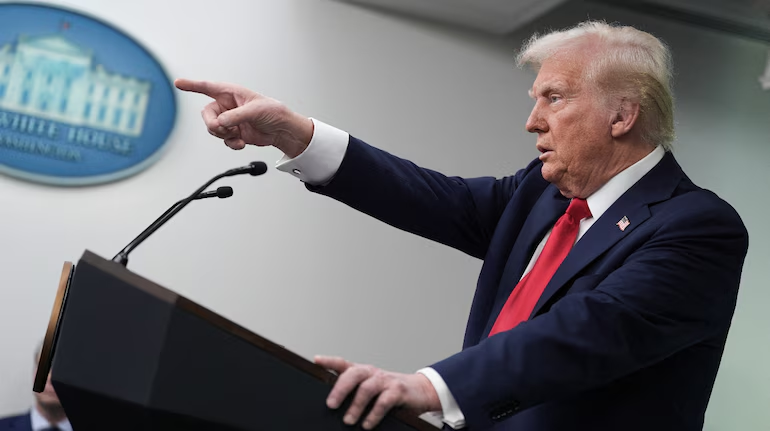
On May 20, 2025, President Donald Trump unveiled the “Golden Dome,” a $175 billion missile defense initiative aimed at protecting the United States from advanced aerial threats, including nuclear missiles, hypersonic vehicles, cruise missiles, and AI-equipped drones. Announced in the Oval Office alongside Defense Secretary Pete Hegseth and U.S. Space Force General Michael Guetlein, the project promises to be operational within three years, fulfilling a key campaign pledge. However, the plan has sparked debate over its cost, feasibility, and geopolitical implications. This article explores the details of the Golden Dome, its technological scope, funding, challenges, and global reactions.

A Campaign Promise Realized

The Golden Dome is rooted in Trump’s campaign commitment to bolster U.S. defenses against evolving missile technologies. Inspired by Israel’s Iron Dome, which intercepts short-range rockets, the Golden Dome aims to protect a much larger landmass—the continental U.S. and potentially Canada—against a broader array of threats. Trump emphasized the inadequacy of current U.S. systems, stating, “There really is no current system. We have certain areas of missiles and certain missile defense, but there is no system.” He referenced Ronald Reagan’s Strategic Defense Initiative (SDI), noting that modern technology makes such a system viable.

Technical Scope and Innovation

The Golden Dome is described as a “System of Systems,” integrating:

  • Space-Based Components: A constellation of hundreds of satellites equipped with advanced sensors and interceptors to detect, track, and destroy missiles at launch, mid-course, and terminal phases. This marks the U.S.’s first deployment of space-based weaponry.
  • Ground-Based Integration: The system will link with existing defenses like Alaska’s interceptors, THAAD, and NASAMS, creating a multi-layered shield.
  • Advanced Threats: The system targets hypersonic glide vehicles, fractional orbital bombardment systems (FOBS), ICBMs, and drone swarms, addressing next-generation challenges.
  • Software Backbone: Silicon Valley expertise and proposals like Booz Allen Hamilton’s “Brilliant Swarms” will enable satellites to detect and collide with missiles, supported by a robust command-and-control network.

The Pentagon has provided three design options, with Trump selecting a concept aligned with his $175 billion budget and three-year timeline. General Michael Guetlein, a Space Force leader, will oversee the project’s execution.

Funding and Congressional Dynamics

The project’s initial $25 billion is part of Trump’s proposed tax and spending bill, with Senate support from figures like Roger Wicker (R-Miss.). However, the Congressional Budget Office estimates costs could range from $161 billion to $542 billion over 20 years, with some, like Senator Tim Sheehy (R-Mont.), suggesting a trillion-dollar price tag. Democrats have raised concerns about SpaceX’s potential role, given Elon Musk’s ties to Trump, prompting calls for oversight.

Geopolitical and Technical Challenges

Russia and China have condemned the Golden Dome as destabilizing, warning of space militarization and an arms race. Defense analysts question the feasibility of scaling Israel’s Iron Dome to a continental level and meeting the three-year timeline, citing past failures like SDI. Existing U.S. defenses already provide significant protection, raising questions about the project’s necessity.

Public and Political Reactions

Posts on X reflect divided sentiment, with some praising the initiative as a bold security measure and others criticizing its cost and timeline. The White House and Department of Defense have promoted the project as a historic investment, while critics highlight technical and geopolitical risks.

Conclusion

The Golden Dome is a bold vision for U.S. missile defense, blending advanced technology with strategic ambition. While Trump’s leadership and General Guetlein’s appointment signal determination, the project faces significant hurdles in cost, technical complexity, and international relations. Its success will depend on overcoming these challenges and delivering a functional system by 2028, a timeline many view as optimistic.

Joe Biden Diagnosed with Aggressive Prostate Cancer; Book Reveals Concerns Over Physical Decline

jeo biden facing Aggressive Prostate Cancer

Former US President Joe Biden has been diagnosed with an “aggressive form” of prostate cancer that has spread to his bones, as per a statement from his office released on Sunday (local time).

According to the statement, the diagnosis followed the discovery of a prostate nodule after he reported worsening urinary symptoms, with tests confirming a high-grade cancer with a Gleason score of 9 (Grade Group 5), indicating metastasis to the bone.

“Last week, President Joe Biden was seen for a new finding of a prostate nodule after experiencing increasing urinary symptoms. On Friday, he was diagnosed with prostate cancer, characterised by a Gleason score of 9 (Grade Group 5) with metastasis to the bone,” the statement read.

Despite the severity, the cancer is reportedly hormone-sensitive, which may allow for effective treatment.

“While this represents a more aggressive form of the disease, the cancer appears to be hormone-sensitive, which allows for effective management,” the statement further read.

The 82-year-old Biden and his family are currently consulting with doctors to determine the best course of action.

“The President and his family are reviewing treatment options with his physicians,” it added.
Meanwhile, according to a new book by CNN’s Jake Tapper and Axios’ Alex Thompson, titled “Original Sin: President Biden’s Decline, Its Cover-Up, and His Disastrous Choice to Run Again ” — set to be released May 20– internal concerns within Biden’s team were revealed on the 46th President’s physical decline during the latter part of his presidency.

Based on over 200 interviews, mostly with Democratic insiders after the 2024 election, the book claims Biden’s aides discussed the potential need for a wheelchair in a second term, though they avoided it during his reelection campaign due to political optics, as reported by CNN.

As per CNN, citing the book, Biden’s doctor, Kevin O’Connor, warned that a fall could lead to a difficult recovery and possibly require wheelchair use and to minimise risks, staff made efforts to accommodate his mobility issues discreetly — such as shortening his walking routes, adding handrails, and using smaller staircases for Air Force One.

These measures intensified as Biden’s physical limitations became more visible, culminating in his poor performance during the June 2024 debate against US President Donald Trump, which ultimately led him to withdraw from the race weeks later. (ANI)

Lashkar-e-Taiba Commander Abu Saifullah Killed in Pakistan, Linked to Major Indian Attacks

Abu Saifullah Killed In Pakistan

In a significant development in the fight against terrorism, Abu Saifullah Khalid, also known as Razaullah Nizamani, a top commander of the Pakistan-based terrorist organization Lashkar-e-Taiba (LeT), was killed by unidentified gunmen in Sindh, Pakistan, on May 18, 2025. The notorious terrorist was a mastermind behind three major attacks in India, marking him as a high-value target for Indian security agencies.

A Trail of Terror in India

Abu Saifullah was directly linked to several high-profile terrorist attacks in India, including:

  1. 2005 Indian Institute of Science (IISc) Attack, Bangalore: This attack targeted a premier research institution, resulting in the death of a scientist and injuries to others. Saifullah’s role in planning and executing the assault showcased his ability to strike at symbolic targets.
  2. 2006 RSS Headquarters Attack, Nagpur: The attack on the Rashtriya Swayamsevak Sangh (RSS) headquarters was a bold attempt to destabilize India’s socio-political fabric. Saifullah orchestrated the logistics and recruitment for this operation.
  3. 2008 CRPF Camp Attack, Rampur: This assault on a Central Reserve Police Force (CRPF) camp killed several personnel, highlighting LeT’s focus on targeting India’s security forces. Saifullah’s strategic inputs were critical to the attack’s execution.

Operating from Matli in Pakistan’s Sindh province, Saifullah played a pivotal role in LeT’s operations. He was instrumental in fundraising, recruiting operatives, and facilitating the infiltration of terrorists into India through the porous Nepal border. His activities made him a key figure in LeT’s anti-India campaign, earning him a spot on India’s most-wanted list.

The Killing in Sindh

On the evening of May 18, 2025, Abu Saifullah was gunned down in Sindh by assailants whose identities remain unknown. The attack took place in Matli, where he had been based for several years. Local reports suggest the killing was swift and targeted, with no immediate claims of responsibility. This has led to speculation about the involvement of rival factions, internal LeT disputes, or even covert operations.

The timing of Saifullah’s death is noteworthy. It comes in the wake of India’s Operation Sindoor, a covert initiative launched after the April 22, 2025, terrorist attack in Pahalgam, Jammu and Kashmir, which claimed 26 lives. The operation aimed to dismantle terrorist infrastructure in Pakistan, targeting key figures like Saifullah who orchestrated cross-border attacks. While no official confirmation links his killing to Operation Sindoor, the context suggests a possible connection.

Lashkar-e-Taiba’s Broader Threat

Lashkar-e-Taiba, designated as a terrorist organization by India, the United States, and the United Nations, has long been a thorn in South Asia’s security landscape. Responsible for the 2008 Mumbai attacks and numerous other strikes, LeT operates with impunity from Pakistan, often with alleged support from state actors. Saifullah’s role as a senior commander underscored his importance in maintaining LeT’s operational capabilities.

His death is a blow to LeT’s leadership structure, but the organization’s deep-rooted network suggests it will seek to replace him quickly. Analysts warn that LeT may retaliate with attacks in India to reassert its relevance, particularly in Jammu and Kashmir, where tensions remain high.

Implications for India-Pakistan Relations

Saifullah’s killing adds another layer of complexity to the already strained India-Pakistan relationship. India has repeatedly accused Pakistan of harboring terrorists like Saifullah, a charge Islamabad denies. The fact that he operated freely in Sindh for years fuels India’s narrative of Pakistan as a safe haven for anti-India militants. His death, especially if linked to Indian operations, could escalate diplomatic tensions or prompt Pakistan to crack down on LeT to deflect international pressure.

For India, the elimination of a figure like Saifullah is a tactical victory in its counterterrorism efforts. It sends a strong message to terrorist networks about the reach of Indian intelligence and security agencies. However, the broader challenge of dismantling LeT’s infrastructure in Pakistan remains daunting, requiring sustained international cooperation.

A Step Forward, But the Fight Continues

The killing of Abu Saifullah Khalid is a significant milestone in India’s battle against terrorism. His role in orchestrating attacks that claimed numerous lives made him a symbol of LeT’s violent campaign against India. Yet, the fight is far from over. LeT’s ability to regroup, coupled with the volatile security situation in the region, underscores the need for vigilance.

Indian security agencies are likely to intensify their focus on other LeT operatives, both within India and across the border. Meanwhile, the mystery surrounding Saifullah’s killers adds an element of intrigue to an already complex geopolitical chessboard. As investigations unfold, the world will watch closely to see how this development shapes the future of counterterrorism in South Asia.

Salman Rushdie Attacker Hadi Matar Sentenced to 25 Years in Prison for Attempted Murder

Hadi Matar

Hadi Matar, the man who brutally attacked author Salman Rushdie in 2022, was sentenced Friday to 25 years in prison for attempted murder under New York state law. Matar, 27, also received a concurrent seven-year sentence for assault, following his conviction in February.

Judge David Foley handed down the sentence at a court in Mayville, near the Chautauqua Institution where the attack occurred. Matar showed no remorse during the hearing, claiming Rushdie “wants to be a bully,” and delivering a confused statement referencing freedom of speech and religion.

Rushdie, 76, was stabbed multiple times on stage before a lecture in August 2022, losing vision in his right eye. The attack also injured Henry Reese, co-founder of a sanctuary program for persecuted writers. Rushdie later recounted the traumatic incident in his 2024 memoir, Knife.

The attack has deep roots in a 1989 fatwa by Iran’s Ayatollah Khomeini, who condemned Rushdie’s novel The Satanic Verses as blasphemous, prompting years of threats and forced hiding.

Chautauqua County District Attorney Jason Schmidt welcomed the sentence, calling it appropriate in light of Matar’s “twisted sense of justice.” Matar’s lawyer, Nathaniel Barone, said he planned to appeal.

Matar also faces separate federal terrorism charges, accused of acting on behalf of Hezbollah. The federal case is expected to proceed to trial in 2026.


Trump Claims India Will Eliminate All Tariffs on U.S. Goods — Reality or Rhetoric?

trump

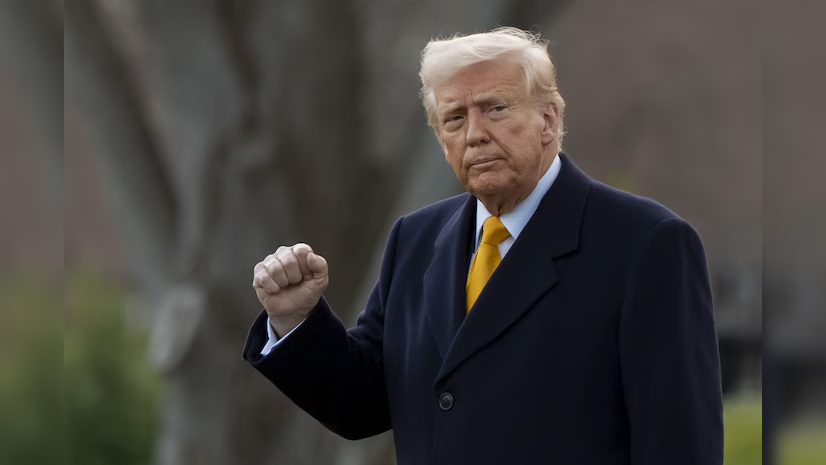
On May 16, 2025, U.S. President Donald Trump made headlines during an interview with Fox News, claiming that India, a nation he has long criticized for its high tariffs, had agreed to eliminate 100% of its tariffs on American goods. Describing India as a prime example of a country with significant trade barriers, Trump touted this alleged concession as a triumph of his aggressive trade negotiation strategy. However, Indian officials, including External Affairs Minister S. Jaishankar, have countered that no such deal has been finalized, highlighting the complexity of ongoing bilateral trade talks. This article explores the context, implications, and veracity of Trump’s claim, delving into the dynamics of U.S.-India trade relations, the current state of negotiations, and the broader geopolitical and economic ramifications.

Background: U.S.-India Trade Relations

The United States and India share a robust trade relationship, with bilateral trade reaching approximately $129 billion in 2024. The U.S. is India’s largest trading partner, while India ranks as the U.S.’s 10th-largest. Despite this, trade imbalances have been a point of contention. In 2024, the U.S. ran a trade deficit of $45.7 billion with India, a 5.4% increase from 2023, fueling Trump’s calls for reciprocity in trade policies.

India’s average tariff rate stands at 17%, significantly higher than the U.S.’s 3.3%, according to the Indian Council for Research on International Economic Relations. Specific U.S. goods, such as bourbon whiskey (previously 150%) and Harley-Davidson motorcycles (previously 50%), have faced steep duties, prompting Trump to label India a “tariff abuser.” In response, Trump imposed a 26% “reciprocal tariff” on Indian goods like shrimp and steel in April 2025, part of his broader “Liberation Day” tariff strategy targeting nearly 60 countries.

Trump’s Claim: A Breakthrough or Negotiation Tactic?

Speaking in Doha, Qatar, on May 15, 2025, Trump asserted, “It’s very hard to sell into India, and they’ve offered us a deal where, basically, they’re willing to literally charge us no tariff.” He reiterated this claim on Fox News the following day, stating, “They’ve already agreed. They would have never done that for anybody else but me.” These statements suggest a landmark agreement, potentially transforming U.S.-India trade by removing all Indian tariffs on American exports.

However, Indian officials have disputed the claim. External Affairs Minister S. Jaishankar emphasized that “these are complicated negotiations. Nothing is decided till everything is,” underscoring that any trade deal must be mutually beneficial. Reports indicate India has proposed reducing duties to zero on 60% of tariff lines in the first phase of a potential deal, with preferential access for nearly 90% of U.S. merchandise imports. Earlier concessions, such as lowering tariffs on bourbon whiskey to 100% and Harley-Davidson motorcycles to 40%, signal India’s willingness to negotiate, but a blanket removal of all tariffs remains unconfirmed.

Analysts suggest Trump’s remarks may be a negotiating tactic to pressure India into concessions or to project strength domestically. Ajay Srivastava of the Global Trade Research Institute noted, “An India–U.S. trade deal may be on the cards, but the deal must ensure strict reciprocity.” The lack of specifics from Trump and the absence of an official Indian confirmation raise questions about the claim’s validity.

The Context of Ongoing Negotiations

Trade talks between the U.S. and India intensified following Prime Minister Narendra Modi’s visit to the White House in February 2025, with both sides aiming to finalize the first phase of a bilateral deal by fall. India’s trade minister, Piyush Goyal, has been actively engaged, with a delegation scheduled to meet Trump administration officials in the U.S. from May 17 to May 20, 2025. These negotiations occur under the shadow of Trump’s 90-day tariff pause, set to expire on July 9, 2025, after which tariffs could escalate to 100% on non-compliant nations.

India’s overtures include proposals for zero tariffs on specific goods like auto components and pharmaceuticals on a reciprocal basis, up to a certain quantity. However, India has also signaled assertiveness, submitting a World Trade Organization filing on May 12, 2025, reserving its right to impose retaliatory tariffs against U.S. duties on Indian steel and aluminum. This dual approach reflects India’s balancing act: seeking to avoid punitive U.S. tariffs while protecting domestic industries, particularly agriculture, which opposes tariff-free American imports.

Broader Implications

Economic Impact

A complete removal of Indian tariffs on U.S. goods would significantly boost American exports, particularly in sectors like agriculture, pharmaceuticals, and automotive. It could narrow the U.S. trade deficit with India and align with Trump’s goal of revitalizing domestic manufacturing. However, Indian industries, especially agriculture, fear being outcompeted by tariff-free U.S. imports, potentially sparking domestic opposition.

For India, securing exemptions from Trump’s tariffs is critical to maintaining its trade surplus and economic growth. A Reuters report suggests India aims to reduce its tariff gap with the U.S. to less than 4% from 13%, a move that could avert higher U.S. duties. Yet, any deal must navigate India’s protectionist policies, designed to shield local manufacturers and farmers.

Geopolitical Ramifications

The U.S.-India trade negotiations are part of a broader geopolitical chessboard. Trump’s tariff strategy, including recent de-escalations with China (slashing U.S. tariffs from 145% to 30%) and a trade deal with the UK, reflects a push for bilateral agreements over multilateral frameworks. India, wary of being caught in a U.S.-China trade war, seeks to strengthen ties with Washington while maintaining strategic autonomy.

Trump’s claim also follows his controversial assertion of brokering a ceasefire between India and Pakistan, a statement that frustrated Indian officials. Public remarks like these risk straining diplomatic relations, even as both nations work toward a trade agreement. The upcoming Goyal-led delegation will likely aim to clarify misunderstandings and advance negotiations.

Public Sentiment

Posts on X reveal mixed reactions. Some users, like @EricLDaugh, celebrate Trump’s claim as a historic win, stating, “The media said this would never happen in a million years.” Others, such as @TruthNo_7, view it as India conceding under pressure, with sentiments like “Trump is really rubbing India’s nose to the ground.” Indian users, including @CAChirag, urge domestic reforms like zero GST on pharmaceuticals to complement tariff cuts, reflecting optimism for economic benefits. However, these posts lack official corroboration and should be treated as inconclusive sentiment rather than fact.

Challenges and Next Steps

The primary challenge lies in reconciling Trump’s bold claim with the nuanced reality of trade negotiations. India’s high tariffs are a cornerstone of its economic policy, and a complete tariff elimination seems improbable without significant U.S. concessions, such as lifting duties on Indian steel and aluminum. The 90-day tariff pause adds urgency, as failure to reach an agreement could trigger retaliatory tariffs, escalating tensions.

The Goyal delegation’s visit from May 17 to May 20, 2025, will be pivotal. Discussions will likely focus on phased tariff reductions, reciprocal concessions, and addressing non-tariff barriers. Both sides must navigate domestic pressures—Trump’s push for manufacturing revival and India’s need to protect local industries—while capitalizing on shared interests, such as countering China’s economic influence.

Conclusion

President Trump’s claim that India has agreed to slash 100% of its tariffs on U.S. goods has sparked global attention, but it appears to be more aspirational than factual. While India has made significant overtures, including proposals for zero tariffs on select goods, no comprehensive deal has been confirmed. The ongoing U.S.-India trade negotiations, intensified by Trump’s tariff threats and India’s strategic concessions, are at a critical juncture. As both nations work toward a mutually beneficial agreement, the world watches to see whether this bold claim will materialize into a transformative trade deal or remain a negotiating ploy. For now, stakeholders should approach such claims with skepticism, cross-referencing official statements and outcomes from upcoming talks.