
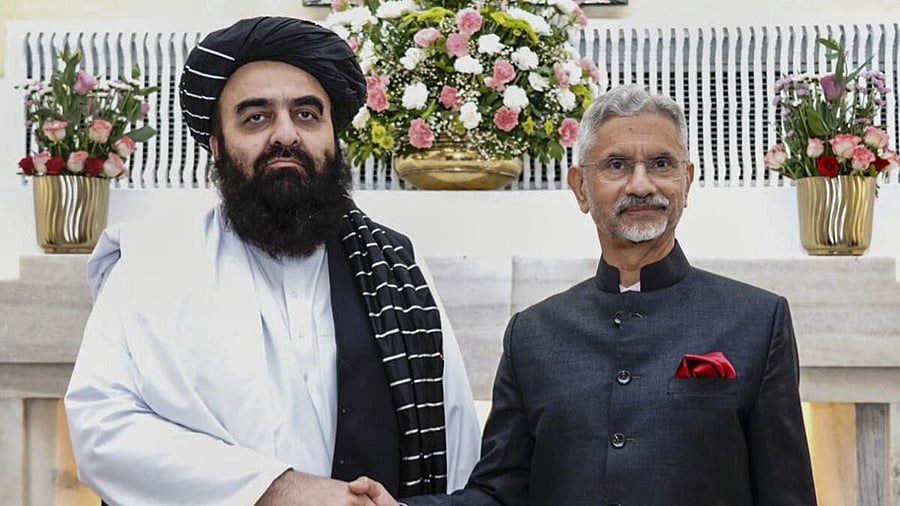
On October 9, 2025, Taliban Acting Foreign Minister Amir Khan Muttaqi arrived in New Delhi for an eight-day visit, marking the highest-level engagement between India and the Taliban regime since the group’s return to power in August 2021. This trip, facilitated by a temporary UN Security Council waiver exempting Muttaqi from long-standing sanctions, came on the heels of his participation in the Moscow Format talks and underscored a significant thaw in India-Afghanistan relations. Amid escalating tensions with Pakistan, including Pakistani airstrikes on Afghan soil just hours before key meetings, Muttaqi’s statements from Indian territory delivered a pointed rebuke to Islamabad on cross-border terrorism. This analysis delves into the visit’s context, key developments, and broader implications, drawing on strategic, security, and geopolitical lenses to explore how this engagement reshapes South Asian dynamics.
Background: From Hostility to Pragmatic Engagement
India’s relationship with the Taliban has historically been fraught with suspicion. During the Taliban’s first rule (1996-2001), India viewed the group as a Pakistani proxy, particularly after events like the 1999 IC-814 hijacking and the sheltering of anti-India militants such as Al Qaeda. Post-2001, India invested over $3 billion in the US-backed Afghan Republic, supporting infrastructure and development while aligning against the Taliban insurgency. The 2021 Taliban takeover prompted India to evacuate its personnel and close its embassy in Kabul, halting visa issuances due to security fears.
However, realpolitik has driven a gradual reset. By June 2022, India reopened a technical mission in Kabul to manage humanitarian aid, and unannounced visits by Taliban officials to Delhi built trust. Key milestones included a January 2025 meeting in Dubai between Muttaqi and India’s Foreign Secretary Vikram Misri, and India’s response to the April 2025 Pahalgam terror attack in Jammu and Kashmir, where the Taliban condemned the incident—a rare alignment that facilitated deeper dialogue. The September 2025 earthquake in Afghanistan further accelerated ties, with India delivering aid via Iran’s Chabahar port, positioning itself as Kabul’s “first responder.”
Meanwhile, Taliban-Pakistan relations have soured dramatically. Once close allies, the two now trade accusations: Pakistan blames the Taliban for harboring Tehreek-e-Taliban Pakistan (TTP) militants, leading to airstrikes, while the Taliban counters that Islamabad seeks to destabilize Afghanistan. This rift has created space for the Taliban to diversify partnerships, hedging against over-reliance on Pakistan and seeking legitimacy from neighbors like India.
Key Events of the Visit
Muttaqi’s itinerary included bilateral talks with External Affairs Minister S. Jaishankar on October 10, focusing on diplomatic, trade, economic, and regional issues. In a joint press conference, Jaishankar announced India’s decision to upgrade its Kabul mission to a full embassy, signaling de facto engagement without formal recognition. Muttaqi hailed India as a “close friend,” emphasizing mutual respect, trade, and people-to-people ties, and proposed a consultative mechanism for stronger relations. He also suggested joint India-Afghanistan-US talks to address trade barriers, such as tariffs imposed by US President Donald Trump.
The visit extended beyond Delhi, with Muttaqi scheduled to meet Indian business leaders, visit the Taj Mahal, and tour the Darul Uloom Deoband seminary in Uttar Pradesh—a nod to cultural and religious linkages. Notably, Pakistan’s airstrikes on alleged TTP hideouts in Kabul, killing 30 militants just before the Jaishankar-Muttaqi meeting, added urgency to discussions on security.
Muttaqi’s Message on Terrorism: A Veiled Warning to Pakistan
The visit’s centerpiece was Muttaqi’s assurances on counterterrorism, framed as a direct swipe at Pakistan. He asserted that the Taliban has “eliminated all terror groups” from Afghan soil over the past four years, including Lashkar-e-Taiba (LeT) and Jaish-e-Mohammad (JeM), claiming “not a single one of them is in Afghanistan” and that “not an inch of land is controlled by them.” Muttaqi urged other countries—implicitly Pakistan—to “act against such terror groups like Afghanistan did for peace.”
In a stern warning, he stated: “The courage of Afghans should not be tested. If someone wants to do this, they should ask the Soviet Union, America, and NATO, so they can explain that it is not good to play games with Afghanistan.” He accused Pakistan of a recent border blast and airstrikes, calling them “wrong” and “provocative,” and emphasized that problems cannot be resolved through violence. Jaishankar echoed this, labeling cross-border terrorism a “shared threat” and subtly referencing Pakistan’s occupation of Kashmir by calling Afghanistan a “contiguous neighbor.”
Security Implications: Countering Threats Amid Distrust
At its core, the visit addresses India’s security concerns over Afghanistan-based militants targeting its interests, particularly in Kashmir. The Taliban’s pledges align with India’s priorities, as evidenced by their condemnation of the Pahalgam attack and assurances against groups like ISKP, Al Qaeda, AQIS, LeT, and JeM. Experts note this as a “convergence of security interests,” where India prioritizes pragmatism over ideological differences, such as the Taliban’s restrictions on women and minorities.
For Pakistan, Muttaqi’s rhetoric exposes vulnerabilities: Islamabad’s accusations against Kabul for TTP safe havens are countered by Taliban claims of Pakistani-sponsored destabilization. This could escalate border clashes, with Pakistan’s Defense Minister warning that “patience has run out.” Substantiated reports of internal Taliban fissures—pro- and anti-Pakistan factions—add complexity, potentially spilling over into regional instability.
Economic and Trade Aspects: Opening Routes for Growth
Economically, the visit pushes for open trade corridors, including via Chabahar port, to boost bilateral trade. Muttaqi reiterated demands for more visas, investments, and resumed infrastructure projects, while India eyes Afghanistan’s mineral reserves. This aligns with regional frameworks like the Moscow Format, promoting Afghan participation in economic projects to counter China-Pakistan influence via the China-Pakistan Economic Corridor (CPEC).
| Aspect | India-Afghanistan Benefits | Challenges for Pakistan |
|---|---|---|
| Trade Routes | Enhanced access via Chabahar; joint US talks on tariffs. | Reduced leverage over Afghan transit; counters CPEC dominance. |
| Aid & Investment | Humanitarian support (e.g., earthquake relief); mineral exploration. | Isolation amid refugee deportations and border closures. |
| Connectivity | Links to Central Asia; people-to-people ties. | Heightened competition in regional trade hubs. |
Geopolitical Ramifications: A Shift in Alliances
Geopolitically, the visit signals the Taliban’s quest for legitimacy, with Russia as the first to grant de jure recognition in July 2025, followed by engagements from China, Iran, and Central Asia. For India, it counters Chinese and Pakistani influence, secures borders, and integrates Afghanistan into South-Central Asian connectivity. Analysts like Brahma Chellaney describe it as a “cautious reset,” prioritizing strategic interests over values.
Pakistan faces isolation: the Taliban’s independence challenges its historical control, potentially opening avenues for Indian support to anti-Pakistan elements like TTP or BLA, though unsubstantiated. Broader effects include messages to the US (opposing military bases) and a multipolar shift, with India hedging against US-Pakistan realignment under Trump.
Challenges and Criticisms: Balancing Pragmatism with Principles
Critics highlight risks: the Taliban’s unreliability on women’s rights and minorities could undermine long-term ties, and India’s engagement might tacitly legitimize the regime without formal recognition. Domestically, it contrasts with past arrests of Indian Muslims for Taliban sympathies, drawing irony from opposition figures. For the Taliban, over-engagement with India risks alienating Pakistan and China.
In conclusion, Muttaqi’s visit represents a calculated convergence of interests, with his anti-terrorism message isolating Pakistan while advancing India-Afghanistan ties. This could foster regional stability if sustained, but hinges on verifiable actions against militants and economic deliverables. As one expert notes, it’s a “setback for Pakistan,” reshaping alliances in a volatile neighborhood.
You Might Also Like:
Watch Dr. Tariq Rasool’s Message to Kashmir’s Apple Orchard Owners: Diseases, Causes
A Reflection on Surat-al-Ankabut : Faith, Effort, and the Delusion of Self-Sufficiency